
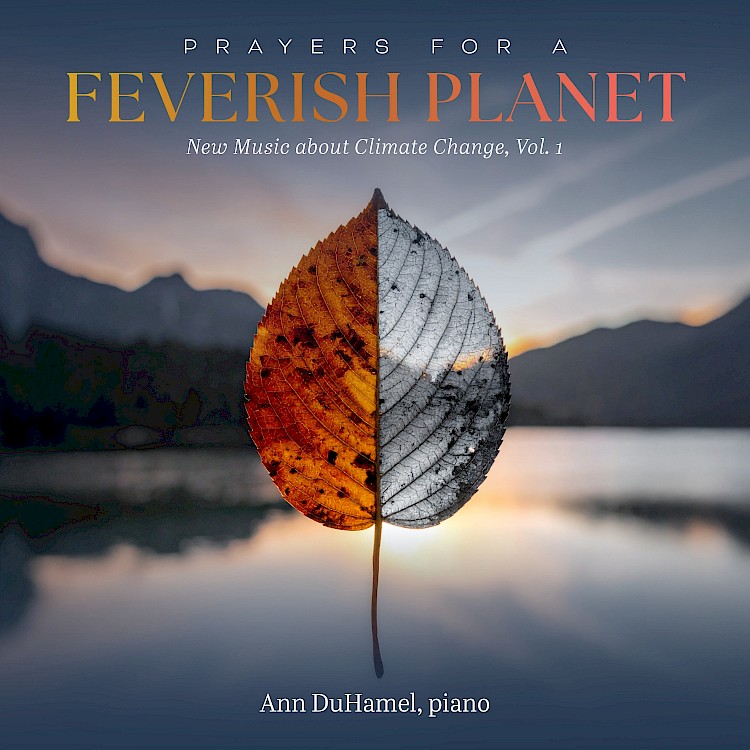
Pianist Ann DuHamel releases the first volume of her commissioning project of solo works that are inspired by and draw attention to the climate change crisis. Featuring works by Laura Schwendinger, Judith Shatin, Juhi Bansal, Karen Lemon, Erick Tapia, Ian Dicke, Daniel Blinkhorn, and Gunter Gaupp, this collection is enlivened by the pathos with which the composers and DuHamel approach the underlying subject matter.
| # | Audio | Title/Composer(s) | Time |
|---|---|---|---|
| Total Time | 69:28 | ||
| 01 | Solipsismo | Solipsismo | 6:22 |
| 02 | Forgive Them Not, For They Know What They Do | Forgive Them Not, For They Know What They Do | 6:44 |
| 03 | Air (from Magic Carpet Music) | Air (from Magic Carpet Music) | 7:29 |
| 04 | Land of Waking Dreams | Land of Waking Dreams | 11:17 |
| 05 | White Parasol | White Parasol | 8:03 |
| 06 | frostbYte: chalk outline | frostbYte: chalk outline | 11:37 |
Plain SongJudith Shatin | |||
| 07 | I. Plain Song | I. Plain Song | 3:09 |
| 08 | II. Lullaby | II. Lullaby | 3:54 |
| 09 | III. Shadow and Smoke | III. Shadow and Smoke | 4:04 |
| 10 | IV. Tutta Gloria | IV. Tutta Gloria | 3:27 |
| 11 | Those Who Watch | Those Who Watch | 3:22 |
Pianist Ann DuHamel's internal sense of despondency about the magnitude of the climate crisis in the fall of 2019 led her to initiate this commissioning project which speaks to the depth of concern and fear many artists share over the future of our environment. Beginning on January 1, 2020, DuHamel put out a call for scores responsive to this programmatic theme; the response was overwhelming, she received works from more than 170 composers in 35 countries. This album is the first volume of recordings documenting this repertoire, music that DuHamel has been performing live extensively since the spring of 2022. In the course of this endeavor, DuHamel collaborated with experts in environmental studies, hydrology, climate activism, and many other disciplines to expand the conceptual frame of her events. Her uplifting idealism in curating this project is matched by her virtuosity and lyricism in the realization of these evocative works.
Erick Tapia’s Solipsismo opens the collection with rich, resonant flourishes answered by liquid chord voicings, performed using a liberal amount of sustain pedal to create a spacious sonic environment. Various forms of solipsism are no doubt to blame for the sluggish reaction of many in leadership positions to the specter of climate disaster. Indeed, Karen Lemon must have had this intransigence in mind when writing Forgive Them Not, For They Know What They Do. A vigorous moto perpetuo texture across registers propels the work’s first section before a reflective second half of thoughtful melodic phrases, lush voicings separated by poignant silences, and a mournful closing hymn.
Laura Schwendinger’s Air (from Magic Carpet Music) is abstract and broad, stretching long contrapuntal lines over an expansive temporal canvas to evoke the ephemeral and ubiquitous characteristics of air itself. Juhi Bansal’s sonic painting Land of Waking Dreams portrays a desert landscape, a paean to the poetry of untouched nature. Bansal makes use of a chain played on the piano strings, creating a shimmering timbre. Melting Arctic ice is the impetus for Ian Dicke’s White Parasol. Dicke explores a range of keyboard articulations, and uses dramatic registral contrasts to conjure the cascading consequences of melting on a multi-layered ecosystem.
Read MoreAlso inspired by the Arctic, Daniel Blinkhorn’s frostbYte: chalk outline integrates video and audio footage recorded on the Svalbard peninsula between the northern coast of Norway and the North Pole. Blinkhorn’s electronic part is a mix of immersive sustained harmony, mechanistic, clicking timbres, and processed field recordings, achieving considerable contrast in material and expression across this over ten minute work.
Judith Shatin’s Plain Song involves a different kind of electronic part; poet Charles Wright reads his own work in fluid dialogue with DuHamel’s piano, edited and reorganized with a collage approach reminiscent of Reich’s Different Trains, albeit with less of a reliance of overt repetition as a structural strategy. Shatin sprinkles her keyboard writing with magical textures played inside the piano, pointillistic constellations, and impetuous chordal outbursts. Wright’s texts and Shatin’s sympathetic setting speak to our internal grappling with existential hurdles.
The recording closes with Gunter Gaupp’s Those Who Watch, an energetic electroacoustic work which examines climate change through the lens of media and industry misinformation and dissembling about its urgency. Taking fragments of news clips and fashioning them into a modular electronic part, the piano soloist plays groove oriented passages in sync with the disparate voices, but increasingly circles in place, as Gaupp distorts the media voices beyond comprehension and the issue is obscured behind the fog of self-absorption.
Ann DuHamel’s Prayers for a Feverish Planet, Vol. 1 features music that explores a broad range of aesthetic approaches that are prevalent in contemporary works for keyboard. From electroacoustic pieces using pre-recorded environmental sounds to those integrating spoken texts, and from prepared piano to extended techniques, DuHamel has curated a collection that has engaging contrast and sonic diversity. Even without a shared thematic focus, it would be a compelling recording. That these pieces share a thematic focus on a crisis of utmost concern only adds to the import of the project, and is a great reminder of how artists can join together to voice a collective response to issues of our time.
– Dan Lippel
Recorded January 11-13, 19-20 and June 6-7, 2024 at Maud Moon Weyerhaeuser Recording Studio, Minnesota Public Radio, St. Paul, MN
Producer: Vanessa Cornett
Engineer and editor: Craig Thorson, MPR Studios
Mastering: Oktaven Audio, Mt. Vernon, NY
Design and album art: Marc Wolf, marcjwolf.com
Program notes: Ann DuHamel and all composers
Photo of Ann DuHamel (p. 2): Nina Francine Photography
P. 15 and back cover: frames from Daniel Blinkhorn’s frostbYte – chalk outline video
Hailed as “an impeccable artist” (Edie Hill), a “forward thinking classical pianist” (Midwest Record), and “a delight for the ears and the soul” (Encuentro Universitario Internacional de Saxofón, Mexico City), pianist Ann DuHamel enjoys an eclectic musical career. Her performances have, so far, spanned 22 countries and 37 United States, including Carnegie Weill Recital Hall. Recent performances include venues in Medellín, Colombia, and Luzern, Switzerland, as well as a performance of Rachmaninoff’s Piano Concerto No. 2 that garnered 3rd place from The American Prize in Piano Performance (concerto) — The Lorin Hollander Award, 2025. Her debut album, Rückblick: New Piano Music Inspired by Brahms on the Furious Artisans label, has been lauded as “an extraordinary, fascinating CD, musically very strong ... so passionate, technically excellent and inspiring” (Piano Bulletin).
Ann’s series Prayers for a Feverish Planet responds to the climate crisis with 60+ new works from composers around the world, including new works she commissioned from Gabriela Lena Frank and Libby Larsen. La Circular: Revista de Cultural Rural y Circular (Spain) wrote that her performance of works from this project at the 2023 Porto Pianofest “demonstrated … the ability of classical music in general, and the piano in particular, to transmit the concerns and thoughts of the contemporary world.” A 2023-24 McKnight Artist Fellow, she currently serves as Professor of Music at the University of Minnesota Morris, where she is the recipient of the 2025 Faculty Distinguished Research Award; as UMM’s 2026 Founders Scholar, she has crafted a series considering Chopin and Rzewski through the lens of Artivism. Ann is an avid bibliophile, ravenous chocoholic, eccentric gardener, Futurama fan, piano nerd, tea drinker, walking enthusiast, and yoga devotee.
https://annduhamel.com/Born in Mexico City, Erick Tapia completed his composition studies at the Faculty of Music of the National Autonomous University of Mexico (UNAM), where he studied with Gabriela Ortiz and Francisco Cortés-Álvarez. In 2019, he was a scholarship holder of the Cátedra Extraordinaria Arturo Márquez at UNAM, where he studied for a year with the renowned Mexican composer. In 2020, he was also selected for the Young Creators program of Mexico’s National Fund for Culture and the Arts (FONCA). He has received multiple awards, including first prize at the First National Composition Competition for Symphony Orchestra #EstarMejor (2020), organized by the School of Fine Arts of Universidad Panamericana; first prize at the 2021–2022 Emerging Composers Fellowship (Concertia, Houston, Texas, USA); and third prize at the Raíces Orchestra Competition (2021), organized by the Secretary of Culture of Jalisco and the Jalisco Philharmonic Orchestra. In 2021, he became the first Mexican student selected by the Central Conservatory of Music in Beijing to have a work performed at the International Forum of the Alliance for Music Education (CCOM). His music has been performed by soloists and ensembles in Mexico, the United States, Costa Rica, Colombia, China, and Finland, and by major Mexican ensembles such as the National Symphony Orchestra of Mexico, the Jalisco Philharmonic Orchestra, and the Eduardo Mata Youth Orchestra of UNAM.
Australian composer Karen Lemon counts amongst her qualifications a Ph.D. in Musicology from the University of Sydney (on Schoenberg’s post-tonal music c. 1910) and a License in Dalcroze Eurhythmics from Carnegie Mellon University, Pittsburgh, USA. Her music has been performed in locations as far afield as Sydney, Los Angeles, New York and Cambridge, and by such distinguished performers as Thomas Hutchinson, Artur Cimirro and Gwion Thomas. Karen has composed music by commission or on request for CAMS, Hourglass Ensemble and the University of Bristol Schola Cantorum, and several of her works have been prizewinners in composition competitions, including Gesualdo Six, the Renée B. Fisher Award and Opus Dissonus. As a performer, though Karen is a pianist by training, she was most active as a chorister and vocalist, notably as a foundation and lifetime member of the Sydney-based new music choir The Contemporary Singers and as founder and director of and arranger for the pop-jazz a cappella ensemble The Five Skins. Karen has worked as a lecturer in Musicology at the University of Sydney and the University of Tasmania, and enjoys Associate Artist representation with the Australian Music Centre. She currently divides her time between Australia and France.
Laura Schwendinger, composer of Artemisia, winner of the 2023 American Academy of Arts and Letters Opera award, was the first composer to win the Berlin Prize. A Professor of music composition at the University of Wisconsin–Madison, her works have been championed by Dawn Upshaw, Jennifer Koh, Janine Jansen, Matt Haimovitz, the Arditti, JACK and Spektral Quartets, International Contemporary Ensemble, Eighth-Blackbird, Juilliard, American Composers Orchestra, and the Franz Liszt Chamber Orchestra of Hungary. Her music has been performed at Kennedy & Lincoln Centers, Berlin Philharmonic, Wigmore & Carnegie Halls, Miller Theater & Théâtre Châtelet, Tanglewood, Aspen, Talis and Ojai Music Festivals. She has received fellowships from the Guggenheim Foundation, Radcliffe Institute at Harvard, Rockefeller Foundation Bellagio Center, and First Prize of the 1995 ALEA III International Competition, as well as multiple fellowships from the American Academy of Arts and Letters, Copland House, Fromm, Koussevitzky and Bogliasco Foundations, MacDowell and Yaddo Colonies. Her music has been called “captivating, artful and moving,” “music of infinite beauty,” in the New York Times, as well as “the genuine article...onto the “season’s best list,” in the Boston Globe. Recent premieres include her second opera, Cabaret of Shadows, a Fromm Commission produced by Musiqa in Houston, Nightingales for Eleanor Bartsch and Ariana Kim, a consortium commission with the Dubuque & UW Symphony Orchestras, and a harp concerto, Second Sight, for Atlanta Symphony Principal Harpist Elisabeth Remy Johnson, commissioned for the 100th anniversary of the Emory University Orchestra program, a solo cello work, commissioned as part of Matt Haimovitz’s Primavera Project, Ghost Music for the Chameleon Arts Ensemble, and Silent Springs for Cantori New York’s 40th anniversary concert at Merkin Hall. Her third opera, about Margaret Fuller, will premiere April 28, 2026, at Symphony Space in New York. The San Francisco Classical Voice reviewed her opera Artemisia as “sumptuous on every level,” and Colin Clarke wrote of her JACK CD QUARTETS, “the sheer intensity of the music is spellbinding…the passion shines through like…light.”
“Radiant and transcendent,” the music of Juhi Bansal weaves together themes celebrating musical and cultural diversity, nature and the environment, and strong female role models. Her music draws upon elements as disparate as Hindustani music, the spectralists, progressive metal, musical theatre and choral traditions to create deeply expressive, evocative sound-worlds. As an Indian composer brought up in Hong Kong, her work draws subtly upon both those traditions, entwining them closely and intricately with the gestures of western classical music.
Recent projects include Love, Loss and Exile, a song cycle on poetry by Afghan women commissioned by Songfest; Songs from the Deep, a new orchestral work inspired by humpback whale songs commissioned by the Oregon Mozart Players; and Waves of Change, a digital operatic short on womanhood, identity, and clash of cultures inspired by the story of the Bangladesh Girls Surf Club. Working across orchestra, choral music, opera, chamber music, art song and electronics, recent seasons have included commissions from the Tonhalle Düsseldorf, Virginia Symphony, Los Angeles Philharmonic Association, Beth Morrison Projects, Choral Arts Initiative, New York Virtuoso Singers, and more. Her music has been featured on several Grammy-nominated albums, and is regularly performed throughout the U.S., Europe and Asia. A conductor as well as composer, Bansal has been awarded fellowships by the Douglas Moore Fund for American Opera, the Atlantic Music Center, Seasons Music Festival, Oregon Bach Festival Composer’s Symposium, and the Pacific Music Festival. She frequently premieres the work of other composers and accompanies singers at the piano.
Ian Dicke is a composer, musician, and software designer inspired by the intersection of technology and social-political culture. Praised for his “refreshingly well-structured” (Feast of Music) and “uncommonly memorable” (Sequenza 21) catalogue of works, Dicke’s music has been commissioned and performed by ensembles and soloists around the world, including the New World Symphony, Alarm Will Sound, Paul Dresher Ensemble, Invoke, Hocket, and pianists Vicky Chow, Nadia Shpachenko, Vicki Ray, and Aron Kallay, among others. His work has been featured on several international festivals, including MATA, the Cabrillo Festival, and the ISCM World New Music Days. In 2022, Dicke’s two act opera Roman received two fully staged performances produced by the Los Angeles organization Synchromy. His debut album Cowboy Rounds was recently released on the label Bright Shiny Things.
Dicke has received grants, awards, and recognition from the Hellman Foundation, Barlow Endowment, San Francisco Conservatory of Music, New Music USA, New York Youth Symphony, ASCAP, and BMI, among others. He was awarded a Fulbright Fellowship to research interactive musical interfaces and environments in Stockholm, Sweden and has served as an artist in residence at various institutions, including the MacDowell Colony and Atlantic Center for the Arts. From 2013-2023 Dicke was the founder and curator of the Outpost Concert Series, which connected Riverside, California’s musical culture with groundbreaking artists across the national contemporary music landscape. Dicke is a Professor of Composition at the University of California, Riverside and founder of Novel Music, a software company that distributes innovative Max for Live devices.
Daniel Blinkhorn is a composer, digital media artist and field recordist currently residing in Sydney, Australia. Although often working in the electroacoustic and videophonic domains, his output includes chamber, symphonic and wind orchestra works, sound installations, music for film, dance, radiophonic composition and various hybrid/inter-media environments. Blinkhorn’s works are widely performed, exhibited and presented internationally, and his compositions have received numerous international and national composition citations. He is a 2011 Churchill Fellow (Winston Churchill Memorial Trust, Australia), has worked in a wide variety of creative, academic, research and performative contexts, and is a lecturer in the Composition and Music Technology faculty at the Conservatorium of Music, University of Sydney. Blinkhorn is also a represented composer at the Australian Music Centre, and the representative member/councilor for composition at Music Australia (2012–2020).
Blinkhorn has undertaken numerous composition residencies, and self-directed recording intensives internationally (La Muse En Circuit, Paris, ZKM|Center for Art and Media, Institute for Music and Acoustics, Germany, CMMAS – Centro Mexicano para la Música y las Artes Sonoras, Mexico, Centre de Arts, Montreal, Visby international Centre for Composers, Sweden and Islao de Arts, Madagascar) and is an ardent location and environmental sound recordist, where he has embarked upon a growing number of expeditions throughout the high Arctic/ North Pole region of Svalbard, Africa, Amazon, West Indies, Northern Europe, Middle East, Alaska, Mexico, Cuba, Madagascar and Australia.
Composer Judith Shatin is renowned for music that seamlessly spans acoustic and digital realms. Called “highly inventive on every level” by The Washington Post, her music combines an adventurous approach to timbre with dynamic narrative design and a keen awareness of the sonic landscape of modern life. She has become ever more drawn to responding to current challenges through her music, resulting in such pieces as For the Birds, Floes, Singing the Blue Ridge, Storm and Terra Infirma. At the same time, her music is replete with references to literature, the visual arts and the sounding world, both natural and built. Her compositions are performed in concert halls and at festivals such as Carnegie Hall, The Concertgebouw, The Kennedy Center, Aspen, BAM Next Wave, Moscow Autumn and the Tel Aviv Opera House. She has been commissioned by organizations and acclaimed ensembles including the Barlow Endowment, the Fromm Foundation, Kronos Quartet, Da Capo Chamber Players, the Dutch Hexagon Ensemble, Berlin PianoPercussion and The American Composer’s Orchestra. The Society of American Music has selected Shatin as their 2026 Honorary Member in recognition of her contributions to American Music. Other honors include four National Endowment for the Arts Composer Fellowships and grants from the American Music Center, Meet the Composer, the Virginia Commission for the Arts and Americans For the Arts Animating Democracy project. A two-year retrospective at Shepherd College was sponsored by the Lila Wallace Readers Digest Arts Partners Program, culminating in her boundary-breaking folk Oratorio Coal. Shatin has held residencies at the Bellagio Center, La Cité Internationale des Arts, MacDowell, the Virginia Center for Creative Arts and Yaddo. Her music is published by American Composers Edition, E.C. Schirmer, Hal Leonard and Wendigo Music, and appears on over 30 commercial recordings. Shatin is William R. Kenan Jr. Professor Emerita at the University of Virginia, where she founded the Virginia Center for Computer Music.
Gunter Gaupp is a composer based in Memphis, Tennessee, whose work combines interests in noise composition and genre music. His recent releases utilize folk melodies, chaotic textures, and improvisation to explore themes of interpersonal connection and accessibility. In particular, his work looks to utilize visceral, relatable gestures along with familiar tonal languages and extended techniques in order to encourage meaningful connection in shared spaces. A recent partnership with Crosstown Arts in Memphis resulted in a performance project wherein the performers and audience were challenged to connect over a shared experience despite not sharing physical space. The resulting piece focused on the use of gestures centered around breath, heartbeat, and vocalization to encourage players to become more intimately aware of their physical relationship to one another and extend a sense of physical vulnerability to an audience. Gunter served as a composer-in-residence at Crosstown Arts in Spring 2022 where he built upon the themes in this piece and worked toward the release of his debut album. Gunter’s work has been recognized in calls for scores by TEMPO Ensemble, Liminal Space Ensemble, and New York Dance & Arts Innovations, and was recently featured in Boston New Music Initiative’s Living Music Summit. Recent premieres include collaborations with loadbang, Hypercube, Julius Quartet, Four Corners Ensemble, and Quijote Duo.
Teamwork of a very different kind underlies a project created by pianist Ann DuHamel. This is the piano as “cause instrument” rather than a keyboard for making and performing music for its own sake. DuHamel has commissioned a series of works relating, at least in their creators’ minds, to the issue of climate change, and has received pieces from 170 composers in 35 countries. A New Focus Recordings release called Prayers for a Feverish Planet: New Music about Climate Change, Vol. 1, is the start of a planned CD series that will showcase these creations for the purpose of, presumably, demonstrating the composers’ concern about climate change and their desire somehow to use music to – what? Highlight it? Fight it? Create greater awareness of it? Evoke aspects of it? This is not music designed to entertain but to, perhaps, inspire or motivate or otherwise have some sort of nonmusical effect; but it is hard to see just what DuHamel’s and the composers’ expectations are. Like other cause-driven music, the eight works in this first volume have a relationship to their underlying inspiration only insofar as the composers and DuHamel say they do – advocacy tends to translate poorly into music, and effective music tends to transcend whatever advocacy may have inspired it. So this (+++) CD, which is certainly not lacking in sincerity and which showcases DuHamel as pianist as well as commissioning spirit, will be primarily of interest to audiences that understand its reason for being and that share the angles and attitudes evinced by the composers herein. The disc opens with Erick Tapia’s Solipsismo, a meandering mixture of chordal and linear material. Next is Karen Lemon’s Forgive Them Not, For They Know What They Do, whose pleasantly almost-peppy first section gives way to slower and eventually more-serious material. Laura Schwendinger’s Air (from Magic Carpet Music) uses individual well-separated notes to create a feeling of space and distance. Juhi Bansal’s Land of Waking Dreams starts with flourishes and uses prepared-piano elements to create a heightened sense of sustained sonority. Ian Dicke’s White Parasol contrasts the piano’s upper and lower registers and, in addition, its individual-note and chordal elements. Donald Blinkhorn’s avant-garde-titled frostbYte: chalk outline includes recorded nature sounds and numerous electronic modifications of those sounds and of the piano itself. Plain Song by Judith Shatin, the longest work on the CD, is also largely electronic and is verbal as well: poet Charles Wright reads four sometimes modified, sometimes repeated examples of his work (“the small crack where the dead come out and go back in,” “live your life as if you are already dead,” and so forth), while occasional piano notes (including some played from inside the instrument) provide contrast and supplementation. Then the disc’s shortest work closes it: Gunter Gaupp’s Those Who Watch, an electroacoustic layering of media voices with flowing piano accompaniment that both underlines and interferes with the increasingly incomprehensible verbal commentary. The connection of the various pieces with the reason for their being is far from obvious in most cases and is over-obvious in a few; pamphleteering makes for poor musical connections (except for the already-connected cognoscenti), but lack of clear attachment to the cause requires the music to stand on its own as music, which is not the intent of this project. The composers’ undoubted sincerity parallels that of DuHamel herself, but whether audiences will find themselves more energized or more enlightened after hearing this CD than they were before sitting through it is at best an uncertain proposition. And what listeners will then actually do after listening that they would not have done beforehand – for that matter, what DuHamel wants or expects them to do – is even less clear.
— Mark Estren, 5.21.2026
A “dark environment that gradually becomes bright.” That’s how composer Erick Tapia describes “Solipsismo,” the piece he wrote that opens pianist Ann DuHamel‘s new album Prayers for a Feverish Planet: New Music about Climate Change, Vol. 1. The album resulted from the pianist’s call for piano pieces responding to climate change. It includes a handful of the 60 works DuHamel selected from the many she received from composers who responded. They contain environments both light and dark. She has performed the “Prayers for a Feverish Planet” project more than 90 times.
“Solipsismo,” as introspective as its title suggests, does indeed have a dark beginning. A broken-arpeggio motif flowers out of pauses and silences, and spreads over the keyboard. Halfway through the six-minute piece, the wandering explorations gain a steady axis of repeated notes to hang onto. Opposing statements from the bass and treble realms keep the tension high, but the final minute brings a kind of resolution.
The message-y title of “Forgive Them Not, For They Know What They Do” by Karen Lemon belies the likable shimmering quality at the start of the piece. Gradually, though, the music grows spiky and angry. An introspective and rather sluggish middle section evolves into what DuHamel describes, not inaccurately, as “a mournful, haunting hymn.” Still, the whole thing feels quite abstract to me; how the music maps to the subtitle “A lamentation on inaction against human-induced climate change” will be up to the listener.
“Air” is the the contemplative and inward-looking second movement of a work called Magic Carpet Music by Laura Schwendinger. Perhaps because it originated as an ensemble piece for flute, clarinet, violin and cello – a version with much more color variation – it feels yes, airy, but also rather skeletal.
More intriguing is “Land of Waking Dreams” by Juhi Bansal, meant to evoke a windy desert nightscape. By turns modernist, nervy, atmospheric like Debussy, and even Lisztian, it traverses a broad landscape of colors and uses extended techniques to widen the scope of the piano’s palette. Perhaps more than anywhere else on the album one gets a sense here of the pianist’s physical investment in the performance. Its 11 minutes seem to me to whistle by in a time warp.
Icy accents at the keyboard’s far north help the patently programmatic “White Parasol” conjure up “sonic images of melting ice and overflowing riverbanks,” as composer Ian Dicke intended. Jumbles of repeated notes and glassy arpeggios fill out the picture, until a ruminative, indecisive ending leaves one hanging.
Works that incorporate organic sounds from outside the piano make some of the deepest impressions.
“frostbYte – chalk outline” by Daniel Blinkhorn powerfully evokes an Arctic coastline, from “the smallest sounds of popping and hissing as snow and ice melt, to the raucous thundering of glacial ice calving,” in the composer’s words. That’s in spite of the absence of the video that formed part of the original version of the piece. And it’s due only in part to the recorded and electroacoustic sounds integrated into the score. Those work hand-in-mittened-hand with the piano to convey the scattered, unpredictable, but relentless change that bubbles in and around glaciers and other icy (but never really “frozen”) environments.
Judith Shatin builds the four-part Plain Song around recordings of poet Charles Wright reciting some of his poems. Here again piano and electronics create a more multidimensional sound world than the album’s pure piano scores. Wright’s drily engaging vocal quality and mannerisms are reminiscent of John Prine, his words and delivery songlike the way a dust storm is songlike.
Gunter Gaupp’s “Those Who Watch” also incorporates human voices, but while its jaunty piano part engages, the recordings of statements by climate deniers and scientists give the piece an earnest, didactic ring. The best pieces on this album show that the subtler messaging of music itself has the deepest impact.
In her liner notes DuHamel quotes approvingly from the essay collection Performing Environmentalisms:
“Expressive culture becomes a resource and…a catalyst for action in settings of environmental crisis.”
In other words, art can spur action. At its best, music like that on Prayers for a Feverish Planet can have more power than the “prayers” the title suggests.
— Jon Sobel, 5.27.2026
New Focus Recordings is an artist-led collective label featuring releases in contemporary creative music of many stripes, as well as new approaches to older repertoire. The label was founded by guitarist Dan Lippel, composer Peter Gilbert in 2004, and composer/engineer Ryan Streber in 2004, formed …Read More …
Listen to full streaming tracks while you browse the site. New tracks enabled for streaming every month. Click on the button to open up the radio player.


