
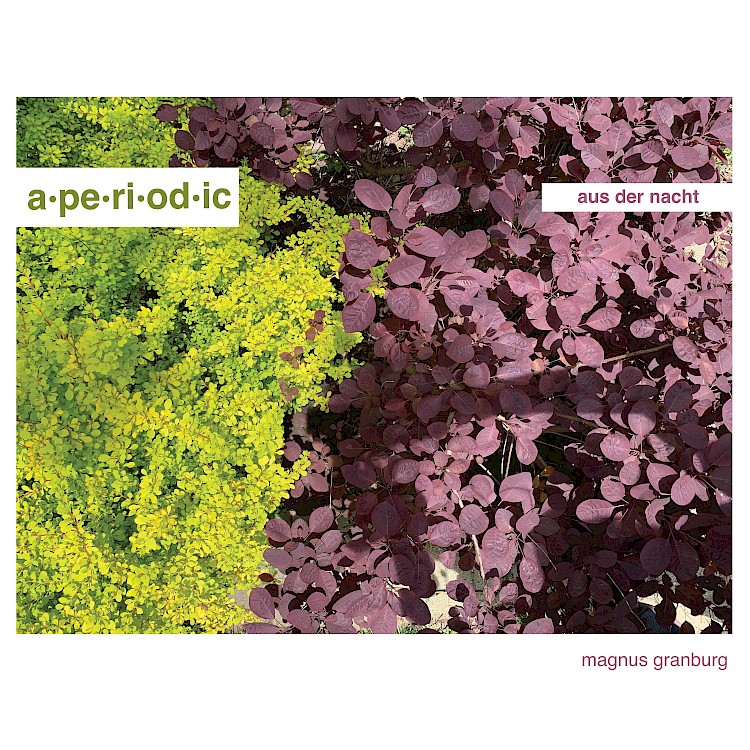
a·pe·ri·od·ic is a Chicago-based experimental music ensemble founded in 2010 and directed by Nomi Epstein featuring post-Cagean notated, experimental music. Their second release on New Focus features an album length work by Magnus Granburg written for the ensemble, Aus der Nacht, von den Wehen, a forty five minute episodic work comprised of 71 distinct sections that explore subtle changes in attack, decay, resonance, and pitch, using an indeterminate notation to inject variability into its performance.
| # | Audio | Title/Composer(s) | Time |
|---|---|---|---|
| Total Time | 45:20 | ||
| 01 | Aus der Nacht, von den Wehen | Aus der Nacht, von den Wehen | 45:20 |
Despite the ubiquity of the word “experimental” across the pantheon of contemporary music practices, there exists a distinct sub-category of new concert music that falls under the umbrella of experimental music. Characterized by explorations with indeterminacy with respect to such parameters as instrumentation, structure, pitch, and duration, the experimental tradition challenges expectations surrounding the performance and experience of listening to musical sound. Among the ensembles that are dedicated to this repertoire is Chicago based a·pe·ri·od·ic, founded in 2010 by Nomi Epstein, who continues to be their director. a·pe·ri·od·ic is known for presenting sparse, contemplative works that many other groups might bypass, and has commissioned, premiered, and recorded works by Michael Pisaro, Catherine Lamb, Eva-Maria Houben, Jürg Frey, Christian Wolff, and Pauline Oliveros, among others. On this recording, a·pe·ri·od·ic presents an album length work by Magnus Granburg written for the ensemble, Aus der Nacht, von den Wehen. The episodic piece contains 71 distinct sections that explore subtle changes musical parameters, using a variable notational strategy that ensures that each realization of the score is unique.
Aus der Nacht, von den Wehen was written in 2023 when Granburg joined the ensemble in Chicago for a portrait concert. The work explores structural indeterminacy, wherein each of the 71 events is flexible but has a recognizable opening and closing profile. Within this frame, there are consistent roles for the members of the ensemble, but also built in flexibility and autonomy related to how their material is articulated within given events. The balance between pre-determined elements and parameters that are left indeterminate necessitates collective listening, which in turn provides an intuitively felt glue to the group’s performance, as each phrase ebbs and flows like inhalation and exhalation.
Read MoreThere is a template for the way the ensemble instrumentation functions together. The flute, clarinet, french horn, bassoon and sometimes the voice sustain high register long tones, sometimes in unison, other times voicing luminous vertical harmonies, and yet other times grinding up against one another with closely spaced microtonal inflections. The prepared piano and pitched percussion provide tintinnabulating sonorities, splashes of color that animate the soundscape. The cello and non-pitched percussion offer punctuation and rhythmic framing within the ethereal sustains.
Each individual episode’s character derives from how these different groups of instruments fill the space between the beginning and end of the events. Density of material, where attacks are articulated, how long durations last, the specific pitch content of verticalities, all of these factors give a distinct contour to the events. There are large scale shifts in texture as well — at 12:13 we hear a new crumbling, crackling timbre introduced in the percussion that is then mirrored by tremolo articulations in the cello, at 15:26 we hear voice enter with sustained pitches. These introductions of new timbral elements register as major structural shifts because the listener’s focus has been drawn in to perceive the subtlest changes between episodes. With two minutes and twenty five seconds remaining, a shimmering, wavelike tremolo texture emerges in the cowbell and cello underneath hollow sustains in the winds. For the final episode of Aus der Nacht, von den Wehen, the oscillation is gone, leaving only the austere, clarion wind unison over a poignant final dialogue between cello pizzicati and prepared piano.
– Dan Lippel
a·pe·ri·od·ic:
Eliza Bangert, flute
Emily Beisel, clarinet
Kenn Kumpf, voice, whistle & sine tone
Matthew Oliphant, French horn
Nomi Epstein, prepared piano
Nora Barton, cello
Robert Reinhart, bassoon
Sam Scranton, percussion
Recorded Feb 22, 2023, WFMT Studio, Chicago, IL
Recording and mastering engineer: Mary Mazurek
Recording project coordinator: Nomi Epstein
Graphic designer: Juli Sherry
Founded in 2010, a•pe•ri•od•ic‘s repertoire explores the indeterminacy of various musical elements including instrumentation, structure, pitch, and/or duration. Drawn to works of sparseness, contemplation, and quietude, this "daring group" (Chicago Reader) has a history of interpreting distinctive pieces using a collaborative rehearsal process, deriving meaning and intention from oblique prose scores with great sensitivity.
Led by Nomi Epstein, the ensemble has commissioned, premiered, and recorded works by composers such as Michael Pisaro, Eva-Maria Houben, Jürg Frey, James Saunders, and Pauline Oliveros. a•pe•ri•od•ic released its debut album, more or less, featuring the music of Jürg Frey in 2014 under New Focus Recordings. The ensemble has received funding from the Swiss Arts Council, the Earle Brown Foundation, the Goethe Institute, and the Foundation of Contemporary Arts. Members of a•pe•ri•od•ic hold graduate degrees in music performance or composition from Chicago-area universities and conservatories, and are featured in other Chicago-based groups including Ensemble Dal Niente and Outer Voices.
http://www.aperiodicchicago.comNew Focus Recordings is an artist-led collective label featuring releases in contemporary creative music of many stripes, as well as new approaches to older repertoire. The label was founded by guitarist Dan Lippel, composer Peter Gilbert in 2004, and composer/engineer Ryan Streber in 2004, formed …Read More …
Listen to full streaming tracks while you browse the site. New tracks enabled for streaming every month. Click on the button to open up the radio player.


