
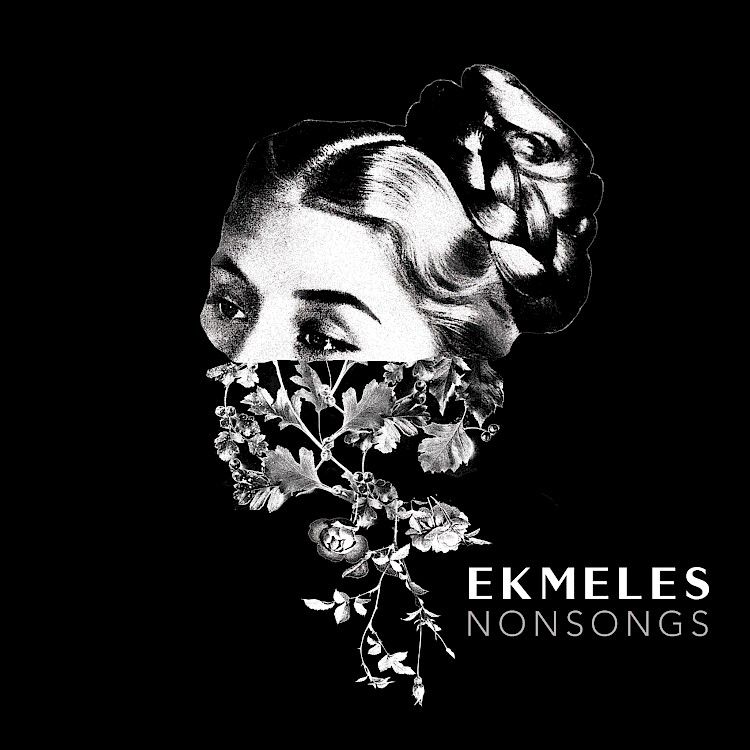
The intrepid contemporary vocal ensemble Ekmeles, directed by Jeffrey Gavett, releases their third recording featuring works written for the ensemble by George Lewis, Wolfgang von Schweinitz, and Katherine Balch. Ekmeles has cultivated an unparalleled reputation for tackling the most challenging vocal scores of our era, navigating microtonality, complex rhythmic textures, and experimental structures with virtuosity and expression.
| # | Audio | Title/Composer(s) | Performer(s) | Time |
|---|---|---|---|---|
| Total Time | 49:58 | |||
| 01 | Plainsound Motet for Ekmeles: "DADA NONO & REJOICE" | Plainsound Motet for Ekmeles: "DADA NONO & REJOICE" | Ekmeles | 22:18 |
| 02 | forgetting | forgetting | Ekmeles | 6:43 |
| 03 | Lone Coast | Lone Coast | Ekmeles, Iwo Jedynecki, accordion | 20:57 |
Ekmeles has distinguished itself as one of the elite contemporary vocal music ensembles active today. They have cultivated a specialization in microtonal singing that is truly pushing the boundaries of what is capable in the genre, as evidenced by their performance of Wolfgang von Schweinitz’s music on this album, and the music of James Weeks on their previous release (FCR394 We Live the Opposite Daring). The ensemble is no less pioneering in their exploration of extended vocal techniques and alternative timbres, and both Katherine Balch’s forgetting and George Lewis’ Lone Coast are excellent vehicles for their formidable facility in this direction. Moreover, Ekmeles is playing a major role by curating significant, ambitious compositions for contemporary vocal ensemble, and their indomitable collaborative spirit inspires composers to write at the peak of their capacities. Nonsongs is yet another fruit of this labor, a treasure trove of fantastic singing and ensemble musicianship in the service of deep artistry and invention.
Wolfgang von Schweinitz has spent the last three decades cultivating a compositional vocabulary and intonation techniques that facilitate performing complex just intonation intervals. He initially developed this "plainsound music” with works for solo strings, instrumental ensembles, symphony orchestras, and in electronic music contexts, and turned to a cappella vocal music at the invitation of Ekmeles’ musical director, Jeffrey Gavett. von Schweinitz’s affinity for Renaissance vocal music is apparent throughout, as the music flows through cadential phrases and imitation that evoke that rich repertoire, while navigating the intricate subtleties of pitch that are the core focus of his work. The text is his own, consisting of a sequence of syllables taken from Hebrew, Latin, Spanish, Russian, French, English, and German. The impact of the piece is profound; the ear recognizes characteristic harmonic and melodic motion, but the coloristic inflections that result from the finely tuned just intervals reveal a magical resonance that feels like one is hearing into the future while tethered by echoes of the past, all glued together by elemental acoustic pillars.
Read MoreComing after the microscopic focus on pitch in Plainsound Motet, the timbral range in Katherine Balch’s forgetting is striking in its diversity. Scored for vocal ensemble playing ratchets, the percussive clacking is woven into the fabric of the composition, modulating from sporadic interjections to immersive, gentle waterfalls of wooden attacks. The voices intertwine with a rich palette of techniques, both pitched and non-pitched, texted and wordless, to create a sonic environment that oscillates between dry tactility and luminous resonance.
George Lewis’ Lone Coast is based on a poem by Nathaniel Mackey, Lone Coast Anacrusis, and explores the phenomenon of nomadism as an artistic and intellectual state of being. Lewis’ language brings a theatricality to this collection, along with an underlying urgency that challenges musical complacency at every turn. Grainy extended vocal techniques merge with liquid glissandi and dense low register voicings to create an unmoored character. Accordionist Iwo Jedynecki joins as the only instrumental guest on the album, with trembling tremolandi, mournful contrapuntal passages, pointillistic interjections, and dark voicings that inhale and exhale in symbiosis with the vocal ensemble. As in the Balch, the members of Ekmeles are given double duty on auxiliary percussion, this time with tolling gongs that contribute to the work’s ritualistic hue. Lone Coast finishes with an instrumental coda, as the accordionist plays embellished figures in dialogue between their two hands and utters gruff, perfunctory accented chords.
– Dan Lippel
Recording location: Oktaven Audio, Mt. Vernon, NY
Recording dates:
Lone Coast: May 6, 2024
Plainsound Motet, forgetting: January 18-19, 2026
Producers: Jeffrey Gavett, Ryan Streber
Engineering, mixing, mastering: Ryan Streber
Editing: Ryan Streber
Art and design: Alex Eckman-Lawn
Ekmeles is a vocal ensemble dedicated to the performance of new and rarely-heard works, and gems of the historical avant garde. They have a special focus on microtonal works, and have been praised for their "extraordinary sense of pitch" by the New York Times. They are the recipients of the Ernst von Siemens Music Foundation's 2023 Ensemble Prize, the first American group to receive the honor.
As part of their work expanding the possibilities of tuning and technique in vocal music, Ekmeles has given world premieres by composers including John Luther Adams, Taylor Brook, Courtney Bryan, Ann Cleare, Zosha Di Castri, Erin Gee, Georg Friedrich Haas, Martin Iddon, Hannah Kendall, Catherine Lamb, George Lewis, Wolfgang von Schweinitz, Christopher Trapani, James Weeks, and Arash Yazdani.
In addition to creating their own repertoire, Ekmeles is dedicated to bringing the best of contemporary vocal music to the United States that would otherwise go unheard. They have given US premieres by composers including Joanna Bailie, Carola Bauckholt, Aaron Cassidy, Beat Furrer, Stefano Gervasoni, Georg Friedrich Haas, Evan Johnson, Bernhard Lang, Liza Um, Claus-Steffen Mahnkopf, Lucia Ronchetti, Wolfgang Rihm, Rebecca Saunders, Salvatore Sciarrino, Mathias Spahlinger, and Agatha Zubel.
Collaborations with other musical ensembles and artists has been a part of Ekmeles's work from the very beginning. In their first several seasons they gave the US premieres of Luigi Nono's Quando stanno morendo with AMP New Music, and Beat Furrer's FAMA with Talea Ensemble. Their collaborations with Mivos Quartet include world premieres by Taylor Brook and Evan Johnson, and the US premieres of Stefano Gervasoni's Dir - In Dir and Wolfgang Rihm's concert-length ET LUX. In 2015 Ekmeles joined with members of Tilt Brass and loadbang for the US premiere of Mathias Spahlinger's monumental über den frühen tod fräuleins anna augusta marggräfin zu baden, and Wolfgang Rihm's SKOTEINÓS. They returned to the Spahlinger in 2024 on a German tour with composers slide quartet and Ensemble Aventure. Ekmeles also collaborates beyond the traditional concert stage, including the integration of singers into choreographic works by New Chamber Ballet, and a staged memorized performance of David Lang's the little match girl passion at the MET Breuer Museum directed by Tony award winning director Rachel Chavkin. They also gave sold-out performances with Oliver Beer's Vessel Orchestra, the first sound-based installation commissioned by the Metropolitan Museum of Art. Director Jeffrey Gavett performed at the keyboard of this instrument, composed of 32 resonant hollow objects spanning 7,000 years of the museum's collection. In 2022 they sang as part of John Luther Adams's installation work Veils and Vesper, broadcast on WNYC's New Sounds.
Ekmeles has taught and premiered works by student composers at Brandeis, Brown, Columbia, University of Florida, Manhattan School of Music, University of New Mexico, NYU, University of Pennsylvania, University of Pittsburgh, Princeton, Rutgers, Stanford, Syracuse, and University of Virginia.
Their second album We Live the Opposite Daring was released in February 2024 on New Focus Recordings, with works by Zosha Di Castri, Jeffrey Gavett, Erin Gee, Shawn Jaeger, Hannah Kendall, and James Weeks. Textura praised it saying "this ever-intrepid outfit goes places few other vocal ensembles dare venture." Fanfare calls it "One of the most amazing choral discs to have come my way: a crack vocal ensemble presenting vitally alive music of our time." In January of 2020 they released their debut album A howl, that was also a prayer on New Focus Recordings, with works by Taylor Brook, Erin Gee, and Christopher Trapani. Fanfare magazine said the album's performances were "beyond expert - almost frightening in their precision." In the spring of 2020 through May 2021, Ekmeles continued to bring their performances to audiences in authentic ways despite the difficulty of singing together. They performed innovative streaming concerts that combined elements of video art created by members of the ensemble, pre-recorded performances, and live synchronous online performing. Ensemble members performed simultaneously from San Francisco, Philadelphia, and New York.
A versatile and experienced performer — once described as "Glenn Gould of the Accordion" — Iwo Jedynecki is changing the perspective for his instrument with his unique approach to concert presentations and programming. Winner of top prizes at over thirty music competitions, as a soloist and a member of chamber ensembles he has performed in 40 countries across six continents. His long-standing partnership with violinist Karolina Mikolajczyk has brought the duo to perform in places like Carnegie Hall, Kimmel Center in Philadelphia, Esplanade Concert Hall in Singapore, Melbourne Arts Centre (Australia), Teatro del Logo (Chile). A 2025 release on Orange Mountain Music showcases premiere recording of the complete Piano Etudes by Philip Glass on classical accordion in Iwo's arrangement and performance. Iwo Jedynecki holds a Ph.D degree in accordion performance and was the first ever accordionist at New York University, as a recipient of the famous Fulbright Scholarship.
Amidst the extended vocal techniques and toy ratchets of Katherine Balch’s forgetting, the second of three pieces here, you may be able to pick out this key phrase from Katie Ford’s Estrangement, which provides the text: “Only the song took formidable work to forget.” It’s going to take more than that to forget what this adventurous vocal sextet has delivered on their third album. Directed by baritone Jeffrey Gavett and including soprano Charlotte Mundy, mezzo soprano Elisa Sutherland, countertenor Timothy Parsons, tenor Tomás Cruz, and bass Steven Hrycelak, Ekmeles sound even more like one entity than on the “rich feast” of their last album.
The opening piece, Wolfgang von Schweinitz’s Plainsound Motet for Ekmeles: “DADA NONO & REJOICE,” requires a daunting command of pitch to execute his microtonal conception. Ekmeles are not only up to the challenge, but sound like they’re having fun doing it. The text is a baffling hymn written by von Schweinitz, using syllables based on eight languages, that somehow manages to provide the resolution even an atheist finds comforting from such works. Finally, we get George Lewis’ Lone Coast, based on a poem by Nathaniel Mackey, which has a strong narrative feel as the singers play tiny gongs to the accompaniment of Iwo Jedynecki’s accordion. Mackey, who was addressing nomadism in all its forms, including through the history of the Ohlone, an ancient Californian tribe, also gives the album its name. In Scene 4, the group sings: “Refugees was a word we heard/the nonsong we sang/the song we nonsang/Wept in our sleep/one with what would never be there again/where the Alone live.” Profound stuff and definitely unforgettable.
— Jeremy Shatan, 5.22.2026
Nel 2010 la costituzione dell’ensemble vocale Ekmeles a New York ha riempito un vuoto nella musica cosiddetta contemporanea, ossia quello di un ensemble interamente dedicato alla composizione microtonale. Grazie al baritono e direttore dell’ensemble Jeffrey Gavett è stato possibile creare un’area di interesse per la composizione che non fosse solo creazione di repertorio per voci soliste con carattere strutturalista o post-moderno; l’alternativa si è fondata su una matrice sonora ben delineata e calibrata su alcune caratteristiche tecniche che non si focalizzano ut est sugli insegnamenti del minimalismo americano ma attingono alla natura del suono. Con una graduale espansione dell’obiettivo l’Ekmeles di Gavett ha pian piano approfondito sulla just intonation chiedendo ai cantanti di assimilare nel loro bagaglio formativo ulteriori frequenze (i parziali) e ha puntato sull’eliminazione del vibrato lirico in modo da far risaltare le minime differenze microtonali: lo spettro acustico delle voci è puro, immediatamente disponibile per un godimento che piace senz’altro ai seguaci dello spettralismo pur mancando di un’indagine profonda a livello informatico. Per i cantanti dell’Ekmeles (1) non è per nulla facile raggiungere questo risultato perché significa avere a che fare con una memoria acustica dei toni parziali, ampliare la tavolozza delle 12 note e utilizzare testi che foneticamente siano in gradi di ottenere il suono puro.
Dal 2011 ad oggi l’Ekmeles ha esaudito bene il suo compito con moltissime prime assolute (2) e con tre CD riepilogativi per New Focus R. (3). L’ultimo CD intitolato Nonsongs è in pubblicazione e contiene 3 pezzi rappresentativi del loro repertorio, dai quali riconoscere il virtuosismo e un’espressività mirata, cioè basata su una ricerca della microtonalità vocale che ammette però trame ritmiche complesse e passaggi sperimentali. Posto che gran parte delle loro esibizioni sono fruibili anche visivamente attraverso video caricati dall’ensemble sul proprio sito o pagina youtube, va detto che Nonsongs è comunque un ascolto necessario per capire le radici del lavoro dell’Ekmeles, dal momento che contiene 3 composizioni che sono anche tre direzioni di sviluppo:
1) Plainsound Motet for Ekmeles:”DADA NONO & REJOICE” di Wolfgang von Schweinitz, richiama il sistema di notazione di Helmholtz-Ellis progettato da von Schweinitz e Sabat in cui alle note tradizionali vengono aggiunti in partitura dei micro-accidenti, ossia frecce, linee e curve che indicano l’innalzamento o l’abbassamento delle note; è un sistema in cui il cantante riceve conferma della giusta nota solo dopo la verifica dell’incastro armonico allorché sente che è sparita qualsiasi oscillazione o fremito dei suoni (un atto che quindi si regola millimetricamente sulla stretta o rilascio dei muscoli della laringe). Il titolo del brano mette insieme sacro e profano poiché da una parte introduce la novità microtonale (un motetto di nuova concezione secondo le regole del plainsound), dall’altra è una strana combinazione dadaista (contiene un nonsense che gioca con Luigi Nono e la negazione che deriva dal cognome del compositore divisa in due sillabazioni); il testo è un insieme di frammenti di parole ebraiche e tedesche che servono per l’ideazione di fonemi utili per la loro risonanza acustica.
2) forgetting di Katherine Balch, richiama l’indagine della fusione microtonale fatta attraverso la combinazione della microtonalità vocale con suoni di oggetti, in questo caso giocattoli rumorosi azionati nella performance. Balch utilizza una versione decostruita e frammentata di Estrangement, una raccolta poetica di Katie Ford con mescola di linee vocali, parole cantate in inglese, puri fonemi e isolamento di vocali che rendono il testo materia puramente acustica e condizionato dall’azione dei giocattoli. Davanti ad un microtono puro e senza vibrato che subisce il rumore frequenziale del giocattolo, si crea una fusione nell’ascolto, una percezione di sgretolamento, di distorsione, che vuol dare l’illusione di una memoria che si perde (da qui il titolo ‘forgetting’).
3) Lone Coast di George Lewis va ad incidere invece sull’integrazione strumentale della vocalità (la fisarmonica di Iwo Jedynecki) nell’ottica di una ‘comunione’ tra estensioni vocali e strumento; i glissandi, le emissioni granulari, il balbettio o i raschiati laringei si incontrano con i tremoli e le aperture d’aria della fisarmonica. Si tratta di circa 20 minuti di instabilità musicale che vuole però condurre l’ascoltatore nell’alveolo emotivo di una narrazione ben precisa, quella del dramma della comunità afro-americana dopo l’uragano Katrina; la fluttuazione microtonale deve rendere l’idea di un senso di perdita, di deriva e persino di un nomadismo intellettuale simile a quello fornito da Nathaniel Mackey nella sua poesia Lone Coast Anacrusis, in sostanza un trauma trasformato in fonetica.
Per completare su Lewis, va detto che il rapporto dell’Ekmeles con il compositore è tuttora attivo e in espansione. Il 24 maggio l’Ekmeles eseguirà un programma in cui comparirà anche Amo del compositore afroamericano, ispirata da Anton Wilhelm Amo, filosofo del Ghana del settecento che fu catturato dai colonizzatori olandesi e poi ‘offerto’ in dono ad una famiglia di nobili tedeschi ottenendo la sua laurea e il suo lavoro di professore tra Halle e Jena. Lewis ha tratto il testo dalla tesi di dottorato di Amo nel 1734 scritta in latino e sembra averla integrata con frammenti di inglese, tedesco, olandese e di twi, la lingua d’origine di Amo, tutte lingue che il filosofo sapeva parlare. La cosa che colpisce è anche l’argomento controverso di quella tesi, una sull’apatia della mente umana che non ha la capacità di ‘sentire’, una che non può avere sensazioni poiché quest’ultime appartenenti solo al corpo biologico, in tal modo disfacendo il dualismo cartesiano.
Translation:
In 2010, the founding of the vocal ensemble Ekmeles in New York filled a gap in so-called contemporary music: that of an ensemble entirely dedicated to microtonal composition. Thanks to baritone and ensemble director Jeffrey Gavett, it became possible to create an area of compositional interest that was not merely the creation of repertoire for solo voices with a structuralist or post-modern character. The alternative was built on a well-defined sonic matrix, calibrated around certain technical characteristics that do not focus, as such, on the teachings of American minimalism, but draw instead on the nature of sound. With a gradual expansion of its scope, Gavett's Ekmeles progressively deepened its engagement with just intonation, asking singers to assimilate additional frequencies (the partials) into their formal training, and focused on eliminating lyrical vibrato so as to bring out the smallest microtonal differences. The acoustic spectrum of the voices is pure, immediately available for an enjoyment that certainly appeals to followers of spectralism, even though it lacks a deep investigation at the computational level. For the singers of Ekmeles (1), achieving this result is by no means easy, because it means dealing with an acoustic memory of partial tones, expanding the palette beyond 12 notes, and using texts that are phonetically capable of producing pure sound.
From 2011 to the present, Ekmeles has fulfilled its mission well, with a great many world premieres (2) and three retrospective CDs on New Focus Recordings (3). The latest CD, titled Nonsongs, is forthcoming and contains three pieces representative of their repertoire, through which one can recognize both virtuosity and a focused expressivity, that is, one grounded in a pursuit of vocal microtonality that nevertheless admits complex rhythmic textures and experimental passages. Given that a large part of their performances can also be experienced visually through videos uploaded by the ensemble on their own website or YouTube channel, it must be said that Nonsongs is nonetheless essential listening for understanding the roots of Ekmeles's work, since it contains three compositions that also represent three directions of development:
1) Plainsound Motet for Ekmeles: "DADA NONO & REJOICE" by Wolfgang von Schweinitz draws on the Helmholtz-Ellis notation system designed by von Schweinitz and Sabat, in which micro-accidentals are added to traditional notes in the score: arrows, lines, and curves indicating the raising or lowering of pitches. It is a system in which the singer receives confirmation of the correct note only after verifying the harmonic interlocking, when they sense that any oscillation or tremor in the sounds has disappeared (an act that is therefore regulated millimeter by millimeter through the tightening or releasing of the laryngeal muscles). The title of the piece brings together the sacred and the profane: on one hand it introduces the microtonal novelty (a newly conceived motet according to the rules of plainsound), and on the other it is a strange Dadaist combination (containing a nonsense that plays on Luigi Nono and the negation derived from the composer's surname split into two syllables). The text is an assemblage of fragments of Hebrew and German words chosen for the phonemes they produce and their acoustic resonance.
2) forgetting by Katherine Balch draws on an investigation of microtonal fusion achieved through the combination of vocal microtonality with the sounds of objects, in this case noisy toys activated during the performance. Balch uses a deconstructed and fragmented version of Estrangement, a poetry collection by Katie Ford, blending vocal lines, words sung in English, pure phonemes, and isolated vowels that render the text purely acoustic material, conditioned by the action of the toys. When a pure, vibrato-free microtone is subjected to the frequency noise of a toy, a fusion is created in the listening experience, a perception of crumbling and distortion, intended to give the illusion of a memory fading away (hence the title forgetting).
3) Lone Coast by George Lewis works instead on the instrumental integration of vocality (the accordion of Iwo Jedynecki) with a view to a "communion" between vocal extensions and instrument. Glissandi, granular emissions, stuttering, and laryngeal scraping meet with the tremoli and air openings of the accordion. It is approximately 20 minutes of musical instability that nonetheless seeks to lead the listener into the emotional cradle of a very precise narrative: that of the drama of the African-American community after Hurricane Katrina. The microtonal fluctuation is meant to convey a sense of loss, of drift, and even of an intellectual nomadism akin to that found in Nathaniel Mackey's poem Lone Coast Anacrusis, essentially a trauma transformed into phonetics.
To complete the picture regarding Lewis: Ekmeles's relationship with the composer remains active and expanding. On May 24, Ekmeles will perform a program that will also include Amo by the African-American composer, inspired by Anton Wilhelm Amo, an eighteenth-century philosopher from Ghana who was captured by Dutch colonizers and then "gifted" to a noble German family, eventually earning his doctorate and working as a professor between Halle and Jena. Lewis drew the text from Amo's 1734 doctoral thesis, written in Latin, and appears to have integrated it with fragments of English, German, Dutch, and Twi, Amo's native language, all languages that the philosopher could speak. What is also striking is the controversial subject of that thesis: one arguing for the apathy of the human mind, which lacks the capacity to "feel" and cannot have sensations, since sensations belong only to the biological body, thereby dismantling Cartesian dualism.
— Ettore Garzia, 6.01.2026
The Platonic ideal of a choral group premiering new music is something like that of a referee in a big sporting event: If they do their job perfectly, you won’t notice the musicians as such. The work itself will take center stage.
Ekmeles is too good for that. Somehow they give us the best of both worlds. Their new album, Nonsongs, features recent work from Wolfgang von Schweinetz, Katherine Balch, and George Lewis, offering a range of what contemporary choral music is capable of in a brisk 50 minutes. It is virtuosic stuff, both in the demands on individual singers and, particularly, the group working as a unit.
The von Schweinetz, “Plainsound Motet for Ekmeles: ‘DADA NONO & REJOICE,’” is both opener and centerpiece. The German composer has written just-intonation “plainsound music” over several decades, and his affinity for early music makes his style a natural fit for choir.
The Motet never falls into predictable patterns, but its gradual motion means it is rarely unsettled. Sections are introduced by solo intervals or ensemble chords, which the group then explores. The piece is most fascinating when it moves through sequences of chords, some traditional, some audibly just-tuned, and others that don’t fall into any neat category.
Throughout, Ekmeles sounds astonishingly good. Perhaps I shouldn’t have spoiled the experience by telling you it’s a six-part unit: I didn’t know that at first, and assumed more voices were involved. For the Motet, they keep vibrato to a minimum and hit some truly abstruse intervals with ease. (Apparently von Schweinetz is working in 47-limit just intonation.) It feels a bit against the spirit of things to highlight one member of the group, but I can’t resist: Bass Steven Hrycelak is impeccable, commanding a part that could make or break this work.
Balch and Lewis demand (slightly) larger forces. Balch gives ratchets to the singers, and the main interest in her work is everything that can be done with the percussion. Sometimes they create a din that voices barely break through; at other points, they sound like de-tuned music boxes. More than von Schweinetz, Balch allows Ekmeles to show off its range, from pianissimo chattering to more traditional choral statements to … well, ratchets.
The album closes with George Lewis’s “Lone Coast,” another ambitious, large-scale piece. Lewis uses a poem by Nathaniel Mackey, and he adds both gongs (played by the singers) and accordion to the mix. While there are rarely solos as such, “Lone Coast” brings out individual voices, in particular that of countertenor Timothy Parsons. I don’t think I’ve ever heard an uninteresting piece from Lewis’s pen, and this is no exception.
Ekmeles is a relatively new group on the scene: Their debut recording came only six years ago. They’ve presented a dazzling array of new music, and New Focus deserves three cheers for putting so much of it on record already.
— Jeff, 6.03.2026
It isn’t often that performers approach microtonal music armed only with a set of tuning forks and their own ingenuity — but for an ensemble like Ekmeles, such resources are no deterrent. In their individual careers, ensemble members Charlotte Mundy, Elisa Sutherland, Timothy Parsons, Tomás Cruz, Steven Hrycelak, and Jeffrey Gavett (director) all engage in projects that bring them to the precipice of singability; but as an ensemble, these six virtuosos are even greater than the sum of their admittedly formidable parts. Their new album Nonsongs (May 2026, New Focus Recordings) contains only three pieces. Yet on this compact, one-hour recording, Ekmeles offers a multidimensional portrait of their interest in microtonality.
The title of the opening track, Plainsound Motet for Ekmeles: DADA NONO & REJOICE, is our first hint about the nature of the journey we’re embarking upon. Not simply a catchy portmanteau, Plainsound refers to a community of composers, performers, and music theorists who write and realize music that experiments with just intonation. Deeply involved in Plainsound, composer Wolfgang von Schweinitz plays with the dissonances of monophony and early polyphony in this “plainsound motet.” Ekmeles begins with a drone of unisons, zooming in on the intricacies of one pitch and using overtone singing to highlight different tones in its harmonic series. Rapidly, however, the piece expands into perfect intervals, then finally emerges fully-fledged into an off-kilter contrapuntal style that characterizes the bulk of the piece.
Achieving a timbre remarkably close to an actual pipe organ, Ekmeles tackles both powerful tutti walls of sound and sudden changes from one vowel to another with absolute accuracy. Their stunning dynamism of timbre and microtonal inflection animates the music, transforming intricate constructions of intervals into something that can be personified: dark and threatening, or playful and even boisterous. One could imagine this piece being set in a medieval church, where long tails of resonance overlap to echo several seconds worth of plainchant at once.
Despite clocking in at just under seven minutes, Katherine Balch’s forgetting feels comparable in scale through its sheer intensity. Such a force of sound is achieved in Balch’s inventive pairing of a chorus of voices with a corresponding chorus of ratchets. All this subverts a diminutive beginning: the ratchets are initially cranked slowly, and their sharp, tinny articulations fall in step with a jumble of aggressive vocables and fragments of distinguishable text from Katie Ford’s 2020 poem “estrangement.” Eventually the text pulls through more decisively: “practice,” “forgetting,” “impossible.”
Soon, Balch’s setting shifts from secco fragments to intersecting, colliding statements of quickly declaimed text. If the ratchets feel in opposition to the poem’s main character or as some pernicious force, the final minute sees them become a rising tide that threatens any semblance of voice. As if melting, the final chord glissandos down slowly as it is increasingly drowned out by the cacophony of the ratchets; in a final act of rebellion, the vocalists pop a sforzando stinger to close.
In another timbral pairing of great variety and nuance, George Lewis’ Lone Coast orchestrates the voices of Ekmeles alongside accordion, performed utterly fearlessly by Iwo Jedynecki. Like the previous track, Lone Coast took shape from a poem, this time “Lone Coast Anacrusis” by Nathaniel Mackey. Lewis’ setting is deeply enjoyable, not only because of the sensitivity of his timbral composites or the creativity of his text painting. Most often, it is because he seizes every opportunity for dramatization, and he does not shy away from the source poem’s gritty, at times obsessive tone. In one especially powerful moment, the ensemble abruptly shifts from mellifluously dovetailing chains of duos and trios to a chorus of haglike snarls, declaiming “like a dreamer” atop a frenetically sawing accordion. The virtuosic work shows Ekmeles’ members in complete lockstep: each unison release and in-tandem swoop of contour happens with absolute precision, executed by a team with both skill and trust.
Music that goes beyond incidental microtonality, like much of the music that Ekmeles champions, can sometimes come off with a bad reputation for being contrived beyond the point of “feeling it.” But on Nonsongs, Ekmeles contradicts that narrative, persuading audiences that committed, attentive performers can surmount those technical or theoretical obstacles to bring real verve to the listening experience.
— Julia Kuhlman, 6.17.2026
The whole notion of “quiet music” is, in a sense, one that deliberately defies expectations, music being inherently something different from silence (John Cage’s notorious 4’33” notwithstanding). To an even greater extent, the vocal ensemble Ekmeles offers singing that does not sing at all on a (+++) New Focus Recordings CD that actually bears the title “Nonsongs.” The 50-minute disc includes two very extended works and one much shorter one, all of them assertively avant-garde in nature. Wolfgang von Schweinitz’ Plainsound Music for Ekmeles—“DADA NONO & REJOICE” (created in 2024 and titled and spelled exactly that way in good solid avant-garde fashion) is a very lengthy exercise in pitch adjustment that requires sensitivity to microtonality and the ability to navigate it vocally. Ekmeles’ skill in the complexities of the material is much in evidence here, but the complexity is the meaning: the vocalizings are nothing but syllables as pronounced in seven languages (English, French, German, Hebrew, Latin, Russian and Spanish). The skill with which the singers (more accurately, vocalizers) navigate the requirements of the piece is impressive on an intellectual level, but the work makes no attempt to connect meaningfully with any audience besides the composer and performers: it is ultimately vapid in terms of content while brimming with technique. And it goes on and on long after making its points about ways in which vocal presentations, like instrumental ones, can be extended beyond the normative ones. For the other works on the disc, voices alone are not quite enough. Katherine Balch’s forgetting (from 2021 and spelled without a capital letter in a typical avant-garde affectation), the shortest piece on the CD, adds percussion in the form of ratchets to the vocal sounds: the singers/vocalizers use percussive elements along with both pitched and non-pitched expressions to create one of those immersive sonic environments that seem designed to pull listeners, for a time, into an otherworldly space – not, however, for any revelatory purpose, but simply to demonstrate ways in which the everyday world can be modified to allow experience of a different sort of sonic palette. George Lewis’ Lone Coast (2023) takes the vocalizers-with-percussion-instruments notion a step further, giving the members of Ekmeles gongs that produce a kind of gamelan resonance and adding an accordion (played by Iwo Jedynecki) to the overall mixture. Again, extended techniques are de rigueur here in a lengthy presentation of technical prowess that challenges performers and listeners alike without really repaying the effort required of an audience to follow the piece’s metamorphoses. The use of gongs and accordion does give Lone Coast a more engaging overall sound than the other pieces on the disc possess, but as with the von Schweinitz work, the soundworld is well-established within a short time period and continues to present itself long after it has made what points it has to make. As is so often the case with ultra-modern compositions, the works here will speak clearly and informatively only to audiences that have determined, well before hearing them, that the pieces and their composers have something worthwhile to say. Or, as the case may be, vocalize.
— Mark Estren, 7.02.2026
Arguably no contemporary vocal ensemble is more daring than NYC-based Ekmeles (Charlotte Mundy, Elisa Sutherland, Timothy Parsons, Tomás Cruz, Steven Hrycelak, and Musical Director Jeffrey Gavett). As if its earlier releases, A howl, that was also a prayer (2020) and We Live the Opposite Daring (2024), didn't already argue that point, it's rendered incontrovertible by its third, Nonsongs, and the trio of works George Lewis, Wolfgang Von Schweinitz, and Katherine Balch fashioned expressly for it and the ensemble. Whereas another vocal outfit might focus its attention on harmonizing celestially, Ekmeles leaves standardized singing behind for microtonality, extended techniques, and other innovative strategies. As challenging as the music is, it's all the more valuable for being so audacious. This group's efforts have been formally recognized too, the Ernst von Siemens Music Foundation's Ensemble Prize it received in 2023—the first American group to be so honoured—a case in point.
While that emphasis on microtonality is taken to an extreme on Wolfgang von Schweinetz's Plainsound Motet for Ekmeles: "DADA NONO & REJOICE,” Ekmeles finds its preoccupation with extended vocal techniques and alternative timbres well-served by Katherine Balch's forgetting and George Lewis's Lone Coast, her seven-minute setting dwarfed by the twenty-minute behemoths on either side.
It's fitting that the release, recorded at Mt. Vernon's Oktaven Audio in 2024 and 2026, would begin with von Schweinetz's material when both he and the group have intensively explored microtonality and alternate tuning systems (viz., just intonation). As contemporary as the music is, the composer's affinity for Renaissance vocal music emerges conspicuously, and when it does the tension between an earlier sounding style and one grounded in just intonation makes for a striking result. Enunciating syllables, the group advances through the piece's episodes with authority, beginning with Tuvan-styled throat singing and overlapping drones. Soon enough, the trajectory the music follows grows complex as the arrangement increases in contrapuntal intricacy. Individual voices separate themselves from the whole, but each component remains clearly audible when the number of singers totals six only. It's a fascinating piece: whereas the soothing passage arising nine minutes along recalls the kind one might hear delivered in a small chapel, microtonal combinations elsewhere brand the work as one clearly emblematic of a contemporary sensibility. Abrupt shifts in dynamics, pitch, and mood are executed with precision, making for a gripping demonstration of vocal artistry.
It's not easy following a piece of such impact, but Balch's forgetting definitely holds its own; the inspired addition of percussion (ratchets, specifically) to the arrangement helps too. A glossolalic barrage of colliding voice fragments initiates the piece, after which the clack of the ratchets surfaces to broaden the sound field. The coupling of the percussive thrum and stuttering voice effects makes for another arresting performance. With the activity level intense, the mass swells ecstatically, but intervals of rest and calm emerge as reprieves too. Broken word utterances morph into a harmonized drone as the end approaches, the ratchets collecting into a thrumming mass as a counterpoint.
The inclusion of a piece by George Lewis, a name well familiar to long-standing new music aficionados, is also fitting. Based on a poem by Nathaniel Mackey (“Lone Coast Anacrusis”), Lone Coast is the album's solo piece featuring an additional performer, accordionist Iwo Jedynecki, and as the performance shows he's as intrepid as his vocal colleagues. Intensely theatrical, the work couples gamelan-like percussive accents (performed by Ekmeles) and careening accordion flourishes with shrieks, snarls, and wails. Brace yourself for vocal gestures that nightmarishly explode thirteen minutes into the performance and equally wild interjections from Jedynecki. The album title's certainly apt: the three pieces are the furthest thing possible from a conventional song, what with its verse, chorus, and bridge components and three-minute duration; no one should come to Nonsongs expecting a melodic hook—the album's the hook in this case. Ekmeles are true risk-takers in championing material of uncompromising character and in challenging listeners at every step. The results are never less than gripping, however, and for those bold enough to join them on its adventurous journey the rewards are many.
— Textura, 7.04.2026
New Focus Recordings is an artist-led collective label featuring releases in contemporary creative music of many stripes, as well as new approaches to older repertoire. The label was founded by guitarist Dan Lippel, composer Peter Gilbert in 2004, and composer/engineer Ryan Streber in 2004, formed …Read More …
Listen to full streaming tracks while you browse the site. New tracks enabled for streaming every month. Click on the button to open up the radio player.


