
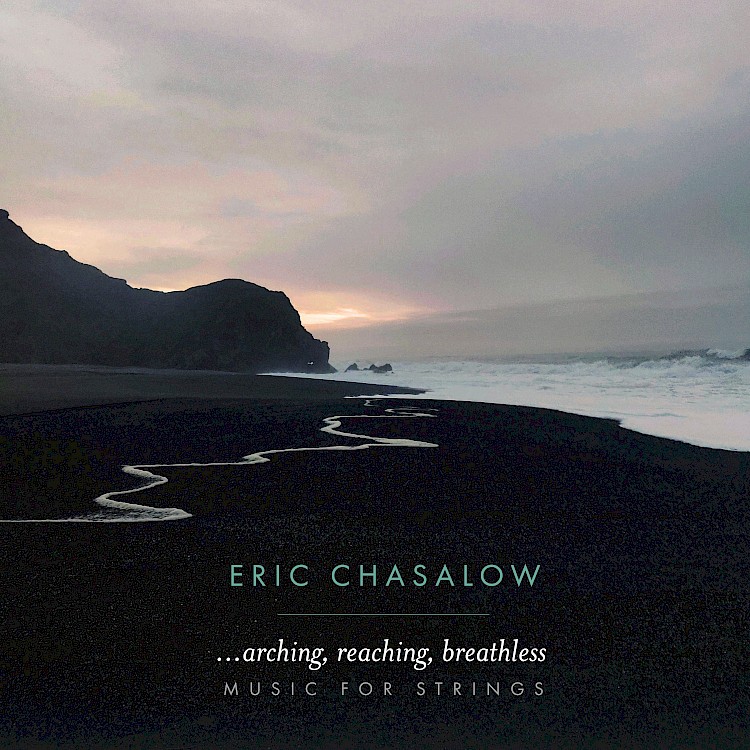
Composer Eric Chasalow releases ...arching, reaching, breathless featuring several pieces for strings in chamber and electroacoustic settings. Featuring performances by the Lydian String Quartet along with several leading freelancers, Chasalow's music is rich in timbral invention, cohesive structural organization, and programmatic inspiration drawn from literary sources, providing a compelling snapshot of one part of this veteran modernist's catalog.
This collection of Eric Chasalow’s music for strings balances his extensive work in electroacoustic contexts with his straight chamber music, touching on two core components of his output. The inclusion of two Wallace Stevens settings and a work inspired by Greek mythology points to another important strain in Chasalow’s work, the integration of literary sources. Chasalow’s music revels in character juxtaposition, expressive use of timbre whether acoustic or electronic, and a deft management of structure, all of which can be heard in various ways in these pieces.
The myth of Icarus and Daedalus is the inspiration for The Wings That Bear the Night Away for violin and fixed media, performed by Mari Kimura. The electronic part is fashioned from preexisting string quartet material that Chasalow subjected to granular synthesis. The result is a percolating, textural environment within which Kimura’s Icarus takes flight. Impetuous ascending scalar fragments and tremolo figures in the violin are juxtaposed against nervous figures in the electronics. As the flight becomes more challenging, Icarus’ electronic environment becomes more unpredictable, pivoting to glitchy timbres and interruptions. The contour of the violin lines turn towards descending passagework, implying Icarus’ fall, before an otherworldly, ethereal passage of microtonal sonorities sets up another reinvigorated, virtuosic ascent. The piece ends with a swirling texture, brilliant against the backdrop of a sonic blinding sun.
Read MoreThird Piano Trio: Rock Hill Variations, performed here by violinist Clara Lyon, pianist Steven Beck, and cellist Hannah Collins, is dedicated to Aaron Copland, and opens with a nod to the great American composer’s expansive musical vision, with sonorous sustained octaves in the piano that explore a broad register. The first ensemble section is pointillistic, with darting figures passing through the ensemble, nimble keyboard gestures, punctuated accented pizzicati, and stark high register violin sustains. A mournful line in the cello establishes a short, slow middle section featuring languid string lines, but is interrupted shortly by a furioso string of keyboard notes. An alternating figure passes from strings to piano, eventually leading into airy, weightless sonorities. The trio closes with a reprise of the energetic, darting material dancing between the three players, and finishes with a wry final staccato attack.
For his setting of two poems by Wallace Stevens, The Snow Man and Disillusionment of Ten O’Clock, Chasalow calls for a performing cellist to recite and sing the poem while playing, with live electronic accompaniment. There is a unique intimacy to the sound of a performing instrumentalist delivering text, and Chasalow builds in subtle shaping of the spoken text in addition to explicitly sung phrases. In The Snow Man, David Russell’s cello plays translucent harmonics and pointed pizzicati, supporting the poem with a halo of sustained sound and punctuated commentary. Throughout, the live electronics creating an enveloping embrace, a cloak for the icy timbres Chasalow has conjured. Russell’s voice is occasionally processed in Disillusionment of Ten O’Clock, creating shadows of delays and altering its timbre, enhancing Stevens’ haunting poem. Steady pizzicato lines pause between short phrases, an anxious over-the-shoulder glance in a spooky environment.
Chasalow’s Second String Quartet exists in different temporal extrapolations. One is an hour long and is designed to be performed by a spatialized ensemble in a gallery space. Loops are developed in the quartet while the audience circulates and then the players convene for a fifteen minute version that is collated from the material. The fifteen minute concert version is what we hear on this recording, played by the Lydian String Quartet. The work opens playfully, with a gentle passage of pizzicati supporting a poignant sustained line passed between instruments. Petulant outbursts begin to interrupt the revelry, growing in frequency and extending into full phrases, establishing a dichotomy between stable and unstable impulses. The piece develops with canonic dialogue, becoming frenetic and angular, before a forceful cadence indicates a structural arrival. Tentative material is exchanged between the members of the ensemble until it coalesces around a steady cantus firmus in the violin, dotted by gentle, tutti pizzicato chords. A vigorous, climactic section best characterizes what Chasalow calls metaclassicism, as memories and associations with the iconic string quartet repertoire are obliquely triggered and used as a jumping off point for further invention.
The three movement String Sextet engages in metaclassicism of its own, specifically in the opening movement’s reference to lines from the fourth movement of Brahms’ Op. 36 Sextet. Chasalow takes Brahms’ material and spins out vigorous contrapuntal interactions. The second movement, "Beautifully imperfect, as if droned on sympathetic strings,” is suspended and mysterious, as the viola plays improvisatory gestures over a bed of luminescent harmonies. Growing intensity leads to an accumulating dialogue with the other strings and the addition of percussive timbres, before the movement recedes back to the hollow fog from which it emerged. The final movement merges three contrasting energies, a rhythmic march, a dreamy interlude with poignant, closely spaced sustains, and an agitated scherzo.
Originally a flute and piano work, To the Edge and Back is heard here in a transcription for violin and piano by violinist Julia Glenn, heard here with pianist Steven Beck. The work features coquettish dialogue between the instruments that occasionally turns adversarial, as the two voices vie for prominence. Just as quickly the mercurial music becomes wistful and reflective, before shifting back to raw vigor or a coy wink. These impetuous expressive changes characterize the piece, which never settles in one mood for long, preferring to weave with glee, keeping the listener on their toes.
– Dan Lippel
Tracks 1, 3, 4, 8 recorded at Dimension Sound, Jamaica Plain, MA
Engineer: Dan Cardinal
Tracks 2, 5, 6, 7 recorded at Slosberg Music Center, Brandeis University, Waltham, MA
Engineer: Antonio Oliart
Track 9 recorded at Slosberg Music Center, Brandeis University, Waltham, MA
Engineers: Eric Chasalow and Giuseppe Desiato
All tracks produced, edited and mixed by Eric Chasalow (except track 1 edited by Mari Kimura)
Mastering: Antonio Oliart
Design, layout & typography: Marc Wolf, marcjwolf.com
Cover image: Photo by Sathyaprabha Rakkimuthu (pexels.com)
Eric Chasalow photo: © Aleks Karjaka
Eric Chasalow is a composer, sound artist, multi-instrumentalist, record producer, teacher, and advisor to non-profits. He is well known for works that combine instruments with electronic sound but has collaborated on a wide range of projects with many artists including Tony Arnold, Boston Modern Orchestra Project, Lucia Bova, Tim Brady, Collage New Music, Sharon Harms, Mari Kimura, Stephanie Lamprea, The Lydian String Quartet, Musicatreize, New York New Music Ensemble, Vicki Ray, Bruno Schneider, Talea Ensemble and many others.
Irving G. Fine Professor of Music at Brandeis University, and Director of BEAMS, the Brandeis Electro-Acoustic Music Studio, Eric Chasalow studied at the Columbia-Princeton Electronic Music Center, and holds the D.M.A. from Columbia University, studying composition principally with Mario Davidovsky and flute with Harvey Sollberger. Among his honors are awards from the Guggenheim Foundation, Koussevitzky Music Foundation, National Endowment for the Arts, Fromm Foundation at Harvard University, New York Foundation for the Arts, and the American Academy of Arts and Letters. His scores are published by Suspicious Motives Music, G. Schirmer, C.F. Peters, and Edition Bim (Switzerland) and recordings appear widely, including on New Focus Recordings, New World Records, Neuma Records, ICMC, SEAMUS, and Suspicious Motives Records. The Eric Chasalow collection in the Library of Congress was established in 2009.
https://www.ericchasalow.com/Violinist/Composer Mari Kimura, hailed by The New York Times as a “virtuoso playing at the edge,” captivates audiences with performances that seamlessly blend virtuosity and innovation. A master of subharmonics—a revolutionary technique producing pitches an octave below the violin’s lowest string—she expands the instrument’s sonic possibilities in breathtaking ways. Kimura has premiered major works by John Adams, Luciano Berio, Tania León, and Salvatore Sciarrino, performing with orchestras including the Hamburg Symphony and Tokyo Symphony. Her performances graced many prestigious festivals including Bartók Festival in Hungary, Chigiana Festival in Italy to Lincoln Center. As an improviser, she collaborates with Henry Kaiser, Elliott Sharp, and Jim O’Rourke; Strings Magazine calls her work “simply stunning... a rare level of excitement and grandeur.”Her performances now feature MUGIC®, her pioneering wearable motion sensor that transforms gesture into sound. Recipient of the 2025 SEAMUS Lifetime Achievement Award and honored by Carnegie Corporation as “Immigrant: Pride of America,” Kimura continues pushing boundaries on stages worldwide. Her latest album, MUGETSU (2024), showcases improvisations Elliott Sharp describes as displaying “a sense of inevitability.”
https://www.mugicmotion.com/Three-time GRAMMY-nominated violinist Clara Lyon is an acclaimed artist whose work sparks imaginative pathways by interlacing sonic languages with diverse artistic disciplines. Celebrated for her stylistic versatility, she thrives as a collaborator across contexts—from chamber music and recital programs to interdisciplinary projects that blend music with literature, visual art, and community-based practice. A prizewinner of the Irving M. Klein and Schadt International Competitions, Clara has appeared worldwide at venues and festivals including Carnegie Hall, the Kennedy Center, the Library of Congress, NPR’s Tiny Desk Concerts, and the Reykjavik Arts Festival. Her artistic vision has been recognized with a Music Academy of the West Alumni Enterprise Award and a Ragdale Foundation Residency with the Theorem Collective. Clara is Co-Artistic Director of Decoda, Carnegie Hall’s only Affiliate Ensemble. Her work spans concert halls and recording projects as well as sustained community partnerships in schools, hospitals, shelters, and correctional facilities. She also performs as a member of the Lydian String Quartet and the chamber orchestra A Far Cry, and teaches at Brandeis University, the Decoda Chamber Music Festival, and Greenwood Music Camp. A dedicated recording artist, she appears on New Amsterdam, Sono Luminus, New Focus, Sideband, and other labels. She holds degrees from the Juilliard School and SUNY Stony Brook and is an alumna of Carnegie Hall’s Ensemble Connect fellowship.
Cellist Hannah Collins is a multifaceted artist, educator, and arts-in-health advocate. Winner of De Linkprijs for contemporary interpretation, she is committed to championing compelling new works for cello. Resonance Lines, her solo debut album on the Sono Luminus label, is an “adventurous, impressive collection of contemporary solo cello music,” negotiated “with panache” (The Strad). Over the past decade, New Morse Code, her “remarkably inventive and resourceful duo” (Gramophone) with percussionist Michael Compitello, has developed projects responding to our society’s most pressing issues. Hannah is a member of Decoda and the A Far Cry chamber orchestra. She holds degrees in biomedical engineering and music from Yale, The Royal Conservatory of the Hague, and City University of New York. She serves as the executive director of the Longwood Symphony, the orchestra of Boston’s healthcare community, which is devoted to promoting the role of the arts in health.
Pianist Steven Beck has recently appeared with the orchestras of Austin, Princeton, and Chattanooga, been heard in chamber music in Chicago and Oklahoma City, and repeated his annual Christmas performance of Bach’s Goldberg Variations at Bargemusic, which has become a New York institution. As a soloist Mr. Beck has performed with the New York Philharmonic and the National Symphony and has appeared at Carnegie Hall, David Geffen Hall, Alice Tully Hall, the Kennedy Center, and the Library of Congress. As an orchestral musician he has played with the New York Philharmonic, the New York City Ballet Orchestra, and Orpheus. Steven Beck can be heard on over 40 CDs, including the first complete recording of George Walker’s piano sonatas, for Bridge Records. Mr. Beck is a member of the Knights, the Talea Ensemble, Quattro Mani, and the Da Capo Chamber Players. He is on the faculty of the University of Massachusetts, Amherst and the Sewanee Summer Music Festival. A Steinway Artist, he is a graduate of the Juilliard School, where he now teaches orchestral piano.
https://nyphil.org/about-us/artists/steven-beckHailed as "superb," “incisive," and "sonorous and panoramic” (Boston Globe), David Russell maintains a vigorous schedule both as soloist and as collaborator in the U.S. and Europe. He was appointed to the teaching faculty of Wellesley College in 2005 and currently serves as Lecturer and Director of Chamber Music. He has served as Principal cello of the orchestras of Odyssey Opera and Opera Boston since 2010 and performs regularly with many ensembles based in New England such as Cantata Singers and Ensemble, the Worcester Chamber Music Society and Emmanuel Music. A strong advocate of new music, Russell has performed and recorded with contemporary ensembles such as Boston Modern Orchestra Project, Firebird Ensemble, Ludovico Ensemble, Callithumpian Consort, Music on the Edge, Dinosaur Annex, Collage, the Fromm Players at Harvard, and entelechron. Recent projects include recordings of cello concertos by Chen Yi and Lukas Foss, recordings of solo and chamber works by Lee Hyla, Eric Moe, Tamar Diesendruck, Donald Crockett, Andrew Rindfleisch and Roger Zahab as well as premieres of music by David Lang, Barbara White, Marti Epstein, Daron Hagen, José-Luis Hurtado, Robert Carl, Gilda Lyons,and Jorge Martin. Russell has also recently premiered works for cello and orchestra by Laurie San Martin and Samuel Nichols, as well as works for solo cello by Tamar Diesendruck, Andrew Rindfleisch, and John Mallia. Russell has recorded for the Tzadik, Albany, BMOPSound, CRI, Centaur and New World Records labels.
From its beginning in 1980, the Lydian String Quartet (Andrea Segar and Judith Eissenberg, violins; Mark Berger, viola; Joshua Gordon, cello) has been acclaimed by audiences and critics across the USA and abroad for embracing the full range of the string quartet repertory with curiosity, virtuosity, and dedication to the highest artistic ideals of music making. In its formative years, the quartet studied repertoire with Robert Koff, a founding member of the Juilliard String Quartet who had joined the Brandeis University faculty in 1958. Forging a personality of their own, the Lydians were awarded top prizes in international string quartet competitions, including Evian, Portsmouth and Banff, culminating in 1984 with the Naumburg Award for Chamber Music.
In the years to follow, the quartet continued to build a reputation for their depth of interpretation, performing with “a precision and involvement marking them as among the world’s best quartets” (Chicago Sun-Times). Residing at Brandeis University in Waltham, Massachusetts since the group’s founding, the Lydians continue to offer compelling, insightful, and dramatic performances of the quartet literature. From the acknowledged masterpieces of the classical, romantic, and modern eras to new remarkable compositions written by today’s cutting-edge composers, the quartet approaches music-making with a sense of exploration and personal expression that is timeless.
The Lydian String Quartet has performed extensively throughout the United States at venues such as Jordan Hall in Boston; the Kennedy Center and the Library of Congress in Washington, D.C.; Lincoln Center, Miller Theater, and Weill Recital Hall in New York City; the Pacific Rim Festival at the University of California at Santa Cruz; and the Slee Beethoven Series at the University at Buffalo. Abroad, the Quartet has made appearances in France, England, Italy, Switzerland, Germany, Russia, Armenia, and Taiwan.
The Lydians have long championed the commissioning, performing and recording of new works. They enjoy work- ing with young composers at the quartet’s Brandeis home as well as in mini-residencies at universities across the US. Since 2012, the Lydians have expanded the string quartet repertoire through their biennial commission prize, one of the largest chamber music commissioning prizes in the country, resulting in newly commissioned, large-scale works by Kurt Rohde, Steven Snowden, Saad Haddad, Vijay Iyer, Riccardo Zohn-Muldoon, and Lembit Beecher. In recognition of their work, the quartet has received numerous ASCAP Awards for Adventurous Programming, commission grants from the Fromm Foundation, Chamber Music America, Meet the Composer/Rockefeller Foundation/AT&T Jazz Program in partnership with the National Endowment for the Arts, and the Aaron Copland Fund for Music.
Praised by the Boston Globe as a “committed and dynamic” performer, violist Dr. Samuel Kelder’s interpretations of contemporary repertoire and virtuosic technique have led him to become a sought-after soloist and chamber musician, traveling widely to work with many prominent artists and ensembles of today. Sam is a member of Sound Icon, Boston Modern Orchestra Project, Callithumpian Consort, East Coast Contemporary Ensemble, and is a founding member of Shizuka Viola Duo. Sam is core violist with the Sandbar Chamber Series, Appalachian Chamber Music Festival, Outer Cape Chamber Festival, and frequent guest with Galatea Series. In 2024 Sam launched Queer Ensemble Project with co-founder Mina Kim. Their mission is to uplift and celebrate queer artistry; amplifying the voices of queer artists and creating concert spaces with the intent of building a stronger community around music. Sam is the most recent addition to the viola faculty member at Boston University.
With a deep love for music new and old and exploring crossroads between music and language, Boston native Julia Glenn performs internationally on modern and baroque violins. Called “remarkable,” “gripping,” and “a brilliant soloist” by the New York Times, she joined the Naumburg-winning Lydian String Quartet after teaching for three years at the Tianjin Juilliard School. In January of 2016 she gave the world premiere of Milton Babbitt’s violin concerto to critical acclaim; her article on the work was published in 2022 in Contemporary Music Review. Glenn received her doctorate from Juilliard in 2018, her master’s from New England Conservatory in 2013, and her bachelor’s in linguistics magna cum laude from Harvard University in 2012. Her solo album The Road featuring new and recent works by Chinese-speaking composers was released on Navona Records in October 2024. She is currently on the faculty at Boston Conservatory at Berklee.
Time is the quiet architecture beneath …arching, reaching, breathless, the new release from composer and seven-time MacDowell Fellow Eric Chasalow. It is not simply that the album spans thirty years of creation, from 1997 to 2022, but that it reveals how a life in music builds, ebbs, flows, and transforms. Each piece on the new record carries the imprint of when and where it was written, and all together they form a continuous whole, like a long measured breath across decades.
When Chasalow listens to this new series of works, he describes it as an experience less like revisiting a fixed past and more like moving through a series of lived environments. A quartet composed at MacDowell in 2019 sits alongside a later work at Bogliasco Center in 2022. In response to being asked what journey he hears unfolding in …arching, reaching, breathless, he shares “...the record creates a dramatic shape starting very focused, still, vibrating and climaxing with intensity with the three movement String Sextet.”
We see this rise and fall, ebb and flow, also mirrored in Chasalow’s evolving creative process. Earlier in his career, time was something to push against. Composition meant long, uninterrupted stretches—entire days spent in the studio, driven by an urgency to complete and move forward. “My time at MacDowell, until my last two residencies, tended to be spent holed up in the studio writing every minute other than breakfast and dinner…I might work a couple of hours in the morning and call it a day, spending the rest of time taking long walks to think or reading and cooking,” Chasalow shares. Time has now softened.
Literature has been one of the constants across this span. The poetry of Wallace Stevens, with its precise musicality and philosophical depth, has long hovered at the edge of Chasalow’s work. “For years they seemed so perfectly calibrated that the idea of setting them seemed impossible. When I finally did decide to create musical treatments, a short song and the two cello pieces on this record, I knew that I had to keep things simple and make every detail count to respect the texts and use music to heighten rather than diminish them.”
When he finally began setting* Stevens’ texts, he approached them with restraint—paring the music down so that every gesture mattered. Similarly, the compressed emotional intensity of John Berryman’s Dream Songs offered a model for holding contrast within tight spaces. These influences persist across decades, not as static references, but as evolving conversations.
If time shapes the music, it is also embodied in collaboration. The Lydian Quartet has been a constant presence, performing all four of Chasalow’s string quartets and developing a deep, intuitive understanding of his voice. Their long partnership lends the album a sense of continuity—of ideas carried forward and reinterpreted over years of shared work.
In the end, …arching, reaching, breathless is not just a retrospective. It is an experience of duration and of how music can hold time, stretch it, and give it form. In a culture of fragments and interruptions, Eric Chasalow hopes listeners will find a piece that resonates with them and stay to listen through the rest. And if they listen closely enough, they may hear not just the passage of time, but the way it breathes.
*“To set (a text)” is to compose music to accompany, interpret, or enhance a literary text (The Oxford Dictionary of Music).
— Made at MacDowell, 5.05.2026
Strings are used much more sparingly and acerbically in the chamber music by Eric Chasalow on a (+++) New Focus Recordings release. Although Chasalow’s lifetime overlaps significantly with Barraine’s, the two approach string writing from very different angles. Chasalow (born 1955) is avowedly seeking a hyper-modern sound, as is apparent even in the two longest works on the disc, both of which use a traditional instrumental complement: Second Quartet (played by the Lydian Quartet) and String Sextet (played by the same ensemble plus violist Sam Kelder and cellist Hannah Collins). Just how different from more-traditional classical models Chasalow wants to be is shown by the fact that the Second Quartet not only exists in the 15-minute version on this CD but also has an hour-long form designed for gallery performance. Fifteen minutes will be plenty for many hearers, though: the one-movement work has the usual avant-garde-style mixture of angularity, disjointedness, harmonics, strong volume contrasts, and other characteristics familiar from countless works from the same aesthetic. The extended quiet stasis midway through the piece eventually gives way to matters that chug along much more feverishly, at least for a time. In the three-movement String Sextet, Chasalow first takes a bit of Brahms and creates a distinctly non-Brahmsian, devoid-of-warmth sound from it, then proceeds to a second movement marked “beautifully imperfect” and a finale labeled “asymmetrical march,” appearing to enjoy the evocative verbiage as much as the associated sounds, which are thoroughly atonal and combinatorially unsurprising. The other works on the disc are shorter and somewhat more focused. The Wings That Bear the Night Away is for solo violin (Mari Kimura) and fixed media – yes, Chasalow employs electroacoustic methods from time to time, and here also shows his fondness for microtonality – and is based on the fatal flight of Icarus. Third Piano Trio: Rock Hill Variations (played by Clara Lyon on violin, Collins on cello, and Steven Beck on piano) is dedicated to Aaron Copland – not the Copland well-known for folkloristic and accessible works but the Copland whose more-caustic music is less frequently performed – and contrasts quickly darting material with somewhat longer (but not lyrical) lines. The Snow Man and Disillusionment of Ten O’Clock, based on Wallace Stevens poems, require cellist David Russell to recite and sing as well as play, all while engaging with electronics that envelop everything in a cloud of sound whose bearing upon the words is less than apparent. The CD concludes with To the Edge and Back, a flute-and-piano work here arranged by violinist Julia Glenn and played by her and pianist Beck. Somewhat less abstruse and more lighthearted than the other music on the CD, this piece plays the instruments nicely against each other and manages to make several comparison-and-contrast points without overstaying its welcome: running less than five minutes, it is the shortest work on the disc. Audiences predisposed to enjoy self-assertive avant-garde expressiveness showcasing strings and their interactions with other instruments and electronics will enjoy the Chasalow works here, although the pieces are not really very differentiated in any stylistic sense from those by other composers who employ analogous techniques for many of the same expressive purposes.
— Mark Estren, 5.14.2026
This album of music for strings by Eric Chasalow opens with a kind of composition that has always appealed to me: live performance with fixed media, i.e. pre-recorded sound. It’s a method that interested me enough, even early on, that I used it for my own final project in my electronic-media composition class in college, back in the 1980s.
I think the reason may be conceptual more than specifically artistic: the friction of a duet between what are in some ways antithetical forms of music. Live performance has freshness and unpredictability. Fixed media has the rigor of immutability.
That doesn’t make “The Wings That Bear the Night Away” for violin and fixed media necessarily my favorite piece on …arching, reaching, breathless but it gives the album a compelling start. The piece has a further twist in that the recorded sound comes from another piece by Chasalow, a song performed by the Lydian String Quartet. The composer “granulated” that recording, manipulating it in various ways to create a jittery track of music obviously generated by string instruments but re-shaped into unnatural forms that a human string player couldn’t physically produce.
Just knowing the choppy track derives from the composer’s own music gives the combination an intimacy it might not otherwise have. At the same time, the man-machine duality of a soloist performing alongside a recording has what in the pre-robotic, pre-AI age we might have called a futuristic quality. Today one could say that it touches on the “uncanny valley” effect.
The live solo violin part is made up of many looping arpeggios and partial scales, with melodic gestures and motifs often of just two notes. Those motifs sometimes repeat in a way that suggests minimalism, but then veer off into other dimensions. The recorded music has a nervous quality and seems to drive along the soloist (a fired-up Mari Kimura, who is also a scholar and technological innovator).
“Third Piano Trio: Rock Hill Variations” offers a calming contrast. There are again jittery passages, but Chasalow intersperses them with flowing, pastoral interludes that indulge in relaxed and even traditional Western harmonies. A crackling performance by violinist Clara Lyon, cellist Hannah Collins, and versatile pianist Steven Beck makes the music sing.
Increasing the instrument count by one, Chasalow’s “Second Quartet” was composed for and is performed by the aforementioned Lydian Quartet. The music here derives from a sound-installation version, in which the musicians first play their parts unsynchronized in different locations around the performance space, then coalesce to play them together and create the 15-minute piece we hear on the album.
Perhaps because of this genesis, the music, though rooted in consistent material, has to me a wandering, unfinished feel – long on contemplation, short on momentum. It grips the ear after the midpoint, when the material grows denser and more active. Decisive thematic statements and even a faux-fugue section lead to an ultimately well-earned harmonious coda.
Upping the number of players to six, Chasalow gives us his String Sextet, an earlier piece (from 2009) whose first movement derives from the fourth movement of Brahms’ Sextet Op. 36. The interpolation and reworking of Brahms’ themes are quite clever and I really enjoyed listening to one and then the other.
Melancholy pervades the slow second movement’s dissonances and discomfiting tensions, which hover unresolved for a full five minutes until a peaceful hum finally settles things. Eastern European or Arabic influences mark the melodic fragments and modal suggestions. The hyperactive third movement feels like standard-issue contemporary avant-garde, a little of everything thrown into the pot, arch and tricky but with a somewhat hollow core.
Elsewhere on the album, cellist David Russell plays and recites settings of two Wallace Stevens poems. His un-studied vocalizing creates warmth and intimacy. In one, he placidly intones the lyrics, mostly speaking, here and there singing, accompanied by sighing music from the cello and manipulated vocal recordings. In the second, he sings most of the text, with a few subtle electronic effects supporting the non-resolving melody and a cello part consisting entirely of slow and very sparse pizzicato arpeggios that parallel the bleak lyrics. (“misery in the sound of the wind, / In the sound of a few leaves, / Which is the sound of the land / Full of the same wind / That is blowing in the same bare place…”
The album closes by looking back to the 1990s, when Chasalow wrote “To the Edge and Back” for flute (his own onetime instrument of study) and piano. Here transposed, without edits, for violin and piano, this compact exercise in virtuosity shines in the able hands of violinist Julia Glenn and pianist Beck, while serving as a reminder of the length and breadth of this composer’s distinguished career.
— Jon Sobel, 5.21.2026
Den Album “…arching, reaching, breathless” vum amerikanesche Komponist Eric Chasalow ass ënnertitelt mat “Musek fir Sträicher”– mee dat ass eng Ënnerdreiwung. Nieft renger Kammermusek fënnt een hei nämlech och elektroakustesch Musek a souguer Literatur spillt eng Roll.
Den Eric Chasalow ass bekannt dofir, live Instrumentalmusek mat elektroneschen Effekter ze kombinéieren. Op dësem Album geet hien nach e Schrëtt méi wäit: Hues du schonn emol een Cellist héieren, deen net nëmme spillt, mee gläichzäiteg e Gedicht virliest a séngt?
Dohannert stécht e Konzept, dat dem Eric Chasalow senger ganzer Aarbecht ënnerläit: hie komponéiert “aus dem Gediechtnes”. An anere Wierder, hien hëlt kulturell Aflëss vu Brahms bis zur griichescher Mythologie a verwandelt se an eppes komplett Neies.
Interview Translation:
The album “…arching, reaching, breathless” by the American composer Eric Chasalow is subtitled “Music for Strings” — but that is an understatement. Alongside pure chamber music, one also finds electroacoustic music here, and even literature plays a role.
Eric Chasalow is known for combining live instrumental music with electronic effects. On this album, he goes a step further: Have you ever heard a cellist who not only plays, but simultaneously recites a poem and sings?
Behind this lies a concept that underpins Eric Chasalow’s entire body of work: he composes “from memory.” In other words, he takes cultural influences ranging from Brahms to Greek mythology and transforms them into something completely new.
Yes, Oceana Kell selected the “Plackespiller” this week, and she has just joined me in the studio to present it.
Good morning, Oceana.
Good morning, Christophe.
As always, let’s start with a bit of an overview — the basic information first. To begin with: what kind of music are we hearing on this album?
On this album we hear music by the American composer and multi-instrumentalist Eric Chasalow. He was born in 1955, and the album contains seven pieces, all composed over the last thirty years, most of them relatively recently. The album is subtitled Music for Strings. And yes, strings can indeed be heard in every piece — but not only strings. As you mentioned, some works are pure chamber music, but Chasalow is actually known for combining live instrumental music with electronic music. On this album, literature also comes into play.
Oh, now I’m really curious, because I honestly haven’t listened to it yet. We sit next to each other in the editorial office, but I still haven’t had a chance to hear it.
But first of all: who performs Chasalow’s compositions on this album?
We hear many different performers, mainly from the United States, including the Lydian String Quartet, the cellist David Russell, and the violinist and composer Mari Kimura.
And to help us orient ourselves thematically: what kind of title or heading would you give this production overall?
Well, the album itself is called …Arching, Reaching, Breathless. That title comes from one of the pieces on the album. It already tells us something about the overall mood of the record, but very quickly one specific concept came to mind for me: memory.
Memory in the sense of cultural memory — musical or literary memory. Eric Chasalow works extensively with that idea.
And what exactly do you mean by that?
In an interview, he explained that he composes “from memory,” so to speak. That means he draws inspiration from a wide range of musical and cultural influences, from Beethoven to the Beatles, as he himself put it. The challenge is to process those memories and transform them into something new.
And memory also appears thematically in his works. That’s why my title for this album would be “From Memory.”
I think this is the perfect moment to listen to a little excerpt and hear how Chasalow processes this cultural memory in practice.
Good idea. Let’s start with his string sextet.
That was the first movement of Eric Chasalow’s string sextet. The movement is titled “Long Arching Lines Reaching and Breathless.” That’s also where the album title comes from.
Listeners who are fans of Johannes Brahms’s chamber music may already have recognized which work from Chasalow’s musical memory is being reworked here. Those “long arching lines” come from the fourth movement of Brahms’s Second String Sextet, which Chasalow calls his favorite chamber music piece.
Then let’s make the comparison directly.
I think you can definitely hear the similarity, especially at the beginning. But it’s also clearly no longer Brahms.
Exactly. It’s something new. And that’s precisely the point of cultural memory: societies preserve their past in symbols, texts, and music, and those elements are constantly renewed when they are reworked in new ways.
Chasalow doesn’t just quote — he actively works with this musical memory. And for him, this doesn’t only apply to music, but also to literature.
“One must have a mind of winter to regard the frost and the boughs of the pine trees crusted with snow.”
You had mentioned earlier that literature would play a role, but I didn’t expect spoken text to appear directly like that.
That’s understandable! But now I really have to explain what this piece is about.
We just heard The Snowman, which is a musical setting of the poem of the same name by the American poet Wallace Stevens, written in 1921.
Here’s the striking part: on this recording, we hear David Russell playing the cello while simultaneously reciting the poem.
So the same person is playing and speaking at the same time?
Exactly. He speaks, and later he even sings parts of it. And in addition, there are electronic effects that intensify the icy winter atmosphere.
That certainly makes it even more atmospheric.
What is Stevens’s poem actually about?
The speaker describes how one can observe a cold winter landscape with distance and without emotion. Human beings tend to project their emotions onto nature, and in an empty winter landscape people often see their own negative feelings reflected back at them.
But Stevens’s poem says that if we become a “snowman” and feel the cold long enough, we can perceive reality as it truly is. We see “nothing that is not there and the nothing that is.” That’s a direct quotation.
I think I understand.
And I think Chasalow’s setting underlines that message very powerfully and vividly. Hearing a musician speak, sing, and play simultaneously creates an intimate and unusual atmosphere.
For me, combining music and literature in this way is something radically new. Again, it’s cultural memory being transformed into something fresh.
There’s certainly a lot to absorb there — not only for the cellist, but also for the listener.
Exactly.
What was it like for you to hear this music for the very first time, before you knew all this background information?
Chasalow uses harmonies that can initially sound unusual. The literary connection intrigued me right away, but I still needed some time to find my footing in the music.
The piece we’re hearing now, for example, references the story of Icarus from Greek mythology.
So the fast, restless violin melody we hear — supported by electronic tape — symbolizes Icarus flying higher and higher with his homemade wings, until his flight becomes unstable?
Exactly.
Let’s listen briefly to a bit of Icarus.
Without that background information, I would have taken much less away from the piece.
So this is an album where it really helps to read the booklet.
Definitely. Now, when I hear those sounds, I can connect them to something concrete. That’s why I find this album so fascinating: through the idea of shared cultural memory — something that includes all of us — it gives me a way into music that might initially sound unfamiliar.
That makes perfect sense.
What should we listen to for the finale?
I’d say let’s return to winter one more time — even though it’s June right now, only for a short while!
And then back to the sunshine afterward.
Exactly. Let’s listen to the complete The Snowman, performed by David Russell, a piece by Eric Chasalow.
Then let’s do that. Oceana, thank you very much for this discovery.
My pleasure.
“One must have a mind of winter to regard the frost and the boughs of the pine trees crusted with snow...”
That was The Snowman by Eric Chasalow. Today we heard David Russell on cello, while he simultaneously recited and sang the poem The Snowman. The performance was further expanded with electronic music.
This was an excerpt from our brand-new “Plackespiller” selection here on Opus. Oceana Kell chose it and presented it for us today.
There’s really a lot to discover here. In a way, the principle is “make something new from something old.” There are references to Brahms, for example, but they are transformed in new ways. The album consists largely of string chamber music, enhanced with a touch of electronics.
If you’d like to discover the “Plackespiller” yourself again, or see what we’ve selected throughout the season, you can find them in the Opus 100.7 app or on our website: www.opus.radio.
— Oceana Kaell, 6.15.2026
How fitting that Eric Chasalow (b. 1955) is both Irving G. Fine Professor of Music at Brandeis University and the Director of BEAMS (Brandeis Electro-Acoustic Music Studio) when his latest release features works in the time-honoured chamber music tradition and others reflecting his electroacoustic interests. Consistent with that, he earned his doctorate at Columbia University, where he studied composition and flute, but also studied at the Columbia-Princeton Electronic Music Center. A list of those with whom he's collaborated exemplifies the range his work encompasses, with forward-thinking ensembles such as Boston Modern Orchestra Project, Collage New Music, New York New Music Ensemble, and Talea Ensemble among those cited.
The subtitle accompanying … arching, reaching, breathless—Music for Strings—is in no way circumscribing: operating within a strings-only milieu, Chasalow presents pieces of dramatically varied character and scored for solo performer, duo, trio, string quartet, and string sextet. A strong literary dimension grounds three of the seven pieces, with Greek mythology and Wallace Stevens reference points. The former emerges in the opening piece, The Wings That Bear the Night Away, in drawing on the myth of Icarus and Daedalus, while two Stevens poems are key to The Snow Man and Disillusionment of Ten O'Clock.
The three works are excellent examples of Chasalow's electroacoustic side: as Mari Kimura performs the opening work, the violinist is accompanied by preexisting string quartet material the composer subjected to granular synthesis; in the other two, cellist David Russell sings the poems while playing, live electronic accompaniment factoring into the equation. Such bold solo presentations make for an enriching complement to the duo and trio works and the single-movement Second Quartet and three-part String Sextet. In addition to Kimura and Russell, the Lydian String Quartet, violinists Clara Lyon and Julia Glenn, cellist Hannah Collins, and pianist Steven Beck appear.
The seventy-minute recording takes flight with The Wings That Bear the Night Away, Kimura's violin darting every which way and, evoking Icarus's ascent, fluttering bird-like into the sky. Against the jittery flickering of the electronic backdrop, Kimura scales ever upwards, her attack vicious in its intensity and her phrases growing fragmented as the figure approaches the sun. Naturally, his earthward plunge is musically intimated, even if the piece ends with a swirling flourish more suggestive of upper heights. From Kimura's incredible solo performance we turn to Third Piano Trio: Rock Hill Variations, composed in January 2022 when Chasalow was in residence at Copland House. Performed by violinist Lyon, pianist Beck, and cellist Collins, the trio setting begins with enigmatic piano figures before the others enter to perpetuate the elusive, darting movements of the keyboard. Gradually the piece assumes a clearer shape with nimble lines, aggressive pizzicati, and rhythmic gestures emerging with authority. An elegiac middle passage shifts the music into a quieter zone until energy reinvigorates the material and the trio catapults towards the finish line. To Chasalow's credit, the piece might have connections to Copland but it's a Chasalow expression full stop, not an exercise in imitation.
Russell's renderings are definitely album highlights, in part due to his dramatic poem readings. Playing cello whilst reciting allows him to combine the two elements with maximum control, and the subtle application of live electronics proves enhancing too. In its slow unfurl, The Snow Man exudes an icy, ethereal quality; with his tremulous voice splintering into ghostly echoes, Disillusionment of Ten O'Clock exudes a cryptic, almost nightmarish quality by comparison.
Interestingly, Chasalow's Second Quartet exists in two permutations, one an hour long and the other a quarter its length. Whereas the longer version is designed to be performed in a gallery space with loops developed and then collated into a fifteen-minute form, the version performed by The Lydian String Quartet is the shorter one. Its impact is in no way diminished by brevity, however: the field of pizzicati accents with which it begins gradually morphs into a series of bowed flourishes and violent outbursts. Plucks, harmonics, and bowed fragments interlace, until haunting violin phrases, punctuated by gentle pizzicato chords, lead into a gradually swelling concluding episode that seems to reference from oblique angles classic string quartet repertoire. Arriving fast on its heels is String Sextet, which augments the Lydians with violist Kelder and cellist Collins. Movement titles alone convey the work's character, with “Long arching lines, reaching and breathless,” “Beautifully imperfect, as if droned on sympathetic strings,” and “Asymmetrical march, fading memory and embedded scherzo” providing a clear outline of the eighteen-minute setting. Following the aggressive, Brahms-influenced opening movement, the meditative central one unfolds mysteriously, like elements only fleetingly visible within an engulfing fog. Originally scored for flute and piano, To the Edge and Back appears here in a violin-and-piano transcription by violinist Glenn, with Beck her partner on the exuberant and oft-vivacious set-closer.
… arching, reaching, breathless is pitched as a collection of Chasalow's music for strings, and it definitely checks that box. It's also, however, a terrific portrait of the composer in the breadth of its material and thus might be regarded as representative of his music-making (a quarter-century separates the earliest and latest works too). The powerful impression created by the works is attributable not only to the writing but to the calibre of musicianship involved. Chasalow's a lucky man for having performers as gifted as Kimura, Russell, and the Lydians to help bring these pieces to life. No performance is ever the last word, yet it would be difficult to imagine the versions on the release being bettered by others.
— Textura, 7.04.2026
New Focus Recordings is an artist-led collective label featuring releases in contemporary creative music of many stripes, as well as new approaches to older repertoire. The label was founded by guitarist Dan Lippel, composer Peter Gilbert in 2004, and composer/engineer Ryan Streber in 2004, formed …Read More …
Listen to full streaming tracks while you browse the site. New tracks enabled for streaming every month. Click on the button to open up the radio player.


