
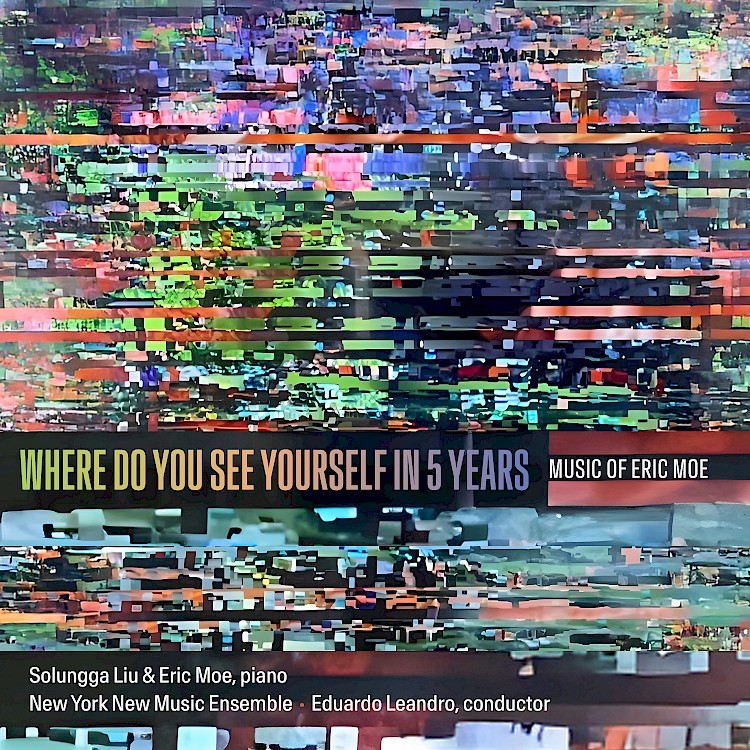
Composer and pianist Eric Moe's newest release, WHERE DO YOU SEE YOURSELF IN 5 YEARS, is a collection of five works for solo keyboard and one quintet featuring piano that centers the instrument in his compositional output. Drawing on some of his most common sources of inspiration, namely natural, scientific, and social phenomena, Moe deftly integrates his observations about various paradigms into the aesthetic and musical vocabulary of his music.
| # | Audio | Title/Composer(s) | Performer(s) | Time |
|---|---|---|---|---|
| Total Time | 50:00 | |||
| 01 | Alternating Currents | Solungga Liu, piano | 7:55 | |
| 02 | Like diamonds, we are cut with our own dust | Eric Moe, piano | 0:56 | |
| 03 | Scree Slope | Eric Moe, piano | 4:38 | |
| 04 | Now This | Solungga Liu, piano | 13:05 | |
| 05 | Rowdy Sarabande | Eric Moe, digital piano | 6:58 | |
| 06 | WHERE DO YOU SEE YOURSELF IN 5 YEARS | New York New Music Ensemble, Adrián Sandí, clarinets, Karen Kim, violin, Chris Finckel, cello, Stephen Gosling, piano, Eduardo Leandro, conductor | 16:28 | |
Piano is at the center of composer Eric Moe’s newest release, WHERE DO YOU SEE YOURSELF IN 5 YEARS. Moe is an accomplished pianist in his own right, having made major contributions as a performer, while consistently featuring his keyboard music in his compositional oeuvre. He uses the instrument to its full capacity, even stretching it beyond its assumed limits at times, as in his work Rowdy Sarabande for digital piano retuned in 19-tone equal temperament. Moe organizes this collection into five solo pieces, three of which he performs, plus a culminating title track, a quintet in which the piano plays a leading role. Common sources of inspiration throughout his work shape these pieces, namely an interest in exploring natural, scientific, and social phenomena, and embedding analogous systems that allow these observed dynamics to play out within his compositions.
The album opens with Alternating Currents (2020), performed by Solungga Liu, a sonic manifestation of a phenomenon most often associated with electrical behavior. The piece is a kind of etude for alternation of the hands on the keyboard, and Moe revels in the playful resultant rhythms and accents that emerge from the physicality of the execution. Implied melodies pop out from an ostinato texture like unpredictable elements within a controlled system. As the piece evolves, the interrupting material becomes more irregular and adventurous. Only in one section is the insistence of an ostinato broken by brilliant trilled figures and luminous arpeggiations.
Moe is the performer on the brief miniature, Like diamonds, we are cut with our own dust (2014). As with Alternating Currents, Moe plays with variability within a regular context in this short work. Opening with a repeating five note figure, he extends it modularly into seven notes, six notes, etc. Moe distills this process into a fleeting microcosm of the organic but non-repetitive impact of water and wind over centuries that shapes stones at a glacial pace over centuries.
Read MoreErosion is also the focus of Scree Slope, named after the small, loose rocks on a mountain side that once comprised solid ground. Moe is an avid hiker, and the experience of stepping up followed immediately by sliding back down informs the pacing of this piece. One hears the forward physical motion and the retreats, but also the mental dialogue that accompanies it, a mix of frustration and mindful persistence. Scree Slope has a few moments of uninterrupted progress, but ultimately, its forward march is the result of a patient composite of advancing and retreating. At the work’s final minute, the music ascends and opens to an otherworldly vista, leaving the trials of the slippery scramble behind.
Now This is a reaction to the sometimes jarring juxtapositions of topic that occur as a result of this common phrase among news reporters that is meant to facilitate a transition. In composition, transitions are often the most fraught part of a piece’s structure to manage; here Moe takes this TV paradigm of sudden tone shifts as a formal cue and organizing principle. The piece opens with thunderous energy and taut, insistent figures, later migrating to airy, disjunct melodies over a lightly toggling ostinato. A rhapsodic, flowing passage is interrupted by the groan of a mallet dragging across the strings inside the piano, only to make way for a enigmatic, pointillistic section. Muted, clicking timbres punctuate a dramatic episode of pillared arrivals connected by virtuosic flourishes. Unlike your nightly newscast, Moe does ultimately tie divergent threads in the piece together in its final minutes, bringing back both of the extended timbres as well as several of the thematic ideas; in doing so, the piece provides a kind of aesthetic cohesion one can only yearn for from the disconcerting world of current events.
Rowdy Sarabande begins with the lilting rhythm associated with the baroque dance for which it is named, embellished by elegant filigree and increasingly agitated interjections. Moe’s choice to use 19 tone equal temperament for the piece sets it in a mysterious haze, as he leans into the tuning’s sonorous consonances and striking dissonances alike. The work’s rowdy character bursts forth in earnest after the one minute and half mark, replacing liquid obscurity with ferocious, angular passagework. Tangled sequences are marked by sharp accents, charged pauses, and poignant sustains during which the listener can contemplate the exotic intonation of the temperament. A series of repeated pitches evokes an off-kilter toy piano, and Moe winds down the raucous energy and returns to the beguiling lilt of the opening, but not before a final brusque gesture to close this study of expressive contrasts.
WHERE DO YOU SEE YOURSELF IN 5 YEARS is a meditation on clichéd job interview questions, and more broadly the tension between a vision of life put forward by the professionalized work world versus a more humanistic way of understanding life’s trajectory. Moe cleverly positions a kind of mechanistically charged rhythmic energy, most clearly articulated by the grooves in the percussion part, as a stand-in for the kind of productivity obsessed mentality that dominates our culture. Pre-recorded samples of interview questions are heard throughout the piece, in addition to the title question, such as: “do you handle stress well?,” or “what are your expectations?” Moe’s treatment of the ensemble alternates between moments when the instruments assert individual character and expression, to others when they conform and coalesce into a hybrid machine. After the questions “what is your greatest weakness?” and “describe something you have handled well in the past,” are posed, we hear lyrical passages for violin and flute, and then piano respectively, that inject a sense of self-reflection that lingers underneath any kind of professional evaluation.
– Dan Lippel
Alternating Currents, Like diamonds, we are cut with our own dust, and Scree Slope recorded March 10, 2023 at Oktaven Audio, Mt. Vernon, NY
Recording producer: Judith Sherman
Sound engineer: Charles Mueller
Engineering and editing assistant: Jeanne Velonis
Piano technician: Daniel Jessie
Editing: Judith Sherman
Now This recorded May 8, 2024 at Oktaven Audio, Mt. Vernon, NY
Recording producer: Judith Sherman
Sound engineer: Owen Mulholland
Engineering and editing assistant: Jeanne Velonis
Editing: Judith Sherman
Rowdy Sarabande recorded February 4-6, 2025 at MacDowell, Peterborough, NH
Recording producer and editing: Eric Moe
WHERE DO YOU SEE YOURSELF IN 5 YEARS recorded May 12, 2024 at Oktaven Audio, Mt. Vernon, NY
Recording producer, sound engineer, and editing: Ryan Streber
Mastering: Jeanne Velonis
Cover photo: © Barbara Weissberger
Design: Marc Wolf, marcjwolf.com
All works published by Dead Elf Music (ASCAP)
Eric Moe (b. 1954), composer of what the NY Times has called “music of winning exuberance,” has received numerous grants and awards for his work, including the Lakond Award from the American Academy of Arts and Letters and a Guggenheim Fellowship; commissions from the Pittsburgh Symphony Orchestra, the Fromm Foundation, the Koussevitzky Foundation, the Barlow Endowment, Meet-the-Composer USA, and New Music USA; fellowships from the Wellesley Composer's Conference and the Pennsylvania Council on the Arts; and residencies at the MacDowell Colony, Yaddo, Bellagio, the Virginia Center for the Creative Arts, the UCross Foundation, the Camargo Foundation, the Aaron Copland House, the Millay Colony, the Ragdale Foundation, the Montana Artists Refuge, the Carson McCullers Center for Writers and Musicians, the Hambidge Center, and the American Dance Festival, among others.
Tri-Stan, his sit-trag/one-woman opera on a text by David Foster Wallace, premiered by Sequitur in 2005, was hailed by the New York Times as “a blockbuster” and “a tour de force,” a work of “inspired weight” that “subversively inscribes classical music into pop culture.” In its review of the piece, the Pittsburgh Post-Gazette concluded, “it is one of those rare works that transcends the cultural divide while still being rooted in both sides.” The work is available on a Koch International Classics compact disc. Strange Exclaiming Music, a CD featuring Moe’s recent chamber music, was released by Naxos in July 2009 as part of their American Classics series; Fanfare magazine described it as “wonderfully inventive, often joyful, occasionally melancholy, highly rhythmic, frequently irreverent, absolutely eclectic, and always high-octane music.” Kick & Ride, on the bmop/sound label, was picked by WQXR for album of the week: “…it’s completely easy to succumb to the beats and rhythms that come out of Moe’s fantastical imaginarium, a headspace that ties together the free-flowing atonality of Alban Berg with the guttural rumblings of Samuel Barber’s Medea, adding in a healthy dose of superhuman strength.” Other all-Moe CDs are available on New World Records (Meanwhile Back At The Ranch), Albany Records (Kicking and Screaming, Up & At ‘Em, Siren Songs), and Centaur (On the Tip of My Tongue). The Sienese Shredder, a fine arts journal, includes an all-Moe CD as part of its third issue.
As a pianist and keyboardist, Moe has premiered and performed works by a wide variety of composers. His playing can be heard on the Koch, CRI, Mode, Albany, New World Records and Innova labels in the music of John Cage, Roger Zahab, Marc-Antonio Consoli, Mathew Rosenblum, Jay Reise, Ezra Sims, David Keberle, Felix Draeseke, and many others in addition to his own. His solo recording The Waltz Project Revisited - New Waltzes for Piano, a CD of waltzes for piano by two generations of American composers, was released in 2004 on Albany. Gramophone magazine said of the CD, “Moe’s command of the varied styles is nothing short of remarkable.” A founding member of the San Francisco-based EARPLAY ensemble, he currently co-directs the Music on the Edge new music concert series in Pittsburgh. Moe studied composition at Princeton University (A.B.) and at the University of California at Berkeley (M.A., Ph.D.). He is currently the Andrew W. Mellon Professor of Composition and Theory at the University of Pittsburgh and has held visiting professorships at Princeton University and the University of Pennsylvania. More information is available at his website, ericmoe.net.
https://www.ericmoe.net/Solungga Liu has earned acclaim as a pianist of remarkable breadth, celebrated for her advocacy of early twentieth-Century American music, underrepresented works in the classical repertoire, and her interpretation of contemporary compositions. Her discography is both wide-ranging and extensive.
Liu’s 2017 debut at the Library of Congress was praised for its “rhythmic precision, expression and a finely calibrated sense of balance between all of the moving parts.” There she performed a solo recital, including the premiere of Charles Griffes’s 1915 piano transcription of Debussy’s Les parfums de la nuit from his orchestral work Iberia, once thought lost by Griffes’s biographers.
A dedicated performer of new music, Liu has had numerous premieres and recordings of contemporary works to her credit and has collaborated with many leading composers of our time. She is Professor of Piano and Piano Area Coordinator at Bowling Green State University.
Eduardo Leandro teaches percussion at Stony Brook University in new York, where he is also the artistic director of its new music ensemble, the Contemporary Chamber Players. He taught at the Haute École de Musique de Genève and directed the percussion program at the University of Massachusetts at Amherst between 1999 and 2007. He has conducted some of the most important pieces of the twentieth century, including Schönberg’s Pierrot Lunaire and Chamber Symphony, Ligeti’s Piano and Chamber Concertos, Messiaen’s Exotic Birds, Xenakis’ Palimpsest, Boulez’s Derives I, and several premieres for mixed ensemble.
As a percussionist Eduardo Leandro has performed with ensembles such as the Steve Reich Ensemble, Orpheus Chamber Orchestra and Bang-on-a-Can All Starts. He is part of the Percussion Duo Contexto, which was an ensemble in residence at the Centre Internacional de Percussion in Geneva for ten years. He played regularly with Ensemble Champ d'Action in Belgium, with Concertgebouw Orchestra in Amsterdam, and with Ensemble Contrechamps in Switzerland, under the direction of Pierre Boulez, Heinz Holliger, and David Robertson among others.
Eduardo Leandro was born in Belo Horizonte, Brazil. He attended the Sao Paulo State University, the Rotterdam Conservatory in the Netherlands, and Yale University, having studied percussion with John Boudler, Jan Pustjens, and Robert van Sice.
Pittsburgh-based composer Eric Moe’s latest release, “Where Do You See Yourself in 5 Years,” includes five works for solo keyboard with another track using a quintet featuring piano.
“(It’s) an amazing variety of keyboard-centered music — tiny pieces, big solo pieces, pieces with more than 12 notes per octave, with more than five players,” Moe said.
The album, released by New Focus Recordings in January, was influenced by “mountains, water, newscasts (and) corporate-speak,” according to Moe.
The title track, the final song on the album, has been described as “a meditation on clichéd job interview questions, and more broadly the tension between a vision of life put forward by the professionalized work world versus a more humanistic way of understanding life’s trajectory.”
A professor in Pitt’s music department, Moe said one of his favorite places to perform is on campus.
“I love the spontaneity of live performances, when you can push things right to the edge and take chances,” he said. “So many good venues — I like the intimacy of the Warhol Museum and City of Asylum; Bellefield Hall is an under-appreciated place to catch great music-making.”
— Mike Palm, 2.09.2026
The expressive capabilities of the piano continue to make it an instrument of choice for contemporary composers. To be sure, modern piano compositions and presentations sometimes include extended techniques, “prepared” pianos, digital instruments and other variations on what is usually thought of as pianistic. But the willingness of some composers to present their own keyboard works remains unchanged: the tradition of the pianist/composer is a longstanding one, which Michael Stephen Brown (born 1987) and Eric Moe (born 1954) both continue.
Moe’s pianism is at the service of three of the six works on his New Focus Recordings CD, including the very short (less than one-minute) Like diamonds, we are cut with our own dust. The piece, written in 2014, simply repeats five notes, then six and seven, giving a sense of the flow of water. The intent is to reflect slow erosion, but it is not necessary to know that in order to absorb this miniature, since composers have used similar approaches to indicate water flow for hundreds of years. Moe also reflects something akin to erosion with Scree Slope (2019), whose personal element draws on the feeling of stepping up on a hiking trail and then sliding back down – but, again, knowing the underlying reasoning beneath the piece is not necessary to absorb its sense of forward motion that then reverses. In this case, the work continues for almost five minutes, which is longer than necessary to make its point – although it does come to a kind of revelatory conclusion at the end that seems to indicate that the slipping and sliding have been worthwhile. Moe plays digital piano on Rowdy Sarabande, a 2024 work that initially bears a passing resemblance to the Baroque dance but soon descends into intense and rather chaotic sounds made possible by using 19-tone equal temperament for the instrument. This sort of extension of technique and aural quality is typical in avant-garde music and is always an acquired taste – the feeling here, a common one in music of this sort, is that the composer is self-indulgently engaged in intellectual experimentation for which an audience is not, strictly speaking, even necessary. This CD also includes two piano works performed by Solungga Liu. The title Alternating Currents implies something electronic, but this 2020 piece actually is non-electronic and uses a non-modified piano. It basically involves alternating notes played by the pianist’s two hands, with regular rhythms interrupted by occasional interjections that range from single exclamations to trills and other decorations. Now This (2017) could as well, perhaps better, have been called “And now for something completely different,” echoing the Monty Python phrase uttered at an abrupt shift in topic. Moe is doing something akin to what the Monty Python troupe did, but without humor: the work’s title is intended to reflect the two-word phrase used in news reporting when an entirely different story is about to be presented. In practice, this means Moe creates a series of completely disconnected segments of varying mood, technique and sound, then presents them without any discernible effort to provide continuity or any type of connection until, at the end, a few elements return. Knowing the “news” connection certainly helps listeners understand what Moe is doing here, but on a strictly musical basis, it is unnecessary, since it is clear from the piece itself what is happening: disjointed material is presented for a considerable period of time (13 minutes), with a bit of this and that eventually returning. Moe also has a significant real-world connection for the all-capital-letters-titled WHERE DO YOU SEE YOURSELF IN 5 YEARS: the title of this 2023 work is a typical job-interview cliché question. This is the one piece on the CD for multiple instruments: the New York New Music Ensemble includes flutes (Emi Ferguson), clarinets (Adrián Sandi), violin (Karen Kim), cello (Chris Finckel), and piano (Stephen Gosling). At 16½ minutes, this is the longest work on the 50-minute CD, but is built with the same sense of disconnectedness and rhythmic variation employed in Moe’s shorter pieces. The timbral variation made possible by use of multiple instruments helps keep the music interesting, and the periodic inclusion of taped interview questions (including the one in the work’s title) makes the piece’s intent and non-musical connections explicit. There is a touch of mechanistic rhythm to indicate the machine-like nature of business, and there are some overt if unsurprising instrumental reactions to some questions, such as an intense outburst after being asked whether the person being interviewed handles stress well. All in all, WHERE DO YOU SEE YOURSELF IN 5 YEARS has numerous clever elements in addition to some unexceptional instrumental writing. Because the music’s inspiration is integrated into the work itself, audiences can respond without having to, in effect, pre-study the piece’s provenance to understand where it is coming from. This is a significant plus and helps make the piece enjoyable to hear once, even if the work goes on somewhat too long and ends (no surprise) ambiguously. Whether listeners will want to replay WHERE DO YOU SEE YOURSELF IN 5 YEARS is, however, another matter. Indeed, the staying power both of Moe’s disc and of Brown’s is likely to depend on how closely an individual is personally attuned to these composer/performers. Close members of Brown’s inner circle are the only people likely to find that his works resonate with them; Moe casts a somewhat wider net, but in most of his pieces as well, it helps a great deal to know how he thinks and what elements of his music are designed to call up which specific extra-musical events, thoughts and feelings.
— Mark Estren, 2.12.2026
Piano music is a natural fit for composer-pianist Eric Moe. A new collection of his keyboard-centric music from the past decade presents four pieces for solo piano and one for piano-driven ensemble. Featured are pianist Solungga Liu, New York New Music Ensemble, and Moe himself.
The title of Where Do You See Yourself in 5 Years (and its title track) takes inspiration from that ubiquitous and ridiculous job-interview question. The set opens, though, with a piece that lasts only five minutes.
“Alternating Currents” starts out with staccato piano notes plunked out in a steady rhythm, suggesting nothing if not bouncing Superballs. Variation is introduced with legato notes joining in the game. Single-note stabs splay into dissonant multi-tone strikes that don’t quite feel like chords; the register drops as the rhythm slows. Melodic flickers and restless trills expand the sound world further, until a restful ostinato announces a quiet dénouement.
The pianist (Liu in this case) must alternate hands, hence the title. But for the listener, “Alternating Currents” is a good introduction to the flavor of the whole album.
“Like diamonds, we are cut with our own dust” is a circular-sounding miniature of under a minute. The composer performs it, and the next piece, “Scree Slope,” in a lighthearted style that feels slightly tongue-in-cheek. The tumbling quality of the staccato figurations in “Scree Slope” do perhaps suggest rocks scattered about a mountainside. The piece is also thoughtful, though, more lyrical, with discrete episodes of music that is, Debussy-like, harmonically graspable if ever-shifting. It finishes on what feels like a quivering question, perhaps glancing ahead to the title track.
First, though, comes “Now This,” a 13-minute opus played by Lui. During my first close listen I took more notes on this than on any of the other pieces. Of the album’s piano solo works it’s the densest exploration of the harmonic and pseudo-melodic possibilities of the musical language Moe employs throughout the set.
Blurs coexist with angular gesturing. Chilly trills decorate a constant rhythmic motion that in the first few minutes suggests something like a subterranean toccata. Studied development ensues, intruded upon by toneless tapping, until a short, laid-back middle section fades to silence with a mechanical groan.
After an elfin scampering sequence that serves as a scherzo of sorts, steady rhythm returns in a fast march that growls down to the piano’s lower octaves. There it flattens into a rough blur, from which individual sustained bass notes emerge to pound out a pediment for rather grim and dissonant rhythmic figures above. More tapping draws the curtain, with a final reprise of the groan that ended the slow section. We are again left with intriguing questions.
Quite different is “Rowdy Sarabande,” played on a digital piano tuned in equal temperament with 19 notes to the octave. Perhaps because of a lifelong mental block against fully understanding the science of harmony and acoustics, I’m not sure if 19 being a prime number contributes to the specific microtonal effects of the piece, but the nasal, plucking timbre certainly does. J.S. Bach wouldn’t have recognized this as a sarabande, but Moe’s title is understandable to a modern ear. This dance is a rollercoaster of rising and falling punctuation, with passages of the album’s most aggressive music, constellations of repeated percussive notes, and, again, quieter intervals.
As in most of this music, I find the piece aesthetically pleasing in an unaccustomed way. I think this comes from the very human patterns of notes and irregular rhythms Moe uses. Contributing too is the revelation at times of the (apparent at least) mechanics of the instrument in a way that recalls at times the sound of a harpsichord. Even with the unnatural-sounding digital-piano sound of this “Rowdy Sarabande,” the sensibility feels recognizably emotional, which is to say, biological.
The 16-minute title track is the album’s lone ensemble piece, but it has a now-familiar quirkiness, given further dimension with strings, winds, and percussion along with piano. It’s a kind of call-and-response piece, with a speaker verbally asking real questions from job interviews and the ensemble responding playfully or seriously with music that remains abstract but may be suggestive of specific answers. (Think Snoopy talking with Woodstock.) The introduction seems to suggest colliding thoughts and moods – maybe the anxiety of an approaching interview.
The placid, optimistic response to the title question contrasts with the fraught popping of the answer to “What are your expectations?” and the painful stress elicited by “Do you handle stress well?”
Asked what is its greatest weakness, the band responds with a lyrical softness that brings to mind the language of someone like Ralph Vaughn Williams. Asked to describe something it has handled well, it produces a pastoral “conversation” between piano and the other instruments. The skillful interplay among the instruments and the contrasting moods of the responses show once again a musical sensibility deeply rooted in the human.
— Jon Sobel, 3.20.2026
New Focus Recordings is an artist-led collective label featuring releases in contemporary creative music of many stripes, as well as new approaches to older repertoire. The label was founded by guitarist Dan Lippel, composer Peter Gilbert in 2004, and composer/engineer Ryan Streber in 2004, formed …Read More …
Listen to full streaming tracks while you browse the site. New tracks enabled for streaming every month. Click on the button to open up the radio player.


