
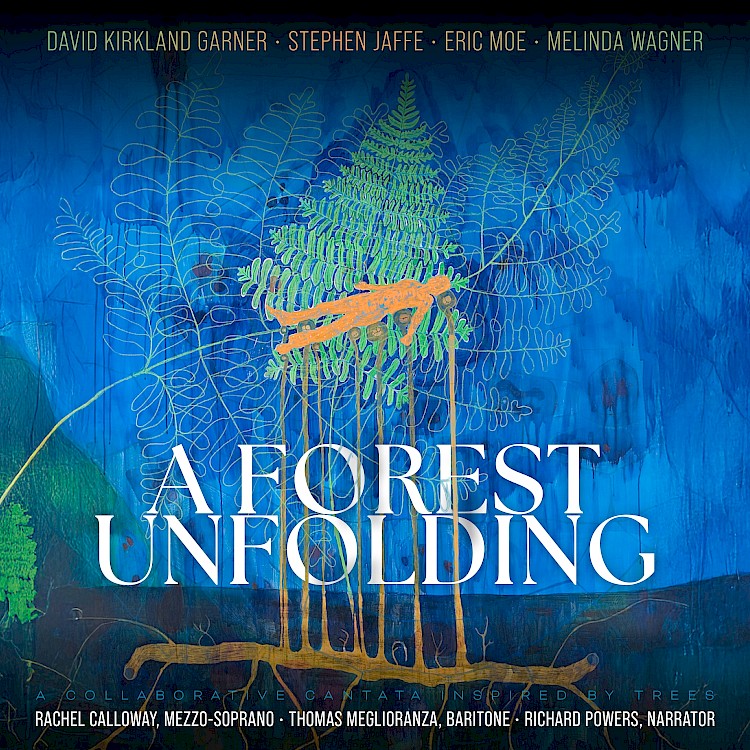
A Forest Unfolding is a collaborative work inspired by recent scientific research into the rich communication and subterranean connectivity between trees. Four writers—the environmentalists Bill McKibben and Joan Maloof, along with the novelists Richard Powers and Kim Stanley Robinson—selected prose passages and poems on the relations among people and trees. They presented these selections to four composers—Eric Moe, Melinda Wagner, Stephen Jaffe, and David Kirkland Garner—who set these words into a linked sequence of recitatives and arias. The resulting whole traces a narrative arc beginning with human estrangement from nature and ending with a glimpse of the endless cooperation that knits a forest together.
By joining forces for this collaborative project about forests, composers Melinda Wagner, David Kirkland Garner, Stephen Jaffe, and Eric Moe mirror the interdependent essence of their chosen subject matter. Collaborative and responsive composition is a challenge that prompts many questions about process, but it also presents a ripe opportunity for dialogue, both musical and aesthetic. What is the balance between collective decision making and individual composition? Since this is a vocal work, how will texts be selected? How can the emergence of a cohesive overall structure be best facilitated?
Lucky for us, the four composers on this project are eminently thoughtful artists, and they fashioned a working model and overall approach to the piece that celebrates each of their individual voices while presenting a harmonious whole. Four writers, environmentalists Bill McKibben and Joan Maloof as well as novelists Richard Powers and Kim Stanley Robinson, suggested texts to the composer team that explore relations between people and trees. The creative paradigm the composers arrived at was dynamic, involving shared sketches that allowed them to observe how initial ideas were progressing as they evolved. The fact that this kind of interconnected synergy is a hallmark of the way species in forests are linked is not merely a coincidence; the sublime cooperative phenomenon of the natural world is in its own way a model for any kind of collective creative activity, whether or not it refers back to the natural world. In addition, the composers chose Gustav Mahler’s “Der Abschied” from Das Lied von der Erde as a shared musical reference point from the canon, and the expansive character of that iconic movement can be heard in direct references as well as an indirect shared affinity.
Read MoreA Forest Unfolding is balanced between longer songs, instrumental pieces, and connective recitatives. Eric Moe’s setting of W.S. Merwin’s “Native Trees” opens the work and is its longest movement. Annunciatory figures open the piece, with staggered attacks articulating lush harmonies. Mezzo-soprano Rachel Calloway’s vocal line is characterized by moderate, fluid intervallic leaps over a liquid ensemble accompaniment. Moe closes with a brief quote from the Mahler and a dramatic glissando flourish inside the piano.
David Kirkland Garner contributed three interstitial recitatives connecting the larger movements and one fully fleshed out setting of his own, all of which feature narration. “From the Book of Job” is poised with restrained anticipation, centered around a cyclical figure of a repeated piano note followed by a subtle swell in the ensemble under Richard Powers' recitation. “Woodswoman Etude” is scored for bass clarinet, piano, and Calloway’s narration; the clarinet spins out a spare melodic line while the keyboard envelops select notes in a halo of sustain. “From Thoreau’s Notebooks” is atmospheric, painting a pastoral nature scene with fleet, oscillating figures and airy chord voicings, while Powers captures the wonder within the iconic American thinker’s words.
Stephen Jaffe’s “Eternal Rhythm” is based around a tolling accompanimental figure in the piano supporting flowing lines in the ensemble before it takes a dark turn towards murky, shrouded textures thirty seconds before its close. Thomas Meglioranza’s baritone expresses an overflowing enthusiasm for the beauty of “Trees” in Jaffe’s W.S. Merwin setting, with the contour of the ensemble lines and the melismatic vocal line tracing their vertical, willowy nature. Jaffe’s third contribution is the exuberant “Variation-Deciso,” a brilliant, pointillistic instrumental interlude.
Melinda Wagner’s setting of Wendell Berry’s “In a Country Once Forested” is one of two movements for two vocalists with ensemble. Wagner dots the sonic landscape with gestures that recall birdsong, animating the texture with echoes of the natural world. Calloway and Meglioranza sing elastic, expressive phrases, and Wagner closes the movement with a nod to Mahler’s ethereal, unresolved harmony at the end of “Der Abschied”.
A Forest Unfolding closes with David Kirkland Garner’s “Eternal Song,” bringing Powers, Calloway, and Meglioranza together and fusing compositional ideas from the previous movements. Garner crafts a lyrical tribute to the forest, with graceful, flowing ensemble textures. Calloway’s wordless vocalise emerges from behind Powers’ narration, echoed by Joseph Eller’s dulcet clarinet. Garner’s approach to the musical material allows it to breathe and evolve on its own. The four composers who collaborated on A Forest Unfolding send a clear message with their gracious approach to the musical and textual material; the natural collaborative order that is the essence of the forest is something to be emulated and admired, not tinkered with or impeded. The fact that A Forest Unfolding feels so cohesive and smooth is a testament to their flexibility and collegiality in the process, embodying the collective spirit of a complex and symbiotic ecosystem.
– Dan Lippel
Recorded April 15, 2023 at the University of South Carolina School of Music
Recording producer: David Kirkland Garner
Sound engineer: Jeff Francis
Editing, mix and mastering: Jeff Francis
Cover painting: “New Growth” by Mary Robinson (water- soluble pencil and acrylic on paper, 80’’ x 60”, 2006). Used with permission from Eileen Waddell
Design, layout & typography: Marc Wolf, marcjwolf.com
A Forest Unfolding was conceived by Richard Powers, Laura Gilbert, and Jonathan Bagg. It was commissioned by Electric Earth Concerts.
Text Credits:
Native Trees (Eric Moe): Text by Merwin, W. S. The Rain in the Trees. 1988. (“Native Trees.”)
From The Book of Job (David Kirkland Garner): Mitchell, Stephen, trans. The Book of Job. 1987. (Chapter 36.)
Woodswoman Etude (David Kirkland Garner): LaBastille, Anne. Woodswoman. 1979. (Excerpt.)
Trees (Stephen Jaffe): Merwin, W. S. The Moon Before Morning. 2014. (“Trees.”)
From Thoreau’s Notebooks (David Kirkland Garner) Thoreau, Henry David. Autumn: From the Journal of Henry David Thoreau. 1892.
In a Country Once Forested (Melinda Wagner): Berry, Wendell. “In a Country Once Forested.” 2012.
Eternal Song (David Kirkland Garner): Powers, Richard. The Overstory. 2018. (Excerpt.)
David Kirkland Garner writes music, plays banjo, studies fiddle, listens to jazz, hears everything, but suspects he knows nothing. Encompassing chamber, large ensemble, electroacoustic, and vocal works, his music reconfigures past sounds—from Bach to minimalism to bluegrass—into new sonic shapes and directions. He seeks to make time and history audible, particularly through an exploration of archival recordings documenting the musical traditions of the U.S. South.
Garner has worked with world-renowned ensembles including the Kronos Quartet, which commissioned a work based on the music of the Scottish diaspora. Awards include a Charles Ives Scholarship from the American Academy of Arts & Letters, an ASCAP Young Composer Award, and first prizes in the OSSIA, Red Note, and NACUSA competitions. His music has been performed by the Imani Winds, Ciompi Quartet, Vega Quartet, San Diego Symphony, Locrian Chamber Ensemble, the Wet Ink Ensemble, the Boston New Music Initiative, and the yMusic ensemble.
Garner holds degrees from Duke University (PhD, 2014), University of Michigan (MM, 2007), and Rice University (BM 2005), and has taught music theory and aural skills at Duke, Kennesaw State, North Carolina State, and Elon Universities. He is currently an Assistant Professor of Composition and Theory at the University of South Carolina.
Eric Moe (b. 1954), composer of what the NY Times has called “music of winning exuberance,” has received numerous grants and awards for his work, including the Lakond Award from the American Academy of Arts and Letters and a Guggenheim Fellowship; commissions from the Pittsburgh Symphony Orchestra, the Fromm Foundation, the Koussevitzky Foundation, the Barlow Endowment, Meet-the-Composer USA, and New Music USA; fellowships from the Wellesley Composer's Conference and the Pennsylvania Council on the Arts; and residencies at the MacDowell Colony, Yaddo, Bellagio, the Virginia Center for the Creative Arts, the UCross Foundation, the Camargo Foundation, the Aaron Copland House, the Millay Colony, the Ragdale Foundation, the Montana Artists Refuge, the Carson McCullers Center for Writers and Musicians, the Hambidge Center, and the American Dance Festival, among others.
Tri-Stan, his sit-trag/one-woman opera on a text by David Foster Wallace, premiered by Sequitur in 2005, was hailed by the New York Times as “a blockbuster” and “a tour de force,” a work of “inspired weight” that “subversively inscribes classical music into pop culture.” In its review of the piece, the Pittsburgh Post-Gazette concluded, “it is one of those rare works that transcends the cultural divide while still being rooted in both sides.” The work is available on a Koch International Classics compact disc. Strange Exclaiming Music, a CD featuring Moe’s recent chamber music, was released by Naxos in July 2009 as part of their American Classics series; Fanfare magazine described it as “wonderfully inventive, often joyful, occasionally melancholy, highly rhythmic, frequently irreverent, absolutely eclectic, and always high-octane music.” Kick & Ride, on the bmop/sound label, was picked by WQXR for album of the week: “…it’s completely easy to succumb to the beats and rhythms that come out of Moe’s fantastical imaginarium, a headspace that ties together the free-flowing atonality of Alban Berg with the guttural rumblings of Samuel Barber’s Medea, adding in a healthy dose of superhuman strength.” Other all-Moe CDs are available on New World Records (Meanwhile Back At The Ranch), Albany Records (Kicking and Screaming, Up & At ‘Em, Siren Songs), and Centaur (On the Tip of My Tongue). The Sienese Shredder, a fine arts journal, includes an all-Moe CD as part of its third issue.
As a pianist and keyboardist, Moe has premiered and performed works by a wide variety of composers. His playing can be heard on the Koch, CRI, Mode, Albany, New World Records and Innova labels in the music of John Cage, Roger Zahab, Marc-Antonio Consoli, Mathew Rosenblum, Jay Reise, Ezra Sims, David Keberle, Felix Draeseke, and many others in addition to his own. His solo recording The Waltz Project Revisited - New Waltzes for Piano, a CD of waltzes for piano by two generations of American composers, was released in 2004 on Albany. Gramophone magazine said of the CD, “Moe’s command of the varied styles is nothing short of remarkable.” A founding member of the San Francisco-based EARPLAY ensemble, he currently co-directs the Music on the Edge new music concert series in Pittsburgh. Moe studied composition at Princeton University (A.B.) and at the University of California at Berkeley (M.A., Ph.D.). He is currently the Andrew W. Mellon Professor of Composition and Theory at the University of Pittsburgh and has held visiting professorships at Princeton University and the University of Pennsylvania. More information is available at his website, ericmoe.net.
https://www.ericmoe.net/Composer Stephen Jaffe’s music has been featured at major concerts and festivals including the Nottingham, Tanglewood, and Oregon Bach Festivals and performed internationally by ensembles including the R.A.I. of Rome, Slovenska Filharmonija, the National Symphony, the San Francisco, North Carolina and New Jersey Symphonies, Berlin’s Spectrum Concerts, London’s Lontano, and many others. Bridge’s four discs of the composer’s music most recently showcased Jaffe’s collaborators including the Borromeo Quartet, the Da Capo Chamber Players, David Hardy, cello and Lambert Orkis, piano in premiere recordings of Light Dances (Chamber Concerto No. 2) and other new chamber music.
Notable recent works include A Forest Unfolding, a collaborative cantata composed with Eric Moe, Melinda Wagner and David Kirkland Garner, writers Richard Powers, Anne LaBastille and others. The 35-minute work is inspired by recent scientific work into the rich communication and subterranean connectivity between trees—evoked also in Richard Power’s novel The Overstory. Jaffe’s three string quartets, six chamber concertos and works for orchestra include the well-received Concerto for Cello and Orchestra and Concerto for Violin and Orchestra. In these works, Jaffe’s musical language ranges from the lyrical, singing voices of the cello and violin to an orchestral world filled with the sounds of contemporary percussion, from steel drums in the Concerto for Violin to sampled songs of Black-Capped Chickadees in Poetry of the Piedmont. Stephen Jaffe is Mary D.B.T. and James H. Semans Professor of Music at Duke University where he has taught since 1981.
Melinda Wagner, a Pulitzer Prize–winning composer from Philadelphia, received national recognition in 1999 for her Concerto for Flute, Strings, and Percussion. Her works have since been commissioned and performed by leading orchestras and soloists, including the New York Philharmonic, Chicago Symphony, National Symphony, and Emanuel Ax. The Chicago Symphony alone has commissioned three of her works: Falling Angels, Extremity of Sky, and an upcoming piece. Other notable commissions include Little Moonhead for the Orpheus Chamber Orchestra, Scamp for the U.S. Marine Band, and Pan Journal for Elizabeth Hainen and the Juilliard String Quartet. Wagner’s chamber music has been featured by ensembles such as the American Brass Quintet and the New York New Music Ensemble. Her honors include a Guggenheim Fellowship, awards from the American Academy of Arts and Letters, and election to its membership in 2017. She is also an acclaimed teacher and mentor at institutions and festivals nationwide.
https://www.melindawagnermusic.com/
Laura Gilbert, flutist, has appeared worldwide as chamber musician, soloist, recitalist, and guest lecturer. In 2012 she co-founded Electric Earth Concerts, a year-round music festival in Peterborough, New Hampshire, and as co-artistic director of Monadnock Music (2006–2011) created award-winning programming supported by the NEA, Argosy, Getty, and Goelet foundations. Founder of the Auréole Trio (flute, viola, harp), she has performed with Musicians from Marlboro, the Brandenburg Ensemble, and the Borromeo, Brentano, Saint Lawrence, and Ciompi Quartets, as well as the New York Philharmonic, the Metropolitan Opera Orchestra, and Saint Luke’s Ensemble. Her duo with guitarist Antigoni Goni has commissioned and recorded new folk-inspired works on From the New Village (Koch International Classics). Gilbert’s discography includes a Grammy for Dawn Upshaw’s Girl with the Orange Lips and twelve Auréole Trio albums on Koch International. She serves on the faculties of Mannes College of Music and Saint Ann’s School in Brooklyn.
https://lauragilbertflute.com/Jonathan Bagg has performed hundreds of concerts in the U.S. and around the world as violist with the Ciompi String Quartet. He is Professor of the Practice at Duke University, where he has directed the chamber music program, taught viola, and performed extensively for many years. Bagg is co-Artistic Director of Electric Earth Concerts in New Hampshire, which he founded in 2012 with flutist Laura Gilbert. The two also co-directed New Hampshire’s Monadnock Music festival from 2007-2011. Their creative programming has included many collaborations with composers, authors, poets, and choreographers resulting in a number of unique multi-media works.
In the summers Bagg has performed at the Portland and the Sebago-Long Lake festivals in Maine, Detroit’s Great Lakes Festival, the Eastern Music Festival and the Highlands festival in North Carolina, and the Mohawk Trail and Castle Hill festivals in Massachusetts. Recitals and concerto appearances have brought him to venues such as the Philips Collection in Washington D.C., Jordan Hall in Boston, Woolsey Hall in New Haven, and numerous other locations across the U.S.
Since 2015 Bagg has been principal violist and soloist with the CityMusic Cleveland chamber orchestra, where he performs throughout the year. Other orchestral appearances include the Boston Symphony, Boston’s Handel and Haydn Society, as well as with several other leading musical organizations in New England.
Bagg has made over 20 recordings with the Ciompi Quartet, most recently A Duke Moment (2024) on New Focus featuring works by Duke colleagues Stephen Jaffe, Anthony Kelley, and Scott Lindroth. His 2014 solo CD on the Albany label, titled Elation, brings together several works he commissioned, including a sonata and trio by Jaffe, and a trio by Lindroth. Other solo CDs contain music for viola and piano by Robert and Clara Schumann, and by the Viennese composer Robert Fuchs. Contemporary solo works by Robert Ward, Arthur Levering, Malcolm Peyton, and Donald Wheelock are on Bridge, Albany, Centaur and Gasparo Records.
Bagg was Chair of Duke’s Department of Music from 2019-2023 and he has also served as Director of Undergraduate Studies and Director of Performance. He holds an M.M. from the New England Conservatory and a B.A. from Yale.
https://jonathanbagg.comRichard Powers is the author of 14 novels that have earned various recognitions including a MacArthur Fellowship, a National Book Award, and a Pulitzer Prize. His books weave together science, art, history, and philosophy in stories that explore the relationship between human beings and the more than human world. Powers studied physics before turning to literature, and his early international upbringing—spending formative years in Thailand—has fed his lifelong fascination with music, spirituality, and narrative. He lives in the Great Smoky Mountains, where he is a student of the great biodiversity of that region.
https://www.richardpowers.net/Rachel Calloway brings versatility and compelling insight to stages worldwide. Her work has been praised by The New York Times for “penetrating clarity” and “considerable depth of expression” and by Opera News for her “adept musicianship and dramatic flair.” Recent performances include a California Symphony debut in works by Gabriela Lena Frank and Mahler, and performances and residencies with Duo Cortona, alongside violinist Ari Streisfeld. She has appeared in concert with the Los Angeles Philharmonic New Music Series, the New York Philharmonic, and Ojai Festival, and has performed with Opera Philadelphia, the PROTOTYPE Festival, and the Glimmerglass Festival. Calloway can be heard on Albany Records, Tzadik Records, BCMF Records, and Toccata Classics. rachelcalloway.com
American baritone Thomas Meglioranza, winner of the Walter W. Naumburg, Concert Artists Guild, Franz Schubert/Music of Modernity, and Joy In Singing competitions, has appeared with major orchestras and opera companies across the United States and abroad. Recent highlights include an all-Hugo Wolf recital at Lincoln Center’s Mostly Mozart Festival, Rufus Griswold in Argento’s The Voyage of Edgar Allan Poe with Odyssey Opera, Saint John in Karchin’s Jane Eyre, Wreck in Bernstein’s Wonderful Town with the Seattle Symphony, Bach’s solo bass cantatas with Lyra Baroque, and Schubert’s Die schöne Müllerin and Winterreise recitals with Reiko Uchida and David Breitman. Described by The New Yorker as an “immaculate and inventive recitalist,” he has sung at Wigmore Hall and on the Cabaret at Café Sabarsky series. His recordings include Schubert and French mélodies with Uchida, Virgil Thomson’s songs with the Boston Modern Orchestra Project, and Bach cantatas with the Taverner Consort.
https://www.meglioranza.com/New Focus Recordings is an artist-led collective label featuring releases in contemporary creative music of many stripes, as well as new approaches to older repertoire. The label was founded by guitarist Dan Lippel, composer Peter Gilbert in 2004, and composer/engineer Ryan Streber in 2004, formed …Read More …
Listen to full streaming tracks while you browse the site. New tracks enabled for streaming every month. Click on the button to open up the radio player.


