
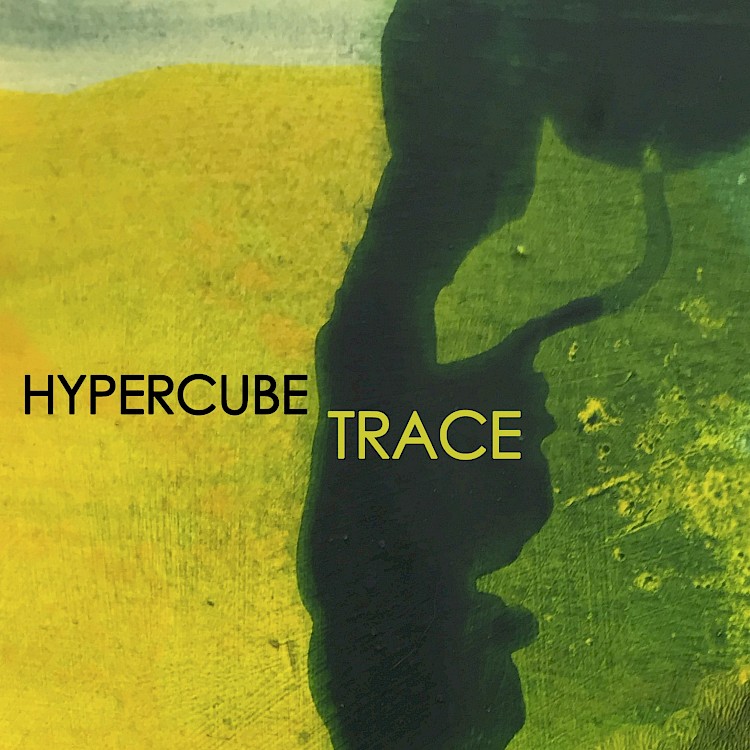
The mixed quartet Hypercube (Erin Rogers, saxophone; Andrea Lodge, keyboards; Jay Sorce, electric guitar; Christopher Graham, percussion) releases their newest recording, Trace, which highlights the ensemble's dynamic approach to hybrid timbres and vanguard expression. Featuring works by Marcel Castro Lima, Seong Ae Kim, Corie Rose Soumah, Farzia Fallah, and Charles Rudig, Hypercube affirms themselves as a group that has gone beyond simply commissioning worthy composers to one that is actively shaping new aesthetic approaches to chamber composition.
| # | Audio | Title/Composer(s) | Time |
|---|---|---|---|
| Total Time | 50:22 | ||
| 01 | Western Music | Western Music | 7:27 |
| 02 | we are here | we are here | 8:24 |
| 03 | SPINNING, TOUCHED, UNDREAMT; SNOW- | SPINNING, TOUCHED, UNDREAMT; SNOW- | 14:47 |
| 04 | in this empty echo | in this empty echo | 10:12 |
| 05 | Speaker for the Dead | Speaker for the Dead | 9:32 |
Hypercube’s instrumentation of saxophone, piano, percussion, and electric guitar invites myriad aesthetic approaches. One could lean in to the popular associations with all four instruments to craft a concert music from vernacular elements. One could turn away from those references and emphasize the burgeoning concert repertoire for saxophone, piano, percussion, and electric guitar while emphasizing the piano’s centrality in the canon. Or one could chart a new path, exploring the rich timbral combinations inherent in the combination to invite composers to discover new hybrid ensemble textures that foster creative expressions. Hypercube has vigorously embraced the third path, presenting five works on this recording that point to a way forward for non-standard instrumentation chamber ensemble composition that emphasizes unique timbres and adventurous, ambitious compositional goals. The results on Trace, in works by Marcel Castro Lima, Seong Ae Kim, Corie Rose Soumah, Farzia Fallah, and Charles Rudig are invigorating and powerful, producing a recording that is both focused in its intention and broad in its affect.
Western Music by Marcel Castro Lima interrogates teleology as a fundamental value in composition. To what extent are the notions of development and progress of musical ideas inherently bound up with fragmentation and destruction? The work opens with discrete sound objects, a three note figure on muted electric guitar colored by a triangle sustain, a gentle saxophone honk in the low register and the entrance of a hollow multiphonic, and a guitar harmonic are presented as seedlings that grow motivic branches. Carlos Lima deftly brings a sonic ecosystem to life, gradually introducing more discrete timbral activity. At the core of the work’s inquiry is how much of the original ideas are lost in this evolving development. A bittersweet microtonal chorale emerges with gruff interjections from the baritone saxophone before the earlier collage texture reemerges, retracing the “progress” of the piece backwards to its opening impulses.
Read MoreSeong Ae Kim’s we are here addresses the alarming rise in hate crimes against Asians in the United States. The work begins with an accumulating cymbal roll that explodes into a explosive flourish. Bracing unison rhythms between guitar and piano clusters are a call to attention, before diffusing into breathless figures in the saxophone, an expression of the aftershock of a traumatic incident. Mourning swells on electric guitar, rolls on Chris Graham’s pitched percussion, rumbling low register piano chords, and saxophone multiphonics characterize the subsequent inward facing section, music of alienation and despair. The cymbal crescendo from the work’s opening returns, ushering in a cathartic burst of saxophone gestures over a recall of the short guitar-piano unison outbursts. Dry, simmering plucked timbres inside Andrea Lodge’s piano are paired with terse vocalizations, capturing the aftermath of kinetic violence as it lives on in the psyche.
Korean TV soap operas provide the source inspiration for Corie Rose Soumah’s SPINNING, TOUCHED, UNDREAMT; SNOW-. Soumah mixes acoustic instrumental timbres with analog electronic sounds, and the stereo field becomes a canvas for sound painting. Timbres oscillate between instruments, as entangled emotions between characters in a drama. Soumah uses heavy distortion in the electric guitar part to conjure immovable blocks of sound, and collective, frenetic improvisatory gestures to signal instability. Soumah’s command over finding expressive potential in refined noise is evident in a passage of variegated static that crumbles, crunches, and crackles after the nine minute mark.
Composer Farzia Fallah traces the impetus for in this empty echo to the work of Iranian poet Forugh Farrokhzad. Describing aching imagery in her program note, Fallah conjures a soundscape that is infused with longing. Composite timbres throughout the ensemble fuse together in sustained crescendi, punctuated by tintinnabulating sonorities. Gestural contour is a guiding parameter of the work, focusing on giving each new hybrid expressive object room to come to full fruition.
The final work on the recording, Charles Rudig’s Speaker for the Dead, features an instrument from the treasure trove of obsolete music technology, the Casio SK-1 keyboard sampler, putting it at the service of the broader concept of “collecting stories for those left behind.” The Casio fulfills the role of “speaker for the dead,” storing sounds made by the rest of the ensemble. Erin Rogers’ complex saxophone multiphonics are accompanied by dense, low sonorities on the synthesizer, later enveloped by foreboding, distorted guitar chords that wash over the texture. Jay Sorce’s high partial harmonics on guitar fracture the symmetry and ascend into a taut tremolo that crossfades into tremolos in the percussion, enclosure figures in the high register of the sax, and short bursts of double stop glissandi in the guitar. A moment of pacific repose just after the five minute mark meditates on an expansive major 6/9 chord that mitigates the fatalism of the piece with a moment of timeless suspension. In the culminating ensemble passage, we hear masses of vertical, distorted sound shift between guitar, sax, and keyboard, connected by fast divisions on woodblocks. Finally, the Casio regurgitates material from the work through its transformative lens, coloring it with its own temporal timestamp. Speaker for the Dead uses exploratory sonic experimentation and legacy instruments as tools of ceremonial ritual.
– Dan Lippel
All tracks recorded by Zach Herchen at Adelphi Performing Arts Center, Garden City, NY and Purchase College Performing Arts Center, Purchase, NY
Mixing & mastering: Zach Herchen
Artwork: ‘Little World’ by Bobbie Oliver
Hypercube has built a reputation on high-energy performances with impressive execution. The NYC-based quartet embraces the boundaries of chamber music, featuring cutting-edge works for saxophone, guitar, piano and percussion, while spanning electric and acoustic worlds.
Hypercube has appeared as guest artist at Music on the Edge (Pittsburgh), The Kennedy Center’s Millennium Stage, the Charlotte New Music Festival, The Garrick Theatre (Newfoundland), Roulette Intermedium, the Nief-Norf Summer Festival (Knoxville), LPR presents (NYC), and the 40th International Festival of New Music “Manuel Enríquez” (Mexico City). With a national and international touring schedule, 2019 appearances include the Now Hear This Festival and Ritornello Chamber Music Festival (Western Canada). In addition to their performance season, HYPERCUBE participates in residencies at universities and conservatories across the US and Canada working with students at Cincinnati Conservatory, Boston Conservatory, Memorial University (Newfoundland), Duke University, Oberlin Conservatory, Acadia University (Nova Scotia), Wesleyan, and CalArts.
From championing original works such as Louis Andriessen’s Hout, Philippe Hurel’s Localized Corrosion, and Chaya Czernowin’s Sahaf, to commissioning new works by composers Nicholas Deyoe, Farzia Fallah, Eric Wubbels, Annie Hui-Hsin Hsieh, Daniel Tacke, Erin Rogers, Amin Sharifi, Nomi Epstein, Christopher Adler, and Juan Trigos, Hypercube has collaborated with composers such as Sam Pluta and Chris Cerrone, to freshly adapt works for the quartet. Hypercube's album, Brain-on-Fire (New Focus Recordings) was released in 2020.
Hypercube is Erin Rogers (saxophones), Jay Sorce (classical & electric guitar), Andrea Lodge (piano & accordion), and Chris Graham (percussion).
Flash forward to a week ago, when I was listening to Trace (New Focus), the third album by Hypercube, and my ears perked up during the last piece, Speaker For The Dead by Charles Rudig. The whole album was fantastic, but something about Rudig’s work kept nagging at me. Then, I read the liner notes and found out why: he uses the SK-1 throughout, having it fulfill “the role of ‘speaker for the dead,’ storing sounds made by the rest of the ensemble.” Genius, I tell you. And how cool that the piece was recorded at SUNY Purchase, where I formed some of the ideas I tried to execute with a keyboard and a cassette deck!
While they released their debut in 2020, I first connected with Hypercube, the mixed ensemble of Erin Rogers, saxophone; Andrea Lodge, keyboards; Jay Sorce, electric guitar; and Christopher Graham, percussion, through their work on Music For Billionaires, the 2023 album by Doug Bielmeier, whom I praised as “one of the brightest lights in the electroacoustic music sphere.” Then came The Force For Good, the 2025 EP that included Hout, the 1991 Louis Andriessen piece that inspired Hypercube’s instrumentation, which they played with a command that was “beyond reproach.”
But I think it’s on Trace, which features five new compositions created in collaboration with Marcel Castro Lima, Seong Ae Kim, Corie Rose Soumah, Farzia Fallah, and Rudig, that Hypercube have truly come into their own. Each piece not only has a very unique approach and sound world, but it also feels like the players are putting more of their own personalities into the recordings.
Speaker For The Dead is a perfect example of what Hypercube has accomplished here. Rogers opens the piece with low notes, like a foghorn announcing a vessel approaching from an unknown land. Soon, she’s duetting with Lodge’s SK-1, presenting a distorted reflection of her sound. Sorce (who really should change his name to “scorch”) enters, his guitar shrouded in fuzz and barely controlled feedback, slipping malevolently into the environment before taking over with a short solo. A new section begins, with rattling percussion from Graham, high squeals from Rogers, and more shards from Sorce.
The last third of the piece hints at Gamelan at first, before the guitar and the SK-1 begin duking it out in a battle that brings to mind Kong vs. Godzilla. In this video of a 2023 performance by Hypercube, you can see Lodge grabbing some sound from Sorce’s guitar before entering the ring, so to speak. The fight is drawn, and after a momentary pause, we get a coda featuring a merry chase between percussion and the SK-1’s 40-year-old sampling chip before the scene fades to black. In Speaker For The Dead, Rudig resurrects the Casio and gives it a new life beyond my wildest dreams.
Another highlight on the album is the recording of Soumah’s SPINNING, TOUCHED, UNDREAMT; SNOW-, which I heard at the MATA Festival in 2023. In that incarnation, I noted that “each instrument had its own agenda, with any joint efforts coming off as happenstance.” Not so in Hypercube’s take, which reveals a group effort of extraordinary focus. And so it goes on all of Trace, a no-skips album if there ever was one!
— Jeremy Shatan, 7.24.2026
The New York quartet Hypercube formed in 2014 when they performed the bracing 1981 Louis Andriessen work “Hout,” which called for its precise instrumentation: electric guitar, piano, percussion, and saxophone. As they’ve soldiered on, commissioning new work for the unusual line-up, they’ve proven that within that stricture they’re capable of conjuring a sound world that spills well beyond what one might imagine. All five pieces presented here are technically demanding, vigorous, and sonically expansive. While Marcel Castro-Lima’s “Western Music” is designed as a sonic riposte to the intellectual and musical feedback loop of so much art music, the music bristles with or without such background. Shifting unisons, jagged counterpoint, and vast fields of sustained tones, like valleys flowing between virtuosic peaks, drive inexorably forward. Corie Rose Soumah cites the peripatetic plotlines of Korean soap operas as a valuable companion to the twists of her own life, and, indeed, her piece “Spinning, Touched, Undreamt; Snow-” mirrors the cracked syntax of the title with a wildly jarring parade of episodes, relying on some acrobatic guitar playing by Jay Sorce, and serrated overblowing and zig-zagging snorts by tenor saxophonist Erin Rogers, woven together with live electronics spasms. Charles Rudig’s “Speaker for the Dead” tosses in the outmoded Casio SK-1 keyboard as a sonic repository for the stories and lives of those no longer with us, its needling tone tattooing expansive slabs of sound. The entire recording—which also includes heady works by Seong Ae Kim and Farzia Fallah—explodes with energy, smashing familiar timbres to bits.
— Peter Margasak, 8.06.2026
New Focus Recordings is an artist-led collective label featuring releases in contemporary creative music of many stripes, as well as new approaches to older repertoire. The label was founded by guitarist Dan Lippel, composer Peter Gilbert in 2004, and composer/engineer Ryan Streber in 2004, formed …Read More …
Listen to full streaming tracks while you browse the site. New tracks enabled for streaming every month. Click on the button to open up the radio player.


