
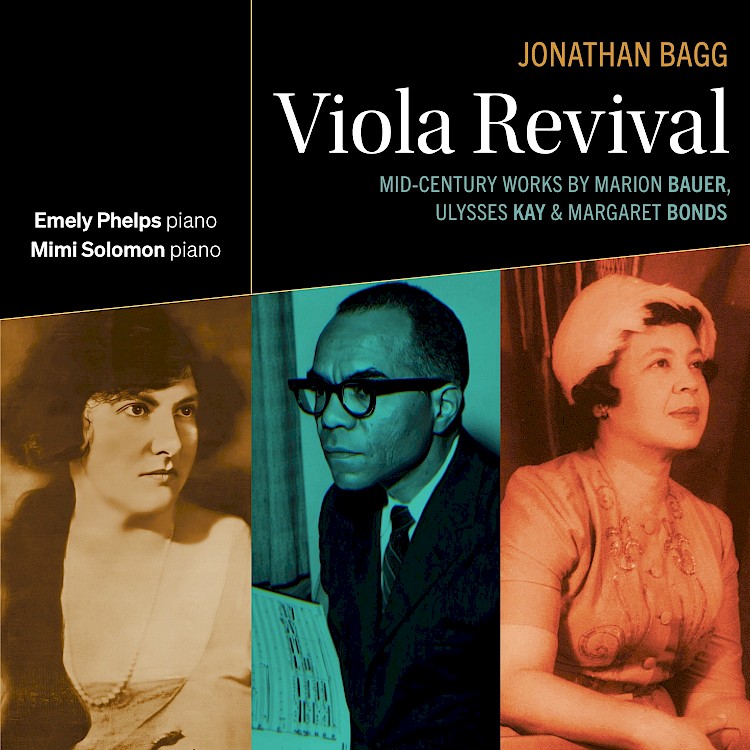
Violist Jonathan Bagg and his collaborators, pianists Emely Phelps and Mimi Solomon, unearth three overlooked gems of the mid-20th century chamber repertoire by Marion Bauer, Ulysses Kay, and Margaret Bonds. Bagg sheds light on well deserving repertoire by three composers whose contributions to the larger musical field went far beyond their fine music.
| # | Audio | Title/Composer(s) | Performer(s) | Time |
|---|---|---|---|---|
| Total Time | 32:37 | |||
Sonata for Viola and Piano, Op. 22Marion Bauer | ||||
| Jonathan Bagg, viola, Emely Phelps, piano | ||||
| 01 | I. Allegretto (rubato) | I. Allegretto (rubato) | 5:28 | |
| 02 | II. Andante espressivo; Scherzo con moto | II. Andante espressivo; Scherzo con moto | 4:56 | |
| 03 | III. Allegro | III. Allegro | 4:47 | |
Sonata for Viola and PianoUlysses Kay | ||||
| Jonathan Bagg, viola, Emely Phelps, piano | ||||
| 04 | I. Largo | I. Largo | 2:10 | |
| 05 | II. Allegro | II. Allegro | 2:16 | |
| 06 | III. Adagio | III. Adagio | 1:00 | |
| 07 | IV. Allegretto | IV. Allegretto | 4:35 | |
| 08 | Troubled Water | Troubled Water | Jonathan Bagg, viola, Mimi Solomon, piano | 7:25 |
On Viola Revival, violist Jonathan Bagg and his collaborators, pianists Emely Phelps and Mimi Solomon, champion works by three significant African American composers who were not given their due during their lifetimes: Marion Bauer, Ulysses Kay, and Margaret Bonds. Each composer made significant contributions to the concert music community of the day. Bagg’s advocacy aims to facilitate more performances of these pieces on contemporary viola programs, while simultaneously enhancing and broadening that instrument’s repertoire of modern American works.
Marion Bauer’s compositional style straddled the old and the new, with a strong grounding in late Romanticism and French impressionism, and interjections of expressive dissonance. The opening movement of her Sonata for Viola and Piano, op. 22, flows with the liquidity of late Ravel, with a broadly lyrical primary theme. A short piano solo opens the second movement Andante espressivo; Scherzo con moto, a steady lilting pedal point pulse in triple meter surrounded by a descending contrapuntal line and gentle melody that is passed to the viola. The coy scherzo is marked by pizzicato in the viola and light interplay between the instruments before the Andante material returns. The final Allegro begins with an insistent figure in the piano supporting an agitated viola line. A rhapsodic viola cadenza develops the material from the first section and creates a transition to a pensive middle section featuring an imitative melodic dialogue before the keyboard ushers in a return of the more active opening material. The piece closes with five declamatory chords followed by a dramatic descending flourish in the piano. In addition to her oeuvre of compositions, Bauer was an influential organizer in classical music, founding the American Music Guild and co-founding the Society for American Women Composers and the American Composers Alliance.
Read MoreUlysses Kay spent a formative year as a student at Yale studying composition with Paul Hindemith, studies that reinforced his development as an artist with a strong foundation in compositional craft. Kay’s neoclassical leanings are apparent in the slow-fast-slow-fast ordering of his Sonata for Viola and Piano and his emphasis on contrapuntal dialogue. The embellishments and regal pacing of the opening Largo echo the stately character of French Overture openings to large scale works. The vibrant second movement Allegro evolves by turning its propulsive primary motivic cell around, examining it from multiple perspectives. The brief Adagio is shrouded and mysterious, with a dotted figure in the main thematic material creating a sense of deliberation. Kay closes with a moderate Allegretto in triple meter that uses subtle rhythmic displacement and imitation to develop thematic ideas into a satisfyingly dramatic close for this concise, restrained four movement sonata.
Margaret Bonds enjoyed a career as a composer and pianist in mid-century Chicago, as one of Florence Price’s most active students, and as a piano soloist. Troubled Water is an adaptation of an adaptation; Bonds originally wrote a solo piano work that was based on the Negro Spiritual “Wade in the Water” that was a staple of her touring concerts. That piece was included on her multi-movement Spirituals Suite for piano, and she later arranged it for cello and piano. It is an arrangement of that cello and piano version that we hear on this recording. Bonds treats the concept of water as an idée fixe in the setting, finding various musical ways to explore its properties. From the flowing opening keyboard accompaniment figure, through passages of cascading arpeggios, rhapsodic sequences, and blues inflected melodic figures, the connection to the soulful original melody is consistently apparent, as Troubled Water drives towards a dramatic end.
– Dan Lippel
Recorded at Baldwin Auditorium, Duke University on May 22 & 23, 2024
Recording producer: Judith Sherman
Sound engineer: Pablo Varga
Editing assistant: Jeanne Velonis
Mastering: Jeanne Velonis & Judith Sherman
Liner notes: © 2025 Andrew Moenning
Pictured on the cover (L-R): Marion Bauer, Ulysses Kay, Margaret Bonds
Jonathan Bagg photo, p.8: © Alex Boerner
Design, layout & typography: Marc Wolf, marcjwolf.com
Additional design contributions: Sandy Silva
Jonathan Bagg has performed hundreds of concerts in the U.S. and around the world as violist with the Ciompi String Quartet. He is Professor of the Practice at Duke University, where he has directed the chamber music program, taught viola, and performed extensively for many years. Bagg is co-Artistic Director of Electric Earth Concerts in New Hampshire, which he founded in 2012 with flutist Laura Gilbert. The two also co-directed New Hampshire’s Monadnock Music festival from 2007-2011. Their creative programming has included many collaborations with composers, authors, poets, and choreographers resulting in a number of unique multi-media works.
In the summers Bagg has performed at the Portland and the Sebago-Long Lake festivals in Maine, Detroit’s Great Lakes Festival, the Eastern Music Festival and the Highlands festival in North Carolina, and the Mohawk Trail and Castle Hill festivals in Massachusetts. Recitals and concerto appearances have brought him to venues such as the Philips Collection in Washington D.C., Jordan Hall in Boston, Woolsey Hall in New Haven, and numerous other locations across the U.S.
Since 2015 Bagg has been principal violist and soloist with the CityMusic Cleveland chamber orchestra, where he performs throughout the year. Other orchestral appearances include the Boston Symphony, Boston’s Handel and Haydn Society, as well as with several other leading musical organizations in New England.
Bagg has made over 20 recordings with the Ciompi Quartet, most recently A Duke Moment (2024) on New Focus featuring works by Duke colleagues Stephen Jaffe, Anthony Kelley, and Scott Lindroth. His 2014 solo CD on the Albany label, titled Elation, brings together several works he commissioned, including a sonata and trio by Jaffe, and a trio by Lindroth. Other solo CDs contain music for viola and piano by Robert and Clara Schumann, and by the Viennese composer Robert Fuchs. Contemporary solo works by Robert Ward, Arthur Levering, Malcolm Peyton, and Donald Wheelock are on Bridge, Albany, Centaur and Gasparo Records.
Bagg was Chair of Duke’s Department of Music from 2019-2023 and he has also served as Director of Undergraduate Studies and Director of Performance. He holds an M.M. from the New England Conservatory and a B.A. from Yale.
https://jonathanbagg.comPianist Emely Phelps enjoys a multifaceted career as a soloist, chamber musician and teacher. Praised by the Boston Globe for her “fleet, energetic, and bright-toned” playing, she made her solo orchestral debut with the National Symphony Orchestra as the grand prizewinner of their Young Soloists Competition and has since been a featured soloist with many orchestras in the United States. Emely has presented solo recitals throughout North America and Europe, with a diverse repertoire ranging from Bach to Carter, and is a particularly passionate advocate for new music, having premiered over a dozen compositions and received second place in the 2023 Ernst Bacon Prize for American Music.
An in-demand collaborator, Emely is on the faculty of the T-Town Chamber Music Festival, performs regularly with Electric Earth Concerts, and has appeared as a guest artist with the Borromeo String Quartet, the Cassatt Quartet, and A Far Cry. She recorded the albums Confluence and Discovering Her Voice with flutist Hannah Porter Occeña and Unbounded with violinist Dawn Wohn, all featuring duos by female composers. Emely has attended numerous chamber music festivals including Yellow Barn and Kneisel Hall, and was a founding member of Trio Cleonice, with whom she spent eight years performing more than 150 concerts across the United States, Europe, and China.
Emely earned Bachelor of Music and Master of Music degrees from the Juilliard School, where she studied with Julian Martin and was awarded the John Erskine Prize for scholastic and artistic achievement. She completed her doctoral studies at St
American pianist Mimi Solomon enjoys a multi-faceted career as a chamber musician, soloist, and teacher. She has performed throughout the United States, China, Japan and Europe, has appeared as soloist with orchestras including Shanghai Symphony, Philharmonia Virtuosi, and Yale Symphony Orchestra, and has been featured on numerous radio and television broadcasts including the McGraw-Hill Young Artist's Showcase, France 3, France Inter, and National Public Radio. An avid chamber musician, she regularly appears at music festivals on both sides of the Atlantic such as Santander, IMS Prussia Cove, Lockenhaus, Rencontres de Bel-Air, Ravinia, Taos, Norfolk, Yellow Barn, Charlottesville, La Loingtaine, and Aspen.
Mimi is also an enthusiastic and dedicated pedagogue: she is co-artistic director of MYCO Youth Chamber Orchestra, she spends part of every year coaching and performing chamber music at Kinhaven Festival in Vermont, and she has taught at Cornell University, East Carolina University, and Ithaca College. She is currently on the faculty of the University of North Carolina at Chapel Hill.
Mimi graduated cum laude in East Asian Studies from Yale, went on to receive a Master of Music from Juilliard, and then studied the fortepiano in Paris. Her main teachers were Peter Frankl and Robert McDonald, and she has also played regularly for Ferenc Rados and studied the fortepiano with Patrick Cohen. Her studies were generously supported by a Beebe Grant and two Woolley Scholarships from the Fondation des Etats-Unis. She currently lives in Chapel Hill with her husband, violinist Nicholas DiEugenio.
https://mimisolomon.wordpress.comThe sonata by Marion Bauer (1882-1955) exists in a sound world spanning consonance and dissonance and uniting the two within a framework of expressiveness: the first movement is designated to be played rubato and the second espressivo. The three movements are all virtually the same length, lending the sonata a feeling of balance that nicely complements its flowing lines, many elements of gentleness, and well-managed balance between instruments. The sonata by Ulysses Kay (1917-1995), which is in four movements but lasts only 10 minutes, is also carefully balanced and even has some of the feeling of a Baroque work through its slow-fast-slow-fast sequence and use of ornamentation. Its harmonic world is decidedly of the 20th century, however, and the focus on the viola points to Kay’s time studying with Hindemith. The 60-second Adagio third movement is in effect an introduction to the finale, the longest movement, which has a pleasantly rocking rhythm and more instrumental interplay than is heard earlier in the work. Troubled Water, the third movement of Spiritual Suite by Margaret Bonds (1913-1972), is here arranged for viola and piano from its cello-and-piano version that Bonds herself created after originally composing the piece for piano solo. Based on the spiritual Wade in the Water, the music flows well throughout, soars with feeling periodically, and never strays far from its underlying foundational melody. Bagg plays all three works with strong emotional commitment and thorough command of the viola’s emotive capabilities, especially when it comes to warmth of both sound and feeling. His two piano accompanists – Emely Phelps in the Bauer and Kay works, Mimi Solomon in the piece by Bonds – back him up skillfully and maintain good balance between strings and keyboard. Despite all the (++++) playing and interesting repertoire, though, this will be a (+++) CD from the perspective of many potential listeners, simply because it is exceptionally short for a full-priced release: just 32½ minutes. Whether its musical quality justifies its economic expectations will be a matter for each individual music lover to determine.
— Mark Estren, 2.26.2026
It seems there’s always more to discover in the annals of 20th-century American music. Violist Jonathan Bagg has dipped into the sea of worthy compositions and fished out some excellent modern/neoclassical music for his instrument and piano. The viola is still somewhat neglected in the repertoire for string soloists, but many composers and violists continue to work to remedy that. With his new album Viola Revival, Bagg makes valuable contributions to our awareness of some worthy viola repertoire – and of some American composers who should be better known.
I first encountered the music of Marion Bauer (1882–1955) on American Virtuosa, an album on which Rachel Barton Pine paid tribute to the now-obscure violinist Maud Powell with a selection of 20th-century American music. Bauer was a highly influential promoter of contemporary American composers in the first part of the century, and a composer of many fine works rarely performed today. Jonathan Bagg puts Bauer’s Sonata for Viola and Piano, Op. 22 (1932) first on his album.
The piece opens with a rich “Allegretto (rubato)” that mingles a deep draught of late Romanticism with flourishes of modernist jaggedness. The fluid, sweet-toned rendition by Bagg and pianist Emely Phelps continues into the second movement, a whispery Andante and sparkly Scherzo in one. Bauer’s flowing melodies shine and a trace of playfulness emerges at the end. The rhythmically insistent, gritty but dance-like main theme of the “Allegro” finale bursts forth with controlled aggression. Unexpectedly a short cadenza and slow section intervene, before the dance returns.
The whole sonata is over in hardly more than 15 minutes but is packed with ideas that suggest more significance than the work did in its time. It’s true Bauer was not exploring the extremes of modernism, but her mastery of a half-century or more of rapid musical development is fully evident here.
Ulysses Kay was studying with Paul Hindemith when he wrote his Sonata for Viola and Piano in 1942. It’s not hard to hear an influence. Hindemith wrote sonatas for many instruments that are not heard so often today, and the same is true of Kay, who was prolific in many genres. In this sonata he underpins his melodies with chromaticism to starkly emotional effect. Bagg and Phelps have clearly devoted plenty of study and love to interpreting the work, and bring out all its merits.
Margaret Bonds has become better known recently thanks to a concerted revival of music by 20th-century Black American composers. It’s a sign, I think, of the success of these efforts that the album has minimal rhetorical focus on the fact that two of the three composers, Kay and Bonds, were African American.
Bonds’ single-movement “Troubled Water” is based on the Negro Spiritual “Wade in the Water.” She composed it originally for solo piano, then created an arrangement for cello and piano, which Bagg has adapted for viola and piano. It forms a lyrical contrast with the Kay sonata and displays in just seven and a half minutes inventive, wide-ranging development of rawly powerful material – indeed an unusually deep fusion of folk music and modern classical technique. The listener can decide whether the “water” here seems truly “troubled.” But Bagg and pianist Mimi Solomon explore it closely, with invigorating results.
— Jon Sobel, 3.24.2026
With Viola Revival, Jonathan Bagg and his collaborators, pianists Emely Phelps and Mimi Solomon, shine a light on three twentieth-century African American composers deserving of greater appreciation, Marion Bauer, Ulysses Kay, and Margaret Bonds. While the latter's Troubled Water is today a staple of the chamber repertoire, the sonatas by the others featured on the release have received less attention and are thus welcome inclusions. Yes, each composer did make significant contributions to the concert music communities of their lifetimes, but death can slowly exile a composer to oblivion unless advocates emerge to champion their works, the violist Bagg one such crusader.
A professor at Duke University and co-Artistic Director (with flutist Laura Gilbert) of Electric Earth Concerts in New Hampshire, Bagg has performed extensively as a member of the Ciompi String Quartet and with the CityMusic Cleveland chamber orchestra. A graduate of the New England Conservatory and Yale, he's released more than twenty recordings with the quartet and issued solo recordings too. An alumnus of Juilliard and Stony Brook University, Phelps, who joins Bagg on the sonatas, has participated regularly in Electric Earth Concerts and appeared as a guest artist with the Borromeo String Quartet, Cassatt Quartet, and A Far Cry. Accompanying the violist on the Bonds piece is Solomon, currently on faculty at the University of North Carolina at Chapel Hill and a Yale and Juilliard graduate.
Bauer's music is striking for its wedding of established forms and new ideas, something audible in her Sonata for Viola and Piano, Op. 22 when there's classical elegance but strains of dissonance too. Such elements are present from the first moment of the opening “Allegretto (rubato)” when an expansive, yearning theme is darkened with vestiges of atonality. The viola wends a serpentine path through the shadowy material, the piano its haunting chromatic partner. Gently lilting piano patterns set the stage for the viola's entrance in the “Andante espressivo; Scherzo con moto” that follows. The keyboard's delicate handling of the material carries over to the viola until bright animation signals the onset of the scherzo, its pizzicato-sprinkled presentation coy and playful. Animation's even more pronounced in the “Allegro” as a rollicking piano part couples with agitated viola gestures. A brief viola cadenza announces the transition into a romantic middle section before the activity level heats up again for a dramatic conclusion.
Kay, who developed his craft studying composition for a year at Yale with Paul Hindemith, hews to classical design in the slow-fast-slow-fast sequence of his Sonata for Viola and Piano and in its contrapuntal emphasis. To initiate the work, Bagg distinguishes the regal “Largo” with an elegiac, vibrato-sweetened turn, Phelps sensitively responsive to his every move. Vivacious by comparison is the “Allegro,” light on its feet as it attacks its primary theme from multiple angles. A mystery-laden, one-minute “Adagio” anticipates a closing “Allegretto” that's illuminated by the sound of Bagg gliding confidently over a sweeping foundation of tinkling chords and cascades.
Speaking of students, Bonds was one of Florence Price's, who might as easily have appeared on Bagg's release as any of the three chosen. Troubled Water grew out of a solo piano work by Bonds based on the Negro Spiritual “Wade in the Water” that was subsequently arranged for cello and piano but is on this recording delivered by viola and piano. The syncopated piano pattern that introduces the classical-folk setting is infectious, irresistibly so, but so too is the sinuous, blues-infected viola part. Captivating for its seductive soulfulness and subtly cryptic aura, it's easy to understand why it's become so popular for performers and listeners alike.
As each work is a compact affair, with Bauer's and Kay's weighing in at fifteen and ten minutes, respectively, and Bonds' seven, the album comes and goes quickly at thirty-three minutes. There's enough here, however, for a strong case to be made, which Bagg and company do compellingly. Enhancing the recording's impact considerably is the violist's playing, which is attention-commanding throughout. Given the number of other possible composer candidates who could have been selected for the release, it's easy to imagine a follow-up volume assembled along similar lines but with works by a different trio of composers presented.
— Textura, 4.01.2026
Bauer founded the American Music Guild in 1921 and co-founded the Society for American Women Composers in 1925 and the American Composers Alliance in 1937. Her Sonata for Viola and Piano, Op.22 from 1932 combines contemporary period stylings with French and late Romantic influences that reflect her early training with Nadia Boulanger.
Kay’s Sonata for Viola and Piano from 1942 was written at Yale University while Kay was studying with Paul Hindemith, whose neoclassical approach is reflected in the sonata.
Bonds was a student of Florence Price and active as a composer and pianist in Chicago. Her Troubled Water, based on the Negro spiritual Wade in the Water was a staple of her concerts, and was later arranged by her for cello and piano. Pianist Mimi Solomon joins Bagg in his arrangement for viola and piano.
— Terry Robbins, 5.18.2026
This is a short CD of mid-1900s American viola music. Marion Bauer (1882–1955) was the daughter of French immigrants whose musical language resembles the French school of the early 1900s. No wonder, for after World War I she studied at the Paris Conservatory. She taught at New York University for 25 years.
The viola sonata (1932) is calm and impressionist, mostly tonal, more dissonant than consonant, more somber than bright. Considering the dearth of good viola sonatas, it may appeal to violists, and at 15 minutes it’s versatile for programs.
Ulysses Kay (1917–95) was a neoclassical composer of mostly choral music and operas. He studied with Howard Hanson, Paul Hindemith, and Otto Luening, and spent 20 years teaching at Lehman College in New York. The sonata (1942) is dissonant and grating. Margaret Bonds (1913–72) began as a pianist, then studied composition with Florence Price in Chicago and with Roy Harris at Juilliard. She spent her career assembling and arranging negro spirituals. ‘Troubled Water’ (1964) is one of these for cello and piano, played by viola in this disc. The composer was deeply affected by the racial turmoil of the 1960s, and poured her lamentation and indignation into the piece. The engineering is very good, and the violist and pianists play well. © 2026 American Record Guide
— Ned Kellenberger, 4.23.2026
The violist Jonathan Bagg is in great company for these 3 involved pieces from African American composers who were criminally overlooked in their time.
Marion Bauer’s “Sonata For Viola And Piano, Op. 22” opens with Bagg’s intimate viola alongside Emely Phelps’ meticulous piano that weave in and out of heartfelt and firm ideas across the 3 segments.
In the middle, “Sonata For Viola And Piano”, by Ulysses Kay, again sees Bagg’s careful strings complemented by Phelps’ for the dramatic and poetic selections that embrace triple meter, rhythmic displacement and mysteriousness.
Margaret Bonds’ “Troubled Water” exits, and it pairs the stirring viola with Mimi Solomon’s lovely keys amid the lively arpeggios and blues tinted moments.
Bagg’s resume is quite impressive, and this project further displays his inimitable viola talents with excellent pianists who illuminate the underrepresented composers that we should all be more familiar with.
— Tom Haugen, 7.22.2026
New Focus Recordings is an artist-led collective label featuring releases in contemporary creative music of many stripes, as well as new approaches to older repertoire. The label was founded by guitarist Dan Lippel, composer Peter Gilbert in 2004, and composer/engineer Ryan Streber in 2004, formed …Read More …
Listen to full streaming tracks while you browse the site. New tracks enabled for streaming every month. Click on the button to open up the radio player.


