
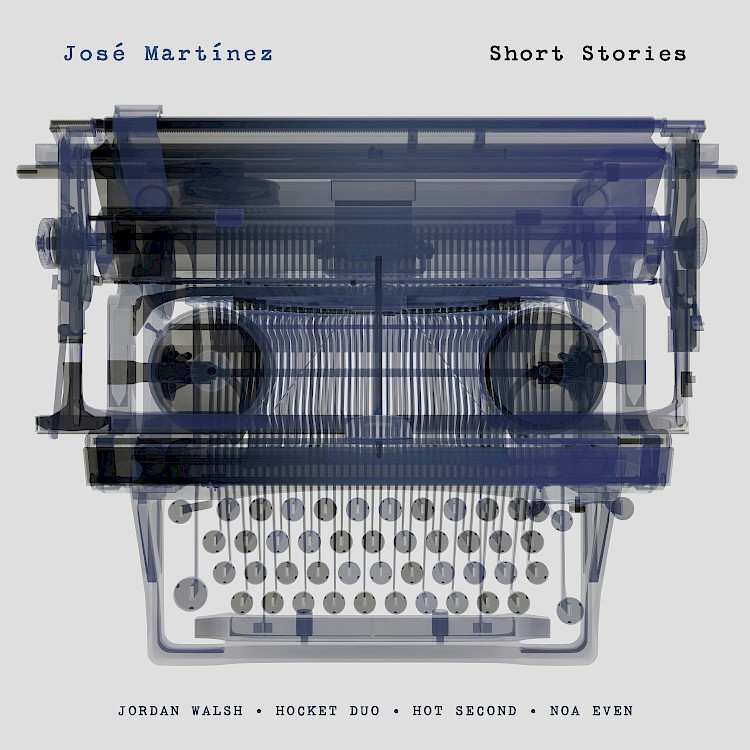
Composer José Martínez releases Short Stories, a collection of his compositions that integrate tradition, technology, and text to tell stories, both direct and surreal. Drawing on his Colombian heritage as well as influences from film and literature, Martínez brings inquisitiveness, curiosity, and thoughtfulness to the phenomenon he explores through music, shedding new light on sounds and ideas.
| # | Audio | Title/Composer(s) | Performer(s) | Time |
|---|---|---|---|---|
| Total Time | 64:12 | |||
| 01 | Monologue V: Hidden Story | Monologue V: Hidden Story | Jordan Walsh, bass drum | 12:24 |
| 02 | Do I Regret? | Do I Regret? | Noa Even, alto Saxophone | 11:15 |
| 03 | Sinsentido del Absurdo | Sinsentido del Absurdo | Hocket Duo, David Kaplan, piano, Thomas Kotcheff, piano | 15:47 |
Instructions for Playing |
||||
| Hot Second, Dylan Feldpausch, violin, Rebecca McDaniel, percussion | ||||
| 04 | I. Instructions for Stargazing | I. Instructions for Stargazing | 3:55 | |
| 05 | II. Instructions for Running | II. Instructions for Running | 1:52 | |
| 06 | III. Instructions for Singing | III. Instructions for Singing | 3:58 | |
| 07 | IV. Instructions for Obstinacy | IV. Instructions for Obstinacy | 1:53 | |
| 08 | V. Instructions for Crying | V. Instructions for Crying | 3:02 | |
| 09 | Coalescencia | Coalescencia | José Martinez, marimba de chonta | 10:06 |
José Martínez releases his first full portrait album as a composer, featuring his electroacoustic music in various guises across five pieces for solo and chamber instrumentations. Martínez’s work is narrative even in its most experimental incarnations, focusing on telling a story through sound in unexpected ways. The influence of Afro-Colombian music is particularly present on two of the included works, while Martínez’s background as a percussionist can be heard as a foundational element in all of his writing. Short Stories is a snapshot of an artist who merges disparate influences in the service of a clear aesthetic of crafting narrative through sound.
The album opens with Monologue V: Hidden Story for bass drum and electronics, performed by Jordan Walsh. The piece opens with a synergistic timbral dialogue between scraping sounds on the drum and non-pitched electronic sounds. There is an improvisatory and spacious quality to the sonic exploration, patiently introducing new sounds; we first hear direct stick attacks on the drum starting at the one minute and thirty second mark. Martinez introduces oblique pitch elements sporadically, subtle gong and chime effects and splashes of harmonic color that frame the intensifying percussive material. In the final section of the work, we hear a sotto voce reading of a Spanglish poem that Martínez wrote. The words are fragmented, hinting at semantic meaning while adding to the variegated and accumulating rhythmic landscape.
Do I Regret? features alto saxophonist Noa Even in a dialogue with a chorus of virtual saxophones echoing her live phrases. Martínez writes that the work explores, without text, the feeling of regret of past actions. Opening with truncated phrases of sustained tones and a punctuation that are processed by the electronics and tossed back at the performer, the material evolves into a haunting chorale of synthetic pitches hanging in the air. The live saxophone part steadily becomes more elaborate, incorporating oscillating trills, turns, and raw multiphonics. Martínez pushes past the boundaries of the saxophone itself with a passage of vocalized phrases mumbled through the horn, interspersed with slap tongue and key clicks. An ominous cantus firmus ascends in the electronics behind this increasingly dense texture before the dialogue thins to alternating long tones between the live player and electronics. As the work approaches its close, Martínez relies increasingly on fragile timbres that capture the resignation of regret.
Read MoreThe rarefied atmosphere of Do I Regret? is shattered instantly by the vigorous opening to the work for two piano ensemble Hocket Duo, Sinsentido del Absurdo. The work was written as part of a commission to write a soundtrack for the French silent film L’Étoile de Mer. Martínez's score is appropriately cinematic, alternating between infectious grooves and evocative sound painting. Beginning with a Afro-Latin influenced rhythmic figure for the keyboards over a pulsing electronic track, Martínez soon pivots to fluid, ascending arpeggios, an ethereal melodic line, and echoes of spoken text in the electronics. Pointillistic figures in the piano and subtle percussive material in the electronics create a new syncopated texture; later Martínez uses timbres inside of the piano to build a quirky, off-kilter ensemble machine. The ethereal electronic melody returns, this time twisted and distorted into a culminating whirl before the opening forceful groove returns to close the piece. Even though we are listening without the film, Martínez’s score paints a vivid visual picture on its own.
Instructions for Playing is a five movement work with electronics for Hot Second, a violin and percussion duo. Inspired by a book of short stories written by Argentinian writer Julio Cortázar, Manual de Instruccions, Martínez opts for brief character movements that each capture a specific affect. “Instructions for Stargazing” relies on taut tremolos, harmonics, and glissandi in the violin, watery arpeggios in the vibraphone, and a halo of harmony in the electronics to evoke the wonder of the cosmos. “Instructions for Running” alternates between insistent, driving figures and more diffuse, lyrical passages, capturing the different speeds one’s mind can go during intense exercise. Bowed vibraphone and gently swirling pitches in the electronics frame a translucent muted violin line in “Instructions for Singing.” “Instructions for Obstinacy” contains the most impetuous music of the work, flitting back and forth between contrasting expressions, from bravura exhortations to coquettish bursts, with a wavering warble in the electronic part creating instability. The work’s final movement, “Instructions for Crying,” opens with an ambient, cavernous passage before delivering cathartic instrumental material for the duo that disintegrates into an obscure over-pressure timbre in the violin. A dystopian electronic harmonization of the instruments follows, like experiencing emotions through the glass of a fishbowl.
The final work on the album highlights the influence of Afro-Colombian music on Martínez’s aesthetic. Drawing on drawing from the currulao style from the Pacific coast of Colombia, Martínez performs on one of the focal instruments of that tradition, the marimba de chonta. We hear overlapping rhythmic cycles that explore the mystical intersection between duple and triple subdivisions that is at the core of so much folkloric music. Martínez’s marimba de chonta figures are eventually enveloped by electronic sounds that fuse and fragment a range of timbres. The dense soundscape diffuses, leaving behind a traditional vocal chant that fades as the piece closes. Martínez remains the story teller throughout, finding ingenious ways to combine and balance various musical elements while still conveying essentially human expression regardless of the chosen materials.
– Dan Lippel
Track 1 recorded by Elise Etherton at Hungry Dog Sound Studios, Austin, TX
Track 2 recorded by Daniel Nissenbaum at Nut Tree Music, New Jersey, NJ
Track 3 recorded by Louis NG at Thayer Hall, Colburn School. Los Angeles, CA
Tracks 4 - 8 recorded by Troy Cruz at Experimental Sound Studio, Chicago, IL
Track 9 recorded by José Martínez at Atavismo Studio, Cali, Colombia
All electronics and sound design by José Martínez
Mixed and produced by José Martínez
Mixing assistance by Alex Fulton and Luca Gardani
Mastered by Luca Gardani
Liner notes by José Martínez
Design: Marc Wolf (marcjwolf.com)
Cover image: Typewriter by Point Normal (Unsplash)
José Martínez is a composer, percussionist, and educator interested in the intersection of contemporary composition, Afro-Latin music, audio sampling, and interactive systems. His portfolio encompasses a range of works, from solo electronics and electroacoustic pieces to chamber ensemble music, large-scale orchestral works, and interdisciplinary collaborations. Leading ensembles, including Alarm Will Sound, Wild Up, and the Grammy Award-winning Third Coast Percussion, have performed his music. An alumnus of the National University of Colombia, he earned advanced degrees in composition from the University of Missouri and UT Austin. He is currently an Assistant Professor of Music at Colby College.
https://josegmartinez.com/Austin-based percussionist, producer, and edu- cator Jordan Walsh specializes in contemporary repertoire, electronics, and musical theater. He is the principal percussionist for Density512 and a frequent collaborator with Line Upon Line. A dedicated proponent of new music, Walsh has performed at major festivals including PASIC, SEAMUS, and New Music Dublin. Beyond per- forming, he is an accomplished audio engineer and producer, specializing in electroacoustic music and software. Currently, Walsh serves as Assistant Professor at Southwestern University and Adjunct Associate Professor at Austin Community College. He holds a Doctorate from the University of Texas at Austin.
https://www.jordanwalshmusic.com/Noa Even is a Cleveland-based saxophonist dedicated to sparking deeper interest in the arts of today through the performance of contemporary music. She is a co-founder and the Executive Director of Cleveland Uncommon Sound Project, a non-profit organization aimed at strengthening the artistic engagement of the Northeast Ohio community by championing the creation and performance of new music. Her duos, Ogni Suono and Patchwork, collaborate regularly with composers and provide educational experiences for students of all ages. They have been featured as guest artists at many notable festivals and concert series, including the Singapore Saxophone Symposium, Bowling Green New Music Festival, NEOSonicFest, Omaha Under the Radar, SEAMUS, Outpost Series, Permutations, and Frequency Series. Noa has also presented numerous master classes and clinics at schools across the country and abroad. She teaches at Kent State University and holds a DMA in contemporary music from Bowling Green State University. Noa is a Conn-Selmer and Vandoren artist.
David Kaplan, pianist, has been called “excellent and adventurous” by The New York Times, and praised by the Boston Globe for “grace and fire” at the keyboard. He has appeared as soloist at the Barbican Centre with the Britten Sinfonia and Das Sinfonie Orchester Berlin in the Philharmonie, and this season makes debuts with the Symphony Orchestras of Hawaii and San Antonio.
Kaplan has consistently drawn critical acclaim for creative programs that interweave classical and contemporary repertoire, often incorporating newly commissioned works. He has given recitals at the Ravinia Festival, Washington’s National Gallery, Strathmore, and New York’s Carnegie and Merkin Halls. Kaplan’s New Dances of the League of David, mixing Schumann with 15 new works, was cited in the “Best Classical Music of 2015” by The New York Times. In the current season, he performs “Quasi una Fantasia,” which explores the grey area between composition and improvisation through works written for him by Anthony Cheung, Christopher Cerrone, and Andrea Casarrubios, together with Couperin, Beethoven, Schumann, Saariaho, Ligeti, and his own improvisations.
Kaplan has collaborated with the Attacca, Ariel, Enso, Hausman, and Tesla String Quartets, and is a core member of Decoda, the Affiliate Ensemble of Carnegie Hall. He has appeared at the Bard, Seattle Chamber Music, Mostly Mozart, and Chamber Music Northwest festivals, and is an alumnus of Tanglewood, Ravinia-Steans Institute, and the Perlman Music Program. Kaplan has recorded for Naxos and Marquis Records, as well as for Nonesuch as part of his longstanding duo with pianist/composer Timo Andres. In 2023 Bright Shiny Things released Vent, Kaplan’s debut album with his wife, flutist Catherine Gregory.
Passionate about teaching, Kaplan serves as Assistant Professor and Inaugural Shapiro Family Chair in Piano Performance at the UCLA Herb Alpert School of Music, where he has taught since 2016. Kaplan’s distinguished mentors over the years include the late Claude Frank, Walter Ponce, Miyoko Lotto, and Richard Goode. With a Fulbright Fellowship, he studied conducting at the Universität der Künste Berlin with Lutz Köhler, and received his DMA from Yale University in 2014. Preferring Yamaha and Bösendorfer pianos, David is proud to be a Yamaha Artist. Away from the keyboard, he loves cartooning and cooking, and is mildly obsessed with classic cars.
http://www.davidkaplanpiano.comViolin and percussion duo Hot Second approaches mu- sic-making through a unique lens of curiosity and joy, supported by a deep commitment to technical rigor. Comprised of Dylan Feldpausch (violin) and Rebecca McDaniel (percussion), the duo harnesses a vibrant en- ergy to craft genre-bending performances that invite audiences into adventurous, playful sound worlds. As bold performers and dedicated educators, Feldpausch and McDaniel maintain active roles within the Chicago arts community. In addition to their work as Hot Second, they collaborate with esteemed organizations includ- ing Apollo’s Fire, Third Coast Percussion, Mycelium New Music, and Beyond This Point, as well as Wheaton Warrenville South.
New Focus Recordings is an artist-led collective label featuring releases in contemporary creative music of many stripes, as well as new approaches to older repertoire. The label was founded by guitarist Dan Lippel, composer Peter Gilbert in 2004, and composer/engineer Ryan Streber in 2004, formed …Read More …
Listen to full streaming tracks while you browse the site. New tracks enabled for streaming every month. Click on the button to open up the radio player.


