
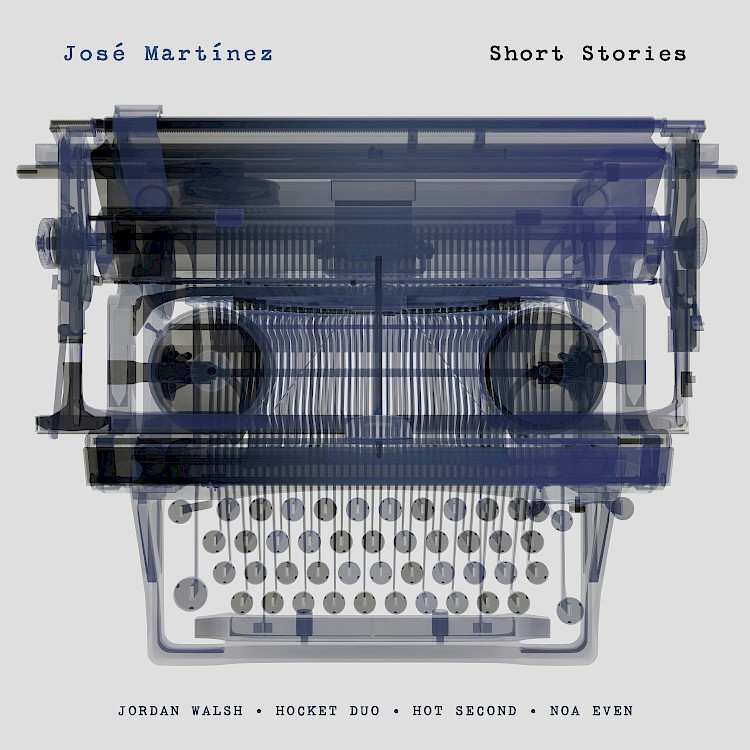
Composer José Martínez releases Short Stories, a collection of his compositions that integrate tradition, technology, and text to tell stories, both direct and surreal. Drawing on his Colombian heritage as well as influences from film and literature, Martínez brings inquisitiveness, curiosity, and thoughtfulness to the phenomenon he explores through music, shedding new light on sounds and ideas.
| # | Audio | Title/Composer(s) | Performer(s) | Time |
|---|---|---|---|---|
| Total Time | 64:12 | |||
| 01 | Monologue V: Hidden Story | Monologue V: Hidden Story | Jordan Walsh, bass drum | 12:24 |
| 02 | Do I Regret? | Do I Regret? | Noa Even, alto Saxophone | 11:15 |
| 03 | Sinsentido del Absurdo | Sinsentido del Absurdo | Hocket Duo, David Kaplan, piano, Thomas Kotcheff, piano | 15:47 |
Instructions for Playing | ||||
| Hot Second, Dylan Feldpausch, violin, Rebecca McDaniel, percussion | ||||
| 04 | I. Instructions for Stargazing | I. Instructions for Stargazing | 3:55 | |
| 05 | II. Instructions for Running | II. Instructions for Running | 1:52 | |
| 06 | III. Instructions for Singing | III. Instructions for Singing | 3:58 | |
| 07 | IV. Instructions for Obstinacy | IV. Instructions for Obstinacy | 1:53 | |
| 08 | V. Instructions for Crying | V. Instructions for Crying | 3:02 | |
| 09 | Coalescencia | Coalescencia | José Martinez, marimba de chonta | 10:06 |
José Martínez releases his first full portrait album as a composer, featuring his electroacoustic music in various guises across five pieces for solo and chamber instrumentations. Martínez’s work is narrative even in its most experimental incarnations, focusing on telling a story through sound in unexpected ways. The influence of Afro-Colombian music is particularly present on two of the included works, while Martínez’s background as a percussionist can be heard as a foundational element in all of his writing. Short Stories is a snapshot of an artist who merges disparate influences in the service of a clear aesthetic of crafting narrative through sound.
The album opens with Monologue V: Hidden Story for bass drum and electronics, performed by Jordan Walsh. The piece opens with a synergistic timbral dialogue between scraping sounds on the drum and non-pitched electronic sounds. There is an improvisatory and spacious quality to the sonic exploration, patiently introducing new sounds; we first hear direct stick attacks on the drum starting at the one minute and thirty second mark. Martinez introduces oblique pitch elements sporadically, subtle gong and chime effects and splashes of harmonic color that frame the intensifying percussive material. In the final section of the work, we hear a sotto voce reading of a Spanglish poem that Martínez wrote. The words are fragmented, hinting at semantic meaning while adding to the variegated and accumulating rhythmic landscape.
Do I Regret? features alto saxophonist Noa Even in a dialogue with a chorus of virtual saxophones echoing her live phrases. Martínez writes that the work explores, without text, the feeling of regret of past actions. Opening with truncated phrases of sustained tones and a punctuation that are processed by the electronics and tossed back at the performer, the material evolves into a haunting chorale of synthetic pitches hanging in the air. The live saxophone part steadily becomes more elaborate, incorporating oscillating trills, turns, and raw multiphonics. Martínez pushes past the boundaries of the saxophone itself with a passage of vocalized phrases mumbled through the horn, interspersed with slap tongue and key clicks. An ominous cantus firmus ascends in the electronics behind this increasingly dense texture before the dialogue thins to alternating long tones between the live player and electronics. As the work approaches its close, Martínez relies increasingly on fragile timbres that capture the resignation of regret.
Read MoreThe rarefied atmosphere of Do I Regret? is shattered instantly by the vigorous opening to the work for two piano ensemble Hocket Duo, Sinsentido del Absurdo. The work was written as part of a commission to write a soundtrack for the French silent film L’Étoile de Mer. Martínez's score is appropriately cinematic, alternating between infectious grooves and evocative sound painting. Beginning with a Afro-Latin influenced rhythmic figure for the keyboards over a pulsing electronic track, Martínez soon pivots to fluid, ascending arpeggios, an ethereal melodic line, and echoes of spoken text in the electronics. Pointillistic figures in the piano and subtle percussive material in the electronics create a new syncopated texture; later Martínez uses timbres inside of the piano to build a quirky, off-kilter ensemble machine. The ethereal electronic melody returns, this time twisted and distorted into a culminating whirl before the opening forceful groove returns to close the piece. Even though we are listening without the film, Martínez’s score paints a vivid visual picture on its own.
Instructions for Playing is a five movement work with electronics for Hot Second, a violin and percussion duo. Inspired by a book of short stories written by Argentinian writer Julio Cortázar, Manual de Instruccions, Martínez opts for brief character movements that each capture a specific affect. “Instructions for Stargazing” relies on taut tremolos, harmonics, and glissandi in the violin, watery arpeggios in the vibraphone, and a halo of harmony in the electronics to evoke the wonder of the cosmos. “Instructions for Running” alternates between insistent, driving figures and more diffuse, lyrical passages, capturing the different speeds one’s mind can go during intense exercise. Bowed vibraphone and gently swirling pitches in the electronics frame a translucent muted violin line in “Instructions for Singing.” “Instructions for Obstinacy” contains the most impetuous music of the work, flitting back and forth between contrasting expressions, from bravura exhortations to coquettish bursts, with a wavering warble in the electronic part creating instability. The work’s final movement, “Instructions for Crying,” opens with an ambient, cavernous passage before delivering cathartic instrumental material for the duo that disintegrates into an obscure over-pressure timbre in the violin. A dystopian electronic harmonization of the instruments follows, like experiencing emotions through the glass of a fishbowl.
The final work on the album highlights the influence of Afro-Colombian music on Martínez’s aesthetic. Drawing on drawing from the currulao style from the Pacific coast of Colombia, Martínez performs on one of the focal instruments of that tradition, the marimba de chonta. We hear overlapping rhythmic cycles that explore the mystical intersection between duple and triple subdivisions that is at the core of so much folkloric music. Martínez’s marimba de chonta figures are eventually enveloped by electronic sounds that fuse and fragment a range of timbres. The dense soundscape diffuses, leaving behind a traditional vocal chant that fades as the piece closes. Martínez remains the story teller throughout, finding ingenious ways to combine and balance various musical elements while still conveying essentially human expression regardless of the chosen materials.
– Dan Lippel
Track 1 recorded by Elise Etherton at Hungry Dog Sound Studios, Austin, TX
Track 2 recorded by Daniel Nissenbaum at Nut Tree Music, New Jersey, NJ
Track 3 recorded by Louis NG at Thayer Hall, Colburn School. Los Angeles, CA
Tracks 4 - 8 recorded by Troy Cruz at Experimental Sound Studio, Chicago, IL
Track 9 recorded by José Martínez at Atavismo Studio, Cali, Colombia
All electronics and sound design by José Martínez
Mixed and produced by José Martínez
Mixing assistance by Alex Fulton and Luca Gardani
Mastered by Luca Gardani
Liner notes by José Martínez
Design: Marc Wolf (marcjwolf.com)
Cover image: Typewriter by Point Normal (Unsplash)
José Martínez is a composer, percussionist, and educator interested in the intersection of contemporary composition, Afro-Latin music, audio sampling, and interactive systems. His portfolio encompasses a range of works, from solo electronics and electroacoustic pieces to chamber ensemble music, large-scale orchestral works, and interdisciplinary collaborations. Leading ensembles, including Alarm Will Sound, Wild Up, and the Grammy Award-winning Third Coast Percussion, have performed his music. An alumnus of the National University of Colombia, he earned advanced degrees in composition from the University of Missouri and UT Austin. He is currently an Assistant Professor of Music at Colby College.
https://josegmartinez.com/Austin-based percussionist, producer, and edu- cator Jordan Walsh specializes in contemporary repertoire, electronics, and musical theater. He is the principal percussionist for Density512 and a frequent collaborator with Line Upon Line. A dedicated proponent of new music, Walsh has performed at major festivals including PASIC, SEAMUS, and New Music Dublin. Beyond per- forming, he is an accomplished audio engineer and producer, specializing in electroacoustic music and software. Currently, Walsh serves as Assistant Professor at Southwestern University and Adjunct Associate Professor at Austin Community College. He holds a Doctorate from the University of Texas at Austin.
https://www.jordanwalshmusic.com/Noa Even is a Cleveland-based saxophonist dedicated to sparking deeper interest in the arts of today through the performance of contemporary music. She is a co-founder and the Executive Director of Cleveland Uncommon Sound Project, a non-profit organization aimed at strengthening the artistic engagement of the Northeast Ohio community by championing the creation and performance of new music. Her duos, Ogni Suono and Patchwork, collaborate regularly with composers and provide educational experiences for students of all ages. They have been featured as guest artists at many notable festivals and concert series, including the Singapore Saxophone Symposium, Bowling Green New Music Festival, NEOSonicFest, Omaha Under the Radar, SEAMUS, Outpost Series, Permutations, and Frequency Series. Noa has also presented numerous master classes and clinics at schools across the country and abroad. She teaches at Kent State University and holds a DMA in contemporary music from Bowling Green State University. Noa is a Conn-Selmer and Vandoren artist.
David Kaplan, pianist, has been called “excellent and adventurous” by The New York Times, and praised by the Boston Globe for “grace and fire” at the keyboard. He has appeared as soloist at the Barbican Centre with the Britten Sinfonia and Das Sinfonie Orchester Berlin in the Philharmonie, and this season makes debuts with the Symphony Orchestras of Hawaii and San Antonio.
Kaplan has consistently drawn critical acclaim for creative programs that interweave classical and contemporary repertoire, often incorporating newly commissioned works. He has given recitals at the Ravinia Festival, Washington’s National Gallery, Strathmore, and New York’s Carnegie and Merkin Halls. Kaplan’s New Dances of the League of David, mixing Schumann with 15 new works, was cited in the “Best Classical Music of 2015” by The New York Times. In the current season, he performs “Quasi una Fantasia,” which explores the grey area between composition and improvisation through works written for him by Anthony Cheung, Christopher Cerrone, and Andrea Casarrubios, together with Couperin, Beethoven, Schumann, Saariaho, Ligeti, and his own improvisations.
Kaplan has collaborated with the Attacca, Ariel, Enso, Hausman, and Tesla String Quartets, and is a core member of Decoda, the Affiliate Ensemble of Carnegie Hall. He has appeared at the Bard, Seattle Chamber Music, Mostly Mozart, and Chamber Music Northwest festivals, and is an alumnus of Tanglewood, Ravinia-Steans Institute, and the Perlman Music Program. Kaplan has recorded for Naxos and Marquis Records, as well as for Nonesuch as part of his longstanding duo with pianist/composer Timo Andres. In 2023 Bright Shiny Things released Vent, Kaplan’s debut album with his wife, flutist Catherine Gregory.
Passionate about teaching, Kaplan serves as Assistant Professor and Inaugural Shapiro Family Chair in Piano Performance at the UCLA Herb Alpert School of Music, where he has taught since 2016. Kaplan’s distinguished mentors over the years include the late Claude Frank, Walter Ponce, Miyoko Lotto, and Richard Goode. With a Fulbright Fellowship, he studied conducting at the Universität der Künste Berlin with Lutz Köhler, and received his DMA from Yale University in 2014. Preferring Yamaha and Bösendorfer pianos, David is proud to be a Yamaha Artist. Away from the keyboard, he loves cartooning and cooking, and is mildly obsessed with classic cars.
http://www.davidkaplanpiano.comViolin and percussion duo Hot Second approaches mu- sic-making through a unique lens of curiosity and joy, supported by a deep commitment to technical rigor. Comprised of Dylan Feldpausch (violin) and Rebecca McDaniel (percussion), the duo harnesses a vibrant en- ergy to craft genre-bending performances that invite audiences into adventurous, playful sound worlds. As bold performers and dedicated educators, Feldpausch and McDaniel maintain active roles within the Chicago arts community. In addition to their work as Hot Second, they collaborate with esteemed organizations includ- ing Apollo’s Fire, Third Coast Percussion, Mycelium New Music, and Beyond This Point, as well as Wheaton Warrenville South.
The Best Contemporary Classical Music on Bandcamp, March 2026
Colombian composer José Martínez presents a fascinating series of collisions on this bracing, diverse, electronics-spiked portrait album, asking musicians to grapple with technology, language, and musical tradition. The clarity of those inquiries emerges from the start with “Monologue V: Hidden Story,” a piece tackled by percussionist Jordan Walsh that uses a bass drum to produce a wide array of sounds and attacks, much of the extended techniques mediated by electronics. Extended technique mixes with percussive patterns of the bàtá drumming used in Santería rituals, which are then vividly smeared and extended by electronics. A bi-lingual text reflecting the shared Latino roots of both performer and composer is articulated within the din, reinforcing dualities in culture and identity. Saxophonist Noa Even must respond to unexpected saxophonic interventions within the solo piece “Do I Regret?,” the title of which refers to a closing section that allows the performer to either reject or embrace the computer-driven feedback. Martínez makes explicit reference to his Colombian roots in the episodic “Sinsentido del Absurdo,” a piece written for a Dadaist film and performed here by Hocket, which gamely embraces the mix of improvisatory piano, electronic grooves, and fractured cumbia rhythms. The five-part “Instructions for Playing” borrows a conceit used by Argentine writer Julio Cortázar, in which simple acts are described with exacting detail; Chicago’s violin-percussion duo Hot Second focus on specific instrumental qualities in each, whether the crunchy, insistent gestures in “Instructions for Running,” or the shimmering, swirling tones in “Instructions for Singing.” The composer plays marimba de chonta on the closing piece “Coalescencia,” where he disembodies the melodic core of Afro-Colombian currulao music with visceral, cross-cutting programmed beats.
— Peter Margasak, 3.31.2026
Short Stories is the first composer-portrait album from percussionist-composer José Martínez. It opens daringly with a long, subdued piece for bass drum, electronics, and quietly spoken word. I say “daringly” because this is the album’s least “accessible” piece. Martínez builds “Monologue V: Hidden Story” from strikes on the drum, pitchless electronic sounds, and, towards the agitated end, a fragmented recitation by the composer of a poem of his own composition.
Martínez writes that the piece is partly inspired by the batá drumming of Santería, whereby drummers speak directly to the Orishas solely with their instruments. It operates in a kind of minimalist space where meaning derives from the momentum of a (mostly) wordless conversation among sounds, instead of from melody, harmony, or rhythm. One can easily imagine the gods are listening.
Listened to with generosity of spirt, “Monologue V: Hidden Story” can be trance-like. Not so with the nervous and nervy “Do I Regret?” This piece also features just one instrument, in this case the alto sax played by Noa Even (a member of New Thread Quartet). Partly improvised and alternately hesitant, melodic, and guttural, Even’s figures interact with electronically triggered echoes of themselves. Muted spoken words and electronic sounds intrude intriguingly. The conversation here is reflexive rather than with other beings; even the distorted spoken words sound like an internal argument with no resolution.
In the fifth minute a gurgling wind-like sound enters, creating tension as it rises chromatically. The saxophone reacts with tremolos and panicky meekness. Later, left to itself, the saxophone finishes plaintively and surrenders most of the final minute to softly whooshing electronics. The Orishas are nowhere to be found.
The HOCKET Duo (pianists David Kaplan and Thomas Kotcheff) commissioned “Sinsentido del Absurdo” as a “reimagined soundtrack for Man Ray’s 1928 film L’Étoile de Mer.” The piece juxtaposes Afro-Colombian cumbia with the Dadaism of the film. It also samples the album Amistad by the Colombian American group Wache.
“Sinsentido” employs extended piano techniques (such as manipulating and playing the strings inside), improvisation, grooving rhythms, and folkloric elements. Some stretches are accompanied by a toneless shuffling rhythm achieved, I presume, by striking the piano’s exterior or interior architecture. Grooving, danceable sections and slow, airy expanses alternate, with a seeming randomness that suits the film’s Dadaism.
At first I questioned Martínez’s use of the word “absurd” in relation to this piece – what does it even mean to call music absurd? But I came to see what I think he means: Without structure, and with collage techniques patching together the various elements, where is meaning? If there is none, isn’t that sinsentido? absurd?
After some ghostly emanations and arpeggios, a last-minute callback to the opening piano riffs suggests structure, but it’s an illusion. It simply marks the end.
The composer created for the album a version for instruments and electronics of his Instructions for Playing. Inspired by a similar-themed literary work by Argentinian writer Julio Cortázar, it purports to provide “instructions” for basic human activities: stargazing, running, singing, obstinacy, and crying. As such, it too has a whiff of the absurd about it. Its five short movements feature percussionist Rebecca McDaniel and violinist Dylan Feldpausch performing as the duo Hot Second.
While “Sinsentido del Absurdo” is the most interesting music on the album, I find Instructions for Playing the most evocative and arresting. The shifting sound-spaces of the material and the conceptual jostling between the programmatic and the meaningless create constant food for thought. And one thought triumphs: Meaninglessness is in the ascendent. Perhaps the tremolos and quietly resonant bell-tones of “Instructions for Stargazing” evoke a sci-fi movie soundtrack; but they don’t resonate with the idea of looking peacefully up into the heavens. Maybe the agita of “Instructions for Obstinacy” suggests the fits of a stubborn child, but such a child needs no instruction in behaving badly.
On the other hand, much of “Instructions for Running” do seem to be in a hurry, as is the movement itself, clocking in at under two minutes. And any sort of music could be considered “Instructions for Singing,” which is the most moody, evocative movement. In any case, the Instructions as a whole define a world of percussion that links uniquely with both recognizable and experimental violin techniques, adding up to a fascinating compendium of useless directions.
Deriving unexpected sounds from acoustic instruments is one of Martínez’ favorite games. This in itself is nothing unusual. But he has his own carefully detailed artistic vision that’s consistent throughout the album’s different sound worlds. That holds for the final work. Martínez performs “Coalescencia” on the marimba de chonta – a traditional instrument associated with Afro-Colombian currulao music – and electronics.
Contrary to the title of the album, the story he tells here isn’t short; though only 10 minutes long, the piece goes deep into its fusion of ancestral and contemporary musical traditions. Trance-inducing rhythms, detuned electronic manipulation, atonal cries from the subconscious – it’s a whirlwind and a world in one.
“Coalescencia” is a beautiful piece of work and a fitting conclusion to an album of inventive music that engages meaningfully with the composer’s heritage while pushing creative boundaries.
— Jon Sobel, 4.03.2026
José Martínez has charted numerous routes through tradition and storytelling by leaning into abstraction, technology, and interdisciplinary performance. Bridging Colombian and Afro-Latin traditions with electronic and experimental music, his work takes many forms to craft sound worlds from personal and intercultural experiences.
As a performer, Martínez’s deep knowledge of Latin percussion traditions propels grooves in salsa bands like Hecho A Mano and is woven into polystylistic interactive electronic pieces like Elastic Skin (2018). As a composer, his solo and electronic works often find a self-reflective tenor through language and form. His “Monologue” series for percussion meditates on experiences of bilingualism and interculturalism, and improvised live electronic pieces like Self-Portrait (2019) create a framework for performers to improvise with self-selected sound samples.
Martínez’s multi-faceted work takes full form in interdisciplinary collaborations that range from intimate to expansive. Close family ties flourish in Atavism(o), where his playful experimentation with Colombian traditional music is brought home through dance by his niece, Laura Moreno, and abstracted through video work by his sister Sara Martínez. In theatrical multimedia collaborations, Martínez similarly weaves voice recordings, rich electronics, videos, and dance to tell poignant stories, including community-engaged reinterpretations of Colombian folklore (Orika and the Hippos) and contemporary stories of undocumented immigration (39 Inside).
In his first portrait album, Short Stories (New Focus Recordings, 2026), Martínez curates recent work where tradition and technology are synthesized through storytelling. Martínez’s seamless integration of percussion and saxophone timbres with live electronics on Monologue V and Do I Regret? provocatively extends earlier experiments with reflexive narrative forms and interactive sound worlds. Boundaries between disciplines and cultural traditions are elided in the cinematic textures of Sinsentido del Absurdo and playfully reimagined in Calescencia.
We caught up with José Martínez to talk about his recent album and to reflect on his wide-ranging musical practice.
When curating the pieces for Short Stories, a striking common denominator emerged as almost every work was tethered to a narrative. What began as an organic discovery soon became the album’s defining framework. Each piece approaches the narrative through different lenses, sometimes through explicit text, sometimes through musical form, and other times with the use of an interactive performance systems. With this thread in mind, I chose a title to honor the cuento corto (short story), one of my favorite literary genres, in which Latin American writers were highly prolific.
In Do I Regret?, the narrative emerges from confronting the past. The performer engages in brief improvisations and thanks to the piece’s performance system, these fleeting short stories are captured and transformed into the ever-present background of the rest of narrative. It becomes a story within a story. Instructions for Playing draws directly from the whimsical prose of Julio Cortázar’s Manual de Instrucciones. The music attempts to translate Cortázar’s surreal, mundane directives, of instructions on how to cry, how to sing, how to run, into specific sonic reflections of my own.
Monologue V moves into a highly personal space and it was born from conversations with my collaborator, percussionist Jordan Walsh, regarding the emotional baggage we carry internally. For the piece, I wrote a bilingual poem in Spanglish about the common immigrant dilemma, the duality of the “here” and the “there.” The poem is woven stealthily into the music as a sort of timid confession. In the writing of both the bass drum and the electronics, I mirror this too, allowing hidden elements to slowly pierce through dense, noisy textures, as truth that comes through a veil.
Commissioned by L.A. based Hocket duo, Sinsentido del Absurdo responds to the explicit narrative of Man Ray’s surrealist silent film L’Étoile de Mer. My objective was to leverage my personal sonic resources to reframe and enrich the film’s historical, abstract love triangle. It was both challenging and fulfilling inserting my own Latin American identity and my personal taste into a century-old piece of European avant-garde cinema.
Finally, Coalesencia flips the paradigm completely by allowing the music to dictate the text. I collaborated with the poet May Romero Quiñonez, who used my experimental blend of folk traditions and electronics to craft a narrative centered on a modern, secular spiritual trance.
This perspective is rooted in my sampling practice, where the sounds of disparate cultures, time periods, and regions can coexist within a single soundscape. While this methodology demands a keen ethical awareness and reflection regarding cultural appropriation, it simultaneously opens opportunities for cultural preservation, cross-pollination, and bringing refreshing sounds into contemporary music.
This idea directly dictates how I build my software systems. When performing with PPIEL (Percussion Performance with Interactive Electronics), the computer acts as an improvisation tool that enables me to introduce specific cultural references and sonic environments that the other performers cannot do. It also guides me on finding out what musical role the computer will have as it has the potential to bring sonic symbols that help situate the piece in a specific cultural space. The system is in constant development as it responds to my artistic inquires and needs.
Both Orika y los Hipopótamos and The Cuban Project are rooted in the preservation of historical memory, specifically focusing on the resilience of marginalized communities. To step into these narratives as a composer is both a privilege and a profound responsibility.
Orika y los Hipopótamos re-examines the legacy of Benkos Biohó—the emancipated leader who established San Basilio de Palenque, the mythical first free town in the Americas. This is told through the lens of a small Afro-Colombian community who is looking for self-governance and through Benkos’ daughter Orika, who married a Spanish military officer agains her father’s will.
It was a treat for me to collaborate with Colombian prominent theater educators and directors, Alejandro González Puche and Ma Zhenghong. They cast young Afro-Colombian students and professionals primarily from Buenaventura, a stronghold of Black Colombian culture. We intended to use this work as a platform so that the story is told by those to whom it belongs.
Tasked with scoring this 120-minute work in five episodes, I anchored the sound in currulao music, the living, ancestral tradition of the Colombian Pacific coast. By intersecting these traditional rhythms with contemporary music, experimental sampling, and electronics, I tried to establish a sound to hold and enrich the historical and expressive narrative of each episode.
The Cuban Project, developed alongside choreographer Leymis Bolaños, Director of Sarasota Contemporary Dance, addresses Operación Pedro Pan—the historical exodus of over 14,000 unaccompanied Cuban minors fleeing communist indoctrination. This project was intimate for Leymis as her parents are themselves Pedro Pan children. The score integrates first-hand spoken word accounts with an experimentation of traditional Cuban music like son, bolero, and rumba.
Both of these projects put me in a space where I was the sole musician in rooms filled with dancers, actors, stage directors, and lighting designers. It was interesting once again to see that music occupied an entirely different psychological space for them than it did for me. To me, music is a highly malleable, structural architecture, an incredible playground; to a choreographer or actor, it could be that but also an atmosphere, a medium in which they can suspend their movement and let their performances soar. The trick is knowing exactly when the music needed to step in to drive the narrative, and when it needed to recede into a supportive role.
Early in my career, engaging with my Afro-Colombian heritage felt like a timid act of self-discovery, it was part of the puzzle of m identity reinitiated after I moved to the US several years ago. Over time, that relationship has matured significantly. It has become a fundamental, permanent tool within my vocabulary that pops up whenever a project can be enriched by it.
As an artists, I always seek at having as many expressive options as possible when I create. Developing fluency in these ancestral traditions keeps me artistically honest, curious and challenged. Integrating these elements is a fundamental part of my work and it actively challenges my classical training, forces me to refresh my compositional systems, and ultimately sharpens the distinctiveness of my creative voice. I am working on a couple of projects where I am experimenting more on this, I want to go into deeper places within the Afro-diasporic music. For example, I am exploring the intricacy and spirituality of Afro-Cuban batá drumming and how this can be implemented in other genres and instruments.
My recent release on Bogotana Records, titled /home/usuarios/share/intuición, signaled a definitive shift back toward live performance. In the album I treat the computer as a reactive and improvisational space, and it has reignited my desire to be back on stage.
I am working on a project/album Atavism(o), designed as a solo performance. In these tracks I use electronics blended with traditional acoustic folk instruments from the Colombian pacific. I am looking to establish an immersive “one-man show” that explores the conceptual intersections of ancestral currulao music and Afrofuturism.
Concurrently, I am conceptualizing my next full-length album, which looks toward systemic global issues. The project is shaping to be a song cycle built entirely around first-hand text, letters, and legal documents detailing individual experiences within global immigration machinery. Musically, I’d like to work on this album as a laboratory where I intend to dissolve genre boundaries entirely, blending diverse styles to amplify these deeply human narratives of migration, time will tell.
— Jacob Kopcienski, 6.25.2026
New Focus Recordings is an artist-led collective label featuring releases in contemporary creative music of many stripes, as well as new approaches to older repertoire. The label was founded by guitarist Dan Lippel, composer Peter Gilbert in 2004, and composer/engineer Ryan Streber in 2004, formed …Read More …
Listen to full streaming tracks while you browse the site. New tracks enabled for streaming every month. Click on the button to open up the radio player.


