
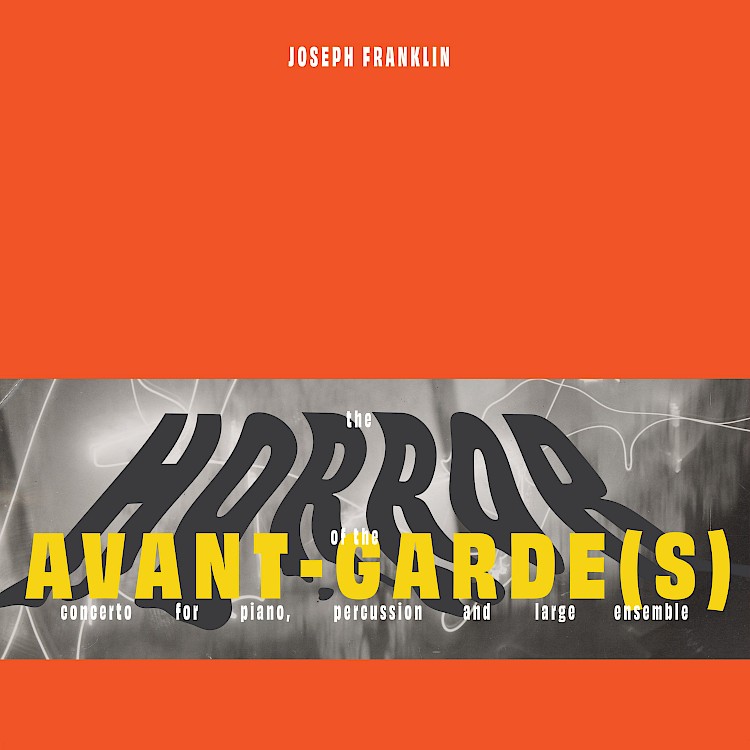
Australian composer Joseph Franklin's The Horror of the Avant-Garde(s) is a concerto for piano (Marc Hannaford) and percussion (Satoshi Takeishi) soloists and 13 players that far exceeds the expectations of the genre. Integrating several modes of improvisation within a fully structured framework and a polystylistic musical language, the work was premiered in Melbourne in an interdisciplinary presentation, incorporating butoh dance theatre, visual art, and culinary "horrors." Franklin has created a kind of gesamtkunstwerk for our collage shaped era, and this release celebrates its US premiere in 2026.
| # | Audio | Title/Composer(s) | Performer(s) | Time |
|---|---|---|---|---|
| Total Time | 37:38 | |||
The Horror of the Avant-Garde(s) | ||||
| Marc Hannaford, piano soloist, Satoshi Takeishi, Laila Engle, flutes, Luke Carbon, clarinets, Jasper Ly, oboe/cor anglais, Callum G'Froerer, double-bell trumpet, Benjamin Anderson, double-bell bass trombone, Louise Devenish, percussion, Melina van Leeuwen, harp, Joseph Franklin, Sophia Kirsanova, violin, Phoebe Green, viola, Anna Pokorny, cello, Elliott Gyger, conductor | ||||
| 01 | I. elasticity | I. elasticity | 13:29 | |
| 02 | II. the stickiness of time | II. the stickiness of time | 13:03 | |
| 03 | III. figures of refined excess | III. figures of refined excess | 11:06 | |
Australian composer and bassist Joseph Franklin’s The Horror of the Avant-Garde(s) is an expansive 38 minute concerto for piano, percussion, and 13 player ensemble that marries several modes of improvisation and notational convention in a landmark work featuring many of Australia’s most prominent new music specialists. In its sold out premiere run of performances in Melbourne in 2023, the performance included a children’s choir, Butoh performance, visual art, experimental writing, and culinary “horrors.” While not part of the audio recording experience, the panoply of disciplines involved in the premiere speaks to Franklin’s ambitious vision. Franklin and his collaborators wisely captured this recording immediately after the premiere, bottling its creative energy while it was fresh.
Piano soloist Marc Hannaford, percussion soloist Satoshi Takeishi, and Franklin himself are all deeply versed improvisers. The integration of improvisation into a modernist compositional vocabulary is carefully handled and seamless, clearly designed by an artist who understands the potential points of intersection between them as well as the ways in which they complement each other. Franklin’s approach extends upon concepts developed in the AACM as well as Gunther Schuller’s Third Stream works in its exploration of porous boundaries between improvised and through composed materials and the role of collective improvisation in large scale works. Horror does not present itself as a traditional heroic double concerto, though the solo parts are very clearly brought to the fore. Instead the piece unfolds like a story with main characters, frequent prominent personalities that are leading the journey. Add to that elements of microtonality, prepared instruments and extended techniques, and the scope of the work takes shape; it is anything but a collection of “horrors,” but instead a wealth of riches.
Read MoreAfter two forceful ensemble punctuations to open Movement 1, “elasticity,” an extended introduction accumulates structural anticipation with sustained, closely spaced harmonic voicings, unsettling overpressure timbres in the strings, and a mysterious, poignant solo in the English horn. We hear the central motive of the movement, an insistent long-short-long ostinato that migrates between instruments while Hannaford reveals his quirky microtonal, prepared timbral vocabulary with nimble figurations on the piano. Franklin excavates diverse characters by moving the ostinato figure to different sections while highlighting others in phrase bursts. The string section careens forward and separates itself from the pack with an extended, swirling passage that begins in unison and gradually divides as it ascends and becomes more fraught and disjunct. What follows is a percolating dialogue between Takeishi’s drums and Franklin’s bass, a spontaneous improvisation that is woven into the structure of the movement so naturally as to feel inevitable; as inevitable indeed as Hannaford’s entrance at 9:17 to expand the section to a trio. The ostinato’s return ushers back in the full ensemble for a dynamic, orchestral passage with responsive dialogue with piano. The movement’s driving energy gradually diffuses as it heads towards it close, echoing the haunting harmonies of its introduction.
The beginning of Movement II, “the stickiness of time,” elides with Hannaford’s searching improvisation that began at the end of “elasticity,” a reflective moment of thoughtful repose after the vigor of the first track. A fleet four note figure reminiscent of a bird call starts in the flutes and steadily spreads to other sections, becoming a new motive around which Franklin facilitates intricate, embellished material. The gong-like preparations in Hannaford’s piano lead the way in a series of accumulating verticalities before Franklin leads a bass, trombone, and clarinet trio. Col legno articulations in the strings imitate a ticking clock, while Hannaford’s tolling arpeggios are answered by sardonic figures in the muted brass. As in the opening movement, Franklin alternates between sections of rhythmic and ensemble regularity and freedom to create and diffuse tension — both can and do serve in either function at different points in the piece. For instance, we hear a liberated improvisation between piano and violin whose spell is broken by a steady march-like pattern in the bass and pitched percussion that provides a foundation for the subsequent collective improvisation. Just as the texture is settling however, we hear a tutti outburst that coalesces into a crescendo into the dramatic opening fanfare of Movement III, “figures of refined excess."
After the initial gesture, “figures of refined excess” initially rotates around a central sustained pitch, as other instruments grind against nearby intervals, producing visceral beatings. The texture intensifies with ornamental and timbral variation before breaking into a ritualistic groove anchored by a four note motive in the winds and brass over a steady, accented percussion figure. This section provides the pad for further piano improvisation before the ensemble focuses briefly on a central high pitch and gives way to an extended percussion improvisation. Hannaford joins the percussionists a few minutes in, as the trio plays furtive, disjointed figures. Later, Franklin and Takeishi drive the ensemble forward with a fast straight swing accompaniment, as the treble instruments take flight with energetic figures. The core trio plays a final group improvisation that registers as a kind of cathartic cadenza, coming where it does near the end of the overall structure, before the full ensemble closes the piece with two final punctuations. “figures of refined excess” is a boisterous movement with many twists and turns, a fitting culmination of Franklin’s balancing act incorporating improvisation and spontaneous composition into a large scale form.
– Dan Lippel
Recorded at Prudence Myer Studio, Ian Potter Southbank Centre, University of Melbourne, Melbourne, Australia, August 18, 2023
World Premiere Performance at Chapter House, Narrm/Melbourne, August 17, 2023
Artistic Director: Tina Stefanou
Recording and mixing: Alistair McLean
Mastering: Magnus Lindberg
Score Reader: Tom Stewart-Toner
Original design: Design Rows
Layout: Simon J. Karis
Photography: Sarah Walker
Joseph Franklin is an Australian composer and bassist whose wide-ranging practice combines formal and spontaneous modalities, drawing from classical and experimental music, sound art, instrument design, and foregrounds a distinctive approach to instrumentality.
He has composed for notable ensembles including Ekmeles, Melbourne Symphony Orchestra, Tasmanian Symphony Orchestra, Flinders Quartet, Australian Youth Orchestra, and The Music Box Project. In 2022, he composed and performed solo in the contemporary ballet Storm Approaching Wangi and Other Desires. He has released several albums as bandleader, with performances in the United States, Germany, Switzerland, Senegal, Belgium, France, Turkey, and Australia.
He is the recipient of the Benjamin Franklin Fellowship from the University of Pennsylvania, a Marten Bequest Fellowship, a 2021 Freedman Jazz Fellowship finalist nomination, a 2020 Art Music Award for 'Excellence in Experimental Music'—where he was also a finalist in 'Performance of the Year (Jazz/Improvisation)'—and multiple grants from Creative Australia. His music is represented by the Australian Music Centre.
Notable residencies and intensives include Tasmanian Symphony Orchestra's Australian Composer's School (2024/25), Critical Path (2023), Darmstadt Ferienkurse (2021), All That We Are (2020), Stanford University intensive with Mark Applebaum (2019), Bundanon Artist Residency (2019), the Australian Art Orchestra Creative Music Intensive (2018), IRCAM Manifeste! (2017), Time of Music Festival (2017) in Finland, and the Australian Youth Orchestra Summer Music Program (2017).
In 2024, his debut solo contrabass guitar album, a thousand tiny mutinies, was released via Nice Music label, and a follow-up live duo album with Ben Carey was released in 2025.
He holds a Master of Music (Composition) and a Bachelor of Music (First Class Honours) from the University of Melbourne and is currently undertaking a PhD in Composition at the University of Pennsylvania.
http://www.josephfranklin.netDon’t be afraid! While this concerto for piano (Marc Hannaford) and percussion (Satoshi Takeishi) has plenty of high-wire moments for the soloists, they never fail to catch themselves on the edge of disaster. The soloists pirouette around and interact with dazzling instrumental colors supplied by 13 expert players, including Franklin on contrabass guitar and harmonium, in a work of substance and surprise. The premiere in Franklin’s native Australia included a children’s choir, butoh dance, visual art, and “culinary ‘horrors,’” whatever that means. It sounds like an enterprising New York City venue (The Shed? Perelman Arts Center? Lincoln Center?) should present that here STAT.
— Jeremy Shatan, 6.05.2026
Avant-Garde! The words still send shivers down our spines. Oh, to be in Greenwich Village or Paris in the first half of the 20th century, on the cutting edge of serialism and surrealism, chanting with beat poets and dancing the Apache. Man Ray and Duchamp, Allen Ginsberg, Gertrude Stein, and Ornette Coleman. George Antheil, the “bad boy of music,” is buried just seven miles from my home, sealing an affection for the rule‑breaking movement that I’ve had as long as I can remember.
But the odd thing about avant-garde is that, unlike other schools within the arts, it is not a sharply defined period with a beginning and an end. The rule‑breakers of 1915 are not that much different from the avant-garde of 1950 and 2026. If I were to sit at the keyboard and improvise in an unorthodox or bizarre style, it would sound pretty much like the avant‑garde from any time in the past 100‑and‑some years.
Avant-Garde is therefore not dead, but still alive and lively, thanks to new artists who are bringing fresh perspectives to the table. One such artist who caught my attention recently is Joseph Franklin, an Australian composer. In fact, a delightful album, The Horror of the Avant‑Garde(s), has just been released, containing Franklin’s complete Concerto for Piano, Percussion and Large Ensemble. The cover is in screeching orange, and in true rule‑breaking spirit, the title omits the Oxford comma.
The album includes an elegant essay by Kevin Laskey, a musician, writer, and music educator, in which he explores the textures interwoven throughout this complex yet engaging musical adventure. The work is in three movements: “Elasticity”, “The stickiness of time”, and “Figures of refined excess”. In the vinyl edition I am reviewing, “The stickiness of time” movement is half on side A and continued on side B, which I found a bit jarring. But jarring is what avant‑garde is all about. I was, however, eyebrow-raisingly impressed by the clarity and brightness of the vinyl sound. Isn’t it fresh to have several platforms to choose from!
Some listeners are not particularly enthralled by discordant sounds, which they associate with modern music. If the thought of modernism turns you off, know that it’s much more enjoyable in this album than you would imagine. Part of the reason for this is the sleek blending of classical, jazz, and avant‑garde elements, and the wide variety of musical experiences scooped out of a large ensemble skilled in traditional performance and improv. I heard a similar blending that was equally satisfying recently when Wynton Marsalis and friends joined forces with the Philadelphia Orchestra in excerpts from his Symphony n° 4 “The Jungle”.
While Franklin’s concerto can be enjoyed without any explanatory commentary, I think most listeners will benefit from learning more about the work and its performers. Avant‑Garde fanciers will have a blast identifying influences throughout the work, while others may want to Google the title and composer to understand the ideas behind the artifact.
Musically, the first movement offers wisps of melodic fragments, mingled with cheerful babble and Morse Code-like patterns. There are jazz elements running throughout the album, but I wouldn’t call this a jazz piece, by any means. This is because in the vinyl version, the second movement is split in half, and it’s hard to maintain absolute continuity for this section, but the work is so good‑natured as to sweep aside any crabby quibbling.
Piano soloist Marc Hannaford offers a constantly evolving performance with plenty of interaction with the other musicians. Satoshi Takeishi on percussion delivers a strong, but flexible rhythmic center that merges smoothly with the ensemble.
While the final product may succeed in conveying an avant‑garde sensibility, the road leading from here to there bears the glow of traditionalism. This is a familiar, even cozy way to make a musical statement. We can recognize this work’s form as a three‑movement concerto. What could be more traditional than this? Though identifying as avant‑garde, the participants do not shy away from familiar roles (e.g., Elliott Gyger, conductor and Tina Stefanou, artistic director). The vinyl edition could use some booklet notes, but even without further background, this is a savvy album that celebrates the rebels of the past through the innovations of the present. I think I can hear George Antheil applauding in his grave.
— Linda Holt, 6.25.2026
New Focus Recordings is an artist-led collective label featuring releases in contemporary creative music of many stripes, as well as new approaches to older repertoire. The label was founded by guitarist Dan Lippel, composer Peter Gilbert in 2004, and composer/engineer Ryan Streber in 2004, formed …Read More …
Listen to full streaming tracks while you browse the site. New tracks enabled for streaming every month. Click on the button to open up the radio player.


