
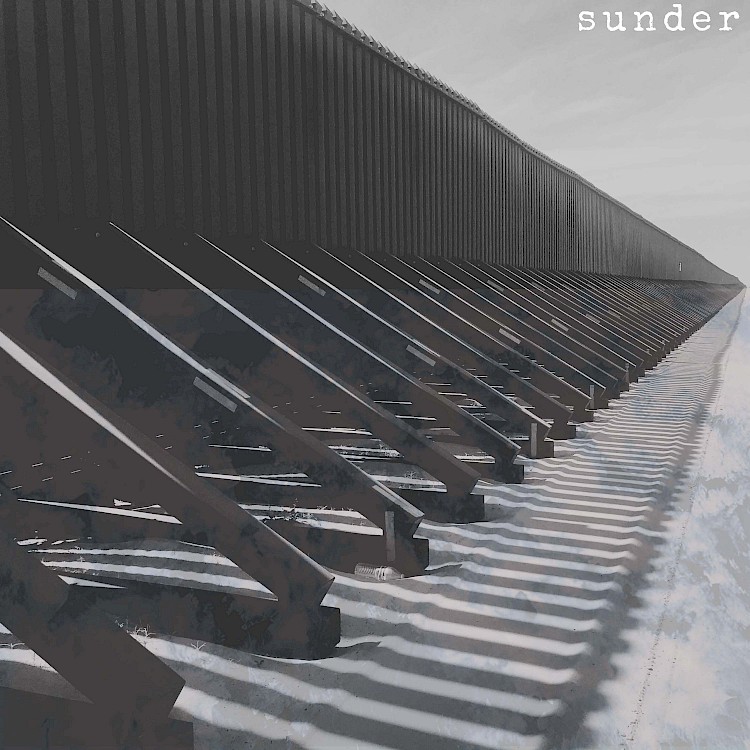
Listening is central to composer Mariel Roberts Musa’s music, which engages landscapes shaped by physical presence, human meaning, and the subtle intersections of sound and politics. Sunder, for solo piano, transducers, and field recordings, is built from recordings made directly on the U.S.–Mexico border wall, allowing the piano to interact with the wall’s subtle resonances and surrounding environment. Rather than treating the wall purely as symbol, the piece listens to its material reality. Lightning Field draws inspiration from Walter De Maria’s land artwork of the same name, translating its sense of electricity, vast space, and underlying structure into sound. Together, these pieces reflect Musa’s interest in place, perception, and the ways sound can reveal hidden relationships within constructed and natural environments.
| # | Audio | Title/Composer(s) | Performer(s) | Time |
|---|---|---|---|---|
| Total Time | 55:13 | |||
sunder |
||||
| Conor Hanick, piano | ||||
| 01 | sunder I | sunder I | 6:10 | |
| 02 | II | II | 4:07 | |
| 03 | III | III | 2:59 | |
| 04 | IV | IV | 1:57 | |
| 05 | V | V | 7:05 | |
| 06 | VI | VI | 7:57 | |
| 07 | I | I | 7:02 | |
| 08 | Lightning Field | Lightning Field | Mariel Roberts Musa, cello, Felix Fan, cello | 17:56 |
Listening is central to composer Mariel Roberts Musa’s music, which engages landscapes shaped by physical presence, human meaning,and the subtle intersections of sound and politics. Sunder, for solo piano, transducers, and field recordings, is built from recordings made directly on the U.S.–Mexico border wall, allowing the piano to interact with the wall’s subtle resonances and surrounding environment. Rather than treating the wall purely as symbol, the piece listens to its material reality. Lightning Field draws inspiration from Walter De Maria’s land artwork of the same name, translating its sense of electricity, vast space, and underlying structure into sound. Together, these pieces reflect Musa’s interest in place, perception, and the ways sound can reveal hidden relationships within constructed and natural environments.
Sunder is a large work for solo piano, transducers, and field recordings from the border wall between the US and Mexico.The recordings were made using ultra-sensitive microphones placed directly on the wall, and each movement represents a different point along the wall. They were recorded over the course of a 10 day road trip along the full length of the border wall, starting in El Paso/Ciudad Juarez and ending in San Diego/Tijuana. Sunder is a dialogue between the piano and the inner subtle vibrations of the wall, as well as the sounds of the open environment. The source material for this work was created by attaching vibration sensors (accelerometers) directly onto the border wall, revealing the resonances of the various types of metallic structures which make up the barrier. This trip was undertaken with the incredible sound artist Jacob Kirkegaard, who captured the recordings and with whom I created another collaborative work (Traverse) using this source material. The piece explores the abstract concept of a political border by engaging on an intimate level with the most concrete physical representation of that idea — the monumental wall which denotes that border. Its mammoth physicality expresses the sentiment behind its construction — power, fear, safety, belonging, all of which are driving forces behind the choices which are propelling the world forward in our current political climate. Yet its physical manifestation belies the wall's basic inability to serve its purpose, in that it fails to prevent the movement of people from one country to another and violently cuts through communities and sacred spaces.
Read MoreLightning Field is based on the Walter De Maria land work of the same name. The artwork is located on a fat, empty plateau about 40 miles from the nearest town. It’s made up of 400 stainless steel poles arranged in a grid which allows visitors to experience the feeling of being inside a lightning storm. I wanted to capture the feeling of electricity, static, and wide open spaces. Within the composition of the piece, I created harmony and rhythms based strictly on mathematical derivations surrounding the material installation of the original artwork, including measurements of the proportions of the poles to each other and to the land area that they are contained in. I think of this piece as psychic geography as much as a spatial work.
– Mariel Roberts Musa
sunder was recorded and edited by Ryan Streber at Oktaven Audio, Mt. Vernon, NY
Lightning Field was recorded and edited by Todd Carder at Bunker Studios, Brooklyn, NY
Mixing and mastering by Patrick Higgins, Future-Past Studios
Produced by Mariel Roberts Musa
Photo and cover design by Mariel Roberts Musa
Location field recording collaborator: Jacob Kirkegaard
Cellist and composer Mariel Roberts Musa is widely recognized not just for her virtuosic performances, but as a “fearless explorer” in her field (Chicago Reader). Her passion for collaboration and experimentation as an interpreter, improviser, and composer have helped create a body of work which bridges avant-garde, contemporary, classical, improvised, and traditional music; and has established her as “one of the most adventurous figures on New York’s new music scene—one with a thorough grounding in classical tradition but a ravenous appetite for and tireless discipline in new work.” (Bandcamp).
Roberts Musa has appeared as a soloist and chamber musician around the world, and is a current member of Wet Ink Ensemble and the International Contemporary Ensemble. She performs regularly on major stages for new music such as the Lincoln Center Festival (NYC), Wien Modern (Austria), Lucerne Festival (Switzerland), Cervantino Festival (Mexico), Klang Festival (Denmark), Shanghai New Music Week (China), Darmstadt Internationalen Ferienkurse für Neue Musik (Germany), and Aldeburgh Music Festival (UK). Roberts Musa has been featured on a wide variety of outstanding recordings, including titles on Innova Records, Albany Records, New World Records, New Amsterdam, Carrier Records, New Focus, and Urtext Records.
Pianist Conor Hanick is regarded as one of his generation’s most inquisitive interpreters of music new and old whose “technical refinement, color, crispness and wondrous variety of articulation benefit works by any master.” (New York Times) Hanick’s playing, “a revelation of clarity and bite,” recalled to the Times’ Anthony Tommasini a “young Peter Serkin,” and his performance of John Cage’s Sonatas and Interludes was, according to Times’ critic David Allan, “the best instrumental concert I have seen all year,” praise echoed by the Boston Globe, which named the performance “Best Solo Recital” of 2019.
Hanick has recently performed with the San Francisco Symphony, Seattle Symphony, Phoenix Symphony, Alabama Symphony, Orchestra Iowa, and the Boston Modern Orchestra Project, been presented by the Barbican, Gilmore Festival, New York Philharmonic, Elbphilharmonie, De Singel, Centre Pompidou, Caramoor, Cal Performances, Philadelphia Chamber Music Society, Park Avenue Armory, and the Ojai Festival, where in 2022 with AMOC* (American Modern Opera Company) he served as the festival’s artistic director. A fierce advocate for the music of today, and “the soloist of choice for such thorny works” (NYT), Hanick has premiered over 200 pieces and collaborated with composers both emerging and iconic; among them, Hanick has worked with Pierre Boulez, Kaija Saariaho, Steve Reich, Tania León, and Charles Wuorinen, in addition to the leading composers of his generation, including Nico Muhly, Caroline Shaw, Tyshawn Sorey, inti fggis-vizueta, Chris Cerrone, Anthony Cheung, and Samuel Carl Adams, whose piano concerto, No Such Spring, he premiered in 2023 with Esa-Pekka Salonen and the San Francisco Symphony. Since 2014 Hanick has been a faculty artist at the Music Academy of the West and in 2018 became the director of its Solo Piano Program.
Felix Fan is a rare talent in the world of contemporary music. Described by Gramophone as “particularly sublime”, he is one of the most acclaimed, renowned, and respected cellists performing today. As a soloist, collaborative artist and advocate for new music, Felix is admired for his technically refined interpretations and independent spirit, working with diverse and contemporary composers including Philip Glass, Michael Gordon, Hans Werner Henze, Oliver Knussen, David Lang, Meredith Monk, Steve Reich, Terry Riley, Kaija Saariaho, Tan Dun, Julia Wolfe and Charles Wuorinen.
Felix continues to collaborate with the most cutting-edge composers and instrumentalists, “navigating the structural complexities and layers of shifting tempo with flair” (New York Times). A strong advocate for the creation and commissioning of new music, Felix has premiered over 100 works and dozens of recordings in his career. On the world stage, he has appeared at Carnegie Hall, The Kennedy Center, Lincoln Center, Musikverein and the Royal Festival Hall and as a soloist with orchestras including the Hong Kong Philharmonic, National Symphony (Taiwan), and the Munich Chamber Orchestra.
Beyond the world of contemporary music, Felix believes in the power of collaboration between musicians, filmmakers, actors and artists. In this capacity, he worked with director Charlie Kaufman and the Coen Brothers (Fargo) on a live radio play featuring Meryl Streep, Philip Seymour Hoffman and Steve Buchemi. He has also performed with members of Sonic Youth, Wilco and The National.
In the Cagean conception, all sound is music. Yet, as listeners, we often do not perceive it as such. We often distinguish between musical sounds and the extramusical. This discriminatory approach to hearing, however, is incredibly problematic as it inhibits a full appreciation of what we hear. As the composer himself noted, in his landmark text, Silence: Lectures and Writings (Wesleyan, 1961), “If you develop an ear for sounds that are musical it is like developing an ego. You begin to refuse sounds that are not musical and that way cut yourself off from a good deal of experience.” In many ways, Mariel Roberts Musa’s Sunder (New Focus, 2026) excels as a case study of Cage’s thesis.
Perhaps best known as a cellist, Roberts Musa has provided her strings to some of the finest creative music records of the last decade. Anna Webber’s Shimmer Wince (Intakt, 2023), Modney’s Ascending Primes (Pyroclastic, 2024), Ambrose Akinmusire’s Origami Harvest (Blue Note (2018), and Henry Threadgill’s The Other One (Pi, 2023), are among several albums made richer by her presence. But with Sunder, she mostly puts her cello aside to focus on her skills as a composer. Specifically, most of the album features a seven-movement suite of the same name composed of transducers, Conor Hanick’s solo piano, and field recordings. The latter consists entirely of recordings captured over the course of ten days, via the placement of ultra-sensitive microphones directly onto various points on the US-Mexico border wall.
To be sure, these field recordings provide very little that the average person would identify as musical. To the untrained ear, they sound like nothing but rustled motions, thunderous clangs, and tensive twinklings. And yet, their artful integration with solo piano allows for two major messages to emerge through Roberts Musa’s work.
The first message is one on the relationship between humanity and the natural environment. Any interaction between human beings and nature will inevitably result in the former impinging upon the latter. And the larger the intrusion, the greater the disruption. It is estimated that the border wall has reduced successful wildlife crossings by up to eighty-six percent compared to less restrictive barriers. These restrictions threaten over fifteen hundred native species by keeping them from the things critical to their survival and propagation: sustenance and mating. The wall has also destroyed plant life and altered water flows. Of course, a contrarian perspective argues that the wall curbs illegal crossings, which itself causes environmental degradation; between 2007 and 2018, over four hundred and sixty thousand pounds of trash were collected along Arizona’s border from migrant activity.
Regardless, it is undeniable that the presence of a massive human-made wall has an environmental impact, and considerate listening to the field recordings incorporates these concerns into the work, whether the sounds of wind on the fourth movement or a babbling stream on the final one. The different sounds of each field recording also reflect the varying types of material used at any given segment of the wall, a slightly different human intrusion into the environment than in other parts. One can also contend that the piano itself is a further human entrance into the natural sounds captured on the recordings. And to further bring home the album’s focus on the sonic relationship between nature and humanity, the second half of Sunder also includes a double cello work, ‘Lightning Field,’ inspired by the outdoor sculpture by Walter De Maria.
The second message heard in the field recordings is one on human relations. The wall is the latest in a long history of complex human movements and interactions over the decades. A small percentage of people crossing the border – the human traffickers, the drug smugglers, and others – come primarily spread pain and chaos for profit. The wall purportedly stops them in their tracks. But it also inhibits the vast majority of migrants, people who come to the US seeking a better life, away from home. They enter their new home with their first action being a violation of their immigration laws. Yet, facing a broken legal process, feel as if they have no alternative. They seek a land of opportunity that proclaims a pride in being built out of immigrants, but which has entrenched a system so difficult for more to come. And, even once here, the recent transplants often encounter people whose own ancestors generally migrated here themselves, yet provide a less-than-warm welcome. The wall stops these new residents, too, raising questions about what exactly it means when the Statue of Liberty asks for the “tired, … poor,… huddled masses yearning to breathe free.”
The complexities of the border itself and the wall that divides it are inherently built into Roberts Musa’s field recordings as they hint at power, fear, security, insecurity, idealism, and pragmatism.
Ultimately, the field recordings provide ineffable qualities that a solo piano recording by itself could not. By treating the purportedly non-musical as equal to the undeniably musical, Roberts Musa adds a rich depth that speaks to the emotions and realities of the border far beyond where mere words alone could ever reach. Sunder is a testament to not only Roberts Musa’s skill as a forward-thinking composer but also a potent reminder that we should listen – truly and fully – to all the sounds that surround us.
PostGenre: Do you see ‘Sunder’ as a continuation of Traverse, your project with Jacob Kirkegaard, or is it wholly separate?
Mariel Roberts Musa: I do see ‘Sunder’ as a continuation of Traverse, as it started with that collaboration with Jacob. We both had a strong desire to address the border wall and the fraught relationship America has with immigration. We started working together on ‘Traverse’ shortly before the pandemic, and the pandemic greatly delayed how we could work on it together. Because of that delay, we decided to keep our project together but also each have separate projects related to the wall as we both found what we has recorded to be fascinating source material.
While I love the project Jacob and I made together, there was so much more that I wanted to do with the sounds of the wall. There were several compositional things I wanted to do that were personally mine. I think Jacob felt the same way about his own work. He does a lot of sound installations and wanted to do a very big one that was entirely focused on the sounds we had recorded. By contrast, I wanted to do something more compositional with the material. But we both shared the desire to use the material in as many ways as possible. So yes, Sunder grew out of our original collaboration together.
PG: With composition at the heart of ‘Sunder,’ what was behind the decision to craft it as a solo piano work instead of writing for yourself for cello?
MR: Firstly, I wanted to challenge myself to write for another instrument. I have not written very many pieces that I don’t also perform myself and wanted to push myself as a composer to create works for others. But I also liked the specific idea of writing for piano for a few reasons. First is how the tuning of the piano is very fixed. Obviously, the field recordings are not in equal temperament.
PG: They probably could not be.
MR: They can’t be. Instead, all the sounds we recorded are based on the overtone system.
In deciding to write for piano, I also wanted to delve into the idea of repositioning the performer in the space and repositioning their instrument as a way to amplify the sounds of the environment instead of simply playing something on top of the field recordings. In a live performance of the piece, I have transducers inside the piano so that sometimes the recordings themselves are being played out of the piano.
PG: Wow.
MR: In a way, it’s like the piano is trying to sing in the voice of the wall. And I felt the piano was the perfect instrument for that because it’s so resonant. It works very well with the technology of transducers inside, to make a deeply beautiful and clear sound. I like the idea of the conflict between the fact that this person is actually playing piano, but then the piano is also making sounds that the person isn’t creating at all.
PG: Your late father was a pianist. Did that enter into your choice to write for the piano at all?
MR: Yeah, I think it did. Many of my very first intense sound experiences were when my dad would take me to his late-night gigs, and I would sit under the piano while he played. Experiencing that massive resonance feels like home. I think that’s something so ingrained in all types of repertoire – all types of music making in the Western music world – that I feel it’s a good foil for this kind of project.
PG: So, before you put the transducers into the piano, what was your process for writing the movements of ‘Sunder’? Did you start with the recordings and then work with them on piano or on the cello?
MR: I did a little bit of both. I worked on my cello quite a bit and also worked on the piano. I don’t play piano, at least not very well. So, I plucked out things. There was a lot of listening. I deeply listened to the field recordings for a very long time, to try to hear all the tones, resonances, and timbres that came out of them.
Then I did a lot of transcription work. I would feel out the resonant harmonies of the various recordings and what I heard in them. Sometimes, I would hear a lot of harmony. Sometimes, I would hear a lot of rhythm. Some recordings were very melodic. I ultimately spent a lot of time focusing on the character of each of those spaces and composed based on both the information of what I transcribed, the energy I felt from the recording, and my memory of being in the place where we recorded it. I feel that where we recorded was a very important part of the project as well. I went across the entire border, driving from San Antonio all the way to San Diego.
PG: Each movement of ‘Sunder’ was captured at different locations along the wall during your trip. How did you decide which locations to use? The trip from Texas to California is a long one, and presumably, you captured significant amounts of material along the way.
MR: Some of the decisions were dictated by practicalities. Some parts of the border are close to cities and would sound different than out in open spaces. In some of the areas along the wall, you can’t physically go up to the wall. So some of the decisions were based on the realities of where you can and can’t physically go in the border region.
And some of it was based on the physical material used on the wall at certain points. Most of the wall is made of giant steel beams. But many places also use a lot of barbed razor wire, which has a very beautiful, different sound. Some parts of the wall have other metal structures attached to it. Some of the wall is next to roads with a lot of traffic. And some of it is in the middle of a sand dune, where all you can hear is the wind. I tried to find as much contrast as I could and chose the recordings that I found most impactful.
PG: You mentioned being unable to physically approach the wall at certain points. Did you encounter any problems with border patrol while being so close to the border?
MR: Definitely. The border patrol agents did not want us there at all. But we met many very interesting people. The experience of spending so much time there greatly enlightened me about the environment around the border, who are the people guarding the border, and who are the people “protecting” us. What are they protecting? Why are they there? Which areas are they most insecure about? Being around that taught me a lot.
PG: Many people are probably surprised by the natural beauty at parts of the border, in places like Big Bend National Park or the Sonoran Desert.
MR: In general, the landscape is stunning and vast. In the places where the wall is are really pronounced, it cuts a dynamic, ugly, and beautiful swath across all of the space. I feel the wall has such an immense character in itself.
PG: Do you feel your interest in the sonic interaction between nature and human-made substances is at all shaped by growing up in Denver, where human-made skyscrapers are set next to the natural beauty of the Rocky Mountains?
MR: I hadn’t thought about that, but I think it definitely was. Colorado has changed a lot since I was growing up. But, especially when I was a kid, it had a lot of empty space. Then a couple of things plunked here and there, like a lot of ranch land or a lot of farmland. Then a little bit of suburban sprawl. There are little buildings plunked into the landscape in a somewhat strange and artificial way. You feel every human intervention in the landscape much more acutely than in a more congested place like New York City. Maybe I’ve always been a little more acutely aware of how those human interventions shape our entire experience in space and our relationship to what that space means to us.
PG: And what is fascinating is where the sounds of nature and of the manmade blur. In Movement VII, for instance, there are moments where you cannot tell if what you are hearing is trucks driving by or wind and water. But one thing that stands out in the field recordings, and the movements more generally, is how much space there often is between sounds. Was that an important element to you in the work?
MR: Definitely. I wanted to balance space and density within the piece.
I think that allowing for space is a part of the most honest relationship you can have with the material. There is so much open space at the border. It is wildly spacious sometimes, almost terrifyingly spacious. I wanted to make sure that was reflected in the work.
But then, when you get up close to the wall, there are so many different types of metal and twisty pieces of refuse and garbage. And that provides a lot of density. So, some of the movements are quite dense.
I also wanted to have a balance of moments where the piano was trying to blend, truly imitate, and speak with the wall, and places where it’s clearly an outside observer looking in on what’s happening.
PG: What do you feel you learned the most from the process of taking the field recordings and incorporating them into composed music?
MR: I think the process of taking the recordings and then transforming them into performance pieces has been interesting because, to me, the recordings themselves are already perfect pieces of music. They’re so complex and beautiful. Ugly and strange. Powerful and oppressive. The recordings themselves say so much. It’s been an incredibly interesting process to consider what I could add to them.
Working with the field recordings is a similar thought process as when I improvise. I improvise often and, when I do, the question that always arises is how I can add something to the piece. Do I even need to add something? Would it be better if I don’t add anything? In general, I need to find the balance between keeping the integrity of the incredibly beautiful pieces that are already completely perfect as they are, and taking a mirror to see what would happen if they were commented on or transformed. Or to see what would happen to the way people listen to them when a human element is added. Does the addition of human-made sounds change the way people perceive the underlying material? Working with the field recordings has taught me a lot about the very careful dance between putting my own intervention into a space and merely observing something from the outside.
PG: There is also the added element of bringing in an another musician. It is one thing to put the sounds you experienced at the border into composed music in a way that makes sense to you. It is another entirely to have somebody else perform your creation. In terms of integrating the field recordings into the written piano score, what form of notation did you use? Did you rely more on Western traditional notation, graphic notation, or something else entirely?
MR: ‘Sunder’ mostly uses Western notation, with a little graphic notation. Critical to the piece was my sitting down with Conor and explaining to him my vision and the stories behind some of the field recordings. Talking about the music’s background was important because I feel some of it is a little outside of what I feel notation can actually express. I felt it was very important for Conor to hear the field recordings and understand the relationship I want between them and his piano.
PG: In advising Conor, do you feel there’s something particular you were able to convey to him from your own experience interacting as a performer with wall recordings on ‘Traverse’?
MR: Maybe. I think there are ways I wrote the piece that I wouldn’t have been able to understand at the depth I did without having done ‘Traverse’ first. With ‘Traverse,’ I had spent so much time with my own instrument, which I understand so much better than the piano, and find moments of harmony and texture that I probably wouldn’t have come to if I had immediately started writing for the piano, since I don’t know the instrument well. Certain techniques grew out of what I was doing on the cello. So, I think my work on the cello was an important part of the process for this piece.
PG: Of course, you have also played cello in some other incredible projects over the last several years. Having worked with Henry Threadgill, John Zorn, George Lewis, Anna Webber, Ambrose Akinmusire, and so many other great composers, do you feel one in particular has particularly influenced how you write your own music?
MR: Specific to ‘Sunder,’ I feel that working with Threadgill was particularly helpful. Working with his music has completely changed how I wrote some things in this piece, in addition to other pieces I’ve written.
But I feel that every great composer I have worked with has guided my personal style and approach to composition in some way. Especially since composition is something that I came to a little later in life. Working with such incredible artists has greatly expanded my compositional vocabulary and given me tools to say things I wanted to say but didn’t quite know how to. I’ve been very lucky, as a performer, to be able to be in all of the different spaces that they create. Those experiences, I think, have definitely made me a more interesting musician.
PG: To point to two particular projects in which you have taken part, Anna Webber’s Shimmer Wince and Modney’s Ascending Primes both incorporate just intonation. Do you feel working on those projects helped you with ‘Sunder’, given that the field recordings, as you mentioned earlier, also are not in equal temperament?
MR: Definitely. But, in general, just intonation is something I’ve worked with for a long time. There’s a huge community of people interested in just intonation, and I have worked with many in that community. For instance, I have also performed music by Eric Wubbels and others that have, I think, trained my ear to be much more aware of tunings outside of equal temperament. Just intonation is definitely something I am very interested in for my own work. Actually, I had an interesting time approaching the piano for that reason, because while there’s a lot of room for exploration with the piano, you are also limited. I needed to find techniques, short of retuning a piano, that would give me different types of tones that are not within the instrument’s natural range.
PG: It would seem that the fact that you don’t play piano would make that especially difficult.
MR: Yes, but I was lucky enough that when I was writing this piece, I was at a residency for about six weeks and had a piano with which I could experiment. The residency gave me a lot of freedom to find the sounds that I wanted, even if I couldn’t perform them fully on the piano.
PG: With ‘Sunder’ being your second recording to incorporate field recordings from the border, do you feel that is an area you will continue to explore going forward?
MR: I do. I don’t feel like I’m done exploring the sounds of the border. I feel like every day that I live as an American, issues at the border are in my face, confronting me. Issues at the border are one of the things we have to continue to talk about, forever.
Probably not many people have been to the border wall and they will probably never go. So, the wall is often some abstract thing they don’t need to confront that much. There’s a lot to be said about how focusing on one sense can transform your idea of a space or of a concept. It can actually transport you to the true feeling of the space. There’s so much knowledge to be gained about what it really means when you can have a real experience of the place. Sound is one of those things that can really transport us. It can actually take us into the body of that object and let us more fully reflect on what it actually means to have the wall there. With a piece like ‘Sunder,’ I want to bring some knowledge, understanding, and experience with that concept closer to the heart. We can never turn around, away from the reality of what is happening there.
— Rob Shepherd, 2.10.2026
The border wall between the U.S. and Mexico is a symbol of division, and unfortunately representative of a manufactured political climate. During a 2020 trip along this structure, Jacob Kirkegaard and cellist Mariel Roberts Musa recorded the wall itself through a set of contact microphones. This was released two years ago as the album Traverse.
On Sunder, the same recordings are used as an accompanying instrument to solo piano compositions played by Conor Hanick. Each of seven movements is based around a different location on the wall, with varying resonance and overall sonic character. But rather than grafting the music to the field recordings or vice versa, Roberts Musa has integrated them more deeply. At times, the piano forcefully accentuates patterns of creaks and groans and at others it lurks in the background, letting the wall take the lead. High points include an “ambient” passage at the beginning of Sunder V in which the wall’s rumble is echoed through extended techniques and spare, isolated notes.
In doing so, Roberts Musa reappropriates the wall’s underlying policy into separation as an aesthetic theme. Sunder is powerful precisely because it does not treat the border wall as a vague metaphor. Instead, it presents this socio-political object in its physicality and having a vibrational voice. The result is a rare kind of art that patiently unfolds but is unsparing in its gaze, providing a strangely beautiful reflection on an ugly moment in history.
Lightning Field, the album’s second piece, is a lengthy cello duet between Roberts Musa and Felix Fan. It translates Walter De Maria’s remote land-art grid of 400 stainless-steel poles into sound, with pitches and timings derived from the installation’s measurements. As it requires patience and bodily presence to fully experience, De Maria’s work exemplifies a site-specific project that cannot be constrained to a book, film, or even a gallery. But Roberts Musa and Fan make a persuasive aural corollary through tactile playing. They employ visceral techniques including bow tapping and long harsh scrapes to represent what it would be like to be inside a lightning storm. The passages vary from light to dark and pastoral to urgent, with falling tones, rapid bowing, and crisp contrapuntal motifs.
Sunder was released February 6, 2026 by New Focus Recordings. Across both works, Roberts Musa converts built environments into musical material, rendering sonic analogues for their respective cultural and geological / meteorological contexts.
— Mike Borella, 2.21.2026
One of the greatest cellists of our time, Roberts further establishes her compositional bona fides on this sumptuous, spiky, and atmospheric epic of an album. After the “engaging brutality” of 2021’s Armament, the sepulchral nature of the sound world comes as less of a surprise. However, the continually evolving development of the seven-movement title piece shows new mastery. Composed for piano (Conor Hanick, in bravura form), and incorporating field recordings and transducers directly from the U.S.-Mexico border wall, the unease the piece inspires is entirely intentional. The album also includes Lightning Field for two cellos (Roberts and Felix Fran), which is based on Walter De Maria’s environmental installation in New Mexico. Using De Maria’s proportional relationships as a structural base, the 17-minute piece feels like abstracted folk music and is sculptural in its own way. I like the idea of Roberts wandering our earth and illuminating the human impact—the good and the bad—on the planet with her music. Wherever she wanders next, I’ll be sure to follow.
— Jeremy Shatan, 2.20.2026
New Focus Recordings is an artist-led collective label featuring releases in contemporary creative music of many stripes, as well as new approaches to older repertoire. The label was founded by guitarist Dan Lippel, composer Peter Gilbert in 2004, and composer/engineer Ryan Streber in 2004, formed …Read More …
Listen to full streaming tracks while you browse the site. New tracks enabled for streaming every month. Click on the button to open up the radio player.


