
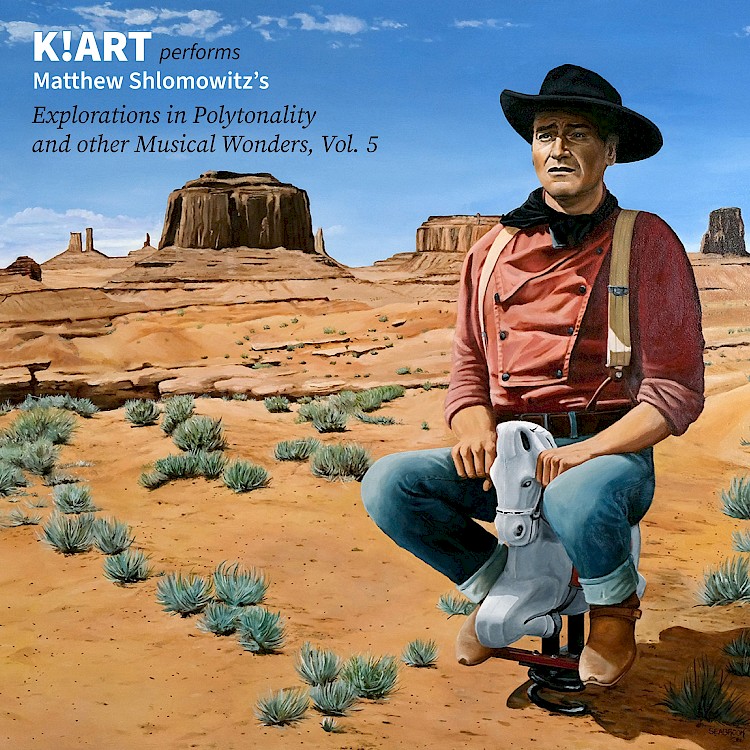
Written in 2025, this is the fifth volume in Matthew Shlomowitz' series Explorations in Polytonality and Other Musical Wonders. Shlomowitz embraces short form pieces, each of which engage with a historical trope from the compositional toolbox and extrapolates upon those techniques beyond their traditional usage. Shlomowitz also cultivates a polytonal language, situating his harmonic sensibility in the mid-twentieth century while he subverts conventional expectations of context, form, and texture. The Copenhagen-based ensemble K!ART, in a line-up of clarinet, bass guitar, cello, synthesizer, and drum kit, are the featured performers and dedicatees of the compositions.
| # | Audio | Title/Composer(s) | Time |
|---|---|---|---|
| Total Time | 17:47 | ||
| 01 | I – vi – IV – V | I – vi – IV – V | 2:56 |
| 02 | Polytonal Organum | Polytonal Organum | 4:00 |
| 03 | Timeless Interlude | Timeless Interlude | 4:27 |
| 04 | Call & Answer (co-composed) | Call & Answer (co-composed) | 3:34 |
| 05 | Additive Binary and tritone substitions | Additive Binary and tritone substitions | 2:50 |
Matthew Shlomowitz’s Explorations in Polytonality and Other Musical Wonders zooms in on existing components of historical musical practice and creates collage textures that delve deeper into their possibilities and present them within ingenious juxtapositions. In doing so, Shlomowitz posits a parallel trajectory for contemporary music, one of many paths not taken. The result, heard here in a fifth volume EP chronicling Shlomowitz’ work in this direction for Copenhagen based ensemble K!ART (clarinet, bass guitar, cello, synthesizer, and drum kit), is simultaneously illuminating, clever, humorous, and fresh.
The EP’s opening track recasts the ubiquitous chord progression of I – vi – IV – V (of “Heart and Soul” fame”) as a polytonal, multi-tempo romp. As Shlomowitz layers the progression over itself in different keys and speeds, myriad associations with this string of harmonies are conjured and morphed in the listener’s mind. K!ART’s instrumentation is uniquely well suited for this kind of refracted referentiality, with the ensemble shifting seamlessly between stylistic feels; breezy calypso, to earthy shuffle, 1950’s crooner, and 1980’s medium tempo rock merge into each other in jump cut genre fluidity. By crashing tempi, tonalities, and feels together, Shlomowitz obscures the conventional roles of foreground and background, melody and accompaniment, that are the pillars of popular music. Any one component of the overall can be heard as primary at a given one moment, creating a cubist sonic tapestry.
Polytonal Organum is just as the title suggests, a homophonic line in which the instruments are all playing in different tonalities in rhythmic unison. Short phrases with dramatic pauses are played by the pitched instruments, ornamented by internal embellishing turns and subtle corners. The drums enter dramatically in contrasting passages of weighty, grunge-fusion grooves that are anchored by an assertive bass line (a nod to Soundgarden, an iconic band from the 1990’s Seattle scene, according to the liner notes). As the piece evolves, Shlomowitz integrates these elements, placing the drums within the homophonic ensemble lines, connecting them with rangy fills, and thinning the texture to playful syncopated hits, before growing into a cathartic exploration of the full band texture.
Read MoreTimeless Interlude contains the EP’s most weightless music, as ethereal harmonies flow from one to another without the impetus of teleological harmonic function. Watery synthesizer figures connect the airy sustains. Towards the piece’s middle, the drums and bass enter briefly, alternating measures between medium and slow tempo in a woozy episode. The interlude ends abruptly, as if being suddenly jolted out of a dream.
Call & Answer, listed as co-composed because the pivotal percussion part performed here by Matias Seibæk is left unnotated in the score, is a responsive dialogue between the quartet and flexatone. The instruments open with bubbly ascending figures which the flexatone answers with good humor; Seibæk meets the challenge of imitating the quartet with impressive creativity, and expressive range. The synthesizer lands on a chordal drone midway through over which Seibæk takes an extended flexatone solo, building a chorus of melodies reminiscent of bird-song. The quartet then takes the fore with overlapping ascending figures that contain fragments of internal cadences, evoking the snippets of harmonic progression heard between plays from a ballgame organ.
Keeping with his directly descriptive titles, Additive Binary and tritone substitutions is a two part piece with an additive rhythmic evolution in the first part and an evolving harmonic strategy of tritone replacement in the second. A swooping line in the clarinet leads the first section, as Shlomowitz builds cycles out of shorter fragments that are elongated subtly with each repetition. The second section is built around a bouncy groove anchored by a driving keyboard figure with a turnaround progression, and in each successive repetition of the section, Shlomowitz substitutes an additional chord with its tritone related harmony. As the number of alternate tritone harmonies increases, the initial dissonance they created gives way to more consonance with their fellow substitutions. The clarinet unleashes from the ensemble with exuberant trills and jovial passagework. A brief reprise of the opening additive material quickly detours into a final cadential phrase, ending on a characteristically ambiguous polytonal sonority.
Matthew Shlomowitz approaches his explorations with intelligence, joy, and wit, drawing connections between disparate styles and eras in music. He does so by shining a spotlight on some of the fundamental building blocks in composition, and looking beyond their common usage to a new suite of possibilities and permutations.
– Dan Lippel
Recording, mixing, and mastering: Kristian Alexander Pedersen
Cover painting and graphic design: Mark Seabrook
Matthew Shlomowitz is a London based composer. Recent works include Minor Characters, co-composed with Jennifer Walshe for Ensemble Nikel; Six Scenes for Turntables and Orchestra, co-composed with Mariam Rezaei, and The Big Idea, a one-hour monodrama for mezzo soprano Lotte Betts Dean and Rubiks (Melbourne), made in collaboration with Vid Simoniti. He teaches at University of Southampton, co-directs Plus Minus Ensemble, and co-produces the Soundmaking podcast.
http://www.shlom.comK!ART [pronounced klart] is an experimental ensemble and creative platform founded by curator Mikkel Schou in 2019. Contextualized as a hybrid between a music ensemble, a cultural production platform and an artist collective, K!ART is a stable presence on the scene for experimental art music in Denmark. The ensemble puts on intermedial music events characterized by experimental instrumental music, staged music, music-theatre, multimedia, performance art, and an exploratory and holistic approach to curation.
New Focus Recordings is an artist-led collective label featuring releases in contemporary creative music of many stripes, as well as new approaches to older repertoire. The label was founded by guitarist Dan Lippel, composer Peter Gilbert in 2004, and composer/engineer Ryan Streber in 2004, formed …Read More …
Listen to full streaming tracks while you browse the site. New tracks enabled for streaming every month. Click on the button to open up the radio player.


