
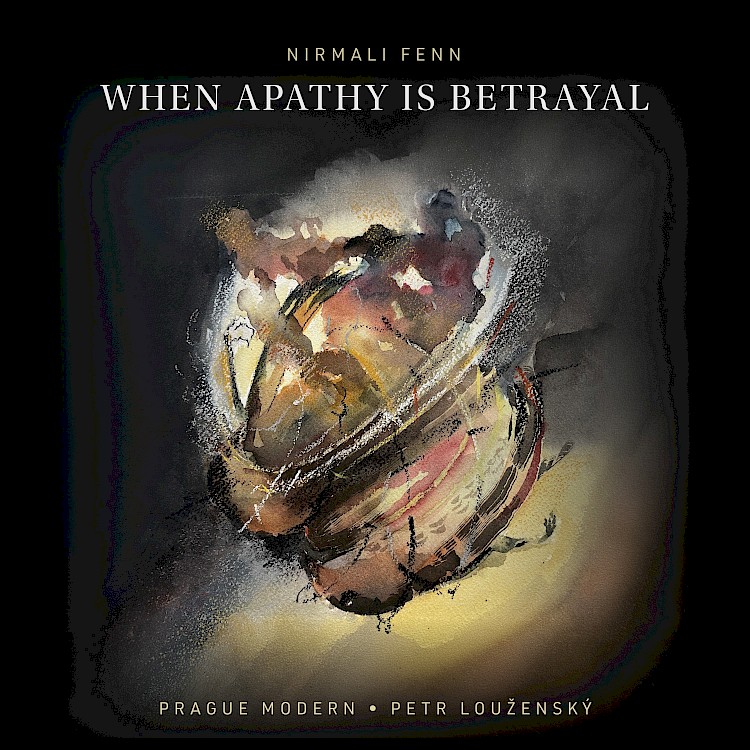
Composer Nirmali Fenn's When Apathy is Betrayal is an album length work for two sopranos and ensemble that interrogates the absence of empathy that allows us to disconnect from the profound suffering of displaced peoples in the modern world. Drawing on influences from Sri Lankan drumming and North Indian devotional singing while assembling a text from various collaborative sources, Fenn's poignant work is as rich in expressive color as it is powerful in the message it carries.
| # | Audio | Title/Composer(s) | Time |
|---|---|---|---|
| Total Time | 57:32 | ||
When Apathy is Betrayal | |||
| Prague Modern, Petr Louženský, conductor | |||
| 01 | Movement 1: do you hear the cry in the night | Movement 1: do you hear the cry in the night | 9:05 |
| 02 | Movement 2: night splinters Movement 3: listen to the stars | Movement 2: night splinters Movement 3: listen to the stars | 7:17 |
| 03 | Movement 4: light splinters, high in the night | Movement 4: light splinters, high in the night | 5:05 |
| 04 | Movement 5: people who walk barefoot in their hearts | Movement 5: people who walk barefoot in their hearts | 11:04 |
| 05 | Movement 6: night splinters, high in the light Movement 7: you enter through dust and stars | Movement 6: night splinters, high in the light Movement 7: you enter through dust and stars | 11:30 |
| 06 | Movement 8: let us go, barefoot in our hearts onto this our earth, without borders Movement 9: from the perspective of the eternal | Movement 8: let us go, barefoot in our hearts onto this our earth, without borders Movement 9: from the perspective of the eternal | 13:31 |
Nirmali Fenn's music invests in the conviction that music is capable of awakening us to a heightened connection to the world around us. Indeed, When Apathy is Betrayal is conceived from a stance of moral awakening, a forceful statement towards empathy and a call for compassion and magnaminity through sound. By embedding elements of rich musical traditions, in this case Kandy drumming from Sri Lanka (heard particularly in the 1st and 8th movements) and Indian ritualistic Dhrupad singing (also prominent in movement 1), Fenn contextualizes her message within enduring lineages, universalizing its impact and scope. Fenn uses texts that are largely in German, broadening the international reference point further but also couching the piece in a language that is central to the Western musical tradition. This choice seems pointed and intentional -- for a piece that implores the audience not to look away from the suffering resulting from displacement that is largely happening in the Global South and so-called Third World, Fenn chooses to speak through a textual language that is at the historical core of the economically dominant culture, the social collective (i.e. Europe and the United States) that is in the best position to extend empathy to the traumatized in our contemporary world. Fenn's musical language, while drawing on specific traditional musics, is universal in its lyricism and grand, gradually evolving structures. The voices are alternatively used in conventional fashion and at other times using extended techniques that become part of the instrumental fabric. The ensemble provides immersive textures, with individual instruments emerging periodically as featured characters in the evolving narrative in dialogue with the vocalists. Prague Modern's performance, led by conductor Petr Louženský, is attuned to the sensitive balancing act of the piece, a spell that the music casts over the listener that aims to leave them transformed by its close.
-- Dan Lippel
When Apathy is Betrayal resists conditions that distance us from the suffering of others. Its title draws on Martin Luther King Jr.’s assertion that “silence is betrayal,” extending this idea further: what if it is apathy that most profoundly distances us from one another? The piece begins by setting up a war zone. Explosive percussion evokes bombardment, heard both from the stage and from behind the audience. Fleeing footsteps add to the chaos on the ground. These conditions bring vulnerability and fear to the surface. The music then turns inward, focusing on what such pressure produces: a cry shaped by loss, displacement, and the severing of belonging. Movement 1, “The Cry in the Night”, moves between external force and an interior landscape of grief.
Movements 1 and 8 draw on two distinct sound worlds that inform Fenn’s work: the drumming traditions of Kandy in Sri Lanka, and the Dhrupad tradition of North India. Kandyan drumming brings a sense of urgency through repetition, accumulation, and physical drive. In contrast, Dhrupad unfolds slowly, shaping sound through breath, pitch inflection, and sustained attention. These two approaches do not resolve into a single language, but remain in tension, each reframing how the other is heard.
Read MoreMoments of resistance form an important counterpoint within the piece. Movement 5 incorporates sampled sounds from global protest movements, including those surrounding the fall of the Berlin Wall, the Arab Spring, Black Lives Matter, MeToo, climate justice demonstrations, and Pride. These are not presented as discrete historical events, but as a dense collective field. In Movement 5, apathy gives way as communities gather around shared concerns. The text of the work, largely in German, is assembled from statements contributed by collaborating artists. Rather than forming a linear narrative, these fragments create a multiplicity of perspectives, reflecting resistance as a shared but heterogeneous act. At key moments, language emerges with direct urgency: hörst du den Schrei? (“do you hear the cry?”) in Movement 1 and lass uns gehen (“let us go”) in Movement 8. The aim is not to invite interpretation, but to call for response. In Movement 8, musicians and audience are asked to leave the interior of the concert space, enacting a passage that parallels migration itself. This gesture is not symbolic alone: it places the listener within a state of displacement, where uncertainty and exposure become part of the experience.
At the threshold between Movement 9 and the final movement, the premiere included an image of Alan Kurdi, the Syrian child whose death became emblematic of the 2015 refugee crisis. For many, this image marked a moment when attention could no longer turn away, prompting a shift from recognition to action. Within the piece, it stands as a fragile counter-image to apathy: a moment in which perception, care, and responsibility briefly align.
When Apathy is Betrayal does not seek resolution. Instead, it dwells in the unstable space between hearing and responding. It asks what it means to remain with what one has heard, rather than turning away. In this sense, the work is not about amplifying voice, but about deepening attention. If apathy begins with the closing of the ear, then this piece proposes listening as an act that binds us, however tenuously, to the lives of others.
– Nirmali Fenn
Recorded June 20, 2024 at Sound studio HAMU, Academy of Performing Arts in Prague, Czech Republic
Recording supervisor: Sylva Stejskalová
Recording engineer: Ondřej Urban
Final mastering: Sylva Stejskalová
Production operations manager: Bohdan Hilash
Cover image: Myke Karlowski, Windswept (2025)
Design: Marc Wolf, marcjwolf.com
Nirmali Fenn is a Sri Lankan-born, Australian composer whose work is shaped by a life lived between cultures, histories, and identities. She spent her early childhood in an orphanage in Colombo before being adopted and raised in Australia. This movement between worlds brought with it a deep and lasting sense of dislocation. Being transplanted across countries so culturally and historically different and growing up visibly marked by that difference created an early awareness of what it means to belong and not belong at the same time. That tension continues to shape how she listens, and how she creates music.
The Sri Lankan civil war forms a lasting, if often indirect, presence in her life. Fenn is of both Tamil and Sinhalese descent, born to parents from different ethnic and caste backgrounds. This dual inheritance, situated within a history of deep national division, has shaped her understanding of identity as layered and internally complex. She stands, in this sense, at the convergence of multiple, unresolved histories. During the years of the Sri Lankan civil war, this reality was not abstract. It could determine where one could go, how one was seen, and what was at risk. These experiences continue to resonate in her music, which brings divisions into relation, creating spaces in which they may coexist.
Fenn studied composition at the University of New South Wales and the University of Melbourne and completed her doctorate at the University of Oxford under the supervision of Robert Saxton. She has since lived and worked across Europe, Asia, Australia, and the United States, holding academic appointments in Hong Kong, Singapore, Sydney, and New York. Her compositions have been performed internationally by ensembles including the Arditti Quartet, Ensemble Cairn, Ensemble Linea, Hong Kong New Music Ensemble, Ekmeles, Trio Radial, Melbourne Symphony Orchestra, and Ensemble BerlinUnited. She has collaborated with leading performers such as Grammy Award-winning bassoonist Frank Morelli and guitarist Dan Lippel. Organizations who have commissioned her music include New Music USA, the Juilliard School, the New York Foundation of the Arts, Musikfonds, and Fondation Royaumont. Fenn has held residencies at festivals including Zeitströme Darmstadt, the Lakes District Summer Music Festival, and the Unheard-of//Ensemble Collaborative Composition Initiative in New York.
Fenn’s portrait CD, released by Kairos in 2018, was described as “dynamic and sculpturally fluid,” exploring the “poetics of spacetime thematic resonance,” an approach that continues across her work. She approaches composition as a way of listening more closely to the world and to the forces that shape it. Her work invites performers and audiences into spaces where sound carries both intimacy and distance, asking how we remain present to what we hear.
When Apathy is Betrayal gives this search a particular urgency, creating a space in which listening is no longer neutral, but an act that carries consequences for how we care for one another.
https://www.nirmalifenn.com/Prague Modern is a flexible contemporary music ensemble comprising leading Czech instrumentalists. Founded in 2008 by conductor Michel Swierczewski within the Prague Philharmonia, the ensemble has established a strong presence on the European new music scene through its performances, recordings, and collaborations.
Praised by music journalists as one of the leading Czech ensembles for new music, Prague Modern performs in formations ranging from solo and chamber settings to small orchestral configurations. Its repertoire spans major works of the international avant-garde alongside music by contemporary Czech composers, whose work the ensemble actively supports and presents abroad. The ensemble has appeared at festivals and venues across Europe, including Prague Spring, Contempuls, Musica Strasbourg, and the Pierre Boulez Saal in Berlin. Its recording of works by Dai Fujikura, conducted by Pascal Gallois, received the Coup de cœur prize from the Académie Charles Cros.
Prague Modern is also engaged in interdisciplinary collaborations with artists working in film, visual art, and theatre, and its members are active in workshops and educational projects focused on contemporary performance practice.
Born in Sri Lanka and displaced to Australia, Fenn has put all of her heart, soul, and intellect into this album-length work, and the committed performance by Prague Modern, conducted by Petr Louženský, translates that directly to the listener. Fenn’s heritage is incorporated as well, with percussion inspired by the drumming traditions of Kandy, Sri Lanka’s cultural capital, and vocal writing that draws on the Dhrupad tradition of North India, a form that goes back centuries. Special kudos to sopranos Barbora Kabátková and Pavla Radostova for navigating this challenging material with precision and emotional heat.
The emotions run high in Fenn’s conception, too, which seeks nothing less than to erase the distance we feel from others who are suffering. In just one coup de theatre, she expertly weaves an audio collage of global protest movements, from the Berlin Wall and Black Lives Matter to the Arab Spring and climate change, into the fifth movement, people who walk barefoot in their hearts. If that all sounds like a lot of freight for a musical piece to carry, the strength of Fenn’s orchestration and composition results in a tremendously compelling and deeply human experience.
— Jeremy Shatan, 5.29.2026
New Focus Recordings is an artist-led collective label featuring releases in contemporary creative music of many stripes, as well as new approaches to older repertoire. The label was founded by guitarist Dan Lippel, composer Peter Gilbert in 2004, and composer/engineer Ryan Streber in 2004, formed …Read More …
Listen to full streaming tracks while you browse the site. New tracks enabled for streaming every month. Click on the button to open up the radio player.


