
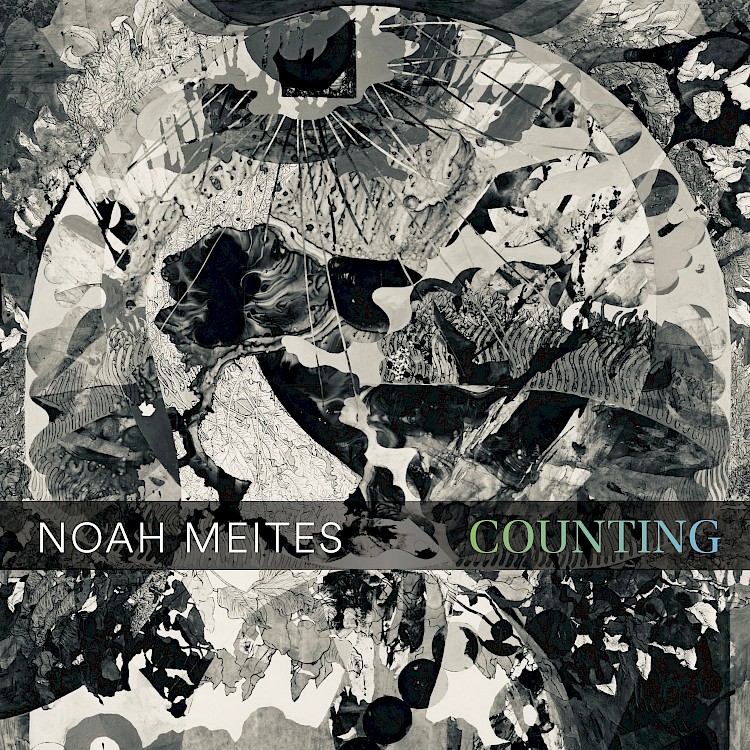
Los Angeles based composer Noah Meites releases a collection of his chamber music that chronicles his vibrant artistic voice and his role as an active member of that city's fertile contemporary music community. Featuring performances by Brightwork New Music, HOCKET, violist Linnea Powell, pianist richi valitutto, New Thread Quartet, and Meites' own ensemble LA Signal Lab, COUNTING is a vital snapshot of a prolific artist in one of the United States' most vital new music scenes.
Composer Noah Meites wrote his doctoral dissertation on affinities between the music of Prince, Igor Stravinsky, and Louis Andriessen. This fact might lead one to assume his music is an amalgam of the three, and while one hears influences of their work in his, Meites has decidedly charted his own path. What his scholarship topic does indicate however is a broad range of practice in his musical background, from commissions and premieres by many ensembles and festivals in the new music firmament, to a certificate in jazz trumpet performance from a university in France, to co-founding LA Signal Lab, a stylistically diverse ensemble specializing in the intersection between improvised and pre-composed music. This flexibility and wide range of experience comes across in Meites’ music in an entirely natural fashion. His collaborators on this album are many of Los Angeles’ most active musicians in the contemporary music scene, including Brightwork New Music, HOCKET, New Thread Quartet, and a host of top freelancers. The music on this collection is finely crafted and each piece defines its own aesthetic terms in organic ways, demonstrating an artist who has a broad tool set but does not feel the need to brandish it gratuitously.
COUNTING opens the album, a tour-de-force work for nineteen instruments and four high voices. Meites uses the relatively large new music ensemble forces to great effect, with ecstatic towering chords led by the brass, percolating, off-kilter rhythmic cells driven by a cadre of saxophones and an extended rhythmic section, and ethereal clouds of harmony framed by the vocal quartet. The choice of instrumentation, reliance on rhythmic devices to vary and develop material within a regular pulse, and harmonic and stylistic language demonstrate the deep impact Andriessen had on Meites. The piece’s expressive world vacillates between vigorous propulsion and evocative soundscape. The vocal quartet often functions as an austere, homophonic chorus, intoning the foreboding text from Jeremy A. Schmidt’s Censuspeak with chilling neutrality. The prevailing rhythmic grid is offset by free gestures in the keyboard, electric guitar, and high winds at select moments in the work to loosen its skeletal infrastructure. Prince’s influence is felt strongly at the fourteen minute mark, with a repeated ostinato growing out of the fretted electric instruments featuring a funk rhythm guitar part that migrates throughout the ensemble into a simmering groove. From that pad, saxophonist Patrick Shiroishi ignites into a blistering improvised alto sax solo. COUNTING ends with an incantation, led first by the vocal quartet and closing with a series of bell-like attacks in the piano, percussion, and guitars.
A drone in the strings and winds, dotted by tolling attacks in the vibraphone, begins Cadere, an emerging consonance trying to peak out from behind obscured clouds. A plaintive clarinet solo provides a bridge to the introduction of brief, frenetic tutti outbursts. The leaner sextet instrumentation leads Meites to distinguish individual voices, developing complex heterophonic dialogues that explore multiple contrasting characters at once. Pitched percussion plays a pivotal role in the work, coloring prevailing harmonies, signaling formal transitions, and supporting primary melodic ideas with imitation and counterpoint. A gentle, prismatic chorale coalesces around a repeated Morse code like figure in the flute. The texture diffuses as the piece winds down, individual parts disentangling from each other like figures splitting from a group and going on their independent paths.
Sonance, for two pianos and played by the HOCKET duo, is pointillistic at first, with delicate sonorities interspersed with sudden, nimble figures. The interaction between the two keyboards creates a complex web of contrapuntal activity across registers that unfolds linearly as it develops vertically. A semi-regular walking figure emerges in the middle register and provides forward direction, occasionally stuttering in a slightly faster speed. Sparse attacks muted inside the piano create anticipation before the suspense is shattered by dramatic, widely spaced forte chords. The mechanical texture that emerges suggests a slightly rickety player piano, one which seems to increasingly rebel against its predetermined role, careening towards an explosive close.
Fracture Mechanics for saxophone quartet balances post-minimalist imitative textures with an exploration of timbre. After an atmospheric, fragile opening featuring multiphonics and swells, Meites brings in a circular, hocketed figure, and the quartet almost sounds like it is chasing the tail of its own phrases. Accents and dynamic contrasts up the stakes of these ensemble passages, before a cathartic squeal emerges from the quartet, an explosion of unhinged energy referencing free improvisation. The outburst is immediately reined in with a genteel section featuring the baritone sax over elegant, pointed accompaniment. The disembodied multiphonics return for the close of the piece, embracing the music in between a hazy cloak.
To Whom Shall I Tell My Grief is an evocative work for viola and piano, with a rhapsodic, brooding opening movement and a taut, charged second movement. Melodic lines with grace note ornamentation lend the chromatic melodic material in “Restlessly” a mournful, folkloric character. Hollow harmonics in the viola extend brilliant high register keyboard attacks and create hybrid timbres, and rumbling low register figures carve out cavernous sustains. The spacious resonance of the work’s early phrases closes in on itself, as the texture becomes increasingly dense. The “Agitato” is playfully rugged, answering brusque heavy passages with light figuration. As in COUNTING, Meites uses repeated ostinatos with subtle variation as a propulsive vehicle. Strident double stops in the viola bring the movement to a peak before watery arpeggios in the keyboard lead to a simple three chord ending.
The final work on the album is Voyager Golden Record for septet and fixed media electronics. The playback part is a collage of recorded communications related to the Voyager space program. Meites’ use of the ensemble facilitates earthy improvisations that track long, structural shapes. After an accumulation during the opening two minutes, the texture clears and opens into an expansive harmonic pad, a sentimental paean to our planet, “the only one we have.” Strains of weightless lyricism float through the ensemble, fusing together into an ethereal closing hymn and a humanistic final gesture for the album.
– Dan Lippel
COUNTING was recorded between December 14th, 2021 and October 15th, 2022 at Evelyn & Mo Ostin Music Center, Los Angeles, CA
Sound engineer: Stuart Schenk
Mixing: Brian Montgomery
Mastering: Zach Herchen
Text: “Censuspeak” (2011) by Jeremy A. Schmidt
Cadere was recorded October 15th, 2021 at Evelyn & Mo Ostin Music Center, Los Angeles, CA
Sound engineer: Sergey Parfenov
Mixing and mastering: Zach Herchen
Sonance was recorded November 19th, 2021 at Zipper Hall, Los Angeles, CA
Sound engineer: Francesco Perlangeli
Mixing and mastering: Zach Herchen
Fracture Mechanics was recorded January 29th, 2023 at Evelyn & Mo Ostin Music Center, Los Angeles, CA
Sound engineer: Sergey Parfenov
Mixing and mastering: Zach Herchen
To Whom Shall I Tell My Grief was recorded June 8th, 2022 at Zipper Hall, Los Angeles, CA
Sound engineer: Sergey Parfenov
Editing: Nick DePinna and Noah Meites
Mixing and mastering: Zach Herchen
Voyager Golden Record was recorded November 11th, 2017 and June 3rd, 2023 at Grandma’s Dojo and Evelyn & Mo Ostin Music Center, Los Angeles, CA
Sound engineers: Miles Senzaki and Nick DePinna
Editing: Nick DePinna and Noah Meites
Mixing and mastering: Zach Herchen
Recording producer: Nick DePinna
Artwork: Slipstream (front cover) and Untitled (back cover) by Katherine Tzu-Lan Mann
Noah Meites photo: Dania Maxwell
Design & layout: Marc Wolf, marcjwolf.com
Noted for his “lyricism and complexity” (SF Classical Voice), composer Noah Meites (b. 1982) writes dramatic, often rhythmically charged music that forges unexpected connections across musical traditions and historical eras. Born and raised in the city of Chicago, Meites draws on wide-ranging interests in literature, visual art, and the natural world to create music that is both viscerally engaging and intellectually probing, inviting listeners to hear familiar materials in new and often surprising ways.
His music has received national recognition from BMI, New Music USA, and SCI/ASCAP, and has been presented by organizations including the LA Phil, ISCM World (New) Music Days in Miami, June in Buffalo, the Gamper Festival of Contemporary Music, Tuesdays@Monk Space, the Carlsbad Music Festival, the Pacific Rim Music Festival, the DiMenna Center for Classical Music, and the Royal Conservatory of The Hague. He has been a resident artist at the Virginia Center for the Creative Arts, the Banff Centre, the Atlantic Center for the Arts, and the Avaloch Farm Music Institute. Recent commissions include works for Vicki Ray / Piano Spheres, New Thread Quartet, Brightwork New Music, HOCKET, Aperture Duo, and Arkora.
He is a co-founder of LA Signal Lab, a composer-performer collective formed with Hitomi Oba, Nick DePinna, and Dan Marschak, dedicated to presenting stylistically diverse work with a particular emphasis on the intersection of improvised and pre-composed music.
His principal teachers include Paul Nauert, Hi Kyung Kim, and Louis Andriessen, with whom he worked closely in Amsterdam as one of the Dutch composer’s final students. He holds master’s and doctoral degrees in music from UC Santa Cruz, where his dissertation examined affinities between the musics of Andriessen, Igor Stravinsky, and Prince through the lens of Bertolt Brecht’s dramaturgical theories. He also holds a degree in English literature from Brown University — where he received the Weston Prize for instrumental performance — and a performance certificate in jazz trumpet from the Centre des Musiques Didier Lockwood in Dammarie-lès-Lys, France.
Meites serves on the faculties of the UCLA Herb Alpert School of Music and the Colburn Conservatory of Music. He lives in the Franklin Hills neighborhood of Los Angeles with his wife, Linnea Powell, their daughters Zoe and Daisy, and their dog Bowie. He probably wishes he were playing tennis right now.
https://noahmeites.info/Michael Matsuno is a flutist whose versatility as a performer encompasses work in classical, experimental and improvised music. He has collaborated with established composers and ensembles such as the Slee Sinfonietta, Harvard Group for New Music, Red Fish Blue Fish, DAD Trio, Wolfgang von Schweinitz, Alvin Lucier, Anthony Vine, Pauline Lay, Carolyn Chen, Matthew Chamberlain, and Jürg Frey. Currently based in Los Angeles, Michael can be heard performing with the San Diego Symphony as well as the Ensemble ECHOI on Monday Evening Concerts, LA’s longest-running contemporary music series. He holds graduate performance degrees from UC San Diego, where he studied under flutists John Fonville and Wilfrido Terrazas.
Canadian-American saxophonist Jan Berry Baker has performed as a soloist, chamber, and orchestral musician on many of the world’s great stages. Recent engagements include performances across the United States, Canada, Japan, Mexico, France, Germany, Scotland, England, Ukraine, Switzerland, Austria, and the Czech Republic. An advocate of contemporary music, Jan is Co-Artistic Director and saxophonist with Atlanta-based new music ensemble Bent Frequency. Founded in 2003, Bent Frequency brings the avant-garde to life through adventurous and socially conscious programming, cross-disciplinary collaborations, and community engagement. Together with Co-Artistic Director Stuart Gerber, they have commissioned over 50 new works for saxophone and percussion and have given numerous performances of these works across the USA, Mexico, and Europe including their Carnegie Hall debut in 2016. Jan regularly performs with orchestras such as the LA Philharmonic and Lyric Opera of Chicago, and has appeared with the Chicago Symphony Orchestra, Atlanta Symphony Orchestra, Joffrey Ballet, and Paris Opera Ballet. As an artist and educator, Jan has held residencies at the Summer Institute for Contemporary Performance Practice (SICPP), Nürnberg Tage Aktueller Musik, New Music on the Point (VT), and is highly sought after as a masterclass teacher and speaker. Dr. Baker is Professor of Saxophone and Woodwind Area Head at the Herb Alpert School of Music at UCLA.
Described as “phenomenal and fearless” Vicki Ray is a pianist, improviser and composer. She has commissioned and premiered countless new works by today’s leading composers. Ray is a founding member of Piano Spheres and head of keyboard studies at the California Institute of the Arts where she was named the first recipient of the Hal Blaine Chair in Musical Performance. She has appeared on numerous international festivals and is a regular member of the faculty at the Bang On a Can Summer Festival at MASS MoCA. Ray has been featured on the Los Angeles Philharmonic Green Umbrella Series as soloist and collaborative artist. Her widely varied performing and recording career covers the gamut of new and old music: from Boulez to Reich, Wadada Leo Smith to Beethoven. Her recording of Cage’s The Ten Thousand Things on Microfest Records received a 2013 Grammy nomination. Recent recordings include the premiere recording of Andrew Norman’s Sonnets with Eighth Blackbird’s Nick Photinos on the New Amsterdam label. Her recent recording of Daniel Lentz’s River of 1000 Streams – was named by Alex Ross in the New Yorker as one of the top 20 recordings of 2017.
Brightwork Ensemble is a classical new music septet based in Los Angeles, California. A flexible and fearless group of world-class musicians, Brightwork consists of piano, violin, soprano, cello, flute, clarinet, percussion (an instrumentation which is often called “Pierrot + percussion,” and which is to modern chamber music what the string quartet was to earlier centuries), and champions the best of the music that’s being written today, while continuing to play the classics of “new” music from the last hundred years.
We play the music we love, whether this is one of our favorite masterworks of the 20th century, or the latest dazzling score from a composer whose music we just discovered. What the listener can expect at a Brightwork concert–at the very least–is exciting, emotionally engaging music presented in state-of-the-art performances. Brightwork seeks to draw the audience into the creative process.
HOCKET is a Los Angeles–based piano duo whose work continues to shape contemporary music through an enduring body of performances, commissions, and recordings. Lauded as “brilliant” by Mark Swed in the Los Angeles Times and as an “adventurous young ensemble” by The New Yorker, HOCKET was formed by pianist-composers Sarah Gibson (1986–2024) and Thomas Kotcheff, whose shared commitment to commissioning and performing new music defined the ensemble’s artistic voice.
Together, they performed at leading festivals and venues across the United States, including the Bang on a Can Summer Music Festival at MASS MoCA, MATA Festival in New York City, the Center for New Music in San Francisco, the Carlsbad Music Festival, and the Los Angeles Philharmonic’s Noon to Midnight Festival. HOCKET premiered over one hundred chamber and duo works and collaborated with leading new-music ensembles including Eighth Blackbird and the Bang on a Can All-Stars. They performed concerti with the Aspen Contemporary Ensemble, USC Thornton Edge, Oberlin Sinfonietta, and the Kaleidoscope Chamber Orchestra.
HOCKET has received grants from the Presser Foundation and The Earle Brown Music Foundation and was selected for Firebird Ensemble’s Outstanding Young Artists Initiative and Eighth Blackbird’s Blackbird Creative Lab. The ensemble was a Piano Spheres core artist and a performing artist on the Schoenhut Piano Company Artist Roster.
New Thread Quartet was formed with the mission to develop and perform impactful new music for the saxophone, and to provide high level ensemble playing to feature today’s compositional voices. In 5 seasons, the quartet has commissioned and premiered over 20 new works by composers such as Richard Carrick, Ben Hjertmann, Scott Wollschleger, and Kathryn Salfelder, with recent commissions from Max Grafe and Taylor Brook as part of its annual Explorations concert series. Based in New York City, NTQ has performed at Carnegie Hall, Roulette, Dance Theatre of Harlem, the Bang on a Can Summer Festival Benefit, Monadnock Music, and the World Saxophone Congress in St. Andrews, Scotland, and has performed or recorded more than 30 important works for saxophone quartet including Kati Agócs’ Hymn on New England Conservatory’s Composer Series at Jordan Hall, a revival of Michael Djupstrom’s 2001 work Test at Arizona State University’s Katzin Concert Hall, and the premiere recording of Elliott Sharp’s seminal work Approaching the Arches of Corti for 4 soprano saxophones, now available on New World Records.
NTQ has a track record of working closely with composers in a workshop environment during the formation of new works and encourages composer attendance at rehearsals. The quartet strives for multiple performances of newly commissioned works in attempt to bring new music to different audiences as often as possible.
NTQ has conducted masterclasses, residencies, and performances for student saxophonists and composers at Peabody Conservatory, Bronx Community College, Aaron Copland School (Queens College), Montclair State University, NYU and NASA Regional and Biennial conferences across the US. NTQ encourages young composers to create new works for saxophones through an open submission policy, conducting reading and feedback sessions throughout the year.
Ensemble members are Geoffrey Landman (soprano saxophone), Kristen McKeon (alto saxophone), Erin Rogers (tenor saxophone) and Zach Herchen (baritone saxophone). NTQ is a presenting partner of Composers Now.
Linnea Powell enjoys a multifaceted career as a freelance chamber, orchestral, and studio violist in the Los Angeles area. An avid interpreter and champion of new music, Linnea is a member of the GRAMMY-nominated ensemble Wild Up and often performs with Monday Evening Concerts, WasteLAnd, Brightwork Ensemble, and the Salastina Music Society.
Along with violinist Adrianne Pope, Linnea has commissioned over 24 new works for violin and viola as the co-founder and violist of Aperture Duo. The LA-based ensemble has been featured in contemporary music festivals throughout Southern California and regularly works alongside emerging composers in educational residencies. Aperture Duo has been featured in Chamber Music Magazine, was a 2021 recipient of the Fromm Foundation Commission, and their self-titled debut album, released in 2021 on Populist Records, was listed in Best of Bandcamp.
Linnea regularly serves as Principal Viola for touring Broadway productions at the Ahmanson and Pantages Theater. She has recorded and performed with such legendary artis as Bjork, The Beatles, John Wiliams, and Van Dyke Parks, and records frequently for the film and television industry.
richi valitutto is a Grammy-nominated piano soloist, chamber musician, and vocal accompanist. Described as “a keyboard superstar” (The New Yorker) and as a “vigorously virtuosic,” “all around go-to new music specialist” (LA Times), their soloistic charisma, flexible collaborative artistry, and inquisitive scholarship distinguish them as a performer with a dynamic spirit and openness to experimentation, interdisciplinarity, and creative reflection. They have collaborated and performed with the Martha Graham Dance Company, Tiny Desk Concerts, PBS Great Performances, Kammerensemble Neue Musik Berlin, and the American Academy in Rome, among many others.
Their debut solo album of contemporary premieres, nocturnes & lullabies (New Focus Recordings) was released in March 2020 to critical acclaim. Since 2010, richi has been an original member of the Los Angeles ensemble Wild Up, most notably as “pianist, and resident [Julius] Eastman scholar” (Vogue), contributing their piano artistry, incisive writing, and tenacious research efforts to the ensemble’s ongoing, multi-volume Julius Eastman Anthology, dedicated to the late composer’s music.
http://www.richardvalitutto.net/Described by the LA Times as a collective of “four young and versatile performer-composer new-music Trekkies who cross genres with the graceful ease of the USS Enterprise traversing galaxies,” LA Signal Lab was formed in 2015 by California-based composer/performers Noah Meites, Hitomi Oba, Dan Marschak, and Nick DePinna. Through commissions, collaborations, performances, and recordings, LA Signal Lab is dedicated to promoting stylistically diverse new works with a focus on the intersection of improvised and pre-composed music.
LA Signal Lab is the recipient of grants from New Music USA, the Hugo and Christine Davise Fund for Contemporary Music, and has been an ensemble in residence at Avaloch Farm. They have performed and/or led masterclasses at the UCLA Herb Alpert School of Music, Las Positas College, San Francisco’s Center for New Music,and SFCM’s Hot Air Festival. Their 2021 album, Water and Power, a collaboration with HOCKET and Aperture, was released on Orenda records.
New Focus Recordings is an artist-led collective label featuring releases in contemporary creative music of many stripes, as well as new approaches to older repertoire. The label was founded by guitarist Dan Lippel, composer Peter Gilbert in 2004, and composer/engineer Ryan Streber in 2004, formed …Read More …
Listen to full streaming tracks while you browse the site. New tracks enabled for streaming every month. Click on the button to open up the radio player.


