
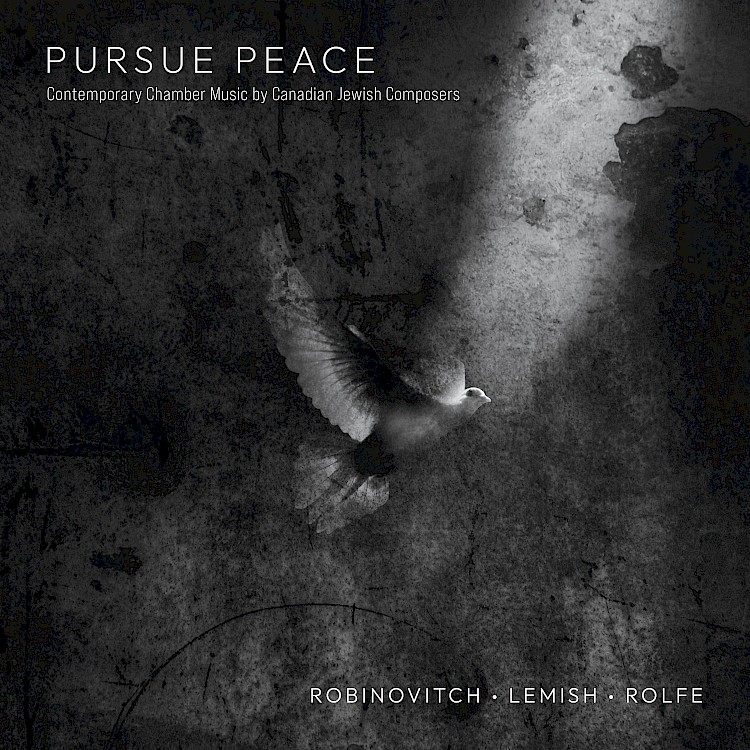
Pursue Peace represents the first volume of a collection of music by Canadian Jewish composers under the "Jewish Music at York" umbrella, curated by composer Noam Lemish. Including works by James Rolfe, Sid Robinovitch, and Lemish himself, the works rotate around themes of conflict, resolution, and peace, engaging with Jewish texts and presenting a diverse range of musical aesthetics.
Pursue Peace is the first project in a series organized by the “Jewish Music at York" initiative from York University in Canada. Led by composer Noam Lemish, the initiative’s mission is to showcase the music of the Canadian Jewish contemporary music community, and to contribute to a climate of dialogue that serves Jewish artists while reaching out to the broader artistic and cultural community. The recording features works by Lemish, Sid Robinovitch, and James Rolfe, integrating Jewish texts and historical context. The compositions, curation, and committed performances all point to a shared conviction about music’s unique capacity to engage with larger issues on an intellectual and emotional level. Two of the works explore Jewish life in contemporary West Asia, while the third looks back to medieval central Europe for inspiration. The composers are subtle in their references to a specifically Jewish musical repertoire, but its presence is felt throughout as they rectify this lineage with each of their individual artistic voices.
Sid Robinovitch’s Adieu Babylon for violin and piano opens the collection, performed by violinist Amy Hillis and pianist Katherine Dowling. Written in 1991, amidst the full blown Persian Gulf War, the work grapples with the turmoil that the region has suffered under over the last several decades. Middle Eastern musical allusions are heard throughout the piece, with characteristic modal colorations embellishing the melodic material. The piece opens with a reverential lament, as the violin spins out rhapsodic lines over a tolling pad. Flowing, rhythmically additive figures enter briefly in unison between the keyboard and violin before the somber opening material returns and is subjected to development. Robinovitch toggles between poignant, nostalgic music and vigorous material, capturing the tension between the centuries old history of the region with the alacrity with which current events were transforming the region at the time. After a frenetic episode of trills, buzzing figures, and tremolos that ascend to the high register in both instruments, we hear an ethereal passage featuring violin harmonics and airy arpeggiations. Vigorous chords interrupt the reverie and drive the work towards three bracing high register accents before quickly disintegrating into pointillistic staccato attacks and angular pizzicati. A coy reprise of the opening mournful music gives way to one more outburst of furious virtuosity before Adieu Babylon closes with lyrical violin phrases that return, searchingly, to the modal material from its opening.
Lemish’s three movement work Pursue Peace for string quartet and clarinet was composed in 2015 for the debut concert of the Israeli-Iranian Musical Initiative, a Toronto based collective active between 2015-2020. The work’s message for peaceful co-existence echoes loudly today, and speaks as well to the long history of friendship between the populations, despite the antagonistic paradigm that currently exists between their respective leadership. The title references the closing words of Psalm 34 (“Avoid evil and do good in the world. Seek and pursue peace.), while the final movement draws inspiration from a musical setting of that same psalm by songwriter Baruch Chait. The opening movement, “What’s the distance between Tel Aviv and Tehran,” engages with physical and metaphorical distance. Lemish captures this duality through a multi-layered texture; the clarinet explores a modal melody that grows from a simple questioning five note motive, supported by flowing, sustained figures in the strings. Clarinetist Eric Abramovitz’s phrases become increasingly ornamental as the accompaniment gains in intensity before receding to a quiet final resolution. “Two Plus Two” draws on material from Israeli composer and songwriter Sasha Argov, and alternates between a lilting, pathos-laden melody and driving passages of repeated notes voiced in close intervallic spacing. A hazy passage midway through the movement staggers fragmentary entrances in the strings, creating a ghostly effect, before Lemish closes the movement with three deliberate pizzicato attacks. The work’s final movement opens with a prayerful solo melody in the clarinet before the strings take the baton with a lush setting of the same material. The clarinet rejoins for a tutti passage, increasingly embellishing the material as Lemish develops motives embedded inside the initial melody. After the movement reaches a resolved cadence, a sustained trill in the clarinet and viola serves as an activated background for a haunting composite melody in high violin harmonics, each new pitch arrival punctuated by a dry pizzicato attack in unison. The work ends amidst this shrouded ambiguity -- to the extent that it explores the dynamic relationship between two nations in conflict, it reflects the unsettling uncertainty that hovers ominmously over the region.
The final work on the recording, James Rolfe’s O Greenest Branch for soprano, vocal ensemble, percussion, and organ, turns its attention to 12th century Germany. Commissioned for a program featuring the music of 12th century composer Hildegard von Bingen, Rolfe reflected on the disparity between the beauty of her music and the violent persecution of the Jewish community in Germany during Hildegard’s lifetime. Rolfe chose to combine sources, setting two texts by Hildegard alongside a medieval lament by Ephraim of Bonn memorializing his fellow Jews alongside a 20th century lament by Chaim Nachman Bialik, connecting the need to bear witness to suffering across generations, and indeed across nations and ethnic groups. Rolfe divides the work's movements cyclically by orchestration, alternating between Sara Schabas’ solo soprano and the vocal ensemble, combining all the forces for the final two movements. The opening movement features the vocal ensemble singing chant-like figures in unison in a moderate, rhythmically irregular dance accompanied by drums. The percolating rhythm is interrupted at select points for the voices to divide from their unison melodies into sonorous harmony. “Lament for the Massacre at Blois” and “On the Slaughter” both feature poignant soprano solos over organ accompaniment, evoking medieval textures without being limited by their restrictive parameters. The former is spare and ritualistic, while the latter vacillates between rigorously rhythmic sections and haunting lyricism. Accented attacks in non-pitched percussion enliven the texture, adding drama and propulsion to the powerful vocal features. The vocal ensemble reenters for brief interludes: in “O Redness of Blood 1,” luminous harmonies build on top of pedal points in the organ, while the soprano soars over the choral voices in “O Redness of Blood 2,” growing towards the final climatic movement, “O Greenest Branch 2.” By combining soloistic vocal material with ensemble singing and instrumental in the work's finale, Rolfe captures the power of collective ritual and individual expression at once for the culminating movement of the piece.
- Dan Lippel
Executive Producer: Noam Lemish
Producer: Cullan Bryant
Producer: Carol Gimbel
Recorded in the Tribute Communities Recital Hall at York University, Toronto, Ontario, Canada, January 24-26, 2025
Engineering: Denis Martin
Editing and Mixing: Denis Martin
Stereo and Dolby Atmos Mastering: Justin Gray
Graphic Design: Yeşim Tosuner
Original Dove photo: Malikmak333/CC-BY-SA-4.0
Noam Lemish is a JUNO-nominated pianist, composer, scholar and educator. He has performed concerts and conducted workshops across Canada, the US, Europe, and in Bhutan and has released multiple albums, including most recently There’s Beauty Enough in Being Here (2025) and the JUNO-nominated Twelve (2022).
Lemish’s transcultural identity is reflected in his music. Over the course of a quarter century of musical creation, he has sought to expand the scope of his exploration, often blurring or ignoring deeply etched boundaries between genres, peoples, and traditions. He is a jazz artist and a classical composer of chamber works, an improviser and an accompanist, an intrepid cross-cultural investigator and an interpreter of contemporary composition. His compositions include jazz works for small and large ensembles, chamber, choral, piano, and “The People’s King”: a commissioned transcultural suite in celebration the King of Bhutan’s 30th birthday, composed while teaching music in the Himalayan Kingdom of Bhutan in 2010. Lemish is currently Associate Professor in the Department of Music at York University, Toronto.
Encompassing a wide variety of musical styles and forms, Sid Robinovitch’s works have been performed throughout North America and abroad, having been featured by groups such as the Elmer Iseler Singers, the Vancouver Chamber Choir, the Amadeus Choir, and the Louisville, Toronto, and Montreal Symphony Orchestras. In addition to his concert works, Robinovitch has written music for film, radio and TV, where he is probably best known for his theme for the CBC-TV satirical comedy series, “The Newsroom”. He has received six JUNO and Western Canadian Music Award nominations and won a Prairie Music Award for outstanding classical composition of the year for his Suite for Klezmer Band and Orchestra, recorded by the Winnipeg Symphony Orchestra under the direction of Bramwell Tovey.
Toronto composer James Rolfe has been commissioned and performed by ensembles, orchestras, choirs, theatres, and opera companies in Canada, the USA, Europe, Asia, Australia, and New Zealand. He has been recognized with a Guggenheim Fellowship, the K. M. Hunter Music Award, the Louis Applebaum Composers Award, the Jules Léger Prize for New Chamber Music, Choral Canada’s Outstanding Choral Work Award, and the Johanna Metcalf Performing Arts Prize. He is a composition instructor at the University of Toronto and frequently works as a composer mentor.
Rolfe’s operas have been performed in Toronto, Halifax, Vancouver, Banff, Edmonton, and New York. Beatrice Chancy (1998, with librettist George Elliott Clarke) played to sold-out houses and rave reviews; The Overcoat (2018, with librettist and director Morris Panych) was premiered by Tapestry Opera with Canadian Stage and Vancouver Opera and nominated for 10 Dora Awards. His collaborators include writers André Alexis, Anna Chatterton, Luke Hathaway, Steven Heighton, Camyar Chai, Alex Poch-Goldin, Dennis Lee, and Sophie Herxheimer, and choreographer James Kudelka.
His solo CDs include raW (2011) and Breathe (2017, nominated for a JUNO Award) on Centrediscs, and Wound Turned to Light (2023, a songbook setting contemporary Canadian poets) on Redshift Records.
Amy Hillis has “a rich, warm sound and has mastered the violin with such ease, that it is impossible to ignore her passion in performance” (Ludwig Van, Montréal). She challenges artistic norms to build community relationships inside and outside the concert hall. As a soloist, Amy has commissioned Canadian works by Luis Ramirez, Matt Brubeck, Fjóla Evans, Gabriel Dufour-Laperrière, Laurence Jobidon, Vincent Ho, Andrew Staniland, Jocelyn Morlock, Nicole Lizée, Carmen Braden, Randolph Peters and Jordan Pal. She is winner of the Pan-Canadian Recital Tour, the Eckhardt-Gramatté National Music Competition, the Canada Council Musical Instrument Bank competition on two occasions, an artistic residency at La Cité Internationale des Arts in Paris, the McGill Concerto Competition, and the Sylva Gelber Foundation Music Award. A passionate chamber musician, she is a founding member of the meagan&amy duo with pianist Meagan Milatz, and the Horizon String Quartet (HSQ) which has performed over 200 school shows for young audiences across Manitoba and Saskatchewan. Amy is currently Associate Professor of Community Music at York University and the Artistic Director of the Women’s Musical Club of Toronto.
Praised by the New York Times for her “crystalline performances, gestural expressiveness, and careful attention to color”, and by the Boston Globe for her “effortless incisiveness”, award-winning “tour-de-force” (OpusKlassiek) pianist Katherine Dowling performs across the Americas and Europe. Katherine is familiar to audiences through regular appearances at Canada’s major music festivals and concert series, including Ottawa Chamberfest and Stratford Summer Music. Recent highlights include her recital debuts in Vienna, The Hague, and Rio de Janeiro. She has premiered over one hundred new works. As a soloist, and as a member of the ensemble Gruppo Montebello, Katherine appears on nine critically acclaimed recordings on the Etcetera label. Her debut solo album Awake and Dreaming was nominated for Classical Album of the Year (Solo Artist) at the JUNO Awards. Her performances have been broadcast on the BBC, National Radio 4 (Netherlands), CBC, and Radio Canada. She credits her teacher, Gilbert Kalish, as the major influence in her musical life.
Noa Sarid is an Israeli violinist and chamber musician. She is first violinist of the Dior Quartet, winners of the 2023 Concert Artist Guild Competition, with performances at Carnegie Hall, Banff International String Quartet Festival, Bravo Vail, and Tippet Rise Art Center. A Naxos Records artist, and a member of the Canadian Chamber Orchestra, she collaborated with the Canadian Children’s Opera Company, Art of Time Ensemble, Gryphon Trio, and Kronos Quartet. Noa teaches at the Royal Conservatory of Music and holds degrees from Indiana University and the Jerusalem Academy of Music and Dance. A 2023 Rebanks Fellow, she is pursuing her doctorate at the University of Toronto.
Originally from Calgary, AB, Toronto-based violist Catherine Gray is a JUNO-nominated ensemble player and orchestral musician. Gray is a tenured member of the Canadian Opera Company (COC) Orchestra and is a tenure-track member of the Naples Philharmonic (Naples, Florida). She regularly performs with the Toronto Symphony Orchestra and the National Ballet of Canada Orchestra. With the COC, Gray performed the offstage viola solos in Puccini’s beloved classics Tosca and Madame Butterfly. As an ensemble player, Gray was nominated for a JUNO Award in 2024 (“Jazz Album of the Year: Group” with Allison Au and the Migrations Ensemble) and has shared the stage with artists including Ed Sheeran, The Who, and the Art of Time Ensemble. Gray completed her Master’s Degree at McGill University and received her Bachelor of Music from the Glenn Gould School, both degrees under the tutelage of Steven Dann.
Mark Chambers is a conductor, cellist and early music specialist. He studied cello with Martha Gerschefski, Lubomir Georgiev and David Miller, and has performed extensively in the United States and Ontario as both a chamber musician and orchestral player. His research interests include scordatura (altered tunings for string instruments), performance anxiety and its effect on performing artists, and the role music can play in the lives of special needs individuals.
Eric Abramovitz is a Montreal-born clarinetist acclaimed for his colourful, versatile artistry. He has served as Principal Clarinet of the Toronto Symphony Orchestra since 2021, after joining the TSO in 2018, and has previously held positions with the Nashville and Santa Barbara Symphony Orchestras. A sought-after guest principal, he performs regularly with the Canadian Opera Company and National Ballet of Canada orchestras and has appeared internationally with ensembles including the Montreal Symphony Orchestra and the New York Philharmonic. A graduate of McGill University and the University of Southern California, he is also a founding member of the Toronto-based klezmer ensemble Schmaltz & Pepper.
Praised for her “beautifully clear, light lyric soprano” (Ludwig Van Toronto), Canadian soprano Sara Schabas has performed as a soloist on three continents. Winner of the 2024 Wirth Vocal Prize, she was nominated for a Dora Award for Outstanding Performance by an Individual, distinguished at the Metropolitan Opera Laffont Competition and the Eckhardt-Gramatté Competition, and named a three-time laureate of the Jeunes Ambassadeurs Lyriques. Career highlights include a recital tour of mainland China, leading roles for Vancouver Opera, Pacific Opera Victoria, Tapestry Opera, the Dayton Opera, and the Aspen Opera Centre, and soloist engagements with the Victoria Philharmonic Choir, Thirteen Strings Ottawa, the Chapelle musicale du Bon-Pasteur, Dayton Philharmonic, and Canadian Opera Company Free Concert Series. A devoted interpreter of new works, she collaborates regularly with composers including Amy Brandon, Cecilia Livingston, Danika Lorèn, and James Rolfe. Born and bred in downtown Toronto, Sara is an avid writer, researcher and librettist. She is the editor of Art Song Canada magazine, and a member of the voice faculty of the Desautels School of Music at the University of Manitoba.
Jane Fingler is a Toronto-based soprano who keeps very busy performing as a soloist and ensemble member with groups such as Tafelmusik, The Trinity Bach Project, The Theatre of Early Music, The Toronto Consort, Diapente and Choir 21. Originally from Winnipeg, she has also performed with Camerata Nova (now “Dead of Winter”), Canzona Baroque choir and Polycoro chamber ensemble. Jane is currently pursuing a DMA in Historical Performance from the University of Toronto.
Vania Lizbeth Chan is a versatile artist, active in vocal performance, academia and education. She enjoys collaborating with fellow artists to create new and exciting projects that entertain, inspire and educate a wide-ranging audience. Vania sings in a variety of styles, her lyric coloratura soprano voice described as “gently shimmering” by Opera News, New York. She made her Carnegie Hall debut in Weill Recital Hall, claiming first prize in the Barry Alexander International Competition. Vania received her Master of Music degree from the Manhattan School of Music and her PhD from York University. Her doctoral dissertation explored the topics of mindfulness and self-regulation. She continues to expand her research through her ongoing interview series “When Music Meets Mindfulness”, available on YouTube (Vania Chan Music) and The WholeNote Magazine. She performs regularly in Toronto and around the world, and frequently works with active composers and producers, bringing their music and creations to life.
Veronika Muggeridge has been praised for her “lovely presence” (Berkshire Fine Arts), “impressively quick and precise coloratura” (Ludwig van Toronto), her “succinct and agile vocal style” and for striking “comic gold” in performance (Opera Canada). Recent concert soloist appearances include Bach’s Mass in B Minor and Christmas Oratorio with the Toronto Choral Society; Beethoven’s Symphony No. 9, Bruckner’s Te Deum and de Falla’s El Amor Brujo with the Scarborough Philharmonic; Mahler’s Rückert-Lieder and Mozart’s Exsultate, jubilate with the Hart House Orchestra; and Bach cantatas with the Trinity Bach Project. Since taking part in Marilyn Horne’s 2018 The Song Continues series at Carnegie Hall and being a 2021 Art of Song Fellow with the Toronto Summer Music Festival, Veronika has presented numerous recitals for the Arts & Letters Club of Toronto, the Linden Project, St. James Cathedral, Metropolitan United, and Concerts @100. Winner of the 2019 Hart House Concerto Competition and the 2014 National Gold Medal in voice performance at the Royal Conservatory of Music, Veronika holds a MMus (2018) in historical voice performance and a BMus (2016) in piano and Italian studies from the University of Toronto.
In demand as both a soloist and ensemble singer, mezzo-soprano Rebecca Claborn performs with some of Canada’s finest ensembles, including the Toronto Mendelssohn Singers, the Elora Singers, Trinity Bach Project, and Toronto-based vocal octet Opus 8. She is a featured soloist on two releases with the Theatre of Early Music: The Heart’s Refuge (JUNO-nominated), and The Vale of Tears, both on the Analekta record label. She also appears on the Toronto Chamber Choir’s 2019 release A Voice of her Own, featuring works by fourteen women composers. Recent recordings include a program of newly recorded Canadian sacred music with Opus 8, the Elora Singers’ recent release In Beauty May I Walk, and Jacques Hétu’s Symphony No. 5 with the Toronto Mendelssohn Choir, the National Arts Centre Orchestra, and the Orchestre symphonique de Québec.
Percussionist Mark Duggan is a versatile performer and composer active in multiple musical genres. A regular performer with the National Ballet of Canada Orchestra and Esprit Orchestra, Mark has also appeared with the Philip Glass Ensemble, Ensemble Intercontemporain de Paris with Pierre Boulez, and Nexus percussion group. He has performed at festivals around the world including the Tongyeong Music Festival in Korea, Lincoln Center in New York, and Montreux Jazz Festival in Switzerland. Duggan is a founding member of Canada’s Evergreen Club Contemporary Gamelan (since 1983) and is a graduate of the University of Toronto and California Institute of the Arts.
Alberta-born pianist Clark Schaufele enjoys a multi-faceted career, spanning genres beyond classical piano. As a pianist and organist, he maintains active performances, tours, and studio recordings, ranging from classical to jazz to country and folk. Recent performances have taken him to Asia, Australia, Europe, South America, and throughout Canada. He served as a piano instructor at University of Regina and York University and presently works at Mount Allison University in the role of staff pianist. He received his Doctorate in Music (Piano Performance) at the Université de Montréal under the guidance of Canadian pianist and educator, Paul Stewart.
Conductor David Fallis is one of Canada’s leading interpreters of operatic and choral/ orchestral repertoire, known especially for his work in the Baroque and Classical periods and contemporary music. He has conducted at the Royal Opera House in Versailles, the Glimmerglass Festival, the Singapore Festival, the Luminato Festival, Festival Vancouver, Houston Grand Opera, the Seoul Arts Centre, Cleveland Opera, Wolftrap Theater, and Utah Opera. As Music Director for Opera Atelier, he has helped bring that company onto stages around the world. On the symphonic stage, he has led the Toronto Symphony Orchestra, the Kitchener-Waterloo Symphony, Orchestra London, the Windsor Symphony, Symphony Nova Scotia, Symphony New Brunswick and the Manitoba Chamber Orchestra. Fallis directs Soundstreams Choir 21, a vocal ensemble specializing in contemporary choral music, and from 1990-2018 he was Artistic Director of the Toronto Consort, a renowned chamber group specializing in the music of the Middle Ages and Renaissance.
New Focus Recordings is an artist-led collective label featuring releases in contemporary creative music of many stripes, as well as new approaches to older repertoire. The label was founded by guitarist Dan Lippel, composer Peter Gilbert in 2004, and composer/engineer Ryan Streber in 2004, formed …Read More …
Listen to full streaming tracks while you browse the site. New tracks enabled for streaming every month. Click on the button to open up the radio player.


