
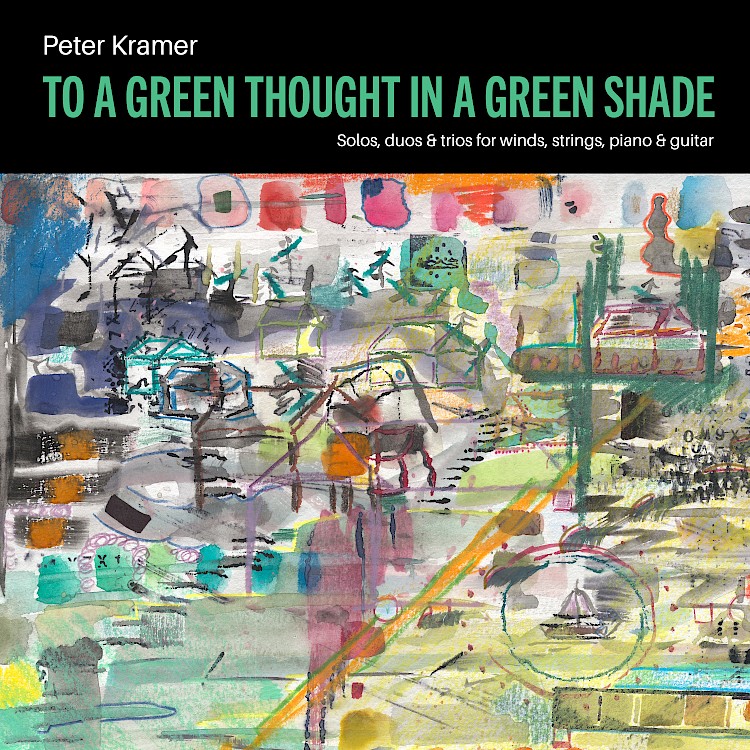
Peter Kramer cultivates a compositional library of ideas from which he draws on and fashions lyrical, thoughtful music. Featuring performances here by Kramer alongside several of his colleagues, his debut full length recording showcases his openness to material drawn from different aesthetic "camps," all in service of his reflective, introspective voice.
The title of composer Peter Kramer's album "To a Green Thought in a Green Shade" takes its name from a line from Andrew Marvell's poem "The Garden:"
"The mind, that ocean where each kind
Does straight its own resemblance find,
Yet it creates, transcending these,
Far other worlds, and other seas;
Annihilating all that’s made
To a green thought in a green shade."
The seven compositions on this album, composed between 2017-2023, consist of material that has been grafted together from piece to piece. Kramer's compositional process borrows liberally from his own stock of draft material which he reworks and contextualizes within new pieces. In this sense, the overarching listening experience on this album can be understood as viewing the fruits of a carefully tended garden of musical ideas that Kramer has cultivated. In addition to his role as composer, Kramer is a featured performer on this album, joined by several close collaborators.
Heights was composed for clarinetist Zachary Good, and bookends the album in two possible performance versions; the opening track of the album was performed on doubled alto recorder and the final track of the album was performed on clarinet. Heights is an arrangement of a composition for harpsichord that Kramer had originally written for and dedicated to his professor Webb William Wiggins. The pitched material is entirely diatonic and references the kind of idioms and textures that one might hear in JS Bach’s suites for solo violin or cello.
Read MoreCopse of Trees takes its name from a strikingly realistic drawing of nature by Leonardo Da Vinci and was composed for bassoonist Ben Roidl-Ward. The structure is that of a collage whereby each measure is culled from first and last measures of nearly every piece from Kramer’s complete catalogue of compositions. The first half of the piece is made up of an assortment of scales and triadic harmonies which meander through different tonalities. This harmonic labyrinth breaks down in the second half of the composition where the bassoon plays static multiphonic gestures separated by large swaths of silence, meanwhile the piano material collapses into an atonal meditation terminating in a fragmented chorale loosely based on the hymn “Schwing’ dich auf zu deinem Gott.”
Still Life was composed for guitarist Daniel Lippel and is dedicated to Kramer's good friend Louis Blair who gave him the guitar that the piece was written on. The work takes inspiration from the countryside of Virginia where Kramer met Blair, capturing the picturesque landscape with lush harmonies and gentle arpeggios.
In Miniature, for cello and piano, is a recomposition of a fragment Kramer composed while first learning to write for these instruments. It is a brief work, under two minutes in length, that strives for a significant emotional affect, performed here by Kramer and cellist John Popham. This material was originally intended as an exercise in 12 tone technique. However, during the recomposition of this work references to traditional tonality percolated and rose to the surface.
Pietà was composed for the Longleash piano trio. The title invokes Michelangelo’s famous sculpture of the same name. The work is arranged in the form of a triptych, a form commonly used in the visual arts to depict the Crucifixion or other divine epiphanies. Kramer writes, "For me, this three-part form evokes death and resurrection — the creative process itself — the birth and renewal of musical material from one composition to another." In this composition the three instruments move at different velocities, the violin being the fastest followed by the slower moving cello and the more sparsely heard piano. Think of moving through a landscape made-up of a foreground, middle-ground and background, or a sonification of the cascading fabric and raging inner voice of a mother holding her dead child as depicted in Michelangelo’s sculpture.
Three Children's Pieces is a composition that Kramer wrote for himself, with material that is based on old sketches that he saw potential in renewing. The work is dedicated to the Southwestern University of Finance and Economics (SWUFE) in Chengdu, China where Kramer taught during the fall semesters of 2024 and 2025. This is perhaps the most tonal work on the album, the trajectory of each movement points towards resolution to C major, a tonality traditionally associated with childlike emotions and affectations.
Limbo Tunes was composed for cellist John Popham and is based on several fragments from Kramer's preexisting compositions which can be heard in snatches throughout the two movements of this work. The accumulation of these fragments culminates in the second movement as a kind of hymn that is woven into the texture of the piece itself, a sort of cantus firmus or through-line, working as a counter balance to the fragmentary nature of the whole.
– Peter Kramer
Recorded on July 14, 2024 (1, 11), December 13, 2023 (2), October 14, 2019 (3), and March 8, 2024 (4, 6-8, 9-10), at Oktaven Audio, Mt. Vernon, NY
Recording engineer & editing: Ryan Streber
Track 5 recorded August 10, 2017 at Loretto Motherhouse, Nerinx, KY
Recording engineer: Chris Kincaid
Editing: Chris Kincaid, Longleash
Mixing and mastering: Chris Kincaid
Produced by Peter Kramer
Cover image: Peter Kramer
Design and layout: Marc Wolf, marcjwolf.com
Post-production advisor: Daniel Lippel
Peter Kramer (b.1989) is a composer, keyboardist and educator based in New York City. He is the featured composer and performer, alongside violinist Pala Garcia, on a forthcoming portrait album of works for violin and piano. Their project is the recipient of a 2021 recording grant from the Aaron Copland Fund for Music. Most recently he has released an album of solos, duos and trios for winds, strings, piano and guitar through New Focus Recordings. Originally from Portland, Oregon Peter spent time studying music at Mount Hood Community College before graduating from the Oberlin Conservatory with a double major in Composition and Harpsichord Performance, and from the CUNY Graduate Center with a PhD in Music Composition. Since 2016 he has taught music courses at Baruch College (CUNY), he has also taught at the Southwestern University of Finance and Economics in Chengdu, China during the 2024 and 2025 fall semesters. Peter is passionate about teaching private piano lessons in New York City and working as an English and Music tutor at Lehman College (CUNY). He has been playing guitar since the age of ten with a focus on American blues and folk music.
https://peterkramermusic.wordpress.com/Zachary Good is a Chicago-based clarinetist, chamber musician, composer, and music educator. He is the clarinetist of the sextet Eighth Blackbird, a member of Ensemble Dal Niente, and Honestly Same. Zachary is the Visiting Assistant Professor of Clarinet at Northern Illinois University. His discography includes releases on Cedille Records, Moon Glyph Records, American Dreams Records, Carrier Records, No Index, Homeroom, Parlour Tapes+, ears&eyes, and his own record label Add Dye Editions.
https://zacharygood.com/Named one of 23 artists “changing the sound of classical music” by the Washington Post, Ben Roidl-Ward has been praised for his “dazzling technique” (The Sydney Morning Herald), “breathless virtuosity” (Bandcamp Daily), and “astounding flexibility and range” (The Double Reed). He is the Assistant Professor of Bassoon at the University of Illinois Urbana-Champaign and Principal Bassoonist of the Chicago Sinfonietta, the Illinois Symphony, and the Champaign-Urbana Symphony. A devoted performer of contemporary music, Ben is the bassoonist of Chicago’s Ensemble Dal Niente and served as a Contemporary Leader and Bassoon Coach for the Lucerne Festival from 2021-2025. Ben’s dedication to working with composers of his generation has led him to premiere over 190 compositions to date. An alum of the Civic Orchestra of Chicago, Ben received his DMA from Northwestern University studying with David McGill. His previous teachers include Ben Kamins (Rice University), George Sakakeeny (Oberlin Conservatory), and Francine Peterson.
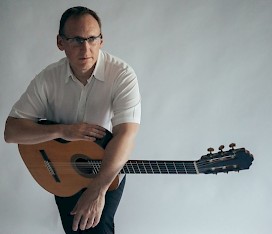 Guitarist Dan Lippel, called a "modern guitar polymath (Guitar Review)" and an "exciting soloist" (NY Times) is active as a soloist, chamber musician, and recording artist. He has been the guitarist for the International Contemporary Ensemble (ICE) since 2005 and new music quartet Flexible Music since 2003. Recent performance highlights include recitals at Sinus Ton Festival (Germany), University of Texas at San Antonio, MOCA Cleveland, Center for New Music in San Francisco, and chamber performances at the Macau Music Festival (China), Sibelius Academy (Finland), Cologne's Acht Brücken Festival (Germany), and the Mostly Mozart Festival at Lincoln Center. He has appeared as a guest with the St. Paul Chamber Orchestra and New York New Music Ensemble, among others, and recorded for Kairos, Bridge, Albany, Starkland, Centaur, and Fat Cat.
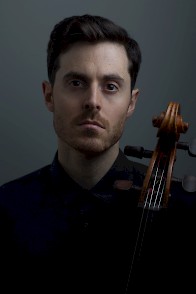 Cellist John Popham is a chamber musician and teacher based in Brooklyn, New York. His playing has been described as “brilliant” and “virtuosic” (Kronen Zeitung), “warm but variegated”, and “finely polished” (The New York Times).
Currently a member of Either/Or Ensemble and LONGLEASH, Mr. Popham has performed internationally with groups including Klangforum Wien, Talea Ensemble, and the Argento Chamber Ensemble. He has appeared as soloist with the Louisville Orchestra, the String Orchestra of Brooklyn, the Red Light Ensemble, and the Kunstuniversität Graz Chorus.
Recent festival appearances include Brücken (Austria), Open Musik (Austria), IMPULS (Austria), the Vermont Mozart Festival, USINESONORE (Switzerland), Bay Chamber (Maine), the Contemporary Classical Music Festival (Peru), Lucerne Festival, and Klangspuren (Austria).
Dedicated to new music performance, Mr. Popham has worked with composers including Pierre Boulez, Tristan Murail, Steve Reich, Nils Vigeland, and Reiko Füting. The recipient of a Fulbright research grant, Mr. Popham spent the 2013/2014 academic year in Austria, where he studied the performance practice of Klangforum Wien and worked with leading figures in contemporary Austrian music: Beat Furrer, Georg Friedrich Haas, Klaus Lang, and Pierluigi Billone.
Mr. Popham is currently cello faculty of the Extension Division of Rutgers University. He received his BM and MM from the Manhattan School of Music where he was a student of David Geber and David Soyer and was awarded the Manhattan School of Music Full Scholarship. He has recorded for Tzadik, Carrier, New Focus, Albany, and Arte Nova records.
http://www.johnpatrickpopham.comPala Garcia is a critically acclaimed violinist whose artistic practice explores the variable nature of interpretation, embodied knowledge, and memory. Praised for her “immaculate, lustrous tone” (The Strad), Garcia brings a unique violinistic sensibility to her creative projects, ensemble work, and contemporary music practice. Garcia was recently named a 2024 National Arts Club Fellow, and was also featured as a leading innovative artist in the Washington Post’s “23 for ’23: Performers and Composers to Watch.”
http://palagarcia.comRenate Tsuyako Rohlfing is a celebrated pianist praised for “pianistic perfection” (Niedersächsische Allgemeine). A prize winner at the Wigmore Hall Song Competition and the Internationaler Wettbewerb für Liedkunst Stuttgart, she has performed at Carnegie Hall, London’s Royal Albert Hall, and the David Koch Theater. Notable festival appearances include Spoleto Festival USA, Wolf Trap Opera, and the Ravinia Festival.
Renate is a full-time Associate Professor at Berklee College of Music, teaching music, psychology, and arts in health. She also serves on the Song Faculty at The Juilliard School and is a recipient of Berklee’s Dean’s Award for Global Presence and Engagement. Her work is supported by the Massachusetts Cultural Council and The Wallace Foundation. Hailing from Honolulu, Hawai‘i, Renate is a graduate of The Juilliard School, New York University, and Manhattan School of Music.
New Focus Recordings is an artist-led collective label featuring releases in contemporary creative music of many stripes, as well as new approaches to older repertoire. The label was founded by guitarist Dan Lippel, composer Peter Gilbert in 2004, and composer/engineer Ryan Streber in 2004, formed …Read More …
Listen to full streaming tracks while you browse the site. New tracks enabled for streaming every month. Click on the button to open up the radio player.


