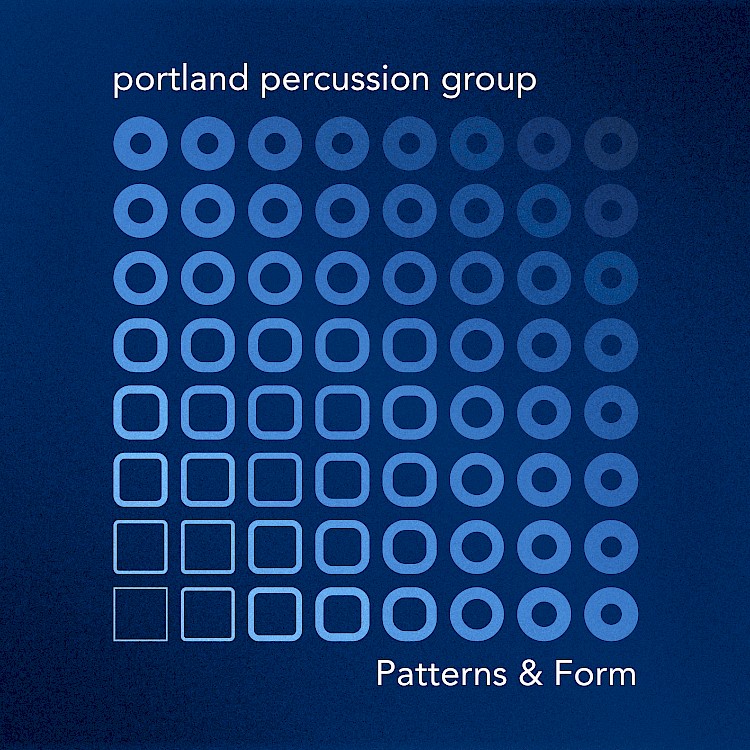
Portland Percussion Group’s newest release features three works commissioned by the ensemble by Alejandro Viñao, Mendel Lee, and Daniel Webbon. Highlighting the ensembles’ virtuosity and range, the works also demonstrate the diversity of compositional approaches to percussion ensemble writing in the current contemporary music scene.
| # | Audio | Title/Composer(s) | Performer(s) | Time |
|---|---|---|---|---|
| Total Time | 40:49 | |||
Patterns & Form | ||||
| Portland Percussion Group, Yoko Greeney, piano | ||||
| 01 | I. The Fabric of Pulse (La Trama del Pulso) | I. The Fabric of Pulse (La Trama del Pulso) | 8:25 | |
| 02 | II. Bells Keep Tolling (Las Campanas siguen Doblando) | II. Bells Keep Tolling (Las Campanas siguen Doblando) | 6:38 | |
| 03 | III. The Fabric of Form (La Trama de la Forma) | III. The Fabric of Form (La Trama de la Forma) | 10:31 | |
| 04 | The Spaces Between | The Spaces Between | Portland Percussion Group | 9:20 |
| 05 | Whatever was lost never thenceforth mattered | Whatever was lost never thenceforth mattered | Portland Percussion Group | 5:55 |
Portland Percussion Group’s newest release features three works that the ensemble brought into being: Alejandro Viñao’s title work, Mendel Lee’s The Spaces Between, and Daniel Webbon’s Whatever was lost never thenceforth mattered. The collection demonstrates the ensembles’ versatility, from metrically intricate, virtuosic interlocking lines, to spacious, delicate textures, to cathartic, vigorous drumming. But it also highlights the wonderful diversity in percussion ensemble repertoire being written today. What was once a landscape of a few high profile pioneering groups has blossomed into one of the most prolific sub-communities in concert music, stretching and challenging the creative frames of composers, performers, and listeners alike. The Portland Percussion Group reinforces their role in this fertile scene with this release, performed with verve and interpretive understanding.
Alejandro Viñao’s Patterns & Form, featuring guest pianist Yoko Greeney, subverts the standard paradigm of minimalist propulsion in several creative ways. In the opening movement, “The Fabric of Pulse (La Trama del Pulso),” we hear surprising additive metric corners, as Viñao shaves off a note in a grouping here and extends a motive there to animate the moto perpetuo texture with vibrant elasticity. There are striking, temporary tempo modulations, where common rhythmic divisions are reinterpreted in a new grouping context. And Viñao incorporates what he terms “polyphony of pulses,” wherein instruments come in and out of phase with each. Viñao uses these techniques to form a series of structural rhythmic modulations, resolving themselves when the ensemble comes together into the simple initial pulse at the end of the movement. All the while, Viñao works within a beguiling harmonic frame, creating a hypnotic halo within which he weaves threads of motivic gesture.
Read MoreThe second movement, “Bells Keep Tolling (Las Campanas siguen Doblando),” is organized around a tolling motif that is consistently present while being rhythmically irregular. Taut gestures are heard in prismatic imitation before fusing into brief, powerful unison statements. Arrivals are embellished by anticipatory ascending flourishes in the mallet instruments; at the 4:30 mark, Viñao downshifts the tempo dramatically for a ritualistic dance based around a sighing descending gesture. Nearly one and half minutes before the end of the movement, Viñao deftly reinterprets a syncopated piano rhythm in triple meter as the new, slower pulse in duple divisions, drawing the texture gradually down to a faint echo.
“The Fabric of Form (La Trama de la Forma)” is inspired by a process pioneered by György Ligeti termed “micro-polyphony.” Indeed, Ligeti’s presence is felt from the sound mass of the opening bars, like heavy droplets of rain falling on a pond. Viñao focuses on the transformation of these amorphous textures, extracting salient rhythmic cells from them as they coalesce into infectious grooves. This process repeats itself several times in the movement, mirroring a trajectory from disorder to order and back again in a cycle. Viñao writes, “the interest here lies more in the process of transformation than in the departures or arrivals.” He treats the pitch language in a parallel fashion, mining the clusters for intervallic content that then populates modal patterns. The overall impression, as with the other movements, is of vital organic forms interacting with each other in a irregular, but nonetheless inherently logical, manner.
Like in Viñao’s final movement, in The Spaces Between Mendel Lee is captivated not with departures or arrivals, but with the sonic journey along the way. But the similarities between the works mostly end there, as Lee’s work stands in textural, energetic, and expressive contrast to the pointillistic persistence of Patterns & Form. The Spaces Between is contemplative and inward facing, using the percussion ensemble as one hybrid instrument and exploring resonating timbres and the ringing textures that connect them. Occasional polyrhythmic punctuations animate tolling sustains, and delicate trills percolate beneath an ethereal chorale of bowed vibraphones.
The album closes with Daniel Webbon’s Whatever was lost never thenceforth mattered, a work inspired by a powerfully disturbing short story by David Foster Wallace, “Incarnations of Burned Children.” Webbon focuses largely on non-pitched percussion in the work, with the exception of a middle section which is anchored by interlocking patterns played by chimes. The piece opens with a dramatic splash of percussive sound before a vigorous rhythm emerges, and a jagged five note gesture presents itself as the motivic seed from which the piece develops. Throughout the textural shifts in the piece, that explosive opening gesture continues to assert its will on the proceedings. In this way, Webbon mirrors Foster Wallace’s integration of a catalyzing event into the formal fabric of his story.
– Dan Lippel
Portland Percussion Group: Garrett Arney, Jonathan Brown, Brian Gardiner, Sijia Huang, Paul Owen, Brett Paschal, Terry Longshore, Christopher Whyte
Patterns & Form:
Portland Percussion Group; Yoko Greeney, piano
Recorded at Mountain View High School, Vancouver, WA, June 2025
Producers: Christopher Whyte and Alejandro Viñao
Recording Engineer: Jonathan Greeney
Editing: Jonathan Greeney
Mixing: Alejandro Viñao
Mastering: Brian Losch
Production Consultant: Svet Stoyanov
Special thanks to Sam Ormson and Mark Claassen
The Spaces Between:
Portland Percussion Group
Recorded at Revolution Hall, Portland, OR, April 2021
Recording Engineer: Jason Powers
Editing and Mixing: Jason Powers
Mastering: Brian Losch
Whatever was lost never thenceforth mattered:
Portland Percussion Group
Recorded at Revolution Hall, Portland, OR, April 2021
Recording Engineer: Jason Powers
Editing and Mixing: Jason Powers
Mastering: Brian Losch
Special thanks to Jim Brunberg and Revolution Hall
Album Artwork: Trevor Calabro
Formed in 2011, the Portland Percussion Group has established itself as a mainstay in the contemporary music space in Portland, Oregon and beyond. After ten years as a quartet, the group expanded in 2021 to a collective of eight members, incorporating a wider range of performers and backgrounds. To date, the PPG has worked with composers to create over 60 new works for percussion chamber ensemble and continues to look for ways to develop new sounds, explore new spaces, and engage new audiences. The group has appeared at festivals and conferences nationally and internationally, and thrives in collaborative endeavors with composers and chamber musicians alike, aiming to champion new and established works for percussion chamber ensemble through live performance and digital mediums. The PPG also extends into educational outreach through involvement with young percussionists in the Northwest region and the creation of new educational opportunities for developing percussionists. The group frequently presents clinics and workshops at universities throughout the Northwest and United States on the topic of chamber percussion repertoire and performance as well as maintaining an ongoing involvement with the Portland Summer Percussion Academy.
If there’s a better example of “moto perpetuo” than the Alejandro Viñao piece that gives this excellent collection its name, I’d like to hear it. With pianist Yoko Greeney joining the octet, the bright noises and sparkling patterns move ever forward for 25 delightful minutes. The recording is gorgeous, too, and the rest of the album, featuring works by Mendel Lee and Daniel Webbon, puts the group’s versatility on full display.
— Jeremy Shatan, 2.20.2026
Percussion music can sound dry and detached. Most of the music on Patterns & Form, out now from Portland Percussion Group, is anything but. Vibrantly rhythmic and restlessly melodic, the three movements of the title piece by Alejandro Viñao brim with warm-blooded energy. “The Spaces Between” by Mendel Lee starts with textural ambient music and finishes with cool, shiny bell pulses. Structurally and timbrally more typical of percussion-ensemble repertoire, the appealing “Whatever was lost never thenceforth mattered” by Daniel Webbon is an exercise in randomness-over-regularity.
Pianist Yoko Greeney joins the members of Portland Percussion Group for Viñao’s opus. The piano is an instrument of multiple natures, and it’s the percussive aspect that the composer stresses here. While prominent in the mix, the piano might just as well be a xylophone or another traditional tonal percussion instrument.
The first movement, “The Fabric of Pulse (La Trama del Pulso),” maintains a constant staccato rhythm while the timbres and tones and melodic fragments shrink, blossom, and evolve continuously. This exciting and vibrant music shows kinship with certain types of progressive rock as well as classic instrumentals like “Tubular Bells.”
Following traditional classical-music form, the second movement is slower, even meditative. It has a similar constant motion, but in rhythms that keeps changing as they support melodies of correspondingly varying character. At the end the sonic landscape shifts to an underwater feel, with chimes and wandering piano notes subsiding into oblivion.
The final movement begins with quietly echoing bells, then rapidly expands into a muscular rhythmic soundscape, still with keen focus on tonal percussion. From there the energy ebbs and flows, time signatures are established and broken, pace quickens and slows, transitions become more dramatic.
Patterns & Form, especially its scintillating first movement, could actually have popular appeal. (Or am I just stuck in the 1970s?)
The first section of Mendel Lee’s aptly titled “The Spaces Between” has a liminal quality, a sense of preparation and potential. What sounds like a quietly tinkling bell beats irregular time over amorphous tonal vibrations from marimbas in a short introductory section. The same instrumentation starts off the second section with a suggestion of Debussy’s “Clair de Lune.”
A moody third mini-movement features marimba in stop-start rhythms as a quiet whistling slowly lowers in pitch, followed by a series of high sighs that increase in volume as if from a backwards recording but achieved by bowing the keys. A bit surprisingly, all the sounds come from mallet strikes on keys. It would not be a stretch to slot the whole nine-minute piece into the category of ambient music, the kind that repays a close listen.
A steady ticking accompanies a drum kit solo and what sound like wood blocks to open “Whatever was lost never thenceforth mattered” by Texas drummer and composer Daniel Webbon. A second section has something reminiscent of a door chime softly ding-donging as the drums continue to play what feel like improvised figures. The playing grows more insistent and a sense of planned chaos grows as the chiming expands in complexity.
This piece too holds to a fast-slow-fast structure, but always dominated by the drums, which convey a sense of struggle. Webbon’s inspiration was a horrific tale by David Foster Wallace, and while the music is abstract, it suggests fear and perhaps violence itself.
The piece clocks in at under six minutes, which is plenty long for a drum solo, and just the right length for this time-bound, wordlessly disturbing abstraction.
— Jon Sobel, 3.27.2026
New Focus Recordings is an artist-led collective label featuring releases in contemporary creative music of many stripes, as well as new approaches to older repertoire. The label was founded by guitarist Dan Lippel, composer Peter Gilbert in 2004, and composer/engineer Ryan Streber in 2004, formed …Read More …
Listen to full streaming tracks while you browse the site. New tracks enabled for streaming every month. Click on the button to open up the radio player.