
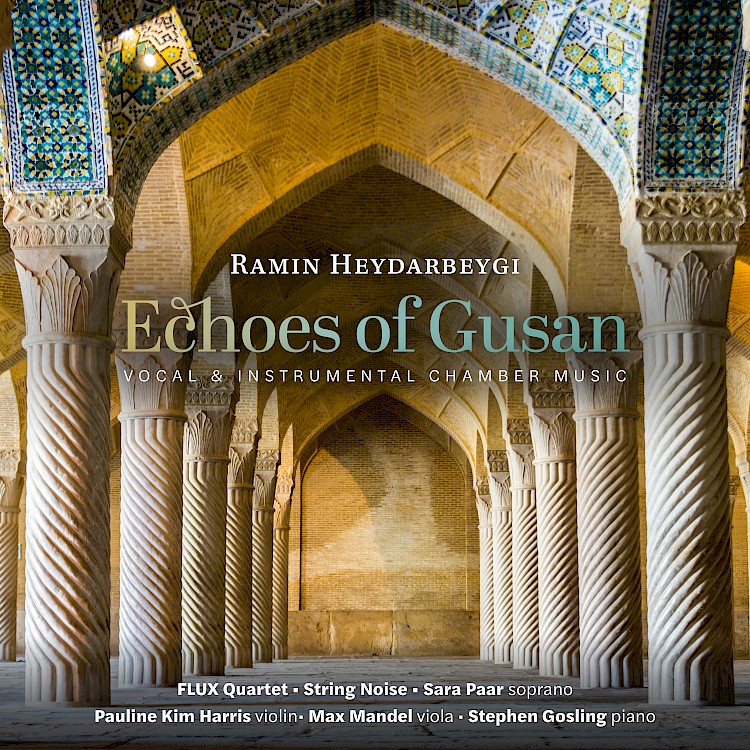
Ramin Heydarbeygi’s music is strongly influenced by Persian aesthetics, especially the concise, intricate, interwoven artistry found in Persian poetry and miniature paintings. Inspired by its beauty and complexity, he has exclusively set Persian poetry to his vocal and choral music. Echoes of Gusan presents selections from his vocal and chamber works, featuring performances by several close collaborators, including violinist Pauline Kim Harris, pianist Stephen Gosling, String Noise, soprano Sara Paar, violist Max Mandel, and FLUX Quartet.
| # | Audio | Title/Composer(s) | Performer(s) | Time |
|---|---|---|---|---|
| Total Time | 71:41 | |||
Rok-ku no Haiku | ||||
| Pauline Kim Harris, violin, Stephen Gosling, piano | ||||
| 01 | I. Poco adagio | I. Poco adagio | 0:58 | |
| 02 | II. Allegro ritmico | II. Allegro ritmico | 0:35 | |
| 03 | III. Calmo | III. Calmo | 1:31 | |
| 04 | IV. Adagio e con devozione | IV. Adagio e con devozione | 1:16 | |
| 05 | V. Sostenuto | V. Sostenuto | 0:36 | |
| 06 | VI. Allegro giocoso | VI. Allegro giocoso | 1:17 | |
Negah | ||||
| Sara Paar, soprano, FLUX Quartet | ||||
| 07 | I. Con grazia; Gisu / The Lover’s Hair | I. Con grazia; Gisu / The Lover’s Hair | 3:08 | |
| 08 | II. Allegro giocoso; Mastam / I’m Drunk | II. Allegro giocoso; Mastam / I’m Drunk | 1:38 | |
| 09 | III. Adagio; Negah / Gaze | III. Adagio; Negah / Gaze | 3:19 | |
| 10 | IV. ♩ = 88; Eshghbazi / Making Love | IV. ♩ = 88; Eshghbazi / Making Love | 1:52 | |
| 11 | V. Largo; Bazaar-e-Eshgh / Love Market | V. Largo; Bazaar-e-Eshgh / Love Market | 2:49 | |
| 12 | VI. Allegretto serioso; Arezu / My Wish | VI. Allegretto serioso; Arezu / My Wish | 4:29 | |
Setayesh az Anahid | ||||
| Tom Chiu, violin, Max Mandel, viola, Felix Fan, cello | ||||
| 13 | I. Presto | I. Presto | 0:21 | |
| 14 | II. Lento | II. Lento | 0:56 | |
| 15 | III. Largo e delicato | III. Largo e delicato | 1:07 | |
| 16 | IV. Moderato | IV. Moderato | 0:36 | |
| 17 | V. Appassionata e espressivo | V. Appassionata e espressivo | 1:07 | |
| 18 | VI. Alla persiano; con motto | VI. Alla persiano; con motto | 1:34 | |
| 19 | VII. Alla breve | VII. Alla breve | 0:08 | |
| 20 | VIII. Adagio e lontano | VIII. Adagio e lontano | 1:38 | |
Muye baraye Farzin | ||||
| Max Mandel, viola | ||||
| 21 | I. Con intensità | I. Con intensità | 0:33 | |
| 22 | II. Adagio | II. Adagio | 3:16 | |
| 23 | III. Elegia, con anima | III. Elegia, con anima | 1:52 | |
| 24 | IV. Con motto | IV. Con motto | 1:21 | |
| 25 | V. Furioso | V. Furioso | 0:43 | |
| 26 | VI. Lento doloroso | VI. Lento doloroso | 1:18 | |
String Quartet No. 2 | ||||
| FLUX Quartet | ||||
| 27 | I. Prestissimo | I. Prestissimo | 0:21 | |
| 28 | II. Lento | II. Lento | 2:07 | |
| 29 | III. Allegro molto | III. Allegro molto | 0:53 | |
| 30 | IV. Adagio e molto cantabile | IV. Adagio e molto cantabile | 2:15 | |
| 31 | V. Allegro | V. Allegro | 0:45 | |
| 32 | VI. Quasi alla marcia | VI. Quasi alla marcia | 0:34 | |
| 33 | VII. Larghetto | VII. Larghetto | 3:25 | |
Gefangene, Musik hörend (after Käthe Kollwitz) | ||||
| String Noise | ||||
| 34 | 0. Quotation from JS Bach | 0. Quotation from JS Bach | 0:46 | |
| 35 | I. Feroce | I. Feroce | 2:40 | |
| 36 | II. Adagio | II. Adagio | 4:29 | |
Gusan | ||||
| Sara Paar, soprano, Conrad Harris, violin, Felix Fan, cello | ||||
| 37 | I. Allegro giocoso; Zamin-e-Xandan / The Laughing Earth | I. Allegro giocoso; Zamin-e-Xandan / The Laughing Earth | 0:40 | |
| 38 | II. Largo; Piri / Old Age | II. Largo; Piri / Old Age | 2:08 | |
| 39 | III. ♩ = 84; Balay Eshgh / Calamity of love | III. ♩ = 84; Balay Eshgh / Calamity of love | 0:35 | |
| 40 | IV. Scherzo; Sereshk-e-Mey / A Drop of Wine | IV. Scherzo; Sereshk-e-Mey / A Drop of Wine | 1:31 | |
| 41 | V. Sostenuto; Marg-e-Mehratan / Death of the Nobles | V. Sostenuto; Marg-e-Mehratan / Death of the Nobles | 5:17 | |
| 42 | VI. ♩ = 88; Qam-e-Asheghi / Sorrow of Love | VI. ♩ = 88; Qam-e-Asheghi / Sorrow of Love | 0:44 | |
| 43 | VII. Andante, non troppo, lamentoso; Pashimani / Regret | VII. Andante, non troppo, lamentoso; Pashimani / Regret | 2:33 | |
The primary source of inspiration for composer Ramin Heydarbeygi is the intricacy of Persian poetry and miniature paintings. The subtleties, interrelated elements, and delicate details found in these disciplines animates the seven works of chamber music with strings heard here on Echoes of Gusan, featuring performances by many of New York City’s most prominent contemporary music interpreters. Heydarbeygi’s penchant for multi-movement works of short duration further reinforces his extramusical models; he paints with substantial musical color on a small canvas.
Violinist Pauline Kim Harris and pianist Stephen Gosling begin the collection with the six movement Rok-ku no Haiku, each a short poetic gem. Heydarbeygi’s style in these compressed pieces is expressive, elegiac, and at times a touch mysterious and coy. Moments of rhapsody are offset by playfulness, as in the contrast between the rhapsodic vibrato laden opening gesture in “Poco adagio,” and the subsequent pointillistic spiccato, or the tiptoeing gesture in “Allegro ritmico” offset by sighing chords. Heydarbeygi turns his focus to specific instrumental techniques to frame individual movements, such as the double stop trills in the violin in “Calmo,” or the ominous inside the piano plucking in "Sostenuto" that creates a brief halo of resonance.
Negah for soprano Sara Paar and the FLUX Quartet sets texts by primarily women poets from Iran, spanning from Rabe’eh in the 10th century to the contemporary poet Parvin Salajegheh. Heydarbeygi compiled these sources into a monodrama, exploring the complex continuum between love, lust, and eroticism. The performers play harmonicas at moments in the piece, and the soprano soloist also plays a hand percussion instrument called a daf. The pizzicato texture in “I’m Drunk” is tempered by the reedy exhale of harmonica sustains and a final relieved sigh in the voice part. “Making Love” opens viscerally, with a wall of overpressure glissandi in the quartet before we hear flushed, sensual gestures in the voice part. “Love Market” begins with arresting accents on the daf, followed by a hushed, somber chorale in the strings and a mournful low register melody in the voice. The work closes with “My Wish,” the longest setting of the work, a freely unfolding movement whose energy is shaped by the ebbs and flows of the text and the drama contained within.
Read MoreSetayesh az Anahid for string trio is Heydarbeygi’s musical homage to the Zoroastrian yazatā and Iranian divinity Nahid, the mother of all knowledge and the one who possesses waters. Setayesh az Anahid is arranged into eight short movements that capture the gravitas and power of their source of inspiration. Heydarbeygi exploits the timbral range and interactive potential of the string trio in these brief movements. “Alla persiano; con motto” features a microtonally ascending cello line and an obscured approach to pitch in all three instruments, lending the gestures a gripping, human quality. “Alla breve” is just that, a short, brusque, three part phrase lasting all of eight seconds. “Adagio e lontano” closes the work in an ethereal haze, ascending into the ether as the texture diffuses into a dewy mist.
Muye baraye Farzin refers to an ancient Iranian tradition of cutting one’s hair as an expression of grief. This six movement virtuoso viola solo is also in six short movements, and excavates a wonderful range of expressive territory on the viola through various techniques, from forceful double stops, to agile pizzicati, to reverent sustains, and limber passagework.
Heydarbeygi’s String Quartet No. 2 is the only non-programmatic music on this recording, though it shares his penchant for constructing large forms from small movements. There is an affinity with the motive centered approach of the Second Viennese School in this piece, an investment in the germination of musical ideas from a seed, and Heydarbeygi returns to those elemental materials in the close of the final movement, paring the texture down to a single unison note.
Gefangene, Musik hörend (after Käthe Kollwitz) for two violins reflects Heydarbeygi’s interest in visual art and the music of Bach. The work opens with a direct quote from the opening of Bach’s C Major Violin Sonata that trails off after forty five seconds. The second movement “Feroce” follows, inverting the dotted rhythm figure from the Bach, drastically increasing its speed, and scrambling the pitches, using the gesture as a jumping off point for variation and extrapolation. The symmetry of Bach’s phrase structure never seems far away, but we are hearing fragments of Bachian impressions filtered through Heydarbeygi’s inner relationship to the music. The final “Adagio” opens with weightless obscurity before we hear dense, fraught harmonies over a pedal point, and closing with rarefied, high register sustains that grind against each other in close proximity before resolving outwards.
The album closes with a companion piece to Negah, Gusan for soprano Sara Paar with violinist Conrad Harris and cellist Felix Fan. Gusan refers to poet-musicians of Iran in the Sassanid era, and Rudaki, whose texts are set here, was a blind harpist and poet of the 9th century who worked in this tradition. As with the other works on the recording, Gusan is divided into short movements, with its longest and most somber, “Death of the Nobles,” anchoring the center of its structure. Ramin Heydarbeygi's capacity for packing significant emotional impact into economical forms echoes throughout this collection, a poetic musical homage to Persian creative traditions that are built on elegant, artful detail and a romantic, idealistic worldview long before "Romanticism" as it became known in Europe was a glimmer on the landscape.
– Dan Lippel
Recorded at Oktaven Audio, Mt. Vernon, NY on September 30 and October 2, 2024
Recording producer: Ryan Streber
Sound engineer: Ryan Streber
Editing, mix and mastering: Ryan Streber
Design & layout: Marc Wolf, marcjwolf.com
Cover photo: Faruk Kaymak; Vakil Mosque, Shiraz, Iran (Unsplash.com)
Booklet images:
p. 5: Folio 35r (The Feast of Faridun and Kundrau), Met Museum;
p. 6: Folio 60v (Manuchihr Enthroned), Met Museum;
p. 8: Folio 110v (Rustam Finds Kay Qubad), Met Museum;
p. 9: MS. Pers. d. 105, fol. 206a, Bodleian Library
p. 12: Folio 80v (Manuchihr Welcomes Sam but Orders War upon Mihrab), Met Museum
p. 13: Bodleian Library MS. Pers. d. 105
p. 17: Folio 60v (Manuchihr Enthroned), Met Museum
Critics have described Ramin Heydarbeygi’s music as “rich and expressive,” and “honest, direct and uncompromising,” with “unique artistic voice . . . well crafted, probing, and rich in content.” His music has been performed in Iran and throughout the US, featured at international music festivals, and presented at Carnegie’s Weill Hall, Le Poisson Rouge, the New York Botanical Garden, Queens Museum of Art, Museum of Arts and Design, Benaroya Hall in Seattle, and Town Hall Seattle; and performed by Da Capo Chamber Players, String Noise, Cygnus Ensemble, Seattle Chamber Players, Dr. Faustus Project, Anti-Depressant, Bronx Arts Ensemble, The Transit, Ensemble 365, Carnegie Hill Chamber Players, FLUX String Quartet, among others.
He was the founding music director and conductor of the Barbad Chamber Orchestra in New York City. With the Barbad Chamber Orchestra he conducted a wide range of music from historically informed performances of the Baroque to premieres by composers of our time. Under his direction, the Barbad presented numerous world, US, and New York premieres by contemporary composers from around the world, including Armenia, Azerbaijan, Bulgaria, Canada, Georgia, Hungary, Iran, Sweden, Ukraine, US, among others, and recorded for the Capstone label.
Ramin Heydarbeygi’s music is strongly influenced by Iranian aesthetics, especially the concise, intricate, interwoven artistry found in Persian poetry and miniature paintings. Inspired by its beauty and complexity, he has exclusively set Persian poetry to his vocal and choral music.
Pauline Kim Harris is a boundary-defying violinist, award-winning recording artist, composer, curator, and producer. Equally at home in a concert hall or an experimental art space, she has performed across the U.S., Canada, Europe, Asia, and Australia as a soloist, collaborator, and music director. Best known as half of the classical avant-punk duo String Noise, Pauline has also toured extensively with the Orpheus Chamber Orchestra, performs regularly with leading new music ensembles in New York City, and is a member of the American Symphony Orchestra. A fierce advocate for innovation, Pauline’s creative work lives at the intersection of sound, movement, and visual art — blending electronics, media, film, and dance into powerful interdisciplinary experiences. Her debut solo album, Heroine (Sono Luminus, 2019) — a bold reimagining of Bach’s Chaconne alongside Ockeghem’s Deo Gratias — was followed by Wild at Heart in 2021, further cementing her status as a genre-fluid artist of rare vision. Her recordings appear on labels including Decca, Tzadik, Northern Spy, Nonesuch, New Focus, Unseen Worlds, Cold Blue, and more. Her performances have been broadcast on PBS, BBC, NPR, WQXR, WNYC, WKCR, and WFMU. Pauline serves as Executive Director of Music at the Anthology (MATA Festival) and was the inaugural Music Director for the Bill T. Jones/Arnie Zane Dance Company. In 2021, she was commissioned to compose the score for Coco Fusco’s Your Eyes Will Be An Empty Word, featured at the Whitney Biennial.
Stephen Gosling earned his Bachelor’s, Master’s, and Doctoral degrees at the Juilliard School, during which time he was awarded the Mennin Prize for Outstanding Excellence and Leadership in Music, and the Sony Elevated Standards Fellowship. He has been a New York City Ballet pianist since 2016, and is a longtime member of contemporary-music groups New York New Music Ensemble and Talea Ensemble. He has additionally been a frequent guest artist of many other groups, including the New York Philharmonic (most notably as soloist in Messiaen’s Sept Haïkaï), Orpheus, the Chamber Music Society of Lincoln Center, Chamber Orchestra of Europe, Orchestra of St. Luke’s, and St. Paul Chamber Orchestra.
Acclaimed as “sensitive to every expression in the text” (New York Concert Review), soprano Sara Paar is an interpreter of contemporary classical music and opera. Ms. Paar is a favorite with composers throughout the United States and has been admired for her beautiful voice, stirring and inherent sense of drama, her sensitive interpretations, and exquisite attention to detail. Ms. Paar has performed both traditional and new works with New York-based ensembles including FLUX Quartet, Ensemble 365, Chelsea Opera, S.E.M. Ensemble, and The Choral Society of the Hamptons. In addition, she has enjoyed premiering and performing the works of Tom Cipullo, Clarice Assad, Reena Esmail, Stefania de Kenessey, Ramin Heydarbeygi, David Wolfson, and many others. Ms. Paar received a doctoral degree in performance from The Graduate Center, City University of New York in June 2017. Her master’s and bachelor’s degrees in Vocal Performance were earned from Binghamton University and the University of Wisconsin-Eau Claire, respectively, and her major teachers have included Stephanie Samaras, Monica Harte, Mary Burgess, and Kathryn Proctor-Duax. Ms. Paar is proud to serve on the Board of Directors for the New York Women Composers, Inc.
The FLUX Quartet, "one of the most fearless and important new-music ensembles around" (Joshua Kosman, The San Francisco Chronicle) "who has brought a new renaissance to quartet music" (Kyle Gann, The Village Voice), has performed to critical acclaim in venues of all sorts, from Carnegie's Zankel Hall and Kennedy Center, to influential art institutions such as EMPAC, The Kitchen, and the Walker Art Center, to international music festivals in Australia, Europe, and the Americas. It has also premiered new works on numerous experimental series, including Roulette, Bowerbird, and the Music Gallery. Strongly influenced by the irreverent spirit and "anything-goes" philosophy of the fluxus art movement, violinist Tom Chiu founded FLUX in the late 90's. The quartet has since cultivated an uncompromising repertoire that follows neither fashions nor trends, but rather combines yesterday's seminal iconoclasts with tomorrow's new voices. Alongside late 20th-century masters like Cage, Feldman, Ligeti, Nancarrow, Scelsi, and Xenakis, FLUX has premiered more than 100 works by many of today's foremost innovators, including Michael Byron, Julio Estrada, David First, Oliver Lake, Alvin Lucier, Marc Neikrug, Matthew Welch; the group has also performed with many influential artists, including Thomas Buckner, Ornette Coleman, Joan La Barbara, Wadada Leo Smith, Henry Threadgill, and many more. The group’s discography includes recordings on the Cantaloupe, Innova, Tzadik, and Cold Blue Music labels, in addition to two critically acclaimed releases on Mode Records that encompass the full catalogue of string quartet works by Morton Feldman. The two volumes feature String Quartet No. 1 and String Quartet No. 2 -- seminal large- scale late works by the iconic composer. FLUX’s radio credits include WNYC’s New Sounds and Soundcheck, WFMU’s Stochastic Hit Parade, and NPR’s All Things Considered
The spirit to expand stylistic boundaries is a trademark of the FLUX Quartet, and thus the quartet avidly pursues projects with genre-transcending artists working in mixed media. These artistic synergies have led to an acclaimed recording with experimental balloonist Judy Dunaway, collaborations with choreographers Pam Tanowitz and Shen Wei, and the 3-D video work Upending with digital art-ensemble, OpenEnded Group. Most recently, FLUX appeared both on film and the soundtrack of River of Fundament, the latest work by visionary artist Matthew Barney and composer Jonathan Bepler.
As part of its mission to support future musical pioneers, FLUX actively commissions, and has been awarded grants from the American Composers Forum, USArtists International, Aaron Copland Fund, and the Meet-The-Composer Foundation. FLUX also discovers emerging composers from its many residencies and workshops at colleges, including Wesleyan, Dartmouth, Williams, Princeton, Rice, and the College of William and Mary.
New music champion and recipient of the Chamber Music America Commissioning Grant, violinist/composer Tom Chiu has performed over 200 premieres worldwide by influential musicians including Ornette Coleman, David First, Oliver Lake, Alvin Lucier, Michael Schumacher, Henry Threadgill, and the late Muhal Richard Abrams. Chiu has also created mixed-media works with choreographer Pam Tanowitz and Eun-Me Ahn, video artist Phill Niblock and Ken Jacobs, balloonist Judy Dunaway, vocalist Jaap Blonk, and Mabou Mines director Lee Breuer. His original works, dedicated to Joan La Barbara, Sylvere Lotringer, Bobby Few, Ensemble Metrix, OpenEnded Group and others, have been commissioned by and/or premiered at the BBC, Mount Tremper Arts, EMPAC, Roulette, STEIM Amsterdam, Bang-on-a-Can Marathon, MOMA PS1, University of Chicago and other institutions. As founder of the FLUX Quartet, he has led a pioneering ensemble which has become “legendary for its furiously committed, untiring performances.” Chiu holds degrees in chemistry and music from Yale and Juilliard, and his album of original works The Live One, was released in 2021 on XI Records.
Violist Max Mandel enjoys a varied and acclaimed career as a chamber musician, orchestral musician, soloist and speaker. Principal Viola of The Orchestra of the Age of Enlightenment and The Scottish Chamber Orchestra, he is also a member of the Mozart specialists Spunicunifait. He has appeared as Guest Principal Viola with The Chamber Orchestra of Europe, The Philharmonia Orchestra, The Australian Chamber Orchestra, The Academy of Ancient Music amongst others. For 23 years he was a member of FLUX Quartet. Recent recordings include Mozart’s Sinfonia Concertante with violinist Aisslinn Nosky on Coro Records and the complete Mozart String Quintets with Spunicunifait on Alpha Classics. Born and raised in Toronto, Canada he lives in London.
Felix Fan is a rare talent in the world of contemporary music. Described by Gramophone as “particularly sublime”, he is one of the most acclaimed, renowned, and respected cellists performing today. As a soloist, collaborative artist and advocate for new music, Felix is admired for his technically refined interpretations and independent spirit, working with diverse and contemporary composers including Philip Glass, Michael Gordon, Hans Werner Henze, Oliver Knussen, David Lang, Meredith Monk, Steve Reich, Terry Riley, Kaija Saariaho, Tan Dun, Julia Wolfe and Charles Wuorinen.
Felix continues to collaborate with the most cutting-edge composers and instrumentalists, “navigating the structural complexities and layers of shifting tempo with flair” (New York Times). A strong advocate for the creation and commissioning of new music, Felix has premiered over 100 works and dozens of recordings in his career. On the world stage, he has appeared at Carnegie Hall, The Kennedy Center, Lincoln Center, Musikverein and the Royal Festival Hall and as a soloist with orchestras including the Hong Kong Philharmonic, National Symphony (Taiwan), and the Munich Chamber Orchestra.
Beyond the world of contemporary music, Felix believes in the power of collaboration between musicians, filmmakers, actors and artists. In this capacity, he worked with director Charlie Kaufman and the Coen Brothers (Fargo) on a live radio play featuring Meryl Streep, Philip Seymour Hoffman and Steve Buchemi. He has also performed with members of Sonic Youth, Wilco and The National.
String Noise, New York’s most daring violin duo comprised of violinists Conrad Harris and Pauline Kim Harris, has expanded the repertoire with over 50 new works since their debut at Ostrava New Music Days in 2011. Nearly a decade later, they continue to break down the boundaries of traditional expectations and inspire innovative compositions, displaying formidable virtuosity, integrating multi-media art, electronics, improvisation, video projections, opera and dance. Premieres by String Noise include works by George Lewis, Christian Wolff, Michael Byron, David Behrman, Alvin Lucier, John King, Phill Niblock, Caleb Burhans, Catherine Lamb, David Lang, Petr Kotik, Du Yun, Annie Gosfield, Bernhard Lang, John Zorn, Greg Saunier, Alex Mincek, Tyondai Braxton, Richard Carrick, to name some.
Violinist Conrad Harris has performed at Ostrava Days, Darmstadt Ferrienkürse für Neue Musik, Gulbenkian Encounters of New Music, Radio France, Warsaw Autumn, and NY Sonic Boom Festival. In addition to playing with Orchestra of St. Luke’s, he is member of the FLUX Quartet and violin duo String Noise, concertmaster/soloist with the S.E.M. Orchestra, Ostravská Banda, STX Ensemble, and Ensemble LPR. He has performed and recorded with Elliott Sharp, Robert Ashley, Alvin Lucier, David Behrman, “Blue” Gene Tyranny, Jean-Claude Risset, Rohan de Saram and Tiny Tim. A recording of the sonatas of Lejaren Hiller was released in 2018 with pianist Joe Kubera on New World Records followed by a CD of the music of John Becker. Harris has also recorded for Lovely, Mode, Asphodel, Vandenburg, CRI, Northern Spy, Cold Blue, New Focus, Chaikin, Infrequent Seams, and Vinyl Retentive Records.
New Focus Recordings is an artist-led collective label featuring releases in contemporary creative music of many stripes, as well as new approaches to older repertoire. The label was founded by guitarist Dan Lippel, composer Peter Gilbert in 2004, and composer/engineer Ryan Streber in 2004, formed …Read More …
Listen to full streaming tracks while you browse the site. New tracks enabled for streaming every month. Click on the button to open up the radio player.


