
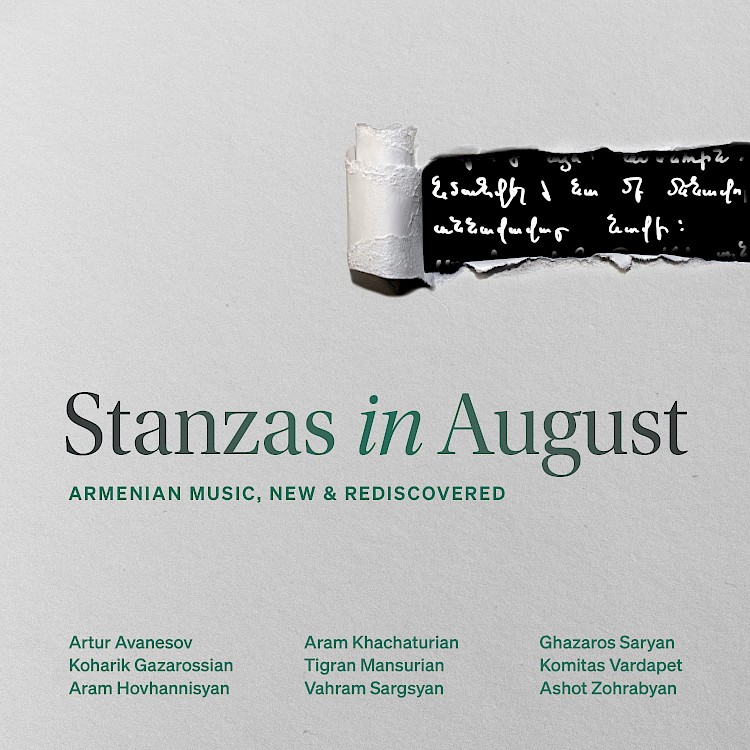
Movses Pogossian and his colleagues in the Armenian Music Project continue their tireless advocacy for the music of Armenia with this ambitious 4 CD collection, Stanzas in August. At the heart of the release are two sub-collections devoted entirely to the music of Ashot Zohrabyan and Koharik Gazarossian, two consequential composers who shaped Armenian music far beyond their own oeuvres. The other discs include lesser known works by Aram Khachaturian, Tigran Mansurian, and Ghazaros Saryan, as well as premieres of piano miniatures by Artur Avanesov, and premieres by Vahram Sargsyan and Aram Hovhannisyan.
Stanzas in August presents the sixth through ninth volumes, released under one cover, of an ambitious and laudable project spearheaded by Movses Pogossian to document the richness and history of modern Armenian concert music. This lineage is framed by some of the most consequential events of the 20th century, including the Armenian Genocide, Soviet rule, and a period of post-Soviet transition that has seen the country turn towards the West. With a diaspora that is 2/3 of the world’s total Armenian population of 11 million people, the shape of Armenian music has absorbed both the viccissitudes of its recent history as well as global influences as it has evolved. Elements of traditional music, sacred repertoire, and internationalist aesthetic trends have seeped into this collective evolution of an Armenian musical style. Pogossian and his colleagues celebrate this vital and ever growing tradition of composition with this four disc set, shining light on crucial figures from Armenia’s musical past as well as some of its most active and influential contemporary voices.
The first disc focuses on chamber ensemble works in various combinations, presenting music by Vahram Sargsyan, Aram Hovhannisyan, Ghazaros Saryan, and Artur Avanesov. Vahram Sargsyan has cultivated an approach to composing for the voice which merges extended techniques, traditional Armenian musical practices, multi-timbral textures, and microtonality. Vox Temporum is scored for voice (Sargsyan himself performing the unique part), saxophone, and string quartet. The voice and saxophone meld together as a hybrid meta-wind instrument, intertwined in melismatic passages while the string quartet frames the harmony. In “Im Annmanin (To My Matchless One),” throat and overtone singing, bird song imitation, and whistling techniques expand the texture multi-dimensionally. “Manook (Little One)” percolates with furtive pizzicati and short articulations, opening up into a halo of brilliant, luminous sonorities. Sargsyan embeds a stealth element within “Calmato e poso allungato;” several gradual ascending glissandi subtly raise the overall pitch by a semitone. The work closes with a mechanical coda, a temporal suspension over which saxophone mutliphonics and vocal whistling float into the ether.
Read MoreAram Hovhannisyan’s String Quartet, dedicated to the memory of one of Armenia’s most impactful musical figures, Ashot Zohrabyan, is taut, charged with electricity. The four instruments behave within a heightened state of vigilant anxiety, each new individual gesture triggering the other instruments in a kind of pinball game of musical reactivity. Hovhannisyan contrasts these kinetic passages with music that holds its explosive energy just beneath the surface of swelling chords and angular punctuations. Ghazaros Saryan represents an important lineage in modern Armenian music, a Soviet era generation of composers that followed Aram Khachaturian. Saryan’s String Quartet #2, written in 1986, opens with a dense, pathos laden chorale, as accented individual entrances form complex vertical voicings. A contrasting middle section features rhythmic vitality, alternating between driving repeated notes, darting pizzicati, and syncopated figures. The collection’s first volume ends with Artur Avanesov’s 2024 trio Unruhig (translated as “unquiet” from German) for clarinet, cello, and piano. Avanesov explores several different roles for the three instruments as their dialogue unfolds. Intially, short melodic bursts circling around one another in restless anticipation. Later the piano plays off-kilter accented chords that frame punctuations from the other instruments. An extended passage features dramatic, passionate phrases in the cello supported by sweeping keyboard fluorishes. The clarinet and keyboard bulld a fleet, jaunty passage in rhythmic unison, culminating in a dramatic moto perpetuo section in the piano, and a return of the irregular repeated note gesture, now heard as an alarming texture in the high register.
The second volume is devoted to solo piano works by Koharik Gazarossian, a composer, pianist, and teacher whose early life unfolded amidst the backdrop of the Armenian genocide in the last years of the Ottoman Empire. Born in Constantinople in 1907, Gazarossian’s family was part of a community of Armenians who were subject to mass arrest, deportation, and subsequent death marches and massacres. Amidst this hostile environment, particularly for intellectuals and artists, Gazarossian’s family managed to survive in what would soon be renamed Istanbul, and she was able to continue her music studies there and later in Paris, absorbing wisdom passed down from mentors who had themselves studied with Lizst, Ravel, and others. Despite the global upheaval in the middle of the 20th century, Gazarossian was able to return to live in Istanbul later in life, and also toured throughout the world as a soloist. While her compositional output extends to chamber music, choral music, and concertos, this collection focuses on her solo keyboard music. Several of the works reflect the incorporation of folk materials and melismatic embellishments into Gazarossian’s writing style for the piano, which is sometimes virtuosic, other times impressionistic, such as Cantique, Cantique de Noël, and “O Sainte Vierge agenouillons-nous devant Toi” from Trois cantiques pour la main gauche. Huit Variations sur un thème populaire du Père Komitas affords an opportunity to hear the tools Gazarossian had at her disposal for developing thematic material, mapping it on an approach that spans ruminating melodies over sonorous chordal accompaniment and jocular, characterful textures that showed her prodiguous facility on the keyboard. The adaptation of a theme by Komitas, the central turn-of-the 20th century figure in Armenian music and indeed a cultural representation of the targets of the genocide itself, reinforces the strong bond Gazarossian maintained with her heritage even as she pursued her studies and career abroad. The two Suites included here demonstrate her unique blend of impressionist and late Romantic tendencies, moving freely between character gems like the hummingbird texture in “L’Oiseau à ma fenêtre,” the rugged “Au son du Davoul,” the Eastern European inflected melancholy of “Nocturne,” and the Lizstian pianism in the two Preludes. Gazarossian imbues the quasi-French Overture Prelude and weighty Fugue from Messe arménienne (O mystère profond) with sufficient ornamentation and invention to elevate them beyond their formal strictures and add her individual stamp. The balance between folk and sacred materials, while not being an exclusive focus, is a core component and foundational concern of Gazarossian’s music. Pianist Nare Karoyan has devoted herself to championing the piano oevre of Gazarossian, and delivers powerful and sensitive performances on this recording.
Volume 3 is dedicated to the chamber music of Ashot Zohrabyan, one of the most pivotal figures in the lineage of Armenian avant-garde composers, beginning with Komitas’ emphasis on traditional music and eschewing of the Romantic mainstream, and extending now to Artur Avenanesov, Vahram Sargsyan, and many others. The spectre of Soviet aesthetic control loomed over Armenian music for much of the 20th century, requiring composers to walk a fine line in their work to conform to imposed expectations while exploring new directions of which they were becoming aware. Zohrabyan’s music stands in the middle of these tensions, and emerges as a body of work that is focused on economy and formal cohesion, steering away from extraneous components of virtuosity and filigree. One hears influences of Ligeti and Lutoslawski in his music, as he moved away from the neo-tonal aesthetic that took hold both in the late and post Soviet world as well as in the West. His three String Quartets presented here, written over the course of twenty six years, are all one movement works; the first two were commissioned for the Kronos Quartet, and stand out for their adventurousness. The first Quartet balances material from a charged opening outburst with delicately lyrical melodic fragments passed between the members of the ensemble. These strains of activity alternate throughout the work. String Quartet #2 contains a reference to a quintessentially Armenian song by Komitas, Antuni (Exile Song), highlighted at 1:08 in an angular motive on the violin of an ascending major 3rd and ending with a double stop minor 9th. The rest of the ensemble stretches this earthy motive, extending its pitches into an accumulating sound mass. Unsettling, sul ponticello tremolos, sharp accented staccato entrances, and syrupy unison lines harmonized by dissonant intervals create uneasiness that is momentarily soothed by passages of ethereal, luminous harmony. Zohrabyan’s third string quartet (2015) is the newest work in this volume, written for Movses Pogossian’s Dilijan Chamber Music Series and given the subtitle Stanzas in August, which in turn named this collection of recordings. Indeed, Zohrabyan organizes the piece as a series of succinct, self-contained stanzas. He writes, “this work purposely lacks consistent development, and short passages of music are separated with suspended rests... My idea was to create poetic music broken down in “strophes,” and to shed such a tender August light over each of them.” The individual sections are gems of expressive clarity, opening with a poignant chorale, and variously moving through fluid imitative lines, propulsive rhythmic passagework, wrenching sustains peppered with accented entrances, pointillistic pizzicati accompanying a haunting melody, and intimate moments of expressive directness.
Zohrabyan’s Piano Sonata, written in 1979 and revised in the 1990s, is a three movement work heard here in one track. It unfolds largely as a meditation on a group of thematic elements, led by a dramatic grace note figure featured in the opening passage. Zohrabyan explores a suite of instrumental behaviors that one might understand as coming from traditional performance practice, embedding them within classical contexts, so as to merge characteristics from different styles instead of tokenizing the folkloric material. This grace note idée fixe reappears in many guises throughout the work, highlighting Zohrabyan’s ingenuity in spinning out a musical cell into myriad extrapolations. These motivic ideas seem to spill over into Zohrabyan’s Cello Sonata, written in the same period, now mapped onto his approach to chamber interaction While the piano articulates similar brilliant fluorishes to those in the Piano Sonata, frequently activating the resonance of the high register, the cello plays rhapsodic lines and ferocious double stops. This contrast between roles, pointliistic on one hand and legato and expansive on the other, frames the work, with two moments of repose providing relief to the overall structure.
The final volume on Stanzas in August, “Soliloquy,” features nine chamber works, seven of them solos, that further illustrate the wide net cast by Armenian composers who were responsive both to global trends and allegiance to aesthetics native to their homeland. Aram Khatchaturian is perhaps Armenia’s most famous composer, but was also one of musical figures most widely associated with the Soviet Union in general. His larger orchestral works are his best known pieces, but the last years in his life he produced a series of more introspective solo chamber works, including the Sonata-Song for viola solo (1976) and Sonata-Monologue for violin solo (1975). The Sonata-Song was Khatchaturian’s final significant composition, It opens with a string of arpeggios that outline implied counterpoint and are connected by fluid melodic lines. Later in the piece, idiomatic viola passagework and coloristic pizzicato chords lead the texture through expressive peaks and valleys. The song referenced in the title is one that is in fact claimed by several West Asian cultures besides Armenian, including, Iranian, Turkish, and Azerbaijani. The violin Sonata-Monologue loosely adheres to sonata form, often developing material more along the lines of a variations set where several themes are present at once. Khatchaturian emphasizes mournful melodic lines with ornamental embellishments that lend the violin a vocal quality. At the 6:25 mark, we hear an uncharacteristic percussive timbre, sounded by the screw of the bow hitting the chin rest. In these two late solo works, we can observe Khatchaturian going outside the extroverted milieu for which he is best known, reaching for an expressive world that is more reflective, and at times more experimental.
Paired with Khatchaturian’s Sonata-Song is Tigran Mansurian’s Ode to the Lotus for solo viola. Mansurian represents a generation of artists after Khatchaturian that was more grounded in writing a distinctly Armenian music, in opposition to the prevailing southern Soviet style that the ruling party in Moscow aimed to cultivate for many of the southern regions of the USSR. But just as Mansurian was more deeply connected to Armenia itself, living there in his later life in contrast to Khatchaturian, he was initially engaged with avant-garde trends that were burgeoning far from Yerevan. Ultimately he imported these avant-garde elements to forge a unique approach to treating traditional materials. Despite the differences in their life trajectories, Ode to the Lotus and Sonata-Song have quite a bit in common, shaped by a similar approach to motivic development, timbral expansion through the use of pizzicati, and shared expressive textures on the viola.
Artur Avanesov’s Dies ist ein Lied fur dich allein is scored for singing male cellist, specifically calling for the intimacy of a non-professional vocal approach. The piece sets texts by Stefan George, whose writings had been set by Webern, Adorno, and Egon Wellesz. Avanesov references a Baroque performance practice with an initial theme by Marin Marais, relying on implied counterpoint, accented appogiaturas, and tonal harmonic progressions to evoke the grandeur of that style. Within that frame, Avanesov subverts expectations with more contemporary instrumental techniques and pitch content, with the inclusion of the voice acting as a kind of ritualistic internal mantra that accompanies the cello.
Chinar es is a traditional Armenian rural folk song that is heard in three treatments. Komitas’ transcription of the folk theme is realized for piano by Villy Sargsyan that captures the serene simplicity of the tune (track six). The other two settings are by Avanesov from his book of piano solos, Feux Follets. First we hear a chorale setting (track two) with tone clusters and parallel perfect intervals that gives the theme a reverent, sacred quality. Avanesov provides one additional setting (track four) of the tune, this time in the form of a late Renaissance set of variations, with Dutch composer Jan Pieterszoon Sweelinck’s music as a model. Suonare is Avanesov’s solo piano homage to Ashot Zohrabyan, incorporating elements of Baroque, Armenian music, and jazz into an improvisatory fantasy. Finally, Stanzas in August closes with Cadenza for solo violin performed by Movses Pogossian, an adapated version of a new cadenza Avanesov wrote for Khatchaturian’s Violin Concerto. Avanesov consciously fused elements of avant-gardists Xenakis and Berio with materials from the Khatchaturian concerto, creating a dynamic merge of aesthetics across eras. In this way, Cadenza is a perfect ending for this remarkable contribution to the trajectory of modern Armenian music, a chronicle of a living tradition that has been shaped, but never daunted, by the historically transformative events that have taken place during its evolution.
– Dan Lippel
Recorded at the Ostin Music Center, UCLA Herb Alpert School of Music, Los Angeles
May 18, 2024: Avanesov Cadenza, Saryan Quartet No. 2
December 16, 2024: Zohrabyan String Quartet No. 1
January 4-9, 2025:
Avanesov: Unruhig, Dies ist ein Lied für dich allein, Chinar Es..., Chinar Es II, Suonare
Khachaturian: Sonata-Monologue
Komitas: Chinar Es
Mansurian: Ode to the Lotus
Zohrabyan: String Quartet No. 3, Piano Sonata, Cello Sonata
March 11, 2025: Khachaturian Sonata-Song
April 29, 2025: Zohrabyan String Quartet No. 2
April 30-May 5, 2025: Piano Works of Gazarossian
May 30, 2025: Sargsyan Vox Temporum
June 1, 2025: Hovhannisyan String Quartet
Executive Producer and Artistic Director: Movses Pogossian
Engineer, Recording, Editing, Mixing, Mastering: Sergey Parfenov
Director, UCLA Armenian Music Program: Melissa Bilal
Artur Avanesov, editor, Movses Pogossian, producer and editor (Avanesov Dies ist ein Lied für dich allein; Unruhig; Suonare; Chinar Es...; Chinar Es II; Komitas Chinar Es; Zohrabyan Cello Sonata, Piano Sonata)
Varty Manouelian, producer, Movses Pogossian, editor (Zohrabyan String Quartets No. 1 and No. 2)
Yoshika Masuda, producer, Movses Pogossian, editor (Saryan String Quartet No.2)
Florian Noack, producer and editor, Nare Karoyan, editor (Piano Works of Gazarossian)
Irina Osetinskaya, producer and editor (Sargsyan Vox Temporum and Hovhannisyan String Quartet)
Sergey Parfenov, producer, Movses Pogossian, editor (Avanesov Cadenza)
Movses Pogossian, producer and editor (Zohrabyan Quartet No.3; Khachaturian Sonata-Monologue, Sonata-Song; Mansurian Ode to the Lotus)
Album cover: Irene Baghdasaryan
Design & layout: Marc Wolf, marcjwolf.com
Photo credits: Sona Andreasyan, Irene Baghdasaryan, David Balasanyan, Melissa Bilal, Varty Manouelian, Emma Martirosyan, Narekatsi Institute, Movses Pogossian
Text editing: Irene Baghdasaryan
Translations: Artur Avanesov, Vahram Sargsyan
Armenian-born violinist Movses Pogossian made his American debut with the Boston Pops in 1990, about which Boston Globe wrote: “There is freedom in his playing, but also taste and discipline. It was a fiery, centered, and highly musical performance…”. Winner of several international competitions, he has performed worldwide. As a chamber musician, Pogossian has performed with members of the Tokyo, Kronos, and Brentano string quartets, and with such artists as Kim Kashkashian, Jeremy Denk, Lynn Harrell, Ani and Ida Kavafian, and Rohan de Saram. Movses Pogossian was the Founding Artistic Director of the critically acclaimed Dilijan Chamber Music Series since 2005 for 15 seasons. A committed champion of new music, Pogossian has premiered over 100 works, and works closely with composers such as G. Kurtág, K. Saariaho, T. Mansurian, Gabriela Lena Frank, Artur Avanesov, and Vache Sharafyan. Pogossian's discography includes the Complete Sonatas and Partitas by J. S. Bach, albums "Inspired by Bach", "Blooming Sounds", "In Nomine”, and “Hommage à Kurtág”. The Bridge Records CD of Complete Violin Works of Stefan Wolpe made the 2015 Top Ten list in Sunday Times (UK), and the 2020 releases of Armenian contemporary music: “Modulation Necklace” (New Focus Recordings) and “Con Anima” (ECM) have garnered critical acclaim. He is a Distinguished Professor of Violin at the UCLA Herb Alpert School of Music and also Founder and Advisor of the UCLA Armenian Music Program.
https://schoolofmusic.ucla.edu/people/movses-pogossian/Vahram Sargsyan (Sarkissian) is an Armenian-Canadian composer, conductor, and singer based in Montreal. His music bridges early Armenian chant and contemporary experimentation, spanning influences from fifth-century modal traditions to innovative extended vocal techniques. His works have been performed in more than thirty countries, including the United Kingdom, Germany, Sweden, Austria, Italy, Switzerland, Japan, Canada, and the United States. Recipient of the 2023 Jules Léger Prize for New Chamber Music and named Artist of the Year 2024 in Laval by the Conseil des arts et des lettres du Québec, Sargsyan is also active internationally as an experimental vocalist. He has cultivated a distinctive vocal language characterized by exceptional range, a wide palette of timbral colors, and a creative integration of both traditional and newly explored sound-production methods. He co-founded Phth, a Montréal-based experimental vocal ensemble that explores the boundaries between composition, improvisation, and extended voice. His Great Mystery appears in the Oxford University Press anthology World Carols for Choirs and has been recorded by the BBC Singers. His instrumental work Hunting the Hunter was premiered under his baton at Carnegie Hall in 2012. Sargsyan’s Epitaphios was commissioned by Movses Pogossian and was premiered at the Dilijan Chamber Music Series, and his choral composition Joyful Light has been performed internationally more than a hundred times. Sargsyan lectures and gives workshops on extended vocal techniques at leading choral festivals and international symposia. Educated at the Yerevan State Conservatory and McGill University, he holds advanced degrees in composition and choral conducting. He is a member of the Composers’ Union of Armenia and the Canadian League of Composers.
Canadian-American saxophonist Jan Berry Baker has performed as a soloist, chamber, and orchestral musician on many of the world’s great stages. Recent engagements include performances across the United States, Canada, Japan, Mexico, France, Germany, Scotland, England, Ukraine, Switzerland, Austria, and the Czech Republic. An advocate of contemporary music, Jan is Co-Artistic Director and saxophonist with Atlanta-based new music ensemble Bent Frequency. Founded in 2003, Bent Frequency brings the avant-garde to life through adventurous and socially conscious programming, cross-disciplinary collaborations, and community engagement. Together with Co-Artistic Director Stuart Gerber, they have commissioned over 50 new works for saxophone and percussion and have given numerous performances of these works across the USA, Mexico, and Europe including their Carnegie Hall debut in 2016. Jan regularly performs with orchestras such as the LA Philharmonic and Lyric Opera of Chicago, and has appeared with the Chicago Symphony Orchestra, Atlanta Symphony Orchestra, Joffrey Ballet, and Paris Opera Ballet. As an artist and educator, Jan has held residencies at the Summer Institute for Contemporary Performance Practice (SICPP), Nürnberg Tage Aktueller Musik, New Music on the Point (VT), and is highly sought after as a masterclass teacher and speaker. Dr. Baker is Professor of Saxophone and Woodwind Area Head at the Herb Alpert School of Music at UCLA.
Varty Manouelian made her American Debut in 1993 with the North Carolina Symphony as First Prize winner of the Bryan International Competition. Shehas also been a prize winner at a number of other competitions in Europe, including the Kotzian International Competition and the Wieniawski International Violin Competition. Manouelian has recorded and appeared as a soloist with numerous orchestras in the United States, Bulgaria, Russia, Armenia, Poland, Spain and Italy. Her chamber music performances include Marlboro Music Festival, Apple Hill Festival, Sebago Festival, El Paso Festival, Olympic Music Festival, among others. She has collaborated as a chamber musician with such artists as Kim Kashkashian, Rohan de Saram, Garrick Ohlsson, Nobuko Imai, Thomas Adès, Yuja Wang, Joshua Bell, and members of the Juilliard, Guarner, Tokyo, Brentano, Borromeo, and Mendelssohn string quartets. Dedicated teacher and educator, Varty Manouelian is a Lecturer of Violin at the UCLA Herb Alpert School of Music and spends summers coaching chamber music at the Apple Hill Festival in New Hampshire. Her recent CD of Complete Violin Works of Stefan Wolpe (jointly with Movses Pogossian) made the 2015 Top Ten list in Sunday Times (UK). Varty Manouelian holds degrees from the State Music Academy in Bulgaria and the Cleveland Institute of Music, where she studied with Boyan Letchev and Donald Weilerstein.
Taiwanese-American violist Che-Yen Chen has established himself as an active performer and educator. Since winning First Prize in the 2003 Primrose International Viola Competition and the “President Prize” of the Lionel Tertis International Viola Competition, he was described as a musician whose “most impressive aspect of his playing was his ability to find not just the subtle emotion, but the humanity hidden in the music.” As the founding and former member of the Formosa Quartet, he won the first prize in the 2006 London International String Quartet Competition, founded the Formosa Chamber Music Festival in Taiwan, and has released recordings on EMI, Delos, New World, and Bridge Records. Chen was the principal violist of the San Diego Symphony and Mainly Mozart Festival Orchestra for eight years and has appeared as guest principal viola with Los Angeles Philharmonic, Los Angeles Chamber Orchestra, San Francisco Symphony, Cincinnati Symphony Orchestra, National Arts Centre Orchestra, and Toronto Symphony. A former Lincoln Center Chamber Music Society Two member, Chen frequently performs and teaches at music festivals across North America and Asia, and is a Professor of Viola Performance and Chamber Music at UCLA Herb Alpert School of Music, Chen joined the renowned Ehnes Quartet in 2023.
Andrew McIntosh is a Grammy-nominated violinist, violist, composer, and baroque violinist who teaches at the California Institute of the Arts, with a wide swath of musical interests ranging from historical performance practice of the Baroque era to improvisation, microtonal tuning systems, and the 20th-century avant-garde. As a baroque performer McIntosh is a member of Tesserae, Bach Collegium San Diego, and Musica Angelica. As a chamber musician he is a member of the Formalist Quartet, Wild Up, and Wadada Leo Smith’s Red Koral Quartet, with whom he recently recorded a 7-CD box set of Smith’s String Quartets 1-12. He has worked personally with a wide range of composers including Christian Wolff, Sofia Gubaidulina, Sir Peter Maxwell Davies, Helmut Lachenmann, Tom Johnson, and Jürg Frey. As a composer he often works with forms and ideas found in nature or in other artistic disciplines, working in instrumental, vocal, and fixed media forms, and was described by Alex Ross in the New Yorker as “a composer preternaturally attuned to the landscapes and soundscapes of the West". His compositions have been featured at venues including Walt Disney Concert Hall, Ojai Festival, the Gaudeamus Festival, and recent commissions include works for the Los Angeles Philharmonic, The Industry opera company, Yarn/Wire, the Calder Quartet, and violinists Ilya Gringolts, Movses Pogossian, Lorenz Gamma, and Marco Fusi.
http://www.septimalcomma.com/Niall Tarō Ferguson, a Los Angeles native, is a versatile cellist, composer, and orchestrator. He’s freelanced in both concert and commercial music, working with cellists like Antonio Lysy and Lynn Harrell. Niall has been featured on “The Voice” and performed at the 2019 Grammy Awards with Shawn Mendes and Miley Cyrus. He studied composition at UCLA, earning his bachelor’s in 2017 under mentors like Ian Krouse and Bruce Broughton.
Cellist Edvard Pogossian was the proud Overall Winner, Strings Winner, and Audience Prize Winner at the Tunbridge Wells International Music Competition in 2022. As the winner of the Juilliard Concerto Competition, Edvard performed the Tchaikovsky Rococo Variations at David Geffen Hall in New York and at the Harris Theater in Chicago with the Juilliard Orchestra under the direction of Itzhak Perlman. The Chicago Tribune praised Edvard’s performance for his “astonishing musical and technical maturity,” as well as his “winning lightness of touch to everything he played, combined with a velvety tone.” He has appeared as a soloist with the Boston Pops, Hollywood Bowl Orchestra, Royal Northern Sinfonia, and the New Mexico Philharmonic. Edvard attended Yellow Barn and the Marlboro Festival from 2019 to 2022. Highly committed to chamber music, he is a member of Trio Isimsiz, who have performed throughout Europe, most notably at the Wigmore Hall. He is a frequent guest principal cello in the Royal Northern Sinfonia.
Artur Avanesov is a composer, performer, and assistant professor of music at the American University of Armenia. He was the Chair of the Department of Musical Composition at the Yerevan State Conservatory where he previously studied piano and composition, and pursued postgraduate studies in composition. In 2005, he earned a Doctor of Arts degree with his research on Zen Buddhism in the music of the 20th century. Avanesov took piano master classes as a member of the Lucerne Festival Academy in Switzerland, and with Ensemble Recherche in Freiburg, Germany. He collaborated and performed with world-renowned musicians including Pierre Boulez, Krzysztof Penderecki, Rohan de Saram, Kim Kashkashian, Anja Lechner, Vladimir Chernov, Tony Arnold, Tigran Mansurian, Movses Pogossian. His chamber, vocal, choral and piano compositions have been performed internationally, and recorded on major labels such as Deutsche Grammophon, Brilliant Classics, New Focus, Albany Records, etc. As a composer and performer, Avanesov contributed to the foundation of a number of Armenian and international contemporary music ensembles, and as a musicologist, his scholarship has appeared in various publications.
Surrounded by contemporary art, dozens of vinyl records, and a piano, Nare Karoyan grew up in Armenia. This abundance of art continues to shape her life today and has given her many lasting experiences with actors, writers, visual artists, composers. Being blessed with fantastic chamber music partners such as cellists Ivan Karizna and Ira Givol as well as violinist Sylvia Huang on the one hand and singers Ruzan Mantashyan, Judith Hoffmann and Benjamin Hewat-Craw on the other has been enriching. Nare studied at the conservatories in Berlin, Cologne, and Karlsruhe in the classes of renowned musicians Pierre-Laurent Aimard, Pascal Devoyon, Peter Eicher as well as Anthony Spiri, one of the assistants of the late Nikolaus Harnoncourt. The influence of her teachers being full of curiosity for the new, unknown or forgotten left its deep mark on her CD recording Shadowlines (Quartziade, 2016) with music by Leoš Janáček, Federico Mompou, George Benjamin, and Robert Schumann. Two further recordings of the 24 Etudes (Piano Classics, 2022), as well as this album, with other works for solo piano by the Turkey-born Armenian composer Koharik Gazarossian, are the result of a search for cultural roots in a globalized world—a search that has occupied and driven Nare privately, artistically, and academically for several years.
Born in Yerevan, Armenia, Aram Hovhannisyan studied composition with Levon Chaushyan and flute with Evgeni Noninyan at the Yerevan Komitas State Conservatory (1999–2003). From 2003 to 2018 he lived in Switzerland, where he continued his studies at the Haute École de Musique de Genève, studying composition with Michael Jarrell and electroacoustic music with Rainer Boesch, and earned a Master of Arts in Composition. He also took part in masterclasses with Klaus Huber, Péter Eötvös and Tristan Murail. Hovhannisyan’s music has received international recognition, including First Prizes at the Pre-Art Competition (2005), Musikfestival Bern (2011) and Mizmorim Festival (2018), as well as the Kiefer-Hablitzer Award (2011). His works have been commissioned by leading festivals and institutions such as Monte-Carlo Spring Arts, Lucerne Zu Ostern Festival, Norddeutscher Rundfunk, Dilijan Chamber Music Series, Swiss Chamber Music Festival and Mizmorim Festival. He has collaborated with prominent contemporary music ensembles including Collegium Novum Zürich, Klangforum Wien, L’Ensemble Orchestral Contemporain, Ensemble XX. Jahrhundert, Ensemble Reconsil, Aequatuor, Pre-Art Soloists, Ensemble Proton, Ensemble Paul Klee, Ensemble 24 and MCME. Since 2017 Hovhannisyan has served as Artistic Director of Ensemble Assonance and the Crossroads Festival in Yerevan. He has been Vice-Rector for Academic Affairs at the Yerevan Komitas State Conservatory since 2018, where he also teaches composition.
Ghazaros Saryan was born on September 30, 1920 in Rostov-on-Don into an artistically distinguished Armenian family. His father was the painter Martiros Saryan and his mother Lusik Aghayan, daughter of the writer Ghazaros Aghayan. After moving to Yerevan in childhood, he studied at the Komitas State Conservatory (1934–1938) with Vardges Talyan and Sargis Barkhudaryan, continued at Moscow’s Gnessin College with Vissarion Shebalin, and completed his composition studies at the Moscow Conservatory in 1950 under Dmitri Kabalevsky, Dmitri Shostakovich, and Anatoly Alexandrov. After serving in the Red Army during World War II, Saryan returned to Yerevan and began teaching at the State Conservatory, where he was rector from 1960 to 1986 and later headed the composition department. Among his students were Tigran Mansurian, Ruben Altunyan, Ruben Sargsyan, Vardan Achemyan, and Armenuhi Karapetyan. Saryan’s style is poised and introspective; his music balances formal objectivity with a quiet poetic sensibility. His harmonies often draw on Armenian modal elements, creating a sound world that is contemplative, finely textured, and vividly atmospheric. Among his most renowned works are the Symphonic Images (1955), the painterly cycle Armenia: Symphonic Panels (1966), and his Symphony (1980). These compositions, praised for their sense of proportion and atmosphere, earned him wide recognition, including the Armenian SSR State Prize in 1983 for his contributions to music. Widely respected as both composer and pedagogue, Saryan helped shape a generation of Armenian musicians. He died in Yerevan on May 27, 1998.
Composer, pianist, and music educator Koharik Gazarossian (Koharig Ghazarosyan) was born in Constantinople/Istanbul in 1907. Graduating the Paris Conservatory, she toured Europe, the United States, Lebanon, and Egypt performing as a concert pianist in major concert venues including the Carnegie Hall, Salle Gaveux, and the Wigmore Hall. She composed piano, chamber, and vocal works, a small part of which were published during her lifetime by Éditions Durand and Éditions Choudens in Paris and appeared in Armenian periodicals. Based in Turkey and France, Gazarossian became a liaison between musicians in her native community, Armenia, and the diaspora by organizing and hosting numerous concerts in Istanbul. She was an active member of a circle of Armenian feminist intellectuals, writers, and artists in Istanbul and one of the first woman composers of the Republic of Turkey. Her archive is now housed at Yerevan’s Matenadaran, the Mesrop Mashtots Institute of Ancient Manuscripts, and the Museum of Literature and Arts named after Yeghishe Charents.
Ashot Zohrabyan was born in Yerevan on January 29, 1945. He studied composition at the Yerevan Komitas State Conservatory (1967–1972) with Grigor Yeghiazaryan, later joining the faculty and eventually becoming Professor of Composition. From 1972 to 2008 he also taught at the Arno Babajanyan Music-Pedagogical College. His distinctions include Honored Artist of the Republic of Armenia (2012) and the RA Ministry of Culture Gold Medal (2017). An Armenian composer known for refined, contemporary chamber writing, Zohrabyan built a catalogue centered on compact instrumental and ensemble works. Representative compositions include Serenade and Parable for 13 soloists, Elegy for string ensemble, Ritual for three flutes, Knots for organ, a Violin Concerto for strings, sonatas for piano and for cello, and three String Quartets. Both No. 1 “Narcissus” (1994) and No. 2 “For Kronos” (2004) were commissioned by and written for the Kronos Quartet, while No. 3 “Stanzas in August” (2016) was commissioned by violinist Movses Pogossian for the Dilijan Chamber Music Series in Los Angeles. His works have been performed in Russia, Ukraine, Belarus, France, Germany, Switzerland, the United States, and elsewhere. Zohrabyan’s music is noted for clarity of form, restraint of gesture, and finely wrought textures. Folk-derived intonations surface as subtle intervallic color rather than quotation, while occasional microtonal inflections act as expressive means. The result is a poetic yet taut musical voice, marked by inner tension, fluid motivic lines, and rich melismatic features, giving shape to some of the most distinctive Armenian chamber music of the late 20th and early 21st centuries.
Aram Khachaturian was born on June 6, 1903 in Tiflis (now Tbilisi, Georgia) to an Armenian family immersed in folk music and dance. In 1921 he moved to Moscow, where he studied cello at the Gnessin Institute and later composition at the Moscow Conservatory with Nikolai Myaskovsky, graduating in 1936. His Piano Concerto (1936) established his reputation, followed by the Violin Concerto (1940) for David Oistrakh and the Cello Concerto (1946) for Sviatoslav Knushevitsky. These concertos, along with the Masquerade Suite (1944), reveal his hallmark rhythmic vitality, melodic clarity, and rich orchestral color. The ballets Gayane (1942) and Spartacus (1950–54, rev. 1968) brought him international fame; the Sabre Dance from Gayane became one of the most frequently performed pieces of the twentieth century. Khachaturian also wrote three symphonies, chamber and film music, and numerous works for theatre. He taught at both the Gnessin Institute and the Moscow Conservatory and, from 1957, served as Secretary of the Union of Soviet Composers. Though briefly censured in 1948 under the Zhdanov decree, his music remained central to Soviet and international concert life. Khachaturian’s style combines energetic rhythm, modal inflection, and broad lyricism drawn from Armenian and Caucasian folk traditions. His vivid, direct musical voice secured his place as the most internationally renowned Armenian composer of all time. He died in Moscow on May 1, 1978 and is buried at the Komitas Pantheon in Yerevan.
Tigran Mansurian was born on 27 January 1939 in Beirut (Lebanon). In 1947 he and his family returned to their homeland in Armenia. After having attended a special music school, Mansurian studied composition at the Yerevan Conservatory, where he subsequently taught music analysis with special emphasis on New Music. Within the space of only a few years he advanced to become one of Armenia’s leading composers. As time went on he developed friendly artistic relationships with composers such as A. Schnittke, S. Gubaidulina and A. Pärt, and with performers such as N. Gutman, K. Kashkashian, A. Lyubimov, and others. In the 1990s, Mansurian served as director of the Yerevan Conservatory. Mansurian’s extensive catalog includes orchestral works, seven concertos for string instruments and orchestra, sonatas for violoncello and piano, three string quartets, choral music, chamber music, and works for solo instruments. Mansurian has said that his models were the Armenian composer Komitas and Claude Debussy. Early in his career he became acquainted with the music of Pierre Boulez, and was soon able to make deft use of complicated modern compositional techniques. In the course of time he developed an increasingly simple and almost liturgical style. Mansurian’s music reflects the heritage of the venerable musical tradition of Armenia, which dates back more than a thousand years. The composer’s sensitivity and his understanding of the spirit of the age find expression in his attempt to rebuild the musical bridges that were destroyed in the final years of the twentieth century.
Komitas Vardapet (Father Komitas, née Soghomon Soghomonyan) was born in Gudina/Kütahya (then Ottoman Empire, present-day Turkey) where he started his singing career as a church cantor. Orphaned at a young age, he was sent to the Gevorgian Theological Seminary of Holy Echmiadzin in Vagharshapat (then Russian Empire, present-day Armenia). Graduating in 1893 ordained as a celibate priest and well-versed in both Western classical and Armenian liturgical music, he left for Berlin in 1896 on a scholarship to study performance and composition at Richard Schmidt’s private music school. During his time there, he also attended musicology and museum studies classes by Oskar Fleischer, Heinrich Bellermann, and Max Friedländer at the Friedrich Wilhelm University (Humboldt University of Berlin today) and attended the founding meetings of the International Musical Society (Internationale Musikgesellschaft, IMG). Upon his return to Echmiadzin in 1899, he worked as the music teacher of the seminary and the director of the cathedral choir. He continued his music research by collecting, transcribing, and analyzing poetic and melodic variants of folk songs and by studying the history, theory, and notation system of Armenian church music. Throughout the next decade, he paid regular visits to various urban centers in the Caucasus and Europe, formed local choirs and gave concerts of new music he wrote based on his collection of Armenian sacred and secular songs. He presented papers in IMG’s annual conferences, contributed to its journal, and printed a series of his folk song arrangements through music publishers in Europe. Moving to Constantinople in 1910, he focused his strengths on training the younger generation as performers and educators of Armenian music. His efforts toward establishing a conservatory in the Ottoman capital were interrupted by the Armenian Genocide, during which he fell victim to the purge against Armenian intellectuals. As one of the eight survivors from the prison camp he was deported to, he suffered from deteriorating mental health, and was eventually transferred to a clinic in a suburb of Paris, where he spent the rest of his life. Komitas Vardapet is celebrated today for his innovations in creating an Armenian musical language in Western classical forms, by his foundational work in Armenian, Kurdish, Turkish, and international music scholarship, and by his pedagogy of forming communal choirs to pass down the rich repertoire he created.
New Focus Recordings is an artist-led collective label featuring releases in contemporary creative music of many stripes, as well as new approaches to older repertoire. The label was founded by guitarist Dan Lippel, composer Peter Gilbert in 2004, and composer/engineer Ryan Streber in 2004, formed …Read More …
Listen to full streaming tracks while you browse the site. New tracks enabled for streaming every month. Click on the button to open up the radio player.


