
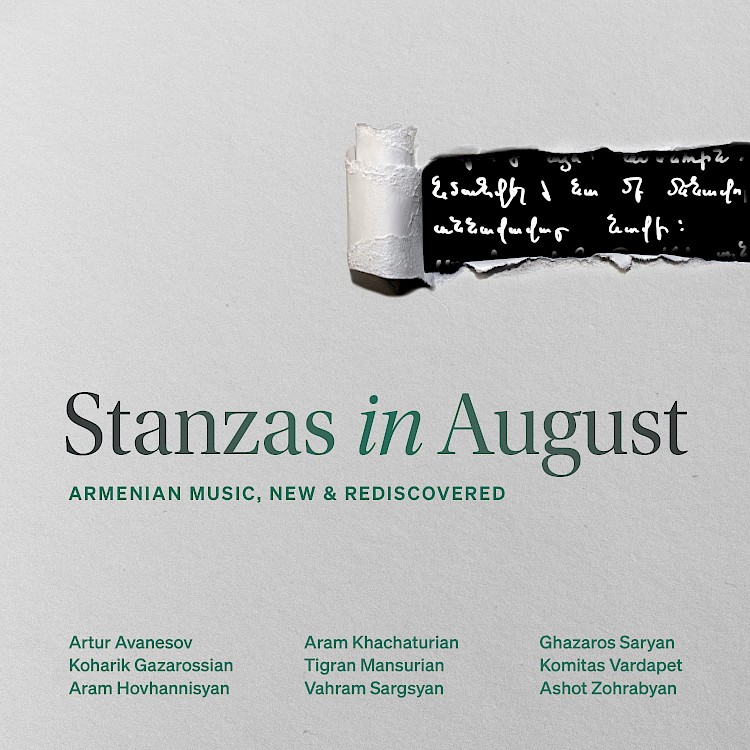
Movses Pogossian and his colleagues in the Armenian Music Project continue their tireless advocacy for the music of Armenia with this ambitious 4 CD collection, Stanzas in August. At the heart of the release are two sub-collections devoted entirely to the music of Ashot Zohrabyan and Koharik Gazarossian, two consequential composers who shaped Armenian music far beyond their own oeuvres. The other discs include lesser known works by Aram Khachaturian, Tigran Mansurian, and Ghazaros Saryan, as well as premieres of piano miniatures by Artur Avanesov, and premieres by Vahram Sargsyan and Aram Hovhannisyan.
Stanzas in August presents the sixth through ninth volumes, released under one cover, of an ambitious and laudable project spearheaded by Movses Pogossian to document the richness and history of modern Armenian concert music. This lineage is framed by some of the most consequential events of the 20th century, including the Armenian Genocide, Soviet rule, and a period of post-Soviet transition that has seen the country turn towards the West. With a diaspora that is two-thirds of the world’s total Armenian population of 11 million people, the shape of Armenian music has absorbed both the vicissitudes of its recent history as well as global influences as it has evolved. Elements of traditional music, sacred repertoire, and internationalist aesthetic trends have seeped into this collective evolution of an Armenian musical style. Pogossian and his colleagues celebrate this vital and ever growing tradition of composition with this four disc set, shining light on crucial figures from Armenia’s musical past as well as some of its most active and influential contemporary voices.
The first disc focuses on chamber ensemble works in various combinations, presenting music by Vahram Sargsyan, Aram Hovhannisyan, Ghazaros Saryan, and Artur Avanesov. Vahram Sargsyan has cultivated an approach to composing for the voice which merges extended techniques, traditional Armenian musical practices, multi-timbral textures, and microtonality. Vox Temporum is scored for voice (Sargsyan himself performing the unique part), saxophone, and string quartet. The voice and saxophone meld together as a hybrid meta-wind instrument, intertwined in melismatic passages while the string quartet frames the harmony. In “Im Annmanin (To My Matchless One),” throat and overtone singing, bird song imitation, and whistling techniques expands the texture multi-dimensionally. “Manook (Little One)” percolates with furtive pizzicati and short articulations, opening up into a halo of brilliant, luminous sonorities. Sargsyan embeds a stealth element within “Calmato e poso allungato;” several gradual ascending glissandi subtly raise the overall pitch by a semitone. The work closes with a mechanical coda, a temporal suspension over which saxophone multiphonics and vocal whistling float into the ether.
Read MoreAram Hovhannisyan’s String Quartet, dedicated to the memory of one of Armenia’s most impactful musical figures, Ashot Zohrabyan, is taut, charged with electricity. The four instruments behave within a heightened state of vigilant anxiety, each new individual gesture triggering the other instruments in a kind of pinball game of musical reactivity. Hovhannisyan contrasts these kinetic passages with music that holds its explosive energy just beneath the surface of swelling chords and angular punctuations. Ghazaros Saryan represents an important lineage in modern Armenian music, a Soviet era generation of composers that followed Aram Khachaturian. Saryan’s String Quartet No. 2, written in 1986, opens with a dense, pathos laden chorale, as accented individual entrances form complex vertical voicings. A contrasting middle section features rhythmic vitality, alternating between driving repeated notes, darting pizzicati, and syncopated figures. The collection’s first volume ends with Artur Avanesov’s 2024 trio Unruhig (translated as “unquiet” from German) for clarinet, cello, and piano. Avanesov explores several different roles for the three instruments as their dialogue unfolds. Initially, short melodic bursts circle around one another in restless anticipation. Later the piano plays off-kilter accented chords that frame punctuations from the other instruments. An extended passage features dramatic, passionate phrases in the cello supported by sweeping keyboard flourishes. The clarinet and keyboard build a fleet, jaunty passage in rhythmic unison, culminating in a dramatic moto perpetuo section in the piano, and a return of the irregularly repeated note gesture, now heard as an alarming texture in the high register.
The second volume is devoted to solo piano works by Koharik Gazarossian, a composer, pianist, and teacher whose early life unfolded amidst the backdrop of the Armenian Genocide in the last years of the Ottoman Empire. Born in Constantinople in 1907, Gazarossian’s family was part of a community of Armenians who were subject to mass arrest, deportation, and subsequent death marches and massacres. Despite this hostile environment, particularly for intellectuals and artists, Gazarossian’s family managed to survive in what would soon be renamed Istanbul, and she was able to continue her music studies there and later in Paris, absorbing wisdom passed down from mentors who had themselves studied with Lizst, Ravel, and others. Despite the global upheaval in the middle of the 20th century, Gazarossian was able to return to live in Istanbul later in life, and also toured throughout the world as a soloist. While her compositional output extends to chamber music, choral music, and concertos, this collection focuses on her solo keyboard music.
Several of the works reflect the incorporation of folk materials and melismatic embellishments into Gazarossian’s writing style for the piano, sometimes virtuosic, other times impressionistic, such as Cantique, Cantiques de Noël, and “O Sainte Vierge agenouillons-nous devant Toi” from Trois cantiques pour la main gauche. Huit Variations sur un thème populaire du Père Komitas affords an opportunity to hear the tools Gazarossian had at her disposal for developing thematic material, mapping it on an approach that spans ruminating melodic over sonorous chordal accompaniment and jocular, characterful textures that showed her prodigious facility on the keyboard. The adaptation of a theme by Komitas, the central turn of the 20th-century figure in Armenian music and indeed a cultural representation of the targets of the genocide itself, reinforces the strong bond Gazarossian maintained with her heritage even as she pursued her studies and career abroad. The two Suites included here demonstrate her unique blend of impressionist and late Romantic tendencies, moving freely between character gems like the hummingbird texture in “L’Oiseau à ma fenêtre,” the rugged “Au son du Davoul,” the Eastern European inflected melancholy of “Nocturne,” and the Lizstian pianism in the two Preludes. Gazarossian imbues the quasi-French overture Prélude and weighty Fugue from Messe arménienne (O mystère profond) with sufficient ornamentation and invention to elevate them beyond their formal strictures and add her individual stamp. The balance between folk and sacred materials, while not being exclusive, is a core component and foundational concern of Gazarossian’s music. Pianist Nare Karoyan has devoted herself to championing the piano oeuvre of Gazarossian, and delivers powerful and sensitive performances on this recording.
Volume 3 is dedicated to the chamber music of Ashot Zohrabyan, one of the most pivotal figures in the lineage of Armenian avant garde composers, beginning with Komitas’ emphasis on traditional music and eschewing of the Romantic mainstream, and extends now to Artur Avanesov, Vahram Sargsyan, and many others. The specter of Soviet aesthetic control loomed over Armenian music for much of the 20th century, requiring composers to walk a fine line in their work to conform to imposed expectations while exploring new directions that they were becoming aware of. Zohrabyan’s music stands in the middle of these tensions, and emerges as a body of work that is focused on economy and formal cohesion, and steers away from extraneous components of virtuosity and filigree. One hears influences of Ligeti and Lutosławski in his music, as he moved away from the neo-tonal aesthetic that took hold both in the late and post-Soviet world as well as in the West. His three String Quartets presented here, written over the course of twenty six years, are all one movement works; the first two were commissioned for the Kronos Quartet, and stand out for their adventurousness. The first Quartet balances material from a charged opening outburst with delicately lyrical melodic fragments passed between the members of the ensemble. These strains of activity alternate throughout the work. String Quartet No. 2 contains a reference to a quintessentially Armenian song by Komitas, Antuni (Exile Song), highlighted at 1:08 in an angular motive on the violin of an ascending major 3rd and ending with a double stop minor 9th. The rest of the ensemble stretches this earthy motive, extending its pitches into an accumulating sound mass. Unsettling, sul ponticello tremolos, sharply accented staccato entrances, and syrupy unison lines harmonized with dissonant intervals create uneasiness that is momentarily soothed by passages of ethereal, luminous harmony. Zohrabyan’s third string quartet (2015) is the newest work in this volume, written for Movses Pogossian’s Dilijan Chamber Music Series and given the subtitle Stanzas in August, which in turn named this collection of recordings. Indeed, Zohrabyan organizes the piece as a series of succinct, self-contained stanzas. He writes, “this work purposely lacks consistent development, and short passages of music are separated with suspended rests... My idea was to create poetic music broken down in 'strophes,' and to shed such a tender August light over each of them.” The individual sections are gems of expressive clarity, opening with a poignant chorale, and moving variously through fluid imitative lines, propulsive rhythmic passagework, wrenching sustains peppered with accented entrances, pointillistic pizzicati accompanying a haunting melody, and intimate moments of expressive directness.
Zohrabyan’s Piano Sonata, written in 1979 and revised in the 1990s, is a three movement work heard here in one track. It unfolds largely as a meditation on a group of thematic elements, led by a dramatic grace note figure featured in the opening passage. Zohrabyan explores a suite of instrumental behaviors that one might understand as coming from traditional performance practice, embedding them within classical contexts, so as to merge characteristics from different styles instead of tokenizing the folkloric material. This grace note idée fixe reappears in many guises throughout the work, highlighting Zohrabyan’s ingenuity in spinning out a musical cell into myriad extrapolations. These motivic ideas seem to spill over into Zohrabyan’s Cello Sonata, written in the same period, now mapped onto his approach to chamber interaction. While the piano articulates similar brilliant flourishes to those in the Piano Sonata, frequently activating the resonance of the high register, the cello plays rhapsodic lines and ferocious double stops. This contrast between roles, pointillistic on one hand and legato and expansive on the other, frames the work, with two moments of repose providing relief to the overall structure.
The final volume on Stanzas in August, “Soliloquy,” features nine works, seven of them solos, that further illustrate the wide net cast by Armenian composers who were responsive both to global trends and allegiance to aesthetics native to their homeland. Aram Khatchaturian is perhaps Armenia’s most famous composer, but was also one of musical figures most widely associated with the Soviet Union in general. His larger orchestral works are his best known pieces, but the last years in his life he produced a series of more introspective solo chamber works, including the Sonata-Song for viola solo (1976) and Sonata-Monologue for violin solo (1975). The Sonata-Song was Khatchaturian’s final significant composition. It opens with a string of arpeggios that outline implied counterpoint and are connected by fluid melodic lines. Later in the piece, idiomatic viola passagework and coloristic pizzicato chords lead the texture through expressive peaks and valleys. The song referenced in the title is one that is in fact claimed by several West Asian cultures besides Armenian, including Iranian, Turkish, and Azerbaijani. The violin Sonata-Monologue loosely adheres to sonata form, often developing material more along the lines of a variations set where several themes are present at once. Khatchaturian emphasizes mournful melodic lines with ornamental embellishments that lend the violin a vocal quality. At the 6:25 mark, we hear an uncharacteristic percussive timbre, sounded by the screw of the bow hitting the chin rest. In these two late solo works, we can observe Khatchaturian going outside the extroverted milieu for which he is best known, reaching for an expressive world that is more reflective, and at times more experimental.
Paired with Khatchaturian’s Sonata-Song is Tigran Mansurian’s Ode to the Lotus for solo viola. Mansurian represents a generation of artists after Khatchaturian that was more grounded in writing a distinctly Armenian music, in opposition to the prevailing southern Soviet style that the ruling party in Moscow aimed to cultivate for many of the southern regions of the USSR. But just as Mansurian was more deeply connected to Armenia itself, living there in his later life in contrast to Khatchaturian, he was initially engaged with avant garde trends that were burgeoning far from Yerevan. Ultimately, he imported these avant garde elements to forge a unique approach to treating traditional materials. Despite the differences in their life trajectories, Ode to the Lotus and Sonata-Song have quite a bit in common, shaped by a similar approach to motivic development, timbral expansion through the use of pizzicati, and shared expressive textures on the viola.
Artur Avanesov’s Dies ist ein Lied für dich allein is scored for singing male cellist, specifically calling for the intimacy of a non-professional vocal approach. The piece sets texts by Stefan George, whose writings had been set by Webern, Adorno, and Egon Wellesz. Avanesov references a Baroque performance practice with an initial theme by Marin Marais, relying on implied counterpoint, accented appoggiaturas, and tonal harmonic progressions to evoke the grandeur of the style. Within that frame, Avanesov subverts expectations with more contemporary instrumental techniques and pitch content, with the inclusion of the voice acting as a kind of ritualistic internal mantra that accompanies the cello.
Chinar es is a traditional Armenian rural folk song that is heard in three treatments. Komitas’ transcription of the folk theme is realized for piano by Villi Sargsyan and captures the serene simplicity of the tune. The other two settings are by Avanesov from his book of piano solos, Feux Follets. On Chinar Es..., we hear a chorale setting with tone clusters and parallel perfect intervals that gives the theme a reverent, sacred quality. Avanesov provides one additional setting of the tune with Chinar Es II, this time in the form of a late Renaissance set of variations, with Dutch composer Jan Pieterszoon Sweelinck’s music as a model.
Suonare is Avanesov’s solo piano homage to Ashot Zohrabyan, incorporating elements of Baroque, Armenian music, and jazz into an improvisatory fantasy. Finally, Stanzas in August closes with Cadenza for solo violin performed by Movses Pogossian, an adapated version of a new cadenza Avanesov wrote for Khatchaturian’s Violin Concerto. Avanesov consciously fused elements of avant gardists Xenakis and Berio with materials from the Khatchaturian concerto, creating a dynamic merging of aesthetics across eras. In this way, Cadenza is a perfect ending for this remarkable contribution to the trajectory of modern Armenian music, a chronicle of a living tradition that has been shaped, but never daunted, by the historically transformative events that have taken place during its evolution.
– Dan Lippel
Recorded at the Ostin Music Center, UCLA Herb Alpert School of Music, Los Angeles
May 18, 2024: Avanesov Cadenza, Saryan Quartet No. 2
December 16, 2024: Zohrabyan String Quartet No. 1
January 4-9, 2025:
Avanesov: Unruhig, Dies ist ein Lied für dich allein, Chinar Es..., Chinar Es II, Suonare
Khachaturian: Sonata-Monologue
Komitas: Chinar Es
Mansurian: Ode to the Lotus
Zohrabyan: String Quartet No. 3, Piano Sonata, Cello Sonata
March 11, 2025: Khachaturian Sonata-Song
April 29, 2025: Zohrabyan String Quartet No. 2
April 30-May 5, 2025: Piano Works of Gazarossian
May 30, 2025: Sargsyan Vox Temporum
June 1, 2025: Hovhannisyan String Quartet
Executive Producer and Artistic Director: Movses Pogossian
Engineer, Recording, Editing, Mixing, Mastering: Sergey Parfenov
Director, UCLA Armenian Music Program: Melissa Bilal
Artur Avanesov, editor, Movses Pogossian, producer and editor (Avanesov Dies ist ein Lied für dich allein; Unruhig; Suonare; Chinar Es...; Chinar Es II; Komitas Chinar Es; Zohrabyan Cello Sonata, Piano Sonata)
Varty Manouelian, producer, Movses Pogossian, editor (Zohrabyan String Quartets No. 1 and No. 2)
Yoshika Masuda, producer, Movses Pogossian, editor (Saryan String Quartet No.2)
Florian Noack, producer and editor, Nare Karoyan, editor (Piano Works of Gazarossian)
Irina Osetinskaya, producer and editor (Sargsyan Vox Temporum and Hovhannisyan String Quartet)
Sergey Parfenov, producer, Movses Pogossian, editor (Avanesov Cadenza)
Movses Pogossian, producer and editor (Zohrabyan Quartet No.3; Khachaturian Sonata-Monologue, Sonata-Song; Mansurian Ode to the Lotus)
Album cover: Irene Baghdasaryan
Design & layout: Marc Wolf, marcjwolf.com
Photo credits: Sona Andreasyan, Irene Baghdasaryan, David Balasanyan, Melissa Bilal, Varty Manouelian, Emma Martirosyan, Narekatsi Institute, Movses Pogossian
Text editing: Irene Baghdasaryan
Translations: Artur Avanesov, Vahram Sargsyan
Armenian-born violinist Movses Pogossian made his American debut with the Boston Pops in 1990, about which Boston Globe wrote: “There is freedom in his playing, but also taste and discipline. It was a fiery, centered, and highly musical performance…”. Winner of several international competitions, he has performed worldwide. As a chamber musician, Pogossian has performed with members of the Tokyo, Kronos, and Brentano string quartets, and with such artists as Kim Kashkashian, Jeremy Denk, Lynn Harrell, Ani and Ida Kavafian, and Rohan de Saram. Movses Pogossian was the Founding Artistic Director of the critically acclaimed Dilijan Chamber Music Series since 2005 for 15 seasons. A committed champion of new music, Pogossian has premiered over 100 works, and works closely with composers such as G. Kurtág, K. Saariaho, T. Mansurian, Gabriela Lena Frank, Artur Avanesov, and Vache Sharafyan. Pogossian's discography includes the Complete Sonatas and Partitas by J. S. Bach, albums "Inspired by Bach", "Blooming Sounds", "In Nomine”, and “Hommage à Kurtág”. The Bridge Records CD of Complete Violin Works of Stefan Wolpe made the 2015 Top Ten list in Sunday Times (UK), and the 2020 releases of Armenian contemporary music: “Modulation Necklace” (New Focus Recordings) and “Con Anima” (ECM) have garnered critical acclaim. He is a Distinguished Professor of Violin at the UCLA Herb Alpert School of Music and also Founder and Advisor of the UCLA Armenian Music Program.
https://schoolofmusic.ucla.edu/people/movses-pogossian/Vahram Sargsyan (Sarkissian) is an Armenian-Canadian composer, conductor, and singer based in Montreal. His music bridges early Armenian chant and contemporary experimentation, spanning influences from fifth-century modal traditions to innovative extended vocal techniques. His works have been performed in more than thirty countries, including the United Kingdom, Germany, Sweden, Austria, Italy, Switzerland, Japan, Canada, and the United States. Recipient of the 2023 Jules Léger Prize for New Chamber Music and named Artist of the Year 2024 in Laval by the Conseil des arts et des lettres du Québec, Sargsyan is also active internationally as an experimental vocalist. He has cultivated a distinctive vocal language characterized by exceptional range, a wide palette of timbral colors, and a creative integration of both traditional and newly explored sound-production methods. He co-founded Phth, a Montréal-based experimental vocal ensemble that explores the boundaries between composition, improvisation, and extended voice. His Great Mystery appears in the Oxford University Press anthology World Carols for Choirs and has been recorded by the BBC Singers. His instrumental work Hunting the Hunter was premiered under his baton at Carnegie Hall in 2012. Sargsyan’s Epitaphios was commissioned by Movses Pogossian and was premiered at the Dilijan Chamber Music Series, and his choral composition Joyful Light has been performed internationally more than a hundred times. Sargsyan lectures and gives workshops on extended vocal techniques at leading choral festivals and international symposia. Educated at the Yerevan State Conservatory and McGill University, he holds advanced degrees in composition and choral conducting. He is a member of the Composers’ Union of Armenia and the Canadian League of Composers.
Canadian-American saxophonist Jan Berry Baker has performed as a soloist, chamber, and orchestral musician on many of the world’s great stages. Recent engagements include performances across the United States, Canada, Japan, Mexico, France, Germany, Scotland, England, Ukraine, Switzerland, Austria, and the Czech Republic. An advocate of contemporary music, Jan is Co-Artistic Director and saxophonist with Atlanta-based new music ensemble Bent Frequency. Founded in 2003, Bent Frequency brings the avant-garde to life through adventurous and socially conscious programming, cross-disciplinary collaborations, and community engagement. Together with Co-Artistic Director Stuart Gerber, they have commissioned over 50 new works for saxophone and percussion and have given numerous performances of these works across the USA, Mexico, and Europe including their Carnegie Hall debut in 2016. Jan regularly performs with orchestras such as the LA Philharmonic and Lyric Opera of Chicago, and has appeared with the Chicago Symphony Orchestra, Atlanta Symphony Orchestra, Joffrey Ballet, and Paris Opera Ballet. As an artist and educator, Jan has held residencies at the Summer Institute for Contemporary Performance Practice (SICPP), Nürnberg Tage Aktueller Musik, New Music on the Point (VT), and is highly sought after as a masterclass teacher and speaker. Dr. Baker is Professor of Saxophone and Woodwind Area Head at the Herb Alpert School of Music at UCLA.
Varty Manouelian made her American Debut in 1993 with the North Carolina Symphony as First Prize winner of the Bryan International Competition. Shehas also been a prize winner at a number of other competitions in Europe, including the Kotzian International Competition and the Wieniawski International Violin Competition. Manouelian has recorded and appeared as a soloist with numerous orchestras in the United States, Bulgaria, Russia, Armenia, Poland, Spain and Italy. Her chamber music performances include Marlboro Music Festival, Apple Hill Festival, Sebago Festival, El Paso Festival, Olympic Music Festival, among others. She has collaborated as a chamber musician with such artists as Kim Kashkashian, Rohan de Saram, Garrick Ohlsson, Nobuko Imai, Thomas Adès, Yuja Wang, Joshua Bell, and members of the Juilliard, Guarner, Tokyo, Brentano, Borromeo, and Mendelssohn string quartets. Dedicated teacher and educator, Varty Manouelian is a Lecturer of Violin at the UCLA Herb Alpert School of Music and spends summers coaching chamber music at the Apple Hill Festival in New Hampshire. Her recent CD of Complete Violin Works of Stefan Wolpe (jointly with Movses Pogossian) made the 2015 Top Ten list in Sunday Times (UK). Varty Manouelian holds degrees from the State Music Academy in Bulgaria and the Cleveland Institute of Music, where she studied with Boyan Letchev and Donald Weilerstein.
Taiwanese-American violist Che-Yen Chen has established himself as an active performer and educator. Since winning First Prize in the 2003 Primrose International Viola Competition and the “President Prize” of the Lionel Tertis International Viola Competition, he was described as a musician whose “most impressive aspect of his playing was his ability to find not just the subtle emotion, but the humanity hidden in the music.” As the founding and former member of the Formosa Quartet, he won the first prize in the 2006 London International String Quartet Competition, founded the Formosa Chamber Music Festival in Taiwan, and has released recordings on EMI, Delos, New World, and Bridge Records. Chen was the principal violist of the San Diego Symphony and Mainly Mozart Festival Orchestra for eight years and has appeared as guest principal viola with Los Angeles Philharmonic, Los Angeles Chamber Orchestra, San Francisco Symphony, Cincinnati Symphony Orchestra, National Arts Centre Orchestra, and Toronto Symphony. A former Lincoln Center Chamber Music Society Two member, Chen frequently performs and teaches at music festivals across North America and Asia, and is a Professor of Viola Performance and Chamber Music at UCLA Herb Alpert School of Music, Chen joined the renowned Ehnes Quartet in 2023.
Andrew McIntosh is a Grammy-nominated violinist, violist, composer, and baroque violinist who teaches at the California Institute of the Arts, with a wide swath of musical interests ranging from historical performance practice of the Baroque era to improvisation, microtonal tuning systems, and the 20th-century avant-garde. As a baroque performer McIntosh is a member of Tesserae, Bach Collegium San Diego, and Musica Angelica. As a chamber musician he is a member of the Formalist Quartet, Wild Up, and Wadada Leo Smith’s Red Koral Quartet, with whom he recently recorded a 7-CD box set of Smith’s String Quartets 1-12. He has worked personally with a wide range of composers including Christian Wolff, Sofia Gubaidulina, Sir Peter Maxwell Davies, Helmut Lachenmann, Tom Johnson, and Jürg Frey. As a composer he often works with forms and ideas found in nature or in other artistic disciplines, working in instrumental, vocal, and fixed media forms, and was described by Alex Ross in the New Yorker as “a composer preternaturally attuned to the landscapes and soundscapes of the West". His compositions have been featured at venues including Walt Disney Concert Hall, Ojai Festival, the Gaudeamus Festival, and recent commissions include works for the Los Angeles Philharmonic, The Industry opera company, Yarn/Wire, the Calder Quartet, and violinists Ilya Gringolts, Movses Pogossian, Lorenz Gamma, and Marco Fusi.
http://www.septimalcomma.com/Niall Tarō Ferguson is a Los Angeles–born cellist, composer, and orchestrator whose work spans the concert and commercial music industries. As a freelance musician, he records and orchestrates for major film and television soundtracks and performs throughout Los Angeles with organizations such as Wild Up, Monday Evening Concerts, Jacaranda, Laós Chamber Music, and the Hear Now Festival. He has performed or recorded with artists including David Foster, Cynthia Erivo, Yoshiki, Andrea Bocelli, Miley Cyrus, Olivia Rodrigo, Danny Elfman, Jennifer Hudson, Seth MacFarlane, and Shawn Mendes. As an orchestrator, his credits include Bruised, Cat Burglar, American Factory (2020 Oscar Winner for Best Documentary Feature), Fast & Furious Presents: Hobbs & Shaw, Ni No Kuni, and Kruimeltje. His string arrangements appear on commercial releases including Lukas Graham’s 3 (The Purple Album), and in 2024 he served as head orchestrator for Miley Cyrus’s Something Beautiful. Niall’s concert works have been performed in venues such as the Walt Disney Concert Hall, the Palau de la Música Catalana, and the Aratani Theatre. He performs widely as an orchestral and chamber musician across the U.S., Asia, and Europe. He is a member of the UCLA-based VEM String Quartet, the UCLA Armenian Music Ensemble. In 2025, he became a member of the Vitamin String Quartet. A member of the Asia / America New Music Institute (AANMI), he has participated in cultural exchange performances and lectures in Asia and the United States. Niall received his B.A. from the UCLA Herb Alpert School of Music.
Cellist Edvard Pogossian was the proud Overall Winner, Strings Winner, and Audience Prize Winner at the Tunbridge Wells International Music Competition in 2022. As the winner of the Juilliard Concerto Competition, Edvard performed the Tchaikovsky Rococo Variations at David Geffen Hall in New York and at the Harris Theater in Chicago with the Juilliard Orchestra under the direction of Itzhak Perlman. The Chicago Tribune praised Edvard’s performance for his “astonishing musical and technical maturity,” as well as his “winning lightness of touch to everything he played, combined with a velvety tone.” He has appeared as a soloist with the Boston Pops, Hollywood Bowl Orchestra, Royal Northern Sinfonia, and the New Mexico Philharmonic. Edvard attended Yellow Barn and the Marlboro Festival from 2019 to 2022. Highly committed to chamber music, he is a member of Trio Isimsiz, who have performed throughout Europe, most notably at the Wigmore Hall. He is a frequent guest principal cello in the Royal Northern Sinfonia.
Artur Avanesov is a composer, performer, and assistant professor of music at the American University of Armenia. He was the Chair of the Department of Musical Composition at the Yerevan State Conservatory where he previously studied piano and composition, and pursued postgraduate studies in composition. In 2005, he earned a Doctor of Arts degree with his research on Zen Buddhism in the music of the 20th century. Avanesov took piano master classes as a member of the Lucerne Festival Academy in Switzerland, and with Ensemble Recherche in Freiburg, Germany. He collaborated and performed with world-renowned musicians including Pierre Boulez, Krzysztof Penderecki, Rohan de Saram, Kim Kashkashian, Anja Lechner, Vladimir Chernov, Tony Arnold, Tigran Mansurian, Movses Pogossian. His chamber, vocal, choral and piano compositions have been performed internationally, and recorded on major labels such as Deutsche Grammophon, Brilliant Classics, New Focus, Albany Records, etc. As a composer and performer, Avanesov contributed to the foundation of a number of Armenian and international contemporary music ensembles, and as a musicologist, his scholarship has appeared in various publications.
Surrounded by contemporary art, dozens of vinyl records, and a piano, Nare Karoyan grew up in Armenia. This abundance of art continues to shape her life today and has given her many lasting experiences with actors, writers, visual artists, composers. Being blessed with fantastic chamber music partners such as cellists Ivan Karizna and Ira Givol as well as violinist Sylvia Huang on the one hand and singers Ruzan Mantashyan, Judith Hoffmann and Benjamin Hewat-Craw on the other has been enriching. Nare studied at the conservatories in Berlin, Cologne, and Karlsruhe in the classes of renowned musicians Pierre-Laurent Aimard, Pascal Devoyon, Peter Eicher as well as Anthony Spiri, one of the assistants of the late Nikolaus Harnoncourt. The influence of her teachers being full of curiosity for the new, unknown or forgotten left its deep mark on her CD recording Shadowlines (Quartziade, 2016) with music by Leoš Janáček, Federico Mompou, George Benjamin, and Robert Schumann. Two further recordings of the 24 Etudes (Piano Classics, 2022), as well as this album, with other works for solo piano by the Turkey-born Armenian composer Koharik Gazarossian, are the result of a search for cultural roots in a globalized world—a search that has occupied and driven Nare privately, artistically, and academically for several years.
Born in Yerevan, Armenia, Aram Hovhannisyan studied composition with Levon Chaushyan and flute with Evgeni Noninyan at the Yerevan Komitas State Conservatory (1999–2003). From 2003 to 2018 he lived in Switzerland, where he continued his studies at the Haute École de Musique de Genève, studying composition with Michael Jarrell and electroacoustic music with Rainer Boesch, and earned a Master of Arts in Composition. He also took part in masterclasses with Klaus Huber, Péter Eötvös and Tristan Murail. Hovhannisyan’s music has received international recognition, including First Prizes at the Pre-Art Competition (2005), Musikfestival Bern (2011) and Mizmorim Festival (2018), as well as the Kiefer-Hablitzer Award (2011). His works have been commissioned by leading festivals and institutions such as Monte-Carlo Spring Arts, Lucerne Zu Ostern Festival, Norddeutscher Rundfunk, Dilijan Chamber Music Series, Swiss Chamber Music Festival and Mizmorim Festival. He has collaborated with prominent contemporary music ensembles including Collegium Novum Zürich, Klangforum Wien, L’Ensemble Orchestral Contemporain, Ensemble XX. Jahrhundert, Ensemble Reconsil, Aequatuor, Pre-Art Soloists, Ensemble Proton, Ensemble Paul Klee, Ensemble 24 and MCME. Since 2017 Hovhannisyan has served as Artistic Director of Ensemble Assonance and the Crossroads Festival in Yerevan. He has been Vice-Rector for Academic Affairs at the Yerevan Komitas State Conservatory since 2018, where he also teaches composition.
Ghazaros Saryan was born on September 30, 1920 in Rostov-on-Don into an artistically distinguished Armenian family. His father was the painter Martiros Saryan and his mother Lusik Aghayan, daughter of the writer Ghazaros Aghayan. After moving to Yerevan in childhood, he studied at the Komitas State Conservatory (1934–1938) with Vardges Talyan and Sargis Barkhudaryan, continued at Moscow’s Gnessin College with Vissarion Shebalin, and completed his composition studies at the Moscow Conservatory in 1950 under Dmitri Kabalevsky, Dmitri Shostakovich, and Anatoly Alexandrov. After serving in the Red Army during World War II, Saryan returned to Yerevan and began teaching at the State Conservatory, where he was rector from 1960 to 1986 and later headed the composition department. Among his students were Tigran Mansurian, Ruben Altunyan, Ruben Sargsyan, Vardan Achemyan, and Armenuhi Karapetyan. Saryan’s style is poised and introspective; his music balances formal objectivity with a quiet poetic sensibility. His harmonies often draw on Armenian modal elements, creating a sound world that is contemplative, finely textured, and vividly atmospheric. Among his most renowned works are the Symphonic Images (1955), the painterly cycle Armenia: Symphonic Panels (1966), and his Symphony (1980). These compositions, praised for their sense of proportion and atmosphere, earned him wide recognition, including the Armenian SSR State Prize in 1983 for his contributions to music. Widely respected as both composer and pedagogue, Saryan helped shape a generation of Armenian musicians. He died in Yerevan on May 27, 1998.
Composer, pianist, and music educator Koharik Gazarossian (Koharig Ghazarosyan) was born in Constantinople/Istanbul in 1907. Graduating the Paris Conservatory, she toured Europe, the United States, Lebanon, and Egypt performing as a concert pianist in major concert venues including the Carnegie Hall, Salle Gaveux, and the Wigmore Hall. She composed piano, chamber, and vocal works, a small part of which were published during her lifetime by Éditions Durand and Éditions Choudens in Paris and appeared in Armenian periodicals. Based in Turkey and France, Gazarossian became a liaison between musicians in her native community, Armenia, and the diaspora by organizing and hosting numerous concerts in Istanbul. She was an active member of a circle of Armenian feminist intellectuals, writers, and artists in Istanbul and one of the first woman composers of the Republic of Turkey. Her archive is now housed at Yerevan’s Matenadaran, the Mesrop Mashtots Institute of Ancient Manuscripts, and the Museum of Literature and Arts named after Yeghishe Charents.
Ashot Zohrabyan was born in Yerevan on January 29, 1945. He studied composition at the Yerevan Komitas State Conservatory (1967–1972) with Grigor Yeghiazaryan, later joining the faculty and eventually becoming Professor of Composition. From 1972 to 2008 he also taught at the Arno Babajanyan Music-Pedagogical College. His distinctions include Honored Artist of the Republic of Armenia (2012) and the RA Ministry of Culture Gold Medal (2017). An Armenian composer known for refined, contemporary chamber writing, Zohrabyan built a catalogue centered on compact instrumental and ensemble works. Representative compositions include Serenade and Parable for 13 soloists, Elegy for string ensemble, Ritual for three flutes, Knots for organ, a Violin Concerto for strings, sonatas for piano and for cello, and three String Quartets. Both No. 1 “Narcissus” (1994) and No. 2 “For Kronos” (2004) were commissioned by and written for the Kronos Quartet, while No. 3 “Stanzas in August” (2016) was commissioned by violinist Movses Pogossian for the Dilijan Chamber Music Series in Los Angeles. His works have been performed in Russia, Ukraine, Belarus, France, Germany, Switzerland, the United States, and elsewhere. Zohrabyan’s music is noted for clarity of form, restraint of gesture, and finely wrought textures. Folk-derived intonations surface as subtle intervallic color rather than quotation, while occasional microtonal inflections act as expressive means. The result is a poetic yet taut musical voice, marked by inner tension, fluid motivic lines, and rich melismatic features, giving shape to some of the most distinctive Armenian chamber music of the late 20th and early 21st centuries.
Aram Khachaturian was born on June 6, 1903 in Tiflis (now Tbilisi, Georgia) to an Armenian family immersed in folk music and dance. In 1921 he moved to Moscow, where he studied cello at the Gnessin Institute and later composition at the Moscow Conservatory with Nikolai Myaskovsky, graduating in 1936. His Piano Concerto (1936) established his reputation, followed by the Violin Concerto (1940) for David Oistrakh and the Cello Concerto (1946) for Sviatoslav Knushevitsky. These concertos, along with the Masquerade Suite (1944), reveal his hallmark rhythmic vitality, melodic clarity, and rich orchestral color. The ballets Gayane (1942) and Spartacus (1950–54, rev. 1968) brought him international fame; the Sabre Dance from Gayane became one of the most frequently performed pieces of the twentieth century. Khachaturian also wrote three symphonies, chamber and film music, and numerous works for theatre. He taught at both the Gnessin Institute and the Moscow Conservatory and, from 1957, served as Secretary of the Union of Soviet Composers. Though briefly censured in 1948 under the Zhdanov decree, his music remained central to Soviet and international concert life. Khachaturian’s style combines energetic rhythm, modal inflection, and broad lyricism drawn from Armenian and Caucasian folk traditions. His vivid, direct musical voice secured his place as the most internationally renowned Armenian composer of all time. He died in Moscow on May 1, 1978 and is buried at the Komitas Pantheon in Yerevan.
Tigran Mansurian was born on 27 January 1939 in Beirut (Lebanon). In 1947 he and his family returned to their homeland in Armenia. After having attended a special music school, Mansurian studied composition at the Yerevan Conservatory, where he subsequently taught music analysis with special emphasis on New Music. Within the space of only a few years he advanced to become one of Armenia’s leading composers. As time went on he developed friendly artistic relationships with composers such as A. Schnittke, S. Gubaidulina and A. Pärt, and with performers such as N. Gutman, K. Kashkashian, A. Lyubimov, and others. In the 1990s, Mansurian served as director of the Yerevan Conservatory. Mansurian’s extensive catalog includes orchestral works, seven concertos for string instruments and orchestra, sonatas for violoncello and piano, three string quartets, choral music, chamber music, and works for solo instruments. Mansurian has said that his models were the Armenian composer Komitas and Claude Debussy. Early in his career he became acquainted with the music of Pierre Boulez, and was soon able to make deft use of complicated modern compositional techniques. In the course of time he developed an increasingly simple and almost liturgical style. Mansurian’s music reflects the heritage of the venerable musical tradition of Armenia, which dates back more than a thousand years. The composer’s sensitivity and his understanding of the spirit of the age find expression in his attempt to rebuild the musical bridges that were destroyed in the final years of the twentieth century.
Komitas Vardapet (Father Komitas, née Soghomon Soghomonyan) was born in Gudina/Kütahya (then Ottoman Empire, present-day Turkey) where he started his singing career as a church cantor. Orphaned at a young age, he was sent to the Gevorgian Theological Seminary of Holy Echmiadzin in Vagharshapat (then Russian Empire, present-day Armenia). Graduating in 1893 ordained as a celibate priest and well-versed in both Western classical and Armenian liturgical music, he left for Berlin in 1896 on a scholarship to study performance and composition at Richard Schmidt’s private music school. During his time there, he also attended musicology and museum studies classes by Oskar Fleischer, Heinrich Bellermann, and Max Friedländer at the Friedrich Wilhelm University (Humboldt University of Berlin today) and attended the founding meetings of the International Musical Society (Internationale Musikgesellschaft, IMG). Upon his return to Echmiadzin in 1899, he worked as the music teacher of the seminary and the director of the cathedral choir. He continued his music research by collecting, transcribing, and analyzing poetic and melodic variants of folk songs and by studying the history, theory, and notation system of Armenian church music. Throughout the next decade, he paid regular visits to various urban centers in the Caucasus and Europe, formed local choirs and gave concerts of new music he wrote based on his collection of Armenian sacred and secular songs. He presented papers in IMG’s annual conferences, contributed to its journal, and printed a series of his folk song arrangements through music publishers in Europe. Moving to Constantinople in 1910, he focused his strengths on training the younger generation as performers and educators of Armenian music. His efforts toward establishing a conservatory in the Ottoman capital were interrupted by the Armenian Genocide, during which he fell victim to the purge against Armenian intellectuals. As one of the eight survivors from the prison camp he was deported to, he suffered from deteriorating mental health, and was eventually transferred to a clinic in a suburb of Paris, where he spent the rest of his life. Komitas Vardapet is celebrated today for his innovations in creating an Armenian musical language in Western classical forms, by his foundational work in Armenian, Kurdish, Turkish, and international music scholarship, and by his pedagogy of forming communal choirs to pass down the rich repertoire he created.
Stanzas in August is a set of four discs comprising Volumes Six through Nine of the Modulation Necklace series curated by violinist and Armenian music expert Movses Pogossian. The focus of the series is to bring Armenian “classical” music to a wider audience. In doing so Pogossian has combined the rediscovery of older works with contemporary composition. Trying to educate and delight the listener with the unfamiliar is a notoriously difficult task, but I have to say that I have never seen or heard it better done than here. It seems to me that Pogossian, working with gifted collaborators, has simultaneously succeeded in every key area critical to our reception of this music: choice of composers; programming; performers; recording quality; and, crucially, documentation. I’ll take those elements in turn.
Composers: the scope of the new discs is wide, ranging from contemporary composers to those who were active when Armenia was part of the Soviet Union (and I should say that isn’t a mutually exclusive category). There’s a fascinating implied narrative in this alone. For example, the final disc of the set, entitled Soliloquy, mingles rarely heard pieces by Aram Khachaturian and Tigran Mansurian with pieces by Artur Avanesov, born in 1980. On the one hand Khachaturian’s Sonata-Song and Mansurian’s Ode to the Lotus—both written for solo viola—seem to me to be in a two-way conversation about the fragility and preciousness of memory in Cara Pogossian’s gorgeously lyrical accounts. Whereas a comparison between two unaccompanied violin pieces on the same disc reveals a dialogue of a different sort: Avanesov’s Cadenza inevitably reminds us of Khachaturian’s Sonata-Monologue heard a few minutes before, but simultaneously it feels forward looking. There are two different violinists: Movses Pogossian for the Avanesov and Eva Aronian for the Khachaturian, but both seem aligned in perspective and approach and are fascinating to listen to.
There’s more Avanesov on the first disc. First, Vox Temporum, which, as its name suggests, is all about contemporary composition. His brilliant Unruhig, composed in 2024 (one of a number of commissions from the UCLAArmenian Music Program) is one of the newest works in the collection. Its nervy sinuousness (for the excellently played combination of cello, clarinet, and piano) is a world apart from Vahram Sargsyan’s extraordinary title piece, which opens the album, scored for male voice, sometimes wordless, sometimes whistling, alto saxophone and string quartet. Already, after the first 50 minutes one feels well-traveled, one’s mind full of experiences, somewhat awestruck. But there’s more. Next is a deep dive into two individual composers.
First, we have an enthralling exploration of the piano music of Koharik Gazarossian, superbly played by Nare Karoyan. Gazarossian was a composer, pianist, and teacher born in Constantinople. Her compositions are wonderfully varied, technically demanding, and very rewarding to listen to. The two main sources of inspiration she relied on are well represented: religiously predicated pieces such as the pellucid Cantiques de Noël and two pieces from the Messe arménienne (whose concluding fugue is both an intellectual and musical delight); and those inspired by folk songs such as the winning Huit Variations sur un thème populaire du Père Komitas and the set of four Préludes from 1947.
Disc Three explores the chamber music of Ashot Zohrabyan. Zohrabyan was by all accounts a vitally important figure in Armenian music, introducing what we might call some elements of avant-garde techniques into that world. The booklet notes argue that the term “post-Webernian” should only be used in relation to Zohrabyan’s music in a limited sense, not least because he cared more about the sound of his music than the theory behind it, but it’s also not unhelpful in terms of aural orientation. However you choose to categorize it, this is essential music, compositions which demand to be heard. This is not least true of his three string quartets, which are fascinating and enthralling responses to the form. Written between 1994 and 2015, they are wonderfully played here. The third of them is the austere and rather diffident Stanzas in August, which gives the whole collection its name.
Programming is the second thing I think this set has got absolutely right. I hope you have got a sense of the overall structure of the set from what I’ve already written. But suffice it to say that in practice framing the two single-composer portraits with two different types of recital disc works really well, and I’d recommend listening in sequence. A lot of care has been taken within each segment as well, though. On Disc 1, between the Sargsyan and Avanesov works I’ve already mentioned, there are two fascinating and contrasting string quartets. Aram Hovhannisyan’s very new String Quartet is a well-constructed, episodic piece which satisfyingly coheres. Ghazaros (Lazarus) Saryan’s String Quartet No. 2 from 1986 is a terse set of formal alternations, exciting and quite complex in terms of what it packs into its 10-minute duration. The two single-composer discs have been similarly well thought through. Sensibly, I think, Gazarossian’s piano pieces are not presented chronologically, and Karoyan’s choice of individual items from larger collections has been very well made. As well as the string quartets on the Zohrabyan disc, there’s a piano sonata and a cello sonata, both earlier pieces than the string quartets which offer interesting compositional perspectives. The piano sonata is an ingenious monothematic exercise, which acts a prequel to the more expansive and resonant cello sonata, in which Avanesov and Edvard Pogossian are an exciting and responsive pairing. As well as the rediscoveries on Disc 4, I found the other pieces by Avanesov and others compelling in themselves (as is Avanesov’s playing) but also highly complementary. The delightful Sweelinckian Chinar Es II is a wonderful prelude to the baroque machinations of the opening of Ode to the Lotus, for example. As Mansurian’s piece slowly fades, the sound of ghostly harmonics still in our ears. The lovely undulating opening of the original Chinar Es by the “patriarch” of Armenian music, Komitas, is both a wonderful response and progression.
Performers are next in my list at the top. Again, I have talked about some already. But without exception every single individual here is clearly not only an outstanding musician but profoundly committed to Movses Pogossian’s project. I’m not going to be able to mention everybody, but I do want to single out particularly the standard of string quartet playing. Movses Pogossian’s VEM String Quartet based at UCLA is outstanding in its pieces, the Saryan No. 2, and the first two of Zohrabyan’s. Remarkably, though, the two different ad hoc quartets who play the Hovhannisyan and Zohrabyan No. 3 also sound as if they have been playing together for years and know the music inside out.
Recording quality can be dealt with very quickly. It’s simply superb, especially in the high-resolution version I’ve been listening to. The Ostin Music Center at UCLA is clearly a sympathetic venue for chamber music, and the production and engineering team of Movses Pogossian and Sergey Parfenov have done a first-class job. Balance and resonance and the position of the listener (immersed but not overwhelmed) have been calibrated very carefully and held consistently over the large number of recording sessions required for the project.
Finally, the booklet notes. Now I will freely confess to being a liner note nerd. I want as much information as I can about the composers, the music, and the context. I find I don’t always get what I want from some labels, who should know better and frankly make the investment. The documentation for this set though is exemplary. There’s an excellent short overview by Movses Pogossian and then all the detail you could want. Where possible, the composers introduce their pieces and do so in a clear and accessible manner. For the Gazarossian disc there’s both a very good biographical essay and a separate analysis of the piano music by Karoyan. The multi-talented Avanesov is a lucid guide to the music of Zohrabyan. In short, a fantastic effort.
I suppose it must be obvious by now that I have been completely swept off my feet by this magnificent set. I’ve had my musical appreciation augmented and enriched and I have learned so much. Movses Pogossian deserves especial commendation for his leadership and participation in the project at every level, it seems, and everybody else involved has matched the commitment he has shown. Bravo.
— Dominic Hartley, 5.01.2026
This four-disc set is one big voyage of discovery. It, and the other volumes of the Modulation Necklace Series, is masterminded by Movses Pogossian, participant here as violinist and my interviewee above. Here, Pogossian exudes an infectious enthusiasm about the music of Armenia, specifically post-Soviet Armenia.
The first disc is entitled Vox Temporum, after the piece by the Armenian-Canadian composer Vahram Sargsyan (born 1981). His piece, Vox Temporum, is scored for voice (himself), alto sax, and string quartet. Sargsyan makes his Fanfare debut with his piece. His morphing of static tones via changes in delivery reminiscent of Karlheinz Stockhausen’s Stimmung (including overtone melodies, well caught by the recording) is stunning. At one point in the first movement, “Im Annmanin,” he starts oscillating between two pitches and sounds 100 percent instrumental as he dialogues with the alto sax of Jan Berry-Baker. The music is at once otherworldly, and yet somehow rooted in the most ancient of folk music. This multitimbral “polymorphism” is juxtaposed with frenetic passages for strings and sax. The second movement is a lament for a lost child, “Manook,” for voice and string quartet. Initially, the instruments sound like a hailstorm; but arco becomes the norm for Sargsyan astonishing overtone melodies, the violin lines now as vocal as Sargsyan was instrumental in the first movement. While this movement, the only one without title, sounds on the surface far more tonal (and haunting, with an exquisite sax song from Jan Berry-Baker), there are other factors at work. The whole piece shifts up gradually thanks to slow, upward, “incremental” glissandos. The composer’s voice seems more anguished here, more potent; and each slow movement on the strings and sax, whether glissando or intervallic, counts for so much.
Born in Yerevan, yet much exposed to European mainstream contemporary music, Aram Hovhannisyan (b. 1984) offers his String Quartet of 2025, written in memory of Ashot Zohrabyan (whom we shall meet later). The piece is episodic, and yet a tension runs through it like a piece of taut string. The players react with quicksilver reflexes to the composer’s sudden shifts of moods: the piece could almost be thought of as modular. Single-line melodies count as much as clusters in this very individual universe. Something else should be mentioned: in New Music (whatever one’s definition), there is a certain point at which excellence of performance and thorough preparation combine to give the perfect sense of “rightness.” Such is the case here. And worth noting, there is warmth in this modernism, too, as well as hints of yearning Armenian accents.
The VEM String Quartet comprises Movses Pogossian and Ally Cho, violins; Damon Zavala, viola; and Niall Tarō Ferguson, cello, and they perform Ghazaros Saryan’s String Quartet No. 2 of 1986. A member of the generation of composers immediately following Khachaturian, it is also worth noting that Saryan’s father, Martiros, was a noted painter, particularly relevant here as this very piece was intended for performance at an exhibition of Ghazaros Saryan’s Second Quartet (“Ghazaros” is a form of Lazarus, incidentally). It is uncharacteristically short for this composer, a mere 10 minutes: it alternates a dissonant, increasingly anguished chorale with faster, sometimes heterophonic dance. The performance is another miracle: the equality of all four players in the passages when they present accented notes that layer up into a significant simultaneity is perfect, as is their grasp of gesture (an important part of the non-chorale parts). Melodies, when they come, seem to glow with sunshine. The recording has just the right presence, too.
Finally for the first disc, Artur Avanesov’s Unruhig (2024) for clarinet, cello, and piano. This composer copped up via my previous interview with Pogossian in Fanfare 47:5 (Serenade for a Dandelion was the set, and Avanesov was represented by four pieces, or excerpts therefrom). Now, we have a piece for clarinet, cello, and piano first drafted in 2020 and finished in 2024. It is a sonic portrait of existential angst driven by political uncertainty, driven by the jittery, disjunct nature of the opening. A central section offers contrast in surface movement by creating what the composer calls “catatonic rigidity”; catatonic shock is more response than contrast, one might suggest. The composer plays with laser focus (and icy attack); two other Pogossians (Anoush and Edvard) react with lightning responses: the scurryings of the final section seem particularly impressive.
So much chamber music; time for some solo piano in the form of the music of Koharik Gazarossian (aka Volume Seven of Modulation Necklace). Melissa Bilal’s book note is a fount of information on the composer. Constantinople-born in 1907, (Alis) Koharik Gazarossian was part of the Armenian population of that great city. She studied piano and harmony with a pupil of Liszt (Géza Hegeyi) before leaving for Paris in Summer 1926, where her composition teachers were Dukas and Jean Roger-Ducasse. She was not to return to Istanbul until 1939, when she became involved with folk music transcriptions, and later traveled far and wide. Her Cantique is a beautiful two-minute miniature that, for all its initial artlessness, seems to make a remarkable number of twists and turns in its short duration while always remaining true to the spirit of its inspired melody. Nara Karoyan (quoted in the above interview) plays with complete rapport with the music.
The date of the Komitas Variations is not fully known, but might be 1938. Only the one named variation, the seventh (Miserere) is not a straight take on the theme, but instead focuses on an Armenian Kyrie. At the opening, the piano seems to be imitating some sort of zither; there is much imagination in the variation set, as well as in the performance. Karoyan’s handling of the drone-like open intervals is most impressive. There is humor here (Variation VI, Vif et léger), too, as well as lyricism (Variation V, Lent et doloureux) before that expensive, profoundly reflective Miserere. Dissonances seem to result from lines clashing, as if overtones from bells, an astonishing moment. I have nothing but praise for Karoyan’s articulation in the final variation. A piece well worth seeking out, and a better performance could not be imagined.
Another piece difficult to date is the First Suite (perhaps from 1934). No doubting the effortless beauty of the opening Prelude, though (which sounds quite French to my ears); Karoyan’s playing is magnificent. The bird at the pianist’s window (“L’oiseau à ma fenêtre”) is rewarded with beautifully articulated repeated and proximate notes, a piece of wit and charm (the perfect encore piece, if anyone’s looking!). “Paresse” (Laziness) languishes nicely before the characterful “Dansons!” implies we should very much do what it says on the tin.
From infectious dance to the flip side of the emotional coin: “Mon enfant, ta mere est morte” (My child, your mother is dead), the first of the 1947 Preludes: appropriately dolorous, and darkly beautiful, this is a lament blessed with a melody as memorable as it is poignant. Karoyan’s account is perfect: hints of Chopin (if not that funeral march) in the background here. This set of four Preludes is like a Schumann set of miniatures (including unpredictable shifts of mood) taken several layers deeper, while actively invoking Armenian folk tropes (“Chérie, ton nom est Chouchan”); note how well the piano is modulated in its upper reaches here, too, and how well that is caught in the recording. The moon is well loved by Impressionists, and there is a marked influence on “La lune de la nuit” (the Moon of the Night), albeit with Gazarossian taking the harmonies to the odd crunchier place. But perhaps the finest movement is “A travers du champs” (Crossing the Field), an ambulatory jaunt that very much sounds as if it takes place at sunset. Glorious; and Karoyan’s invocation of the darker edge to twilight is magnificent. It does sound as if it could be expanded, as a piece, into something altogether more impactful, a stand-alone tone poem for piano.
At the time of writing, Christmas is a recent memory, so good to have Cantique de Noel (1957), those characteristic “vocal” grace notes informing the poignant, somehow reassuring melody, Karoyan’s tone perfectly sweet. And the Album bien tempéré is the perfect continuation. The title refers also, surely, to Gazarossian’s sequence of recital programs entitled Programme Bien Tempéré, which was a sequence of 24 recitals exploring the Western canon, plus music by Komitas Vardapet. The four movements are nicely balanced, an opening “Choral” ceding to a “Pièce populaire” that in Karoyan’s hands has real magic (one can hear that in lesser hands it might well not be so blessed). The clout of the active inner lines is perfectly pleasant thanks to Karoyan’s finger strength. More exploratory harmonically and almost pulseless is “the “Nocturne (Midi-Nocturne),” which we know was written in 1951. And is that a zither meditation I hear? It is marvelously fantastical, anyway. Again, though, I can’t help feeling it is cut short cruelly; there is more space for expansion, compositionally speaking, here. The final “Courant d’air” (Draught) is surprisingly tempestuous, given both context within the suite, and title.
The Suite No. 2 takes us to hitherto unknown regions in its Prélude, the opening profound so that more active, even dancing, gestures also take on a serious aspect. The sense of both thematic and harmonic vortices invokes the piano music of Scriabin: the more playful “Au son de Davoul” (to the sound of the davoul). A “davoul” (sometimes, “davul”) is a double-headed bass drum characteristic of Turkey, the Balkans, the Middle East, and parts of Central Asia. So no surprise that his movement is more robust (a nice sense of the piano sings “ringing” on this recording!); the Suite ends quietly with an evocative “Nocturne.” It is fascinating to hear a Prelude and Fugue from the Messe arménienne. This is indeed listed in the catalog of Gazarossian’s piano works (Cairo, 2005) so seems to exist as a piece in its own right (there is some commentary on the work in that publication, but in Armenian, and so beyond both myself and, it would appear, Google Translate). The Fugue subject seems desolate; the arrival of the second statement is almost as if company has appeared. There are surprises at every turn here: this has the mystical individuality of a Sorabji. Finally, an amazing piece for left hand only: “O Sainte Vierge, agenouillons-nous avant Toi” (O Holy Virgin, let us kneel before You), the piece reverent, the opening pedal-bathed statement a mistily remembered Heavenly carillon that slowly comes into focus on the corporeal level, but remains no less magical for it.
It’s worth noting, too, that Karoyan’s performance of Gazarossian’s 24 Etudes appears on Piano Classics label (Fanfare 46:6).
Volume Eight of Modulation Necklace is the third disc, chamber music by Ashot Zohrabyan (1945–2023). While this composer’s catalog of works is far from huge, he exerted a tremendous influence on post-Soviet Armenian music. There are parallels with Webern to be made in terms of Zohrabyan’s compact mode of expression and his emphasis on cohesion. The String Quartet No. 1 of 1994 is subtitled “Narcissus.” Nearly 50 at the time of writing, this came along quite late on. The subtitle came about because of how the melodic stands seem to seek their own “reflection” (echo, or perhaps inversion). The music is of extraordinary tension: the instruments congregate in the upper reaches, creating a sense of pushing at unseen boundaries. This is a very intense 12 minutes.
Written for the Kronos Quartet, the Second Quartet is actually subtitled “For Kronos.” Spanning nearly 20 minutes, it is ambitious and masterly, and unashamedly modernist, despite a prevalence of the use of the interval of a major third (G-B features prominently). For all the gestures, it is the linear acuity of the players that impresses the most; and the VEM Quartet is surely the ideal interpreter, all four players sharing a common vision. The recording helps, too: instrument placement is carefully considered, and consistent throughout.
The Third Quartet was commissioned by Movses Pogossian. The interview above gives the background of its subtitle, “Stanzas in August.” August comes after the uncomfortable heat of summer and offers a window of comfort (and comfortable working conditions); the title also refers to William Faulkner. In terms of the poetic meaning of “stanza,” it refers to passages of music separated by gaps; but the word also means “place to stay.” Rests are just that; and the music is broken into “strophes.” There is a tender sense of a coda here; this is a late work, and sounds it. The control of the players is again magnificent: not the VEM Quartet this time, but a group comprising Varty Manouelian and Eva Aronian, violins, Cara Pogossian, viola, and Edvard Pogossian, cello. Nowhere is this more significant than in the thinly scored, fragile final pages.
Amazingly, there is only one other piece on the Fanfare Archive by Zohabyan, and that appeared in a previous Modulation Necklace: the 2009 Novelette, based on Komitas’ Antouni, a song also referenced by the booklet notes in relation to the current repertoire (see 43:5).
The Piano Sonata separates the First and Second Quartets. It is played by Avanesov, and is the earliest piece of the collection (1979, although it was revised in the 1990s). Structurally, while cast in three sections (presented as one movement), all three play with a succession of “elements.” Thematically, a tone preceded by a grace note (a typically Armenian trope) runs through the whole. There is more than a touch of deconstruction here, as rhythmic cells imply dance before being curtailed, derailed, or diverted elsewhere. Avanesov’s performance is characterized by his sensitivity to Zohrabyan’s harmonic constructs, and his ability to find lyricism in stellar, angular passages (Boucourechliev springs to mind while listening).
The Cello Sonata (1978–80) is placed between the Second and Third Quartets and is in some way a sequel to the Piano Sonata. The two instruments are seen as the “other,” so the piano becomes a “cello” but with wider range and resonance; the cello becomes a “piano” with added vibration (vibrato) and harmonics. It is not quite so clear-cut: the cello sings, the piano invokes its percussive persona in the form of invocations of deeply resonant temple bells. The effect is monolithic, despite that the duration of the work is just shy of 16 minutes. Edvard Pogossian and Artur Avanesov make an ideal pairing, offering purest chamber music and offering the most convincing case possible. The staples of the bell-laden final moments are beautifully atmospheric, while microtones on the cello are used expressively and sparingly.
The final disc presents mainly solo pieces and is entitled Soliloquy. It is a veritable cornucopia of late Khachaturian, and for that alone we should be grateful. Dating from 1976, the Sonata-Song for solo viola is haunting, especially when played with such subtlety as Cara Pogossian accords it on this occasion. Her tuning is strong, as is her tone, positively tensile as the music ascends; her strummed chords project well, too. Cara Pogossian is no less impressive again in Mansurian’s 2012 Ode to the Lotus. Here, the mystery of the Orient meets what Mansurian saw as the mystery of the viola itself. Armenian modes and decorations seem to pine for movement ever more Eastwards. Pogossian is accorded just the right proximity to the listener and just the right amount of space around the sound. It works perfectly. Moments are properly virtuoso, and brought off with appropriate aplomb here.
Violinist Eva Aronian gets her moment in the sun for Khachaturian’s Sonata-Monologue of 1975. It is a wonderful melding of sonata and variation forms, while around the middle of the piece there is a quote from a song to a poem by the 18th-century Armenian troubadour (ashugh) known as “Sayat-Nova.” The melody comes from “relocation” of those melodies by more latter-day ashughs. The piece indeed has a dramatic component, as the implication of dramatic monologues suggests, here with characteristic melodic grace notes that “place” it perfectly. The wood of the instrument is used percussively as part of the process. A fascinating piece.
Komitas’s Chinar Es is typical of his output. There are three arrangements on the final disc, the first for piano by Avanesov, tastefully played by the arranger; it is a simple but effective arrangement, and Avanesov gives it all the space it requires, the descending core of the theme taking on real import. Avanesov’s own 2003 piece, Das ist in Lied fur dir allein is scored for “singing cellist” which here equates to Edvard Pogossian on cello, with the composer offering the most remarkable semi-sung contribution. It is as if his voice is in black and white, and the cello in color. The piece takes as inspiration Marin Marais’s La Reveuse. And it is the cello that is in the forefront here, too, closely miked, tonal arrivals like a Bach Cello Suite breaking through mist. With the composer’s voice repeating the same interval, distancing, the end is very effective. The text used is by Stefan George.
From Book V of Avanesov’s Feux Follets cycle, Chinar Es II boasts an almost Bachian purity while invoking Renaissance keyboard ornamentation techniques. It is very tasteful while being respectful of the source; Avanesov plays it beautifully, keeping the basic pulse nicely steady. Villy Sargsyan’s arrangement of Chinar Es is highly atmospheric, and relatively simple at heart, as if leaning toward folk origins.
When jazz appears on the scene, it is a (pleasant) shock, as in Avanesov’s Suonare, written in memoriam for Zohrabyan. Again from Feux Follets (Book IX his time), the jazz reflects the “improvised” preludes by Louis Couperin and d’Anglebert, and the music in time refers more explicitly to them, too. The title means “to sound” or “to ring.” Finally, Avanesov’s Cadenza (2011) for solo violin, performed by Movses Pogossian, an homage to Khachaturian. Other factors are at play: apparently (read “anecdotally”), Khachaturian took offence at Xenakis’s dislike of his Children’s Album; in this cadenza, designed for inclusion into Khachaturian’s Violin Concerto, Avanesov plays with gestures and tropes from both Khachaturian and Xenakis, while throwing a bit of Berio (the violin Sequenza) for good measure. Rather than an unholy mishmash, it is a strong piece in its own right. Movses Pogossian is supreme, highlighting the Armenian accent perfectly while projecting a spirit of unrelenting curiosity. It would be great to hear this exciting performance in situ, as it were, within Khachaturian’s Concerto. One can only dream.
This is a dream of a set, superbly produced and recorded. Unhesitatingly recommended, and a clear Want List contender.
— Colin Clarke, 5.01.2026
This release is part of an ongoing project, called Modulation Necklace, under the direction of Movses Pogossian, a violinist who also is the founder of UCLA’s Armenian Music Program. Earlier volumes—there are five of them—were reviewed in Fanfare and received well, including by me, so it is a pleasure to hear and review four more discs that continue down a similar path. My only caveat is that a four-CD set of music, not all of it closely related, will be a deep dive for collectors, and if they are not familiar with the earlier volumes, they might not take a chance on Stanzas in August. That would be too bad.
The first CD, which is focused on chamber music, is named after its opening work, Vox Temporum. This is a work for string quartet, male voice, and alto saxophone. Its composer, Vahram Sargsyan (b. 1981), was born in Yerevan and is now a resident of Montreal, and he is active in the Canadian music scene. Sargsyan’s dual interests in the indigenous music of his Armenian birthplace and in extended vocal techniques are combined in this haunting three-movement work. The composer himself performs the vocal part in Vox Temporum, and almost immediately he brings to mind Tuvan throatsinging, although that is only the beginning. Composed last year, and receiving its first recording here, this is the kind of music that the Kronos Quartet embraced during its early Nonesuch years. If this work had been around then, I think it would have attracted a lot of positive attention, and it still deserves to do so now.
This is a followed by the String Quartet by Adam Hovhannisyan. Across its 13-minute span, there are several contrasting episodes that follow each other without a break. The language here is tougher than it is in Sargsyan’s work, but the composer has structured the quartet in a way that makes it relatively easy to follow its musical argument, and to become involved in it. Admirers of the string quartets of Sofia Gubaidulina, for example, will find music to admire here.
Next we have a string quartet (his second) by a much older composer, Ghazaros (Lazarus) Saryan (1920–1988). He fought in World War II and was a pupil of Shostakovich and Shebalin, among others, in the years after the war. His pupils, later in life, included Tigran Mansurian. Otherwise, he remained in Armenia for most of his life and was recognized by the government several times. His String Quartet is even shorter than Hovhannisyan’s (10:07 here) and was composed in 1986 to accompany an exhibition of his painter father’s artworks. Composed using a 12-tone technique, and alternating between slow, contemplative music and faster music in dance style, it is “modern” music that makes its points with integrity, and without alienating listeners.
The first disc closes with an effective short work, Unruhig (Unquiet) for clarinet, cello, and piano by Artur Avanesov, a contemporary of Sargsyan. This work was commissioned by UCLA’s Armenian Music Program, and returns to the style of Vox Temporum, blending recognizably Armenian elements with modern musical styles. The composer writes, “This work is an expression of existential dread of living in the world where democratic institutions erode at an astonishing speed, and the capital is given priority over human life and dignity,” and I am sure that resonates with many of us.
In contrast to the first CD, the second is devoted entirely to the piano music of a single composer, Koharik Alis Gazarossian, played by a single performer—the excellent Nare Karoyan, a young Yerevan-born pianist. Gazarossian (1907–1967), while Armenian, was born in Istanbul. Before she was 20, she had entered the Paris Conservatoire, where her composition teachers included Dukas and Roger-Ducasse. She was an accomplished pianist and she concertized extensively throughout Europe, playing the music of many composers. Her pupils included Idil Biret. She composed 24 etudes, and these were recorded by Karoyan a couple of years ago. (Unfortunately, they have not come my way yet.) They were praised by Aram Khachaturian. The present disc contains 10 other works in various genres, from suites and a set of variations to sacred works. Nothing here is very long—no sonatas or the like, but the music is not shallow. Stylistically, the works have both French and Armenian characteristics. In some, the music sounds more French, and in others, more Armenian, but even in the works in which French style has the upper hand, the Armenian influence never entirely disappears. Some of the movement titles have a rather Debussy-esque flavor—La lune de la nuit, for example, and À travers les champs. Even so, this is not mere picture postcard music. The disc opens with a Cantique, a world premiere recording, and this work often reminded me of Ravel or Messiaen. This is very attractive, and it is unbelievable that it has not been recorded until now. In some cases, it is not even certain when these works were composed, but most appear to have been composed between roughly 1934 and 1957.
Nare Karoyan makes nothing but a good impression on this CD. Her strong technique unlocks the door to this music’s secrets, and her sensitive phrasing and colorful playing open that door to let us listen in, unencumbered. This recording was made after concerts at UCLA, where Karoyan was hosted by Melissa Bilal, a professor in that school’s Department of Music, and director of its Armenian Music Program. Bilal also contributes detailed and helpful booklet notes, and these enhance one’s enjoyment of Gazarossian’s music and Karoyan’s performances. I imagine most listeners will respond to this atmospheric yet intelligently composed music.
On the third CD, we turn to chamber works, including three string quartets, by Ashot Zohrabyan, who was born in 1945 in Yerevan, and who died in 2023. He received his training as a composer in his homeland, at the Komitas State Conservatory, and he taught there beginning in 1980. The five works on this CD were composed between 1978 (the Cello Sonata) and 2015 (the String Quartet No. 3). Of the composers represented in this collection of four CDs, he is the one whose music sounds most like what we think of us “modern music.” Nevertheless, it seems that he relied more on intuition, and on the refinement of his ear, than on theories, methods, and compositional techniques associated with the past century, such as serialism and minimalism. In the words of Artur Avanesov’s introductory essay, “Zohrabyan’s perception of the avant-garde was rather of acoustic than scholastic nature; he was a more interested in how the music sounds than how it is made.” Avanesov refers to Ligeti and Lutosławski as Zohrabyan’s “points of reference,” which is fine, but again, I think Sofia Gubaidulina should be named, and also Alfred Schnittke. The mood here, on this CD, is almost always dark, and the pace slow, slower, and slowest, yet the music never loses its listenability. The music is particularly rewarding when you can hear indigenous Armenian music push its way through the gloom. Zohrabyan was recognized by his homeland, but one can call him a nationalist composer only if one broadens one’s definition of what constitutes nationalism.
It took me a few listens to get into appreciating Zohrabyan’s language, and the String Quartet No. 2 (1998), which opens the CD, is a difficult place to start. Suffice it to say that the Cello Sonata (1978) is most inviting, and then I recommend moving forward with the other works in their order of composition. All of the performances are strong, and special recognition is deserved by Artur Avanesov himself, whose contributions as a pianist ring all of the bells in Zohrabyan’s work.
The last disc is titled Soliloquy because it is comprised entirely (almost) of solo works. Several of these are by the father figures of Armenian music: Komitas (a touching folk song that he documented, here presented in a version for piano by Villi Sargsyan), Khachaturian (two longish works, one for solo viola and the other for solo violin), and, from a later generation, Tigran Mansurian (another longer work for solo viola). The song by Komitas (Chinar es) is presented in two other versions, also for piano, by Artur Avanesov, who performs them here. I also would like to mention Avanesov’s Dies ist ein Lied für dich allein, which initially is a cello solo (eloquently played by Edvard Pogossian), but the cello soon is joined by the singing voice of the composer himself. His is not a trained singing voice, but professional-quality singing is not the point of this work. As he writes, “It calls for shaky, unskillful vocal production.” The text (“This is a song for you alone”) is by Stefan George. The effect, haunting and honest, is similar to what one might hear on several ECM New Series discs, particularly those documenting the music of Georgian composer Giya Kancheli.
This collection ends strongly with another work by Avanesov, that being the Cadenza (2011) for solo violin. This interesting work reimagines the cadenza from Khachaturian’s Violin Concerto as if it had been co-composed by Iannis Xenakis and Luciano Berio. (The story goes that Xenakis disparaged Khachaturian’s Children’s Album, to Khachaturian’s annoyance, so Avansov’s work is intended as a kind of reconciliation. However, “the story is likely fictitious.”) Cadenza is an intriguing way to end this collection, and it leaves one looking forward to future releases.
— Raymond Tuttle, 5.01.2026
Stanzas in August marks the continuation of a series of releases from New Focus Recordings dedicated to the works of Armenian composers. The previous releases are the singledisc Modulation Necklace (FCR 244) and Serenade with a Dandelion (4 CDs, FCR 397). A guiding spirit behind these recordings is Movses Pogossian, Distinguished Professor of Violin at the UCLA Herb Alpert School of Music. In my review of Serenade with a Dandelion (May/June 2024 Fanfare, 47:5), I offered this summary of Pogossian’s career, and the New Focus recording: “Violinist Movses Pogossian, a graduate of the Yerevan Komitas State Conservatory, moved to LA in 2004. In his liner notes for a new 4-disc set on the New Focus label, Serenade with a Dandelion: Armenian Chamber Music, Old and New, Pogossian recounts collaborative efforts that exposed Angelenos to Armenia’s rich musical tradition. In 2005, Pogossian co-founded the Dilijan Chamber Music Series, ‘dedicated to showcasing traditional pieces of Western classical chamber music, as well as pearls from the treasury of Armenian chamber works.’ For the first decade of its existence, Movses Pogossian also headed the UCLAArmenian Music Program, part of the UCLA Herb Alpert School of Music. Both the Dilijan Chamber Music Series and UCLAArmenian Music Program have presented numerous concerts showcasing the works of Armenian composers, past and present. Many of those compositions, as well as the artists who perform(ed) them, are featured on Serenade with a Dandelion, a set comprising music by Armenian composers of the 20th and 21st centuries.” I found Serenade with a Dandelion: “A first-rate, enriching musical journey, one I recommend to all with the utmost enthusiasm.”
Stanzas in August follows a similar course, with like impressive results. Discs 2 and 3 are each devoted to the works of a single composer; respectively, Koharik Gazarossian (1907–1967), and Ashot Zohrabyan (1945–2023). Gazarossian, born in Istanbul, studied at the Paris Conservatory with Lazar Levy (piano), Paul Fauchet (theory and harmony), and Paul Dukas and Jean-Roger Ducasse (composition). Gazarossian forged a career in Paris as a pianist, composer, and teacher, and she concertized successfully throughout the world. The Gazarossian solo piano works presented on the second disc of Stanzas in August are elegant, melodious, transparent in texture, and often imbued with the spirit of Armenian folk music. Pianist Nare Karoyan, who has emerged as a distinguished advocate for Gazarossian’s compositions, plays with finesse, lovely phrasing, and a marvelous range of colors. Disc 3 presents various chamber works by Zohrabyan, one of the shining lights of the Armenian avant-garde concert music movement that began in the late 1960s. In his extensive and informative written commentary, composer/pianist Artur Avanesov (whose works also appear on this set) describes Ligeti and Lutosławski as Zohrabyan’s “points of reference.” The influence of Webern is manifested by “comprehensibility and cohesion,” and the absence of “external virtuosity.” Characteristic of Zohrabyan, the featured chamber works on this collection are generally cast in single movement, ranging in TT from 11–19 minutes. Both the First (1994) and Second (1998) String Quartets were championed by the Kronos Quartet. Movses Pogossian commissioned the Quartet No. 3 (2015) for the Dilijan Chamber Music Series. All three Quartets are uncompromising in bypassing conventional tonality, melody, and thematic development. Zohrabyan calls upon a broad palette of moods, dynamics, and instrumental colors, with episodes of silence playing an important role. Much of Zohrabyan’s ensemble writing is ravishingly beautiful and transparent. The Cello Sonata (1978) and Piano Sonata (1979) are companion works. The Cello Sonata is the more lyrical of the two, with the string instrument frequently embodying a singing/speaking role. As Avanesov comments, this is characteristic of Zohrabyan’s approach to composition as the creation of “ardent rhapsodies where ‘speech,’ ‘recitative,’ and ‘singing’ merge into one pyroclastic flow.”
The remaining two discs survey works by several composers. Disc 1 opens with Vox Temporum (2025) by Vahram Sargsyan (b. 1981). Scored for male voice, alto saxophone, and string quartet, Vox Temporum, according to the composer, “unites the melismatic contours of Armenian music with extended vocal techniques and subtly shifting microtonal harmonies.” Vox Temporum is in three movements. The first employs “only vowels and voiced sonorants and fricatives (m, n, l, r, y, v).” The remaining two movements feature Armenian texts, authored by the composer. Throughout, Sargsyan showcases “the voice as a compositional medium in its own right, employing modified low-laryngeal phonation inspired by throat singing, bird-song imitation through whistling, simultaneous whistle-voice multiphonics, overtone singing, special tongue trills, and other unconventional gestures” (Sargsyan is the vocalist on the recording). Vox Temporum weaves a dreamlike tapestry, with a mesmerizing synthesis of vocal and instrumental sonorities. Aram Hovhannisyan (b. 1984) composed his String Quartet (2025) in memory of Zohrabyan. In both its single-movement structure and musical aesthetic, the Quartet evokes Hovhannisyan’s celebrated predecessor. Ghazaros Saryan (1920–1988) studied both with Shostakovich and Vissarion Shebalin. The son of visual artist Martiros Saryan, Ghazaros Saryan composed his String Quartet No. 2 (1986) as a musical complement to a German exhibition of his father’s paintings. The 10-minute work juxtaposes contrasting episodes. Artur Avanesov (b. 1980), an assistant professor of music at the American University of Armenia, composed Unruhig (2024) for the UCLAArmenian Music Program. The title, which may be translated as “unquiet,” “uneasy,” “unsettled,” etc., refers to “an expression of existential dread of living in the world where democratic institutions erode at an astounding speed, and the capital is given priority over human life and dignity.” Scored for clarinet, piano, and cello, Unruhig is a concentrated and harrowing 10-minute journey.
Stanzas in August’s final disc surveys works for solo instrument. As with the Gazarossian CD, lyrical, tonal music serves as a contrast to the avant-garde expression of the preceding disc. Two of Aram Khachaturian’s final works, the Sonata-Song for viola solo (1976) and Sonata-Monologue for violin solo (1975), offer a fascinating departure from the composer’s most famous creations. Introspective, devoid of showmanship, and tinged with echoes of Armenian folk melodies, these are highly personal and affecting compositions. Tigran Mansurian (b. 1939) at first embraced the avant-garde movement, but later gravitated to, as Artur Avanesov describes: “neo-modal musical language laced with nostalgic references.” Mansurian’s Ode to the Lotus (2012) for solo viola, reflective of that aesthetic, is similar in approach to the featured late Khachaturian works. There are also several pieces by Artur Avanesov. These include a number of solo piano works, all performed by the composer. Chinar Es I (2015) and II (2022) are lovely explorations of the Armenian folk song. Avanesov’s Chinar Es I began as a choral work, while Chinar Es II is “conceived as late Renaissance-style variations.” Komitas’s own transcription of this folk song, for voice and piano (here arranged by Villy Sargsyan), is also included. Suonare (2023), dedicated to the memory of Zohrabyan, “combines elements of Baroque, Armenian music, and jazz.” Avanesov composed Dies ist ein Lied für dich allein (2003) for “singing male cellist.” On this recording, Avanesov performs the vocal part (a setting of poetry by Stefan George), alongside cellist Edvard Pogossian. Avanesov originally composed Cadenza (2011) for performance within the Khachaturian Violin Concerto, but it may also be played as an independent work.
All told, Stanzas in August presents an extraordinarily rich and varied repertoire. The majority of the works receive world premiere recordings. As is the case in the preceding Serenade with a Dandelion, the performances are beautifully played and intensely committed. The recorded sound is excellent as well. The extensive liner notes offer a wealth of information about the composers, works, and performers. Recommended.
— Ken Meltzer, 5.01.2026
This new collection of Armenian chamber music from recent decades is a continuation of a series called Modulation Necklace; its four discs comprise volumes 5–8. The collection covers a span beginning with the mid-20th-century piano music of Koharik Gazarossian, moving through the last works of Khachaturian composed in the mid-1970s, and includes recorded premieres of pieces by Hovhannisyan and Avanesov composed in 2024 and 2025. A major portion of the collection is devoted to retrospectives of Ashot Zohrabyan and Gazarossian, with a full CD devoted to each. The entire collection encompasses a wide range of styles, with strong emphasis on the challenging avant-garde musical language heard in the more recent works.
Disc 1 presents chamber music by four composers, three of them born in the 1980s and represented by pieces composed in the past few years. Vahram Sargsyan’s Vox Temporum (2025) features wordless vocals by the composer himself, backed by string quartet and saxophone. Drone-like textures predominate, with each of the three movements built upon a different tonal base. Hovhannisyan’s 2025 String Quartet’s non-tonal language employs sharp contrasts between extreme registers and a wide variety of textures. Artur Avanesov’s Unruhig (2024) for clarinet, cello, and piano contains three distinct sections, with harsh melodic “shards” bookending a more introspective middle section. Ghazaros Saryan (1920–1998) belongs to an earlier generation and his String Quartet No. 2 (1986), although not traditional, is written in a somewhat more accessible style than the works of his younger colleagues. There is some 12-tone writing, but the melodic and rhythmic gestures sound more traditional.
The entire second disc is devoted to the piano music of Koharik Gazarossian (1907–1967). She was an accomplished miniaturist; all the pieces or individual movements heard here are only two or three minutes in length. The music is tonal, deceptively simple on the surface, but often containing hidden delights. Gazarossian is adept at a number of genres and is able to project a wide variety of tempos, textures, gestures, and styles within a limited framework. Here is a 20th-century composer of piano miniatures to place next to Federico Mompou or York Bowen.
Disc 3 features chamber music by Ashot Zohrabyan (1945–2023). Zohrabyan is particularly interesting because his career spanned sweeping changes in his cultural and political milieu. He began composing under the strictures of Soviet Realism, worked through a period of interest in folk idioms, and also belonged to the first generation of Armenian avant-gardists. He gained a good bit of international notoriety; his First and Second Quartets were both promoted by the Kronos Quartet and received much critical praise. The composer apparently claimed Ligeti and Lutosławski as important influences. His three string quartets, Piano Sonata, and Cello Sonata are all challenging works. Thematic material is often fragmentary, extreme registers are common, and following the musical narrative can be difficult. However, closer acquaintance reveals a composer in complete control of his materials. These works are closely argued and systematically developed. Not easy music, but I found it worth some effort.
With Disc 4 we return to a collection of several composers. The surprise here is two late works for instrumental solo by Khachaturian. Like many listeners, my previous contact with the composer was through his rather bombastic orchestral music, which seems the epitome of Soviet-era Realism. These late pieces show us a very different composer at work. Although the Sonata-Song for viola is loosely based on a folk song, it is predominately introspective. Both pieces are freely evolving soliloquies that shun any sort of virtuoso display, let alone any Realist bombast. Artur Avanesov is represented by four short works. They feature sparse textures, often employ neo-modal harmonic language, and are largely contemplative in mood. They reminded me of Arvo Pärt or Giya Kancheli.
This collection provides a fascinating overview of an important nexus of musical composition covering almost a century. There are a number of relatively unfamiliar names here and much interesting material to discover. The wide array of musical languages on display makes it likely that there is something here that most listeners will enjoy.
— Michael Vaillancourt, 5.01.2026
The four-disc set Stanzas in August is a phenomenal overview of recent Armenian music. A review follows this interview, but here Movses Pogossian, the man behind the project, discusses the many and varied composers included in this set.
In Stanzas in August, you of er “a post-Soviet landscape of current Armenian music.” Could you perhaps give us an overview of the music presented here, and any characteristics you see as constants, or parallels between the composers?
I’d say we have three main themes in our project: homages, premieres, and rediscovered treasures.
The two homages at the heart of this collection, with one full CD per composer, are dedicated to Ashot Zohrabyan and Koharik Gazarossian, two consequential and hugely gifted artists who not only created masterpieces that deserve to be documented and shared with the world, but who also made invaluable and lasting contributions to their respective communities of students, followers, and cultures. Almost all the music on these CDs consists of world premiere recordings.
The three commissions receiving their world premieres are works by Vahram Sargsyan, Aram Hovhannisyan, and Artur Avanesov. These unique pieces are unified by their creators’ unapologetic boldness, visionary sonic imagination, and willingness to push the boundaries of the current post-Soviet landscape of contemporary Armenian music.
And, finally, the last disc, “Soliloquy,” presents the lesser known and sparsely recorded works by the greats of Armenian music, Aram Khachaturian and Tigran Mansurian, as well as premieres of piano miniatures by Artur Avanesov in tributes to Komitas and Ashot Zohrabyan. Avanesov’s Cadenza for solo violin pays homage to Aram Khachaturian, closing the arc of our musical feast with an exclamation point of sorts.
And why did you choose the title Stanzas in August? Is there a relationship between the month of August and Yerevan, Armenia? Or is it related to the light in Yerevan during August (perhaps in reference to Faulkner)?
Actually, it is the subtitle of Ashot Zohrabyan’s String Quartet No. 3. Zohrabyan was inspired by both Faulkner and the special quality of light in August, as he wrote eloquently in the short accompanying note to the piece.
And how does this set relate to the previous one we discussed back in Fanfare (47:5), Modulation Necklace? I noticed the title crops up here, too!
Modulation Necklace is the title of one of Artur Avanesov’s solo piano pieces from his cycle Feux Follets. But now we also “branded” it, so to speak, with all of our Armenian music projects as a part of the Modulation Necklace Series.
What were the criteria for the inclusion of the composers in the set?
It was a relatively quick process of gestation that started, in fact, even before the release of Serenade with a Dandelion. Melissa Bilal, my UCLA colleague and director of the Armenian Music Program, is one of the foremost scholars of Gazarossian, and she and I talked about documenting some of the treasures that, until now, were not much known. The passing of Ashot Zohrabian in 2023 was, sadly, a catalyst in my realization that his unique music deserves a proper tribute. The three commissions/world premieres were made possible by the UCLAArmenian Music Program. I’ve been commissioning and/or premiering for many years and really love the entire process: from identifying the composer, to waiting eagerly (and at times cajoling when the progress stalls!), receiving the score for the first time, getting to know it, working closely with the composer, the exciting back and forth. And then, of course, the joy of bringing it to life for the very first time … it’s a thrill! I’ve had the pleasure of working with each of the three composers on several occasions, and so there was no doubt in my mind that they would come up with instant masterpieces, which, in fact, happened!
Vahram Sargsyan’s Vox Temporum gives the first disc its name. Sargsyan is a composer based in Montreal, a city that seems to have a vibrant musical life itself, what with both the Orchestre Symphonique de Montréal and their exciting conductor Rafael Payare, and also hosting the Azrieli Prizes recently. Do you find that Sargsyan has maintained an Armenian purity of compositional voice despite, or perhaps because of, his displacement? Do you find such geographic displacement positive in terms of the enrichment of one’s musical voice?
Vahram has a deep foundation in Armenian traditional music, and his musical language did not change dramatically with relocation so much as it matured over time. Exposure to a culturally diverse environment, however, offered a new perspective, in a way allowing Armenian musical memory to emerge more implicitly through reinterpretation and reflection, rather than direct reference.
There is an emphasis on the changes between vowel/consonant sounds, almost in the manner of Stockhausen’s “Stimmung.” This is part of his “polymorphic” approach—many-shaped, literally—to the human voice, right?
Yes, absolutely. The shifting focus between vowel and consonant sounds is central to his polymorphic approach, treating the voice as a continuously transforming, multitimbral instrument shaped through his own long-term experimentation with extended vocal techniques.
The second movement is a lament for a lost child; the third plays “incremental glissandos” to ef ect an overall upward shift of a semitone, harmonically. The final movement is an invocation of “chronostasis” (time stopping)—a vast array of techniques all bound in one voice. What do you find impressive about this piece? Also, as you play in it, what are the performative challenges? Did working with the composer (himself a performer here too) help?
It was a very special experience for all of us. Vahram Sargsyan’s voice, with all the amazing sounds that he makes, provokes some sort of a raw emotional response, which is difficult to explain rationally. It is as if the music exists in a different, alien dimension. Needless to say, working with Vahram in his triple capacity as a creator, fellow ensemble member, and, at times, a conductor, made the process consistently inspirational. The hardest instrumental challenge for the string quartet was the unique section in the third movement where, in the course of a minute or so, we were tasked to “travel” jointly through three steps of microtonal bending, resulting in a truly astonishing resulting aural effect —but mind-boggling to accomplish it together! For Jan Baker, our virtuoso saxophone colleague who can literally do everything and anything on the instrument, I believe it was achieving a specific effect that sounds like whistling, for which she has to slide with her teeth on the reed—you can hear it near the end of the piece—along with some mesmerizing multiphonics.
I have to say I was very taken by Aram Hovhannisyan’s String Quartet. Anguished harmonies, juxtaposed panels which are then expanded. Born in 1984, Hovhannisyan studied in Geneva; the musical life, again, of that city is amazing. What I take from this set is the individuality of Armenian composers and the sheer imagination: the closing of the quartet, for example, is amazing, like shards of glass crescendoing! What do you think makes this particular piece interesting?
I agree with you wholeheartedly. Hovhannisyan is a brilliant composer indeed. This is my second opportunity to premiere a work of his; the previous one, called Pachyan Fragments (2015), is scored for soprano, percussion, and violin, and is an absolute rollercoaster! Therefore, I already expected a high degree of difficulty from Hovhannisyan’s first String Quartet, and that was exactly the case. Fortunately, my copilots in learning the piece were virtuoso musicians (Andrew McIntosh, Adrianne Pope, and Mia Barcia-Colombo), and from our first rehearsal we already knew that we love the Quartet—although it played a lot of tricks on us! You used an excellent metaphor, “shards”—I’d say we really enjoyed obsessing over the many witty challenges that the composer throws at performers, from rhythmic complexities and interplays to some (almost) impossible notes and tempos. But, as it is always the case, at least in my own experience of working with many composers, the good ones always know what they want and hear everything. The Quartet is not long but feels rather substantial, as it is packed with ideas, characters, and contrasts, a bit like a wild scenic ride. I think it’s a very important piece, not only for Aram, but also for Armenian contemporary music—and, as a biased string quartet aficionado, I look forward to Aram’s future works in this revered medium.
Let’s turn to Lazarus Saryan (1920–1998), who taught the rather better-known composer Mansurian. He followed on from Khachaturian. Are we seeing a historical line here that you are of ering us? Saryan was the son of a famous painter. Of ering the alternation of a dodecaphonic chorale and dance, this piece was short because it was intended as part of the opening of an exhibition of his father’s paintings. It is phenomenally beautiful, full of frozen moments (and unusual for this composer due to its short length). This is the Fanfare debut of this composer, so perhaps would you like to introduce him and his piece?
Saryan is among the most significant representatives of the generation of Soviet Armenian composers that immediately followed Aram Khachaturian. He had to interrupt his composition studies in Yerevan to serve actively in the military from 1941 until the victorious end of World War II. After the war, he briefly studied with Dmitri Shostakovich and then returned to Yerevan to teach at the State Conservatory, where he was rector from 1960 to 1986, and later headed the composition department. Saryan’s style is poised and introspective; his music balances formal objectivity with a quiet poetic sensibility. His harmonies often draw on Armenian modal elements, creating a sound world that is contemplative, finely textured, and vividly atmospheric. Widely respected as both composer and pedagogue, Saryan helped shape a generation of Armenian musicians. He was a quiet and modest man beloved and respected by everyone who was fortunate to know him, including myself in my student years at the Yerevan Komitas Conservatory.
Like the Hovhannisyan, Avanesov’s Unruhig receives its first recording here: are there Armenian folk echoes here? And is the piece a response to capitalism’s threat to democracy? Its premise seems particularly resonant at the time of writing.
No one will describe this piece better than the composer himself, so let me quote from Avanesov’s program note: “...The title translates from German as ‘unquiet.’ This work is an expression of existential dread of living in the world where democratic institutions erode at an astounding speed, and the capital is given priority over human life and dignity. The outer sections of the composition constitute a tangled web of polyphonically interwoven restless melodic shards punctuated by impetuous repetitions of separate pitches and chords. Towards the end of the piece, these repetitions shift to the uppermost register, becoming more strident and unsettling. The middle section opens with a moment of catatonic rigidity, where, according to the score, ‘the gestures of the performers must be extremely precise and tense, as if they played in front of a ticking mechanism,’ and then proceeds with a passionate dialogue between the cello and the piano.”
Moving on to the second disc, we find Koharik Gazarossian’s piano music. She was born in 1907 in what is described as “Armenian Constantinople”—can you explain exactly what that means?
I think the best person to explain is my cherished UCLA colleague Melissa Bilal, who is the holder of the inaugural Promise Chair in Armenian music, arts, and culture, and a renowned scholar on Gazarossian. Here is what she writes: “...Koharik Gazarossian was born in Constantinople, the capital of the Ottoman Empire, an early twentieth-century urban center with a vibrant Armenian community. The city where she attended elementary school and took her first piano lessons was quickly transformed from an intellectual and artistic hub for Armenians to one witnessing the arrest and deportation of its members. The community would soon receive the news of death marches and massacres of Armenians all over the empire. In the immediate aftermath of World War I and the Armenian Genocide, Armenians in the capital engaged in massive relief efforts for genocide survivors from the provinces, most of whom were women and children. Among these relief activists were a circle of Armenian feminists with whom Koharik would later become close friends and collaborators. Gazarossian left her hometown in 1926, approximately three years after her graduation from high school, and the final massive exodus of Armenians from the city. She returned to her beloved Bolis (now legally named exclusively as Istanbul) in the late 1930s to an Armenian community whose numbers were drastically reduced and was trying to survive the anti-minority, antiArmenian policies of the new nation-state, the Republic of Turkey. Over the next three decades, while living between Paris and Istanbul, Koharik made essential contributions to the Armenian community in Istanbul and its musical life, which by then had largely retreated to less visible, safer communal spaces. She was also recognized as a celebrated figure in Istanbul’s Western classical music circles, performing on major concert stages, mentoring many students, and connecting musicians across communities, at times when her community’s musical and cultural activities were strictly surveilled by the state.”
There is sheer beauty here (Cantique). The composer strikes me as a master of the miniature. Would you agree? Again, there is beauty to the Komitas theme, and Gazarossian’s variations have points of contact with Ligeti and his “Musica ricercata.” Would you care to elaborate on that link?
I took the liberty of passing on your question to the wonderful Nare Karoyan and here is what she writes: “By choosing the form of miniatures Koharik Gazarossian indeed continues a very long-standing tradition of the Armenian arts. This tradition, despite also having many examples of art works on a grand scale, remains a core form of expression in music, architecture, literature and so on. Even Gazarossian’s Piano Sonata is a combination of four miniatures, out of which ‘Cantique’ is the slow movement while the others find their place also in her cycle of 24 pieces ‘Album bien tempéré.’ Regarding Ligeti’s ‘Musica Ricercata,’ I would say that the repetitive character of the left hand of ‘Miserere’ of Gazarossian which at some point seems to blur in the listener’s ear and become like a ‘pedal point’ on which the sacred melody can evolve freely, has certain associative connection with the famous seventh movement of Ligeti’s composition. But unlike the latter, in the former the left hand becomes more and more dramatic in the further development of the composition.”
Nare Karoyan is a superb pianist. How did you get to know the playing of this pianist? Also you capture the piano sound so well—how was that achieved? (I’m curious about the microphone placement, or venue, etc.)
I met Nare via a recommendation from Melissa Bilal, and here is how Melissa describes their connection: “I was listening enthusiastically to Nare Karoyan’s album of Gazarossian’s 24 Etudes when she reached out to me after seeing the announcement of my lecture on Koharik Gazarossian at UCLA. Our shared enthusiasm for bringing more of Gazarossian’s work to public recognition led to this creative collaboration. In May 2025, we had the pleasure of hosting Karoyan at UCLA. Her concert at the Lani Hall and the days in the recording studio, hearing Nare breathe new life into Gazarossian’s music, were both emotional and historic.”
And, regarding your complimentary comment about the recording quality, we’ve been very fortunate to continue working with fantastic engineer Sergey Parfenov, continuing our multi-year collaboration (both Modulation Necklace and Serenade with a Dandelion were engineered, edited, and mastered by him as well). It’s interesting that you are commenting on the captured piano sound—in fact, there are two wonderful pianos used on this set: a Yamaha Grand (Nare Karoyan’s choice) and a Steinway (Artur Avanesov’s). All the pieces, without exception, were recorded at the recording studio of the Ostin Music Center at UCLA—it is an exceptionally well-built, well-equipped, and visually inspiring space. The Music School faculty are very lucky to be able to use it at very low cost, and by the way it’s completely free for the students. Regarding the microphone placement and other technical information, here is Sergey’s answer: “... The piano was captured pretty standard way, with three planes of microphones: main pair of omnis fairly close to the instrument with classic 2ft AB spacing, close cardioid pair to accent the bloom of the instrument, and a wide pair of omnis in the room to give instrument breathing space and illuminate the size of it. Fortunately, the recording room size and acoustics accommodate that positioning with ease, so mostly what was needed was to carefully place the mics and balance the sound of the piano, room and artificial reverb. Of course, none of that would be possible without a good piano itself.”
Another aspect of Gazarossian’s output is her relationship to poetry, and some movements of this disc are directly influenced by poems. How do you see that relationship, and how do the poems manifest sonically on the piano? (In other words, how do they “translate” to a nonvocal instrument?)
The connection with poetry in Gazarossian’s music is purely on the level of transporting the atmosphere and the mood of the words into music. “Paresse” from the Suite No. 1 that is based on a poem by her friend, the well-known feminist writer Hayganush Mark (in Armenian), has traditional elements of a melody and an accompaniment like a “Song without Words” by Mendelssohn. “Courant d’air” from the Album bien tempéré, on the other hand, is based a poem of Armand Harpoutian (in French) and is in a sense “program music” in continuation of Schumann, Liszt, Debussy, and many others.
And there is an element of “Kinderszenen” here in piano music that could be for children but has an adult’s touch—do you agree?
I agree with you—and so does Nare, who writes: “...It is true that there is a certain element of naïveté which is deeply human in some of Gazarossian’s compositions. And despite all the thoughts and skills, her music never becomes ‘academic’ but remains rather direct in emotion.”
What would you list as Gazarossian’s musical characteristics: lightness/humor, concealed depth, rhythmic quirks?
Despite the big variety of moods and characters that Gazarossian’s music expresses, we seem always to feel a certain melancholy that is full of light and lightness in the very depth of it. This also is a unique trait of Armenian traditional music, in general.
Moving on to the third disc now, we find music by Ashot Zohrabyan. Could you introduce this composer, perhaps with reference to his introduction of contemporary techniques into Armenian music and his influence because of that?
Paying homage to Ashot Zohrabyan is a deeply personal honor for me. I was blessed with the privilege of calling him a friend, and, without exaggeration, enjoyed every minute of our musical and personal interactions over the years. A quiet man of the most modest demeanor, he was the unsung giant of Armenian contemporary music. His output is not particularly large, mainly consisting of chamber and ensemble works, each approximately 10–20 minutes in duration. Yet, it is hard to overestimate the importance of his voice in Armenian music. Always balancing passion and rationality, he was among the first who introduced many contemporary idioms and techniques, though never losing the classical feeling of the form, and caring for the emotional significance of each note he wrote. Composers like Ligeti and Lutosławski remained his points of reference. He closely followed their stylistic transformations; like them, he outgrew the avantgarde not by renouncing it but by gradually cutting out all things superfluous and excessive, thus returning to the very principles on which all classical music is based.
His music is masterly. For example, the way the First String Quartet seems on the cusp of heterophony and polyphony is fascinating: lines combine, but they feel like variants of each other, generating incredible intensity. And the music is incredibly intense. Does this music hold its own unique challenges to perform?
Oh yes, it’s quite challenging! His first two string quartets (both commissioned by the Kronos Quartet) took weeks and even months of individual and then collective work, before starting to feel cohesive. As we were learning and preparing them with the VEM Quartet, there were multiple “traps” along the way. For example, Zohrabyan’s notation is extremely precise and specific, and that may tempt the performer to focus too much on staying true to the text—but at the cost of seeing and bringing out the bigger picture, which, in fact, is surprisingly “classical” and benefits from such timeless concepts as phrasing, line, character, rubato. At the same time, one feels almost guilty taking too much liberty because the composer’s markings are almost micro-managerial and often counterintuitive.
And are some of the techniques required inspired by indigenous vocal techniques?
I’d say it’s a mix of vocal and speech patterns, enhanced by the sounds of such traditional Armenian instruments such as kamancha. I love how Artur Avanesov writes in his booklet essay: “... All Zohrabyan’s works are, in fact, ardent rhapsodies where ‘speech,’ ‘recitative,’ and ‘singing’ merge into one pyroclastic flow.” There is also an always-present idée fixe of sorts, in the form of frequent and obsessive grace notes.
The Piano Sonata is almost the same duration, superbly played by Avanesov. Am I right in hearing heterophony here, too? Can you explain the underlying techniques, and where they may come from in the Armenian tradition? There are fascinating compositional techniques here too, taking fragments and perpetually wrapping them up in new guises.
Let me quote once again Avanesov here: “... [an] important feature of Zohrabyan’s sonata is its predominantly heterophonic texture, and almost total avoidance of counterpoint. The primary unit of the whole sonata is a tone preceded by a grace note. This model permeates all three movements. It is often irregularly repeated before taking a sudden dive into a new register. The grace notes sometimes merge with the main tones, forming layered structures—not chords in the traditional sense. During the climactic moments, the grace-note aggregates move further away from the main tone. Occasionally, the tones are interspersed with brief, percussive tone clusters.” I’d like to also point out that the Piano Sonata (1979) is the earliest written work from the five represented in this CD. However, Zohrabyan kept working on it over the many years, substantially editing it, and republishing in the mid-1990s. The Sonata has an almost cult status in Armenian contemporary music’s canon.
The Second Quartet contains massive contrasts, which demand phenomenal control from upper strings. This is almost like an opera for string quartet, such is the drama. How high does it go? The harmonics seem stratospheric! And is stretching the limits of the medium part of this piece?
Thank you for picking up on this; I love your description of it as an opera! If the First Quartet, with its giocoso-marked opening, was leading us in the direction of lightness and playfulness in search of the treasure trove of hidden lyricism, then I’d characterize the Second Quartet as an alien monolith: dense, often dark, and mysterious. The closer you get to it, the more you see and hear, and, somehow, it just manages to bewitch you on its journey to those stratospheric galactic heights. It’s my personal favorite of Zohrabyan’s quartets.
When it comes to the Cello Sonata of 1979, this has a brilliant concept—the cello is a piano, the piano is a cello. But there is more: the music is haunting, almost vocal too. Can you explain the background concept of the “swapping” of roles, and how that works (“works” in both senses, technically, and in the sense of being successful as an idea)?
I would argue here a little bit with you; in my opinion, each of the two instruments is asked to display qualities of both a piano and a cello. To continue with the “cosmic” metaphor, the two instruments are like neighboring galaxies, interacting and intersecting at free will, singing, drumming, and dancing alone and together. Listening to the Cello Sonata is emotionally draining, and it requires, naturally, a great deal of stamina from both performers. I absolutely love the final result!
How do you see the three quartets as related, if at all? The Third is perhaps the most expressive, with those descending, overlapping lines (like Dowland’s tears). Is lament a connecting factor? And is dance a contrast, too?
Good question! The three quartets, of course, are very different from each other, but they also feel like a part of a big cycle, a trilogy of sorts. And I agree with you that the Third Quartet is most openly expressive—this is not to say that the first two are devoid of lyricism; it’s just harder to find and bring it out. Regarding your insightful comment about lament, I thought it would be good to share Ashot Zohrabyan’s own program note, which also lifts the veil from that somewhat mysterious title: “... [the] Italian word ‘stanza’ has a double meaning. It may refer both to a poetic strophe, as well as to a room—‘a place to stay.’ My intention was to combine both these meanings. In terms of a strophe, it has an allusion to the poetry, notably to Joseph Brodsky (‘Seven Strophes’). On the other hand, this work purposely lacks consistent development, and short passages of music are separated with suspended rests—‘stays,’ or ‘stops.’ There’s yet another reference in the title, this time to Faulkner. His Light in August got its definitive title after a remark by his wife Estelle about the special quality of the light in August. My idea was to create poetic music broken down in ‘strophes,’ and to shed such a tender August light over each of them.”
I’d like to close the Zohrabyan-dedicated portion of this interview with another eloquent quote, by Vahram Sargsyan, the author of the Vox Temporum, and one of Zohrabyan’s pupils: “... Zohrabyan’s music stands as a landmark of chamber writing not only within the Armenian context but also in the broader landscape of contemporary classical music. He became a bridge between Armenian modal traditions and European modern and avant-garde aesthetics. His three string quartets, in particular, will remain a vital part of Armenia’s legacy in the genre and deserve their place among the world’s exemplary chamber works. A gesture-based motivic poet, a singer of pain, desire, tension, and austere beauty, he created music as a process of purification through stern and uncompromising introspection.”
And now let’s turn to CD 4: Soliloquy. The first piece is Sonata-Song by Khachaturian. The booklet notes point out that a number of composers (Shostakovich, Bartók, Reger) turned to viola solo (or indeed viola concertos) at the end of their lives: why do you think this is? Is there an inherent melancholy to this instrument?
Your comment will make all the violists of the world very happy and proud! Let’s also not forget that Haydn, Mozart, Brahms, and Mendelssohn preferred to play viola in chamber music gatherings. I think it’s the most “human” of all the string instruments. The viola’s perceived weaknesses (such as lack of brilliance and cutting power) become, in fact, advantages because of the intimacy and confessional quality of its unique voice.
This was Khachaturian’s last substantive statement. Interestingly, the folk song used for this viola piece has been claimed by multiple nationalities! It obviously speaks deeply. How do you think Khachaturian works with this? He certainly seems to pinpoint the melancholy! The piece is remarkably vocal. This is a terrific piece that to me confirms Khachaturian’s status at the top of the Armenian tree. Such power (the later statements of the theme up high, punctuated by pizzicato chords) is of the scale. (The playing is so in tune, too!) Do you agree there is still work to be done in fully appreciating Khachaturian in the West?
Khachaturian’s blockbuster works are well known, such as the Violin and Piano Concertos, Symphony No. 2, and the Spartacus and Gayaneh ballets (with the infamous “Sabre Dance” from the latter one being, probably, the most frequently performed piece of Armenian music worldwide). And it must be pointed out that, for various reasons, his total creative output is considerably smaller in comparison to Prokofiev and Shostakovich, the other “big two” Soviet-era contemporaries. But I agree with you that a few of Khachaturian’s lesser audience-friendly works are virtually not known—and, interestingly, some of them contain, perhaps, some of his most creative ideas. For example, almost no one is aware of his fiendishly challenging cycle of Concerto-Rhapsodies (for violin, cello, and piano), which are very substantial works. Rostropovich, who premiered the Cello Rhapsody, has an excellent recording of it. Regretfully, Khachaturian has virtually no chamber music, aside from his popular early Trio for clarinet, violin, and piano. Going back to your question, the last three substantial works by Khachaturian, his solo works for violin, viola, and cello, absolutely deserve to be known—and that is why I am very happy that our recordings of the Sonata-Poem and Sonata- Monologue contribute to the very slim existing catalog of these works available to listeners worldwide.
What issues did the expansion of folk song by Avanesov raise? Avanesov honors the simplicity of the folk song, so as it goes on, the added dissonances seem to illuminate it from within. This alignment of the folk song’s naivety and the simplicity of Avanesov’s “casing” seems very ef ective. There’s also a transcription of a choral piece, and makes perfect sense when you know that; but it sounds perfectly as a piano piece if you don’t! Could you perhaps comment on how Avanesov works with folk song? And also, what does folk song mean to you or to the Armenian people?
Once again, I will turn to Artur Avanesov’s eloquent program notes, as he is providing a thoughtful (and playfully provocative) angle of thought: “Nowadays, one method of musical creation appears to be of particular interest. It constitutes reimagining history through creating music that could or ought to have been written before, yet it never was. What if, for example, organum or Renaissance polyphony grew out of Armenian, and not Western European music? Though purely speculative, such questions may lead to some interesting reasoning and yield unexpected results. The three transformations of the Armenian folk song Chinar es may be regarded as an attempt to address the question above. Komitas, the patriarch of Armenian music, wrote it down and subsequently arranged it for voice and piano. This simple tune is typical for Armenian rural music. The anonymous narrator compares his beloved to a plane tree and begs to always stay by his side. Then he runs out of words, simply muttering his ‘nay-nay-nay.’ It is at this point that the major mode changes to minor, and the music sinks back into silence. The first version featured in this recording is a piano arrangement of Komitas’song carried out by Villy Sargsyan (born 1930), a highly regarded piano professor at Yerevan State Conservatory. Minimally intrusive and faithful to the original, it only adds a few modest echoes to Komitas’s serene, minimalistic writing. The following two versions are my own renditions of the song. Chinar es I (2015, from Book IV of Feux follets) was originally written as a choral work and transcribed for the piano shortly thereafter. It is a chorale full of diatonic tone clusters and organum-like parallel fourths and fifths. Driven by the logic of the folk song with its major-tominor transition, the piece features some ‘reverse Picardian’ resolutions, where a minor third arrives instead of the expected major one. Just like the previous arrangement, it leaves the original choral texture largely unadorned, except for a few ‘beads’ of ascending resonances. Chinar es II (2022, from Book XI of the same collection) is larger and more complex. Conceived as late Renaissance-style variations, it draws upon the musical form of keyboard works by Jan Pieterszoon Sweelinck, notably his famous Mein junges Leben hat ein End. The piece is equally playable on the piano and on organ. The unfolding of the folk melody entails certain harmonic twists and unexpected chord progressions.”
The composer’s own voice joins a solo cello in Dies ist ein Lied für dich allein. A very early work by Avanesov for singing male cellist, inspired by Marin Marais’ “La Reveuse,” which makes sense as Marais was a viola da gamba virtuoso. The singing is separated by rests, though, as if the cellist is musing on the idea. The composer’s voice is fragile, as instructed in the notes—how do you see that reference to Marais working both on a musical level (technically) and on an emotional level?
Also, we have a Sweelinck reference for another piece: Mein junges Leben hat ein End, SwWV 324. No missing the late Renaissance element at the opening! Why do you think this music meant so much to the composer? And how does he make it his own?
This is such a haunting work; I remember being absolutely mesmerized by it when I heard it for the first time. This is one of the earlier works by Avanesov (written in 2003), but we already can hear the composer’s fascination with having a “dialogue through the ages.” In this case, it is inspired by a poem by Stefan George, which also was previously set to music by Anton Webern, Theodor Adorno, and others. Avanesov uses a Baroque binary form, where the human voice provides commentary to the cello line, a bit like traditional ornaments. Despite its modest length, the ending of the piece provides impactful drama, with the melting cello and voice lines suddenly interrupted by the sudden loud click of the tuning pegs, releasing the built-up tension.
Mansurian’s Ode to the Lotos for solo viola includes Mansurian’s own signatures and lots of nods to the Khachaturian. Would you care to expand on the similarities and the dif erences between these two composers?
The answer to this question could easily become a book, as we are talking about two of the most recognizable ambassadors of Armenian music (along with Komitas, who headlines this very exclusive circle). I will just say that while Khachaturian and Mansurian are, of course, very different— by their roots, upbringing, historical era—what unites them is the love of what each of them considers to be essential characteristics of Armenian music, the courageous stubbornness that is a mandatory component for a truly great creator (not only for a musician!), and, of course, the ability to pen down their imagination to paper—in other words, the craft. For Khachaturian, it’s all about the melody and the color —no wonder his orchestrations are so amazing. For Mansurian, it’s about the Armenian language in which he finds his greatest inspiration, and in the painstaking search for transparency. He avoids grand gestures—no wonder his greatest output is in vocal music and in the great catalog of chamber works. Regarding the solo viola work on this CD, according to Mansurian’s own description, he was inspired, on the one hand, by the mystical powers ascribed to the lotus in the East, and, on the other hand, by the equally “mystical” sound of the viola. Speaking of the lotus petals as a series of subtle, wavy folds, Mansurian says that he “realized that this kind of abundance and singularity of folds is present in the modal structures and prosody forms of ancient Armenian sacred music.”
Komitas’s Chinar Es (arr. Sargsyan) hints again at Komitas’s importance. What would you say Komitas means to the Armenian people?
Komitas’s role—not only in Armenian music, but also in the Armenian psyche—is unique. His remarkable contributions to preserving the national cultural heritage by collecting, documenting, and performing thousands of folk songs, and planting the roots of the Armenian classical music tradition through his educational activities, the choirs that he created and directed, as well as the groundbreaking musicological and ethnographic research, are simply unmatched. In addition, his tragic life story of an Armenian Genocide victim embodies the painful historical memory for the millions of Armenians, so Komitas’s life and music have fused, in a way, and have become the essence of our national identity.
When it comes to the Khachaturian violin Sonata-Monologue, an introspective piece, would you agree this is another side to the composer of the Violin Concerto and Spartacus?
Since I already had a chance to talk about Khachaturian’s “other side,” I’ll just bring to your attention the fact that I never heard these three late works while growing up and studying in Armenia! Yes, they are a bit obscure and not as audience-friendly as the beloved scores that everyone in Armenia hums by memory, but they certainly deserve to be known. I hope that the new generations of performers, especially the Armenian musicians, will be more adventurous and will take on the challenge!
Is Suonare (in memoriam Zohrabyan), the penultimate piece by Avanesov, jazz? Please relate the story behind this; it’s fascinating. What is the connection to the unmeasured preludes of Louis Couperin and d’Anglebert? Suonare includes a masterly range of styles all in one piece.
Avanesov gives a touching background to how he decided on the title and the style of this Zohrabyan tribute: “The Italian title of the piece is translated as ‘to sound,’ ‘to ring,’ or ‘to play.’ The piece combines elements of Baroque, Armenian music, and jazz. Once, Zohrabyan had heard me practice the ‘unmeasured’ preludes by Jean-Henri d’Anglebert and Louis Couperin. He got interested, and kept inquiring about my choices of interpreting ‘short’ and ‘long’ durations, or adding ornaments. In retrospect, it may have been indicative of his keen interest towards fixed and fluid elements in music, common among the three mentioned musical styles. Whether it was the case or not, for a musician, there is no better—and perhaps no other—way of celebrating one’s life than to ‘suonare’ for them.”
I find it very poignant that your final piece, Avanesov’s Cadenza (played by yourself), is itself a tribute to Khachaturian. A lament, or plaint, it seems to sum up the set succinctly—was that the idea?
I like arcs, so while planning the order of the pieces on the disc, it seemed logical to start with one of the most unusual of the Khachaturian works (Sonata-Poem for viola solo), and to finish it with a modern comment by an Armenian contemporary colleague to one of his most iconic works, the Violin Concerto. Avanesov’s Cadenza is only six minutes long, but is packed with phantasy and musical wit, with a good dose of creative turbulations inspired by Berio and Xenakis. There is a rather funny anecdote tying Khachaturian and Xenakis that the listener will discover while reading the program notes—but I don’t want to give all the secrets away!
I felt touched, saddened and exhilarated by this set, and that’s just some of the emotions I felt! What are you hoping a listener takes away from listening to these pieces?
Thank you so much for your kind words! This is exactly what I want for a listener to experience: “touched, saddened, exhilarated”—now I am quoting you, too! But, in all seriousness, this project was a labor of love, not only for me personally, but for the collective of like-minded collaborators amply represented in this project, from my co-pilot Melissa Bilal to every single performer, the composers represented, Sergey Parfenov’s monumental work overseeing all the recording aspects, colleagues, friends, supporting staff. It does take a village to produce four and a half hours of Armenian music!
And what’s the next instalment? I’m assuming there will be one. And when? I am very eager to hear it already.
I have some ideas and some pieces are already “in the can” to be used for future releases, but will keep the wraps on for now, if you don’t mind. But when it happens, we will be into double digits in our Modulation Necklace series, and that makes me happy, and also proud of Armenian music and culture.
— Colin Clarke, 5.01.2026
Masterfully midwifed into being by violinist Movses Pogossian and his Armenian Music Project colleagues, Stanzas in August presents the latest far-reaching addition to their multi-volume advocacy for the music of Armenia. The 256-minute collection is smartly presented in four parts, two separately devoted to the music of composers Ashot Zohrabyan and Koharik Gazarossian and the other two featuring material by Aram Khachaturian, Tigran Mansurian, Ghazaros Saryan, Artur Avanesov, Vahram Sargsyan, and Aram Hovhannisyan. Whereas the first part presents chamber ensemble works in different combinations, the fourth emphasizes solo works, with eight of nine delivered by a single player. The logistics involved in producing a release of such monumental proportions are staggering, but the indefatigable energy shown by Pogossian to bring it to the finish line impresses too.
The music of Armenian composers clearly differentiates itself from that of their counterparts in France, Germany, Japan, and elsewhere. If an undercurrent of mournfulness permeates the Armenians' music, it's only natural, given the struggles the country's people have endured, the Armenian Genocide to cite one example. That said, outside influences have seeped into the music to enrich it and broaden its scope. Couple that with the presence of traditional and sacred elements and you've got a music whose branches extend in any number of possible directions. Stanzas in August, which exemplifies that in presenting world premieres, commissions, and homages, was recorded between May 2024 and June '25 at the UCLA Herb Alpert School of Music in Los Angeles where Pogossian is a Distinguished Professor of Violin. A host of instrumentalists joins him, including saxophonist Jan Berry Baker, clarinetist Anoush Pogossian, violinists Varty Manouelian, Eva Aronian, and Andrew McIntosh, violists Che-Yen Chen and Cara Pogossian, cellists Ben Hong and Edvard Pogossian, pianists Nare Karoyan and Artur Avanesov, and the VEM String Quartet (Movses plus violinist Ally Cho, violist Damon Zavala, and cellist Niall Taro Ferguson).
Inaugurating the first volume is Sargsyan's haunting Vox Temporum (2025), with the composer himself delivering the vocal part. Scored for the unusual combination of voice, saxophone, and string quartet, the three-part piece at times sees Baker's alto entwining with Sargsyan's melismatic voice like Jan Garbarek's with The Hilliard Ensemble. Episodes of restless agitation destabilize the opening movement, its adventurousness a harbinger of what follows. Peaceful and supplicating by comparison are the “Manook (Little One)” and "Calmato e poco allungato - Coda” movements. Techniques of various kinds are explored within the piece, from pizzicati and harmonics to whistling and jaw's harp-like throat singing. Also written in 2025, Hovhannisyan's String Quartet bristles with Psycho-like electricity, agitation driving the players' expressions and the composer transmuting their energies into scalpel-sharp gestures of venomous angularity. Saryan's second string quartet (1986) follows, its elegiac intro worlds removed from the fury of the work preceding it. Gentleness gradually morphs into vitality, however, with exuberant assertions by the four players converging into counterpoint, pizzicati, and rhythmic thrust. At disc's end, Avanesov's trio Unruhig (2024) enacts a spiky dialogue between clarinet, cello, and piano, clipped fragments at the start eventually settling into longer if still jaunty cross-currents.
The second volume's a special one for focusing exclusively on the solo piano works of Gazarossian (1907-67), whose music developed against the backdrop of the Armenian Genocide. With her family somehow managing to survive mass arrest, deportation, and death, she was able to continue her music studies (in Paris too) and went on to produce concertos, chamber music, and, of course, solo keyboard music. Karoyan, a recognized champion of the composer, is at the piano for all ten of the pieces, six of them multi-part. Setting the tone, Cantique chimes resplendently, the listener pulled instantly into Gazarossian's singular realm. Huit Variations sur un thème populaire du Père Komitas presents eight succinct variations—luminous, haunting, pretty, and playful—on a prototypically enchanting folk theme by Komitas Vardapet (1869-1935). Two suites appear, the first distancing itself from Armenian style with graceful flourishes of Romanticism and Impressionism, beginning with the first suite's rather Lizst-ian “Prélude” and Ravel-esque “Paresse” carrying over into the second's muscular “Au son du Davoul.” A quartet of Préludes (1947) appears, “Mon enfant, ta mère et morte” naturally solemn, “Chérie, ton nom est Chouchan” radiant, and “La lune de la nuit” hushed. A dignified “Choral” and clandestine “Nocturne (Midi-Nocturne)" distinguish the four-part Album bien tempéré, while “Du monde céleste, les voix arrivent” (from Cantiques de Noël), “O Sainte Vierge agenouillons-nous devant Toi” (Trois cantiques pour la main gauche) and Réjouissons-nous de ta naissance find Gazarossian at her most haunting.
Zohrabyan (1945-2023) is the sole figure featured on the third volume, with three string quartets (all in single movements) interspersed with piano and cello sonatas. These chamber works move away from a strict Armenian style to suggest the influence of other composers (Ligeti and Schnittke come to mind), on his writing. From 1994, the first quartet lunges into action with aggressive gestures before easing into a lyrical passage that's passed baton-like from one member to another. Also performed by VEM String Quartet, String Quartet No. 2 (1998) opens scaldingly but soon enough pivots to an Armenian song by Komitas, “Antuni,” with a rustic violin quote quickly taken up by other members and collecting into a writhing, Ligeti-esque mass. Both quartets aren't without angst and aren't afraid of dissonance, savagery, or luminosity either. The third quartet, arriving twenty-six years after the first and carrying the subtitle Stanzas in August, does in fact develop as a series of self-contained stanzas with conspicuous rests between them. With Avanesov at the keyboard and packaging three movements into one track, Zohrabyan's 1979 piano sonata enters in an array of sprinkles before branching out into probing examinations that blossom from a musical cell. Avanesov's also at the helm of the Cello Sonata, written a year earlier and featuring Edvard Pogossian. Alongside piano flourishes and upper-register plunks, the cello waxes rhapsodically, his lyrical lines thickened with double-stops and bent notes flooding the sound field.
As mentioned, the final volume concentrates on solo performances, with only one of the nine a duo. Works by four composers are presented two, one apiece for Komitas and Tigran Mansurian, two for Khachaturian, and five for Avanesov. Violist Cara Pogossian opens the volume with an impassioned rendering of Khatchaturian's Sonata-Song for viola solo (1976), an inwardly directed excursion that fluctuates between episodes of intensive self-examination and dance-inflected expressions. The disc's other viola setting is likewise performed by Pogossian, this one Mansurian's Ode to the Lotus, which in its character and design is strikingly complementary to Khatchaturian's. The disc's longest solo performance is Eva Aronian's rendition of Khachaturian's Sonata-Monologue for violin solo, with the performance reaching an odyssey-level sixteen minutes. Scored “for singing male cellist,” Dies ist ein Lied für dich allein features Edvard Pogossian on cello but gives the vocal part to Avanesov, the work's composer. Veering into Baroque and lamentation realms, the ten-minute piece assumes the character of a severely stripped-down ritual.
A definite highlight of the final volume is Avanesov's solo piano treatment of Chinar Es…, a traditional Armenian rural folk song that's presented three times. The stirring theme's voiced directly and with little embellishment in the hymnal first version (from Avanesov's book of piano solos, Feux Follets); in his second treatment, the theme's still clearly audible though this time clothed in regal Renaissance garb and subjected to a breezy set of variations; in the last version, Sargsyan's piano arrangement of Komitas' transcription might well be the release's loveliest moment in capturing its serenity so purely. Fittingly, Movses Pogossian gets the last word with a solo violin performance of Avanesov's Cadenza. Needless to say, a recording of such marathon-like duration requires stamina and dedication on the listener's part, especially when a number of pieces push past the ten-minute mark (Gazarossian's seem miniatures by comparison), but effort is rewarded. Enhancing this important release is a deluxe booklet featuring photos, detailed commentaries, a Karoyan article on Gazarossian, and composer tributes to Zohrabyan. Such an elaborate presentation is appropriate for a project of such immense value and one so deserving of attention.
— Textura, 6.15.2026
New Focus Recordings is an artist-led collective label featuring releases in contemporary creative music of many stripes, as well as new approaches to older repertoire. The label was founded by guitarist Dan Lippel, composer Peter Gilbert in 2004, and composer/engineer Ryan Streber in 2004, formed …Read More …
Listen to full streaming tracks while you browse the site. New tracks enabled for streaming every month. Click on the button to open up the radio player.


