
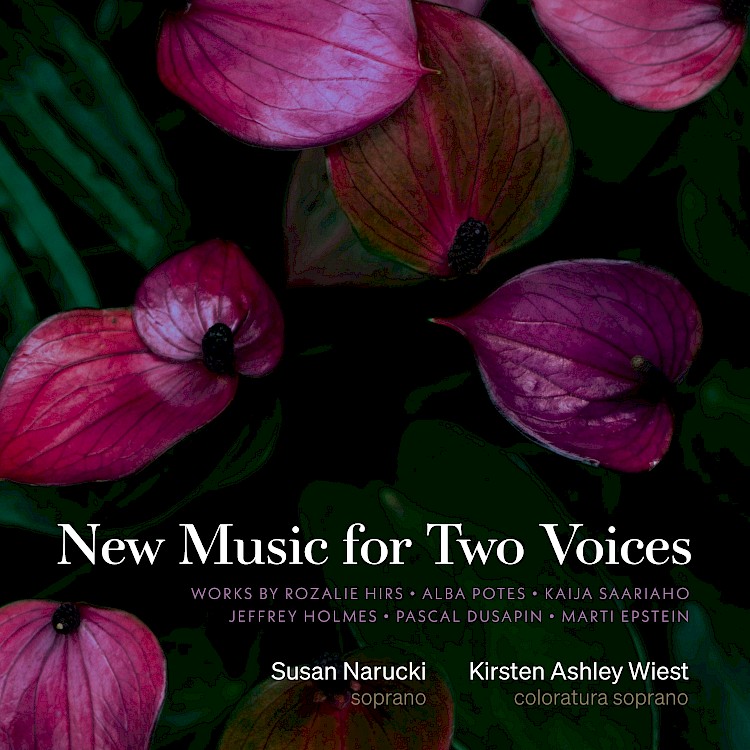
Sopranos Susan Narucki and Kirsten Ashley Wiest team up for an illuminating collection of music for two voices by a range of composers. Featuring music by Kaija Saariaho, Marti Epstein, Alba Potes, Jeffrey Holmes, Rozalie Hirs, and Pascal Dusapin, the duo explores a wide section of techniques and aesthetics that are the focus of composition today through the lens of the intimate vocal chamber format.
| # | Audio | Title/Composer(s) | Time |
|---|---|---|---|
| Total Time | 64:09 | ||
| 01 | come sempre | come sempre | 7:41 |
TRINOSAlba Potes | |||
| 02 | I. Jazmin | I. Jazmin | 0:55 |
| 03 | II. Entra illuminando la casa | II. Entra illuminando la casa | 0:33 |
| 04 | III. Ni antes ni después | III. Ni antes ni después | 0:59 |
| 05 | IV. No saldré | IV. No saldré | 0:38 |
| 06 | V. La calle que camino | V. La calle que camino | 0:49 |
| 07 | VI. Timida flor | VI. Timida flor | 0:33 |
| 08 | VII. Ven, anclemos | VII. Ven, anclemos | 0:58 |
| 09 | VIII. Olas en las nubes | VIII. Olas en las nubes | 0:28 |
| 10 | IX. Se hundió el buque | IX. Se hundió el buque | 0:43 |
| 11 | X. Canta pajarillo | X. Canta pajarillo | 1:00 |
| 12 | XI. Podemos estar juntos | XI. Podemos estar juntos | 0:50 |
| 13 | XII. En los hilos | XII. En los hilos | 0:49 |
From the Grammar of DreamsKaija Saariaho (b. 1952) | |||
| 14 | I. | I. | 2:08 |
| 15 | II. | II. | 1:38 |
| 16 | III. | III. | 1:34 |
| 17 | IV. | IV. | 1:36 |
| 18 | V. | V. | 1:25 |
NauðaR Níu [The Nine Needs]Jeffrey Holmes | |||
| 19 | I. | I. | 0:38 |
| 20 | II. | II. | 0:45 |
| 21 | III. | III. | 1:44 |
| 22 | IV. | IV. | 1:36 |
| 23 | V. | V. | 1:00 |
| 24 | VI. | VI. | 2:37 |
| 25 | VII. | VII. | 1:40 |
| 26 | VIII. | VIII. | 0:56 |
| 27 | IX. | IX. | 3:40 |
Two WalkingPascal Dusapin | |||
| 28 | I. How many little wings | I. How many little wings | 1:49 |
| 29 | II. Kiss my lips | II. Kiss my lips | 1:54 |
| 30 | III. May, June | III. May, June | 3:07 |
| 31 | IV. A scene in singing | IV. A scene in singing | 1:03 |
| 32 | V. It seems to be | V. It seems to be | 3:36 |
| 33 | Melisande | Melisande | 12:47 |
The music on this recording by Susan Narucki and Kirsten Ashley Wiest for two unaccompanied soprano voices makes its primary limitations its central strengths. The melodic exclusivity of the human voice and its raw vulnerability facilitate works that communicate harmonic information through the subtlest of means and bring the listener into an intimate expressive space immediately. Narucki and Wiest embrace this challenge with enthusiasm and artistry, presenting a compelling program that captures very diverse visions for the instrumentation from six distinct composers.
Come sempre takes its text from the opening poem of Rozalie Hirs’ eighth collection, ecologica, here sung in an Italian translation by Patrizia Filia. come sempre centers the joy of singing itself, particularly singing with another. Hirs’ language prizes equality in its allocation of vocal roles, reveling in various forms of interplay, including call and response, interwoven phrases, and parallelism. The work’s melodic vocabulary is singable and transparent, pointing to clear harmonic frames while preserving a sense of mystery and subverted expectation.
Alba Potes’ TRINOS provides twelve short snapshots of expression, notable for their succinct encapsulation of individual affects. Using ornamental figuration, microtonal shading, and the extremes ranges in each voice part, Potes extracts haunting expression from limited means. “Jazmin” announces the work with dramatic sighing gestures, while the intervallic leaps in “Entra illuminando la casa” are coy and playful. “La calle que camino” casts a somber, reflective mood, with the silences between phrases carrying as much weight as the phrases themselves. “Timida flor” returns to the dramatic leaps of the second movement, barely lingering on their impact before transitioning into the heaviness of “Ven, anclemos,” a mournful exhalation. “Se hundío el buque” is declamatory and severe, while “Canta pajarillo” provides a contrast with wide ranging, trilled high register figures. “En los hilos” closes the evocative set with liquid lyricism.
Kaija Saariaho’s From the Grammar of Dreams sets excerpts from The Bell Jar by Sylvia Plath for two singers, embodying the instability of the protagonist’s struggles with issues of life and death, madness and solace. In the second movement, each singer in the duo alternates between athletic singing and forceful, rhythmic recitation of the text, creating an unsettling texture where song and speech are unbroken even as each individual performer leaps back and forth between roles. This alternation culminates in the earthy fourth movement, as the two singers hocket between each other in spats of heavy breathing and swooping, plaintive figures.
Composer Jeffrey Holmes’ music is notably engaged with microtonality and alternate tunings; in this work, NauðaR Níu (translated as The Nine Needs) he adds auxiliary percussion to the ritualistic score. The texts, compiled by the composer from ancient Runic carvings in Proto-Germanic and Old Norse languages, are presented in the manner of incantations, accompanied by poignant chimes, gongs, and non-pitched instruments. Holmes conjures an otherworldly sonic landscape, marshaling his modal melodic material, overtone based tuning, and subtle ear for timbre in the service of a score that transports the listener to another time.
Pascal Dusapin’s Two Walking has a connection with his chamber opera also based on Gertrude Stein texts, To Be Sung, whose premiere Susan Narucki performed. Dusapin cleverly mimics the repetition with variation nature of Stein’s texts with a musical analogue of his own, turning motivic kernels around to listen to them from every angle and leaning on embellishment and interaction to propel the direction of the texture. “Kiss my lips” integrates extended vocal technique to add timbral diversity and wry humor. The two voices are treated like a hybrid instrument, like in “A scene in singing,” where one soprano articulates an attack on a pitch and the reveals the sotto voce sustain in the other. “It seems to be” creates a structural mirror with the opening movement, toying with fragmentary figures that are oriented around consistent intervals, fashioning an overall fabric that is circular in its recurring material and linear in its constant sense of forward motion.
The final work on the recording is Marti Epstein’s Melisande, a nearly thirteen minute work of thoughtful repose that reveals, on closer examination, a wealth of textural variety. Epstein adapted texts by Maurice Maeterlinck and gave voice to the thoughts of the character Melisande, circumventing the extent to which male characters have imprinted their identities and desires onto her. The two voices sing alternatively in homophony, responsively, and in heterophonous counterpoint, always processing with an organic sense of gradual unfolding, the revealing of a previously unexamined inner world.
– Dan Lippel
Recorded at UC San Diego Department of Music’s Conrad Prebys Music Center, Conrad Prebys Concert Hall on July 8-9, 2024 (Potes, Saariaho) June 23-26, 2025 (Holmes, Dusapin) and March 16-19, 2026 (Hirs, Epstein)
Producer and engineer: Andrew Munsey
Assistant engineer (June 2025): Kristina Tran
Cover image: m carty (@melatonical), Unsplash.com
Back cover: @unefilleenvadrouille, Unsplash.com
Design, layout & typography: Marc Wolf, marcjwolf.com
Photos: pp. 3-4: Andrew Munsey; p. 19: Lisa-Marie Mazzucco; p. 20: Brian L. Wiest
American soprano Susan Narucki has forged a unique path; her dedication to the music of our time has led to critically acclaimed performances with musicians of the first rank and close collaborations with generations of composers. She has appeared with the Cleveland Orchestra, Los Angeles Philharmonic, Netherlands Opera, San Francisco Symphony and numerous appearances at Carnegie Hall. Her long-standing relationship with the ASKO/Schoenberg Ensemble led to iconic recordings and performances of works of Louis Andriessen and Claude Vivier. Her extensive discography includes three GRAMMY Nominations for Best Classical Solo Vocal Album, including Elliott Carter: Tempo e Tempi (2002, Bridge Records), The Edge of Silence: Vocal Music of Kurtág (2020, AVIE), and most recently, a 2026 nomination for Kurtág: Kafka Fragments with violinist Curtis Macomber (AVIE).
Susan has commissioned and produced several distinctive chamber operas that focused on critical issues of our time: Cuatro Corridos (2013) which addressed human trafficking in the San Diego/Tijuana border region and Inheritance (2018) a work that dealt with gun violence in America. Her projects have earned support from the Creative Capital Foundation, the MAP Fund for the Performing Arts, UC MEXUS and multiple awards from the National Endowment for the Arts. She joined the faculty of UC San Diego in 2008 and serves as Distinguished Professor of Music.
http://www.susannarucki.net/Award-winning coloratura soprano Kirsten Ashley Wiest is celebrated for her “extraordinary performance virtuosity” and “impressive range and power” (Sequenza21), which captivate audiences and composers across the globe. A passionate advocate for the evolution of classical vocal music, she has premiered more than 100 new works spanning operatic roles, chamber music, monodramas, art songs, and a cappella repertoire. Her artistry is defined by a fearless commitment to expanding the boundaries of vocal expression and collaborating closely with today’s most innovative performers and composers.
Kirsten has appeared with leading ensembles and institutions including the Los Angeles Philharmonic, San Diego Symphony, PARTCH ensemble, wild Up, and The Industry, among many others dedicated to advancing contemporary music. Her performances are noted for their technical brilliance, emotional depth, and versatility across a wide range of styles and demands.
Her voice is featured on recordings released by Sony Classical, Centaur Records, MicroFest Records, innova Recordings, and others, bringing new music to an international audience. In addition to the concert stage, her work extends into film, where her voice can be heard on soundtracks for major horror productions including The Unholy and The Conjuring series.
Kirsten holds a Master of Fine Arts degree from California Institute of the Arts and a Doctor of Musical Arts degree from University of California San Diego where she studied with soprano Susan Narucki. Alongside performing, Kirsten also teaches voice at the university level and serves on the Board of Directors for several nonprofit organizations.
https://www.kirstenashleywiest.com/New Focus Recordings is an artist-led collective label featuring releases in contemporary creative music of many stripes, as well as new approaches to older repertoire. The label was founded by guitarist Dan Lippel, composer Peter Gilbert in 2004, and composer/engineer Ryan Streber in 2004, formed …Read More …
Listen to full streaming tracks while you browse the site. New tracks enabled for streaming every month. Click on the button to open up the radio player.


