
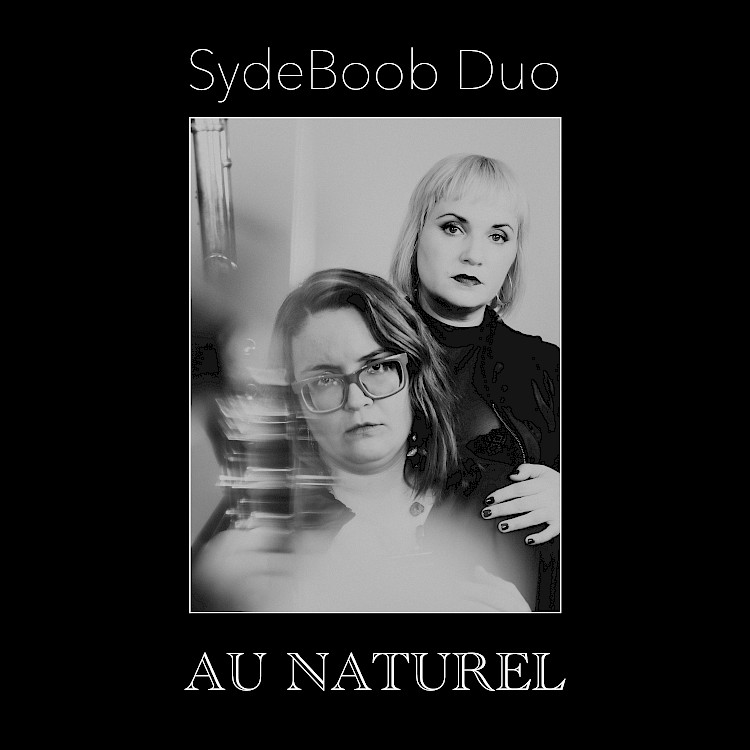
Brooklyn based SydeBoob Duo is dedicated to pushing the boundaries of contemporary performance in repertoire for soprano and flute, bringing their virtuosity to ambitious works that highlight their commitment to broad representation alongside the highest aesthetic standards. On this debut full length release, they perform works by Rebecca Saunders, Eric Moe, Anthony Braxton, Ramin Akhavijou, Max Johnson, and Beat Furrer that are both landmark works for the instrumentation and core works that have shaped SydeBoob as an ensemble.
| # | Audio | Title/Composer(s) | Time |
|---|---|---|---|
| Total Time | 48:49 | ||
| 01 | O Yes & I | O Yes & I | 7:31 |
| 02 | She Is There | She Is There | 6:44 |
| 03 | Composition No. 304 | Composition No. 304 | 6:43 |
| 04 | Translucent Yawn | Translucent Yawn | 9:10 |
| 05 | The Frontierswomen | The Frontierswomen | 9:38 |
| 06 | Invocation VI | Invocation VI | 9:03 |
SydeBoob Duo, soprano Anna Elder and flutist Sarah Steranka, release their debut album Au Naturel, featuring several pieces that have shaped their ensemble. Both musicians bring an impressive level of facility and understanding to these works, championing repertoire that is challenging and rewards many repeat listens.
Rebecca Saunders’ O Yes & I sets text from Molly Bloom’s monologue in James Joyce’s Ulysses with a rich palette of timbres that are fused together to create composite gestures. Saunders’ keen ear for creating hybrid sonic objects between instruments, or in this case voice and instrument, is a hallmark of her richly detailed music. Key to this sensitivity of scoring is how she treats each sound envelope, modulating a sustained pitch with a timbre change, animating a vocal glissando with a softly purring flutter tongue, punctuating an accented gesture with a large vocal leap and an overblown flute articulation, or extending a phrase end with a sensuous “s” consonant. O Yes & I holds the dramatic tension of a monologue throughout, a uniquely intimate moment in a literary work where one character brings the reader into their internal world.
Gertrude Stein’s enigmatic poetry is the source for Ramin Akhavijou’s She Is There. Akhavijou captures the neurotic music inherent in Stein’s repetitive and fixated style. The flute skitters through delicate flutter tongued passagework while soprano Anna Elder alternates between whispering and parlando text delivery. The pitch material rotates around central arrivals with an obsessive quality, circling back to reinforced contours after flights of improvisatory virtuosity. In a final section of the piece, the flute echoes the soprano’s whispering, speaking sotto voce through the mouthpiece of the instrument as the texture disintegrates with disembodied utterances moving towards silence.
Read MoreAnthony Braxton created his own language of structured improvisation, cultivating a rarefied balance between composed materials and guidelines for spontaneous performance that is unparalleled to this day. Braxton’s music has the uncanny quality of allowing for a remarkable degree of freedom in interpretation and performance while still retaining its identity as his music. SydeBoob’s performance of Composition No. 304 opens with gestures that move homophonically, and alternate between sustained tones and short staccato gestures using delicate timbres. As the duo enters its improvisation, we hear faint, fragile whistle tones in the flute before Elder enters with a modulated sustained tone that mimics a didgeridoo. Sarah Steranka’s flute glides through fricative played and vocalized sounds before the two launch into an adventurous and engaging dialogue of extended timbres that builds organically to a cathartic high point. The duo reprises Braxton’s composed material at the end, making a satisfying structural shape.
Max Johnson’s Translucent Yawn, with text by Todd Colby, is organized around ensemble sections that are broken up by solos for both flute and soprano, and different manners of interaction in the duo sections. The opening features spoken text over a disjunct flute line, with phrase endings marked by unison high sustains. The two play two short phrases in rhythmic unison before the flute plays a lyrical solo. The duo material that follows picks up where they left off, with the two moving rhythmically together. A soprano solo that follows features wide leaps and a subsequent flute solo is increasingly agitated and virtuosic. When the soprano re-enters, it is with quasi-scat singing material, before a dramatic yelled passage by both performers. The climactic section features an interwoven contrapuntal dialogue that culminates in a brash high register arrival. Johnson closes the piece with a dolorous choral passage, ending with a stark minor second.
Eric Moe’s The Frontierswoman, with text by Mikko Harvey, unfolds as a clear narrative, with the soprano articulating a macabre and fantastical story of medical mishap. The vocal style is conventional initially, with less emphasis on extended technique than the other repertoire in this collection, while the flute primarily adds instrumental color and word painting. A flute solo passage signals a break however, integrating a series of multiphonics into freely unfurling passagework. When Elder returns, her text delivery style is momentarily casual (“the patient was speechless”) before returning a “proper” art song presentation. Tongue ram flute articulations, and even hand clapping, make their way into the piece, expanding the sonic palette for the retelling of this quixotic story.
Beat Furrer’s Invocation VI makes an apt responsive bookend to the Saunders work, as both mine possibilities for inventive composite timbres. But while the Saunders invites listeners to consider each sound object as a unique gem, Furrer builds ensemble mechanisms that are powered by forward direction and rhythmic energy. Off-kilter, glitchy micro phrases are fit together to create textures which are simultaneously irregular while reinforcing familiar gestures and pitch content. The result is layered music which can be listened to close to the canvas, for each detail, or further back, for the gradual iterative changes that shape the overall structure. SydeBoob’s prodigious virtuosity is on full display here, as they navigate the performance demands of Furrer’s score with command and fluidity, creating a soundscape that seems far beyond the capacities of only two performers. It is a strong ending to this excellent debut album from an impressive duo dedicated to bracing, ambitious chamber music. Invocation VI ends with ritual mystery, with delicate, airy gestures that close this album enveloped in sensual mystery.
– Dan Lippel
Recorded, mixed, and mastered by Kevin Ramsay at Harvest Works Studios in New York, NY
Produced by SydeBoob Duo
Photo Credit: Cavatina Creative
Layout/Design: Aestheticize Media
SydeBoob Duo is dedicated to pushing the boundaries of contemporary performance, amplifying the voices of female artists, and using alternative performance mediums to invite listeners into a more unique and challenging listening space.
SydeBoob Duo aspires to redefine the landscape of contemporary performance by continually pushing artistic boundaries, elevating the voices of female, LGBTQIA+, and BIPOC artists, and exploring innovative performance mediums through commissioning, composing, and mentoring young composers. We aim to connect with marginalized communities and create immersive, provocative experiences that challenge and engage audiences, fostering a more inclusive and dynamic space for diverse expressions of art.
New Focus Recordings is an artist-led collective label featuring releases in contemporary creative music of many stripes, as well as new approaches to older repertoire. The label was founded by guitarist Dan Lippel, composer Peter Gilbert in 2004, and composer/engineer Ryan Streber in 2004, formed …Read More …
Listen to full streaming tracks while you browse the site. New tracks enabled for streaming every month. Click on the button to open up the radio player.


