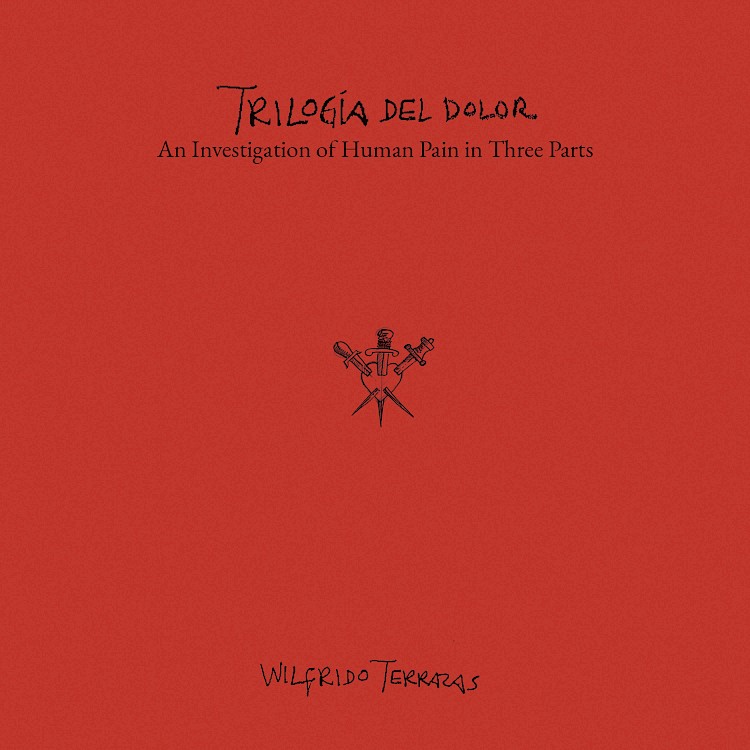
Flutist and composer Wilfrido Terrazas presents Trilogía del Dolor (Trilogy of Pain), a collection of works blending music and poetry to explore the complexities of the human experience of pain. Going beyond common idealizations, the trilogy seeks to spark conversations and challenge taboos around pain, featuring poignant texts by Mexican authors Nuria Manzur–Wirth, Ricardo Cázares, Tania Favela, Mónica Morales Rocha, Nadia Mondragón, and the composer, in conversation with the unique visual imagination of artist Esther Gámez Rubio. The album features the vocal artistry of soprano Mariana Flores Bucio and tenor Miguel Zazueta, and the fiery talents of clarinetist Madison Greenstone, cellist rocío sánchez, percussionist Camilo Zamudio, and Terrazas on flutes and narration.
| # | Audio | Title/Composer(s) | Performer(s) | Time |
|---|---|---|---|---|
| Total Time | 64:41 | |||
Part One: Llevarás el nombre |
||||
| Miguel Zazueta, tenor, Wilfrido Terrazas, flutes | ||||
| 01 | Intento recoger nuestra memoria | Intento recoger nuestra memoria | 6:25 | |
| 02 | No recuerdo cómo | No recuerdo cómo | 5:26 | |
| 03 | Lengua nueva | Lengua nueva | 5:22 | |
Part Two: Pequeña familia |
||||
| Madison Greenstone, clarinet, rocío sánchez, cello, Wilfrido Terrazas, narrator | ||||
| 04 | Recuento | Recuento | 7:46 | |
| 05 | Duelos | Duelos | 6:46 | |
| 06 | La tumba de Zapata | La tumba de Zapata | 7:08 | |
Part Three: Ten Thousand Regrets |
||||
| Mariana Flores Bucio, soprano, Miguel Zazueta, tenor, Wilfrido Terrazas, flute, Madison Greenstone, clarinet, rocío sánchez, cello, Camilo Zamudio, percussion | ||||
| 07 | Esta es la orilla | Esta es la orilla | 4:28 | |
| 08 | Y nada, los árboles esos | Y nada, los árboles esos | 4:55 | |
| 09 | No hay posibilidad de movimiento | No hay posibilidad de movimiento | 6:50 | |
| 10 | No volverán mis pasos | No volverán mis pasos | 5:16 | |
| 11 | La pérdida | La pérdida | 4:19 | |
Composer and flutist Wilfrido Terrazas has cultivated a practice that merges many disciplines into one powerful musical ritual. Crafting music that is at the edge of notation, improvisation, folk and experimental traditions, philosophy, and collectivism, Terrazas’ work cuts deep into an audience’s psyche, transforming the listener’s experience into something other worldly and deeply earthy at the same time. Trilogía del Dolor: An Investigation of Human Pain in Three Parts is scored for instrumental quartet, including Terrazas who does double duty on flutes and narration, two voices, and visual artist in live performance, is an eleven movement meditation on the universality of pain. Terrazas does not valorize or idealize pain, instead he sees it as a driving life force of its own, a catalyst for accepting change and embracing impermanence.
The first section of the trilogy, Llevarás el nombre, sets texts by Nuria Manzur-Wirth and is in three movements for tenor and flute. “Intento recoger nuestra memoria” opens with an improvisatory flute solo accompanied by tolling chimes before introducing Miguel Zazueta’s tenor with passages dripping with pathos. Zazueta and Terrazas pull phrases out from each other as if exorcising deep wells of emotion. Terrazas’ flute establishes steady drones in the beginning of “No recuerdo cómo” over which Zazueta explores the expressive tension and release inherent in various intervallic relationships. After a narrated passage the music explodes as both musicians launch into fraught, spastic phrases of release. “Lengua nueva” opens once again with an embellished line in the flute supporting a narrated passage before Zazueta ascends into the high register with a rhapsodic song evocative of a bolero, with Terrazas’ flute harmonizing. A visceral passage of extended vocal techniques is broken by the ritualistic tolling of the chime before the movement closes with an introspective, hummed phrase.
Read MorePequeńa familia, the work’s second large section, features Madison Greenstone on clarinet and rocío sánchez on cello with Terrazas reading his own texts. In “Recuento,” the cello and clarinet open with skittering, animated figures, creating a flurry of disjunct activity before settling on a searching unison line that features microtonal subtleties. Terrazas enters in a storytelling pace above the gradual refraction and distortion of the instrumental timbres. “Duelos” opens with an ambivalent dialogue between the cello and clarinet, blooms into an ethereal chorale on the words “Ah la perdida. El dolor original (Oh the loss. The original pain),” before a gripping primordial growl emerges from the two instruments, and eventually spins out into virtuosic flights of unbridled energy. The movement ends on the text, “Fuego que arde en el sonido, dime quién soy (Fire that burns in sound, tell me who I am),” as clarinet and cello exhale fragile multiphonics, the flames of the internal fire quietly burning away. “La tumba de Zapata” takes a lighter turn, with Terrazas in full story-recounting mode over a gentle melody in the instruments. The text tells of a visit to the grave of Emiliano Zapata, a key figure in the Mexican Revolution, and avoids direct word painting; the line, “I was there for a few minutes, in silence,” is met with a cacophonous instrumental reaction. Terrazas finds just the right mysterious tone to express why some experiences conjure powerful reactions within us while others leave us empty.
For the final section, Ten Thousand Regrets, Terrazas utilizes the entire ensemble and two vocalists. A nod to Josquin des Prez’s Mille Regretz, it was initially conceived as a set of variations on Josquin’s chanson theme, but ultimately the reference remained a source of inspiration and not a structural component. A chorus of bells introduces Mariana Flores Bucio’s soprano in “Esta es la orilla” before Zazueta joins with the rest of the ensemble for a mournful incantation. The increased forces allow Terrazas to revel in more lush harmonies, but the revelry is brokenly dramatically by a strident clarinet and forceful tenor phrase. “Y nada, los árboles esos” begins with a gestural percussion solo on non-pitched drums, and later progresses to a tangle of instrumental lines underneath long-limbed, elastic tenor phrases. An extended instrumental passage follows, building to a frenzy of interaction before Camilo Zamudio’s percussion closes the movement, this time with pitched gongs and bells that elide into the next section, “No hay posibilidad de movimiento.” Soprano and tenor sing chant-like melodies over a haunting cello pedal point, while pitches from their lines echo and percolate in the other instrumental parts. Midway through the movement, a melancholic waltz supports fluid, elegiac vocal lines in flights of embellishment. Song form underpins “No volverán mis pasos” as well, with a triple meter dance that flirts with a hemiola rhythm as Flores Bucio, Terrazas, and clarinetist Madison Greenstone take off in liberated ornamentation and modal improvisation before eventually breaking apart into an explosive free passage. The work’s final section, "La pérdida,” is a hymn that is at once woeful and full of hope, a siren song for Trilogía’s profoundly personal journey through grief and anguish and towards resignation and acceptance, ending with a simple utterance of gratitude, “la vida tiene un sonido perfecto (life has a perfect sound).” Wilfrido Terrazas has created a musical work that simultaneously functions as a process of healing, drawing on his broad range of practices to find ways into the soul through sound.
– Dan Lippel
All music composed by Wilfrido Terrazas
Produced by Wilfrido Terrazas
Recorded by Christian Cummings at Studio A, Warren Lecture Hall, UC San Diego, on February 13th and 21st, 2025
Mixed and mastered by Christian Cummings at Studio A, Warren Lecture Hall, UC San Diego, June 18th–20th, 2025
Cover art and design by Esther Gámez Rubio
Wilfrido Terrazas is a flutist, improviser, composer, and educator whose work explores the borderlands between improvisation, musical notation, and collective creation. He has performed over 380 world premieres, composed around 70 works, and recorded more than 40 albums, six of them as a soloist or leader. His recordings have been published in Mexico, the US and Europe, on labels like Abolipop, Another Timbre, Bridge, Cero, Creative Sources, New World, Umor, and Wide Hive. Wilfrido has presented his work in 20 countries in Europe and the Americas. He has been a guest performer at international festivals such as Creative Fest (Lisbon), ¡Escucha! (Madrid), Festival Cervantino (Guanajuato), High Zero (Baltimore), MATA (NYC), NUNC! (Chicago), and TENOR (Hamburg), and at venues and series for experimental music like Auditorio Nacional (Madrid), Bowerbird (Philadelphia), Teatro Nacional Cervantes (Buenos Aires), CCRMA (Stanford University), Splendor (Amsterdam), Flagey (Brussels), Littlefield Hall (Mills College), Unerhörte Musik (Berlin), St. Ruprechtskirche (Vienna), The Wulf and REDCAT (Los Angeles), Soup & Sound and The Stone/New School (NYC). He has also carried out residencies at Omi International Arts Center (NY), Atlantic Center for the Arts (Florida) and Ionion Center for the Arts and Culture (Greece).
Wilfrido is a member of two influential Mexico City-based ensembles: the improvisers’ collective Generación Espontánea, widely acknowledged as one of the pioneering groups for freely improvised music in Latin America, and Liminar, one of Mexico’s leading new music groups. Since 2014, Wilfrido co-curates La Semana Internacional de Improvisación, an improvised music festival in Ensenada, his hometown. Other current projects include Filera, a trio with vocalist Carmina Escobar and cellist Natalia Pérez Turner, and the Wilfrido Terrazas Sea Quintet, an Ensenada-based creative music group, paradoxically formed by six people. Recent collaborations include projects with Amy Cimini, Angélica Castelló, Michael Dessen, Lisa Mezzacappa, Roscoe Mitchell, Abdul Moimême, artist G.T. Pellizzi, and poets Ricardo Cázares, Nuria Manzur, and Ronnie Yates. Additionally, his compositions have been performed by José Manuel Alcántara, Anagram Trio, Aldo Aranda, Ensamble Süden, Ghost Ensemble, in^set, International Contemporary Ensemble, Omar López, Low Frequency Trio, Kathryn Schulmeister, Alexandria Smith, and wasteLAnd, among many others. Wilfrido has also published more than 30 texts about music, amongst them four book chapters. Some of his writings can be read in the Pendragon, Routledge, and Suono Mobile presses. He has been an Assistant Professor of Music at the University of California, San Diego since 2017.
Miguel Zazueta is an interdisciplinary voice artist specialized in contemporary music and opera, from Tijuana, Mexico. He has studied and collaborated with artists like Jorge Folgueira, Wilfrido Terrazas, Carmina Escobar, Robert Castro, Yuval Sharon, and Meredith Monk, as well as groups like the LA Phil New Music Group, Orquesta of Baja California, Ópera de Tijuana, Kallisti Ensemble, Bodhi Tree Concerts, Meredith Monk & Ensemble, and the ItaloAmerican Institute of Interna- tional Cooperation. He obtained his MA and DMA degrees in Contemporary Music Performance at UC San Diego and is the founder and co–director of Radical Ensamble, an interdisciplinary vocal collective with singers from the Baja California Region.
Madison Greenstone is a Brooklyn-based performer, writer, and clarinetist of TAK Ensemble and the [Switch~ Ensemble]. Notable performances have been as a soloist at the Vigeland Mausoleum (Oslo), the Merce Cunningham Centennial Night of 100 Solos (LA), and as a soloist presented by ISSUE Project Room. As a writer, Madison has published through the Museum of Art and History in Neuchâtel, TEMPO, Cambridge, and upcoming in Contemporary Music Review. Madison has performed as a soloist and chamber musician at Fondation Abbaye Royaumont (FR), Darmstadt (DE) Petersburg Art Space (DE), Ende Tymes Festival (NYC), Harvard, The Stone, Studio 8 (DE), Princeton, Space for Free Arts (FI) among other venues and presenters. Madison has worked with Michelle Lou, Bryan Jacobs, Suzanne Thorpe, Stephan Moore, John McCowen, Eric Wubbels, Joy Guidry, and RAGE Thormbones. They can be heard on Wandelweiser Editions, Another Timbre, TAK Editions, and Tripticks Tapes.
rocío sánchez is a Mexican cellist, composer, improviser, and educator. Their practice connects composition with the use of virtual animation and collages. rocío’s performances encompass improvisation, prepared cello, solo and ensemble acoustic and electroacoustic pieces, interdisciplinary collaboration, and collective composition. rocío is humbled to have collaborated with Matana Roberts, Pamela Z, Frank Gratkowski, Wilfrido Terrazas, gabby fluke-mogul, Kyle Motl, Laura Cocks, Kennet Jimenez, Drew Wesely, Madison Greenstone, Orchid McRae, among others. They have performed at Klangspuren Schwaz, the Darmstadt Summer Courses, Red Ecología Acústica México, Semana Internacional de Improvisación in Ensenada, Méx- ico, The Center for Advanced Musical Studies at Chosen Vale, Carnegie Hall, Roulette Intermedium, Americas Society, (NYC), among others. rocío is currently based in Brooklyn and is a 2026 Artist-in-Residence at ISSUE Project Room.
Mariana Flores Bucio is a Mexican singer whose work spans contemporary music, Mexican traditional musics, opera, and experimental performance. Her artistry reflects vocal versatility, expressive nuance, and collaborative exploration. She has premiered many new works and performed with the American Modern Opera Company, Project [Blank], Orquesta de Baja California, and Péndulo Cero, and collaborated with artists such as Wilfrido Terrazas, Susan Narucki, and Steven Schick. She has performed across Latin America, Europe, and the U.S., including at the Lincoln Center and at Mexico City’s Zó- calo. Mariana holds MA and DMA degrees in Contemporary Music Performance from UC San Diego, co–directs Radical Ensamble, and develops her project MEXPERIMENTAL.
Camilo Zamudio is an explorer of new sounds and an advocate for Latin American musical cultures. For him, percussion is an intimate form of expression that invites listeners to expand inherited sonic notions while enhancing their musical curiosity and imagination. He merges diverse musical languages: the legacy of Colombian musical communities, the chants of freedom from Afro–diasporic voices, and the endless complexity of contemporary sounds. Camilo joined the National Symphony Or- chestra of Colombia and performed at major festivals such as the Darmstädter Ferienkurse (Germany), Neofonía (Ensenada, Mexico), Ojai Music Festival (US), and the Cartagena International Music Festival (Colombia). He is currently a member of red fish blue fish percussion ensemble, and a DMA candidate in contemporary music performance at the University of California San Diego.
Wilfrido Terrazas’ Trilogía del Dolor moves through strange terrain, a collision of soundworolds that melt together in ways that feel impossible to predict. The work explores pain without idealizing it, treating it instead as a foundation for transformation and acceptance. The work is scored for instrumental quartet, two vocalists, and a visual artist in live performance. Texts by Mexican authors, including Nuria Manzur-Wirth, Ricardo Cázares, and Terrazas himself, anchor the work, building a conversation about how pain connects us all, regardless of where we come from or what we’ve lived through.
Flickering moments of whimsy from Terrazas’ flute paint pointillist memories against the raw intensity of the vocal performances. Mariana Flores Bucio and Miguel Zazueta carry entire lifetimes in their voices, something both earthy and divine that pulls us deep into the work’s emotional core. Madison Greenstone conjures impossible tones from the clarinet, weaving alongside rocío sánchez’s cello with uncanny precision. I find myself getting especially lost in the silences of Trilogía del Dolor, those empty spaces where the air itself feels charged. They breathe like their own lifeforms, heightening every moment of sound that surrounds them. This is music as reckoning, as catharsis, as something essential.
What are some of your earliest memories of sound or music that still resonate with your practice today?
There are sounds from my childhood that still resonate with me in a strange, distant, unclear way. I’m thinking of tortilla-making machines, playground sounds of school recess, such as balls bouncing, kids running and yelling, or rusty old swings in motion, playing outside sounds, such as bicycle riding sounds, or the sounds produced by a bag of marbles. There are also scary sounds, such as water in my ears from attempting to swim (for which I consequently developed a phobia), adults yelling, or dogs chasing me. I’m a Gen Xer and experienced the world growing up in absolute peril! But early music experiences were also powerful. My parents used to sing in the house, not really as performance, but rather to themselves, like a sort of absent-minded meditation while doing chores or in moments of leisure (my mom still does). No one in my family is a musician except me, but music was always present in my childhood. The radio or record player was always on, and I remember the strong presence of música norteña blasting through the neighbors’ radio all the time. I remember singing in school, the Mexican national anthem and children’s songs as well, but also plenty of ranchero songs and corridos like El Cachanilla, which I had to memorize in a weird display of Baja California regional pride (I grew up in Ensenada, which I think is the strangest Mexican town).
When did you first recognize that music could function as a space for addressing difficult human experiences like pain and grief?
I don’t know if there was a specific moment, though it is at least partially a consequence of my experiences in psychotherapy and recovery work. I guess in an intuitive way, I have always known, but didn’t make the connection to my creative work until relatively recently. Emotions have almost always been at the core of my work, but pain and grief were not a focus until I started working on Trilogía del Dolor. As a young artist, I was much more interested in expressing my anger and frustration, as well as my yearning for freedom and belonging. My early work is all about reclaiming agency and rebelling against oppression (but whose isn’t?). Later, I was more focused on hope and reconciliation, the latter being at the center of my Torres Cycle.
Can you talk about what sparked Trilogía del Dolor? Was there a specific moment or experience that made you feel this was necessary to create?
There is, at the same time, there isn’t. In 2024, I read Nuria Manzur-Wirth’s Exilio de la palabra at a moment when I was navigating an extremely difficult moment in my personal life, and the poems resonated with me very strongly. I decided to select three poems from the book to write Llevarás el nombre in response to that moment, but also to fulfill a commission from the incredible vocalist Miguel Zazueta. I didn’t know at the time that it would become the first part of a trilogy. The longer answer to your question is that I am a trauma survivor and have struggled with depression my whole life. Even though I have been in therapy for years and I care about (and work with) my mental and emotional health a great deal, I never before felt the need to address pain and grief directly in my music. I decided to compose these pieces first to face my own shame about living with trauma, and then it beautifully transformed into this broader conversation in which I felt empowered to address what I see as the ultimate taboo for artistic expression: pain as humans actually experience it, in all its naked horror. After I wrote Llevarás el nombre, I realized the piece was laser-focused on emotional pain, and I decided to write two more pieces, one focused on grief (Pequeña familia), and the other focused on regret (Ten Thousand Regrets).
You chose to work with texts from multiple Mexican authors rather than writing all the text yourself. How did you find these collaborators, and what drew you to their particular voices?
I have been interested in poetry for most of my life, and while I lived in Mexico City, I met many poets and enjoyed hearing them read and share their worldviews. To me, poets are the heirs of not just bards and troubadours, but also of seers and shamans. They have the power to see through appearances and go deeper into the human soul to reveal it in all its complexity and contradictions. Poets wield the power of saying, somehow, what cannot be said. By hanging out with poets, especially women poets, I realized how narrow my experience was and how much I still had to learn. I met Nuria in Mexico City in 2012, and we became instant friends and collaborators. Choosing her poems for Llevarás el nombre was an easy choice because of our previous work together. Something similar can be said about Ricardo Cázares, with whom I had also collaborated before, for my album My Shadow Leads the Way. As for Nadia Mondragón, she and I have been friends for a long time, I have loved her poetry and visual art, and it felt very natural to invite her to the project. I also knew Tania Favela from Mexico City, whose poetry I always appreciated as being particularly musical, and more recently started collaborating with the phenomenal Tijuana-based poet Mónica Morales Rocha. I basically reached out to all of them and sent a prompt asking them to write a short poem about regret. They came up with not just hauntingly beautiful texts but also somehow perfectly fitting as a group. I also wanted to have various authors to expand the conversation beyond my personal experience. Said conversation ended up touching upon underlying questions about Mexican identity and the immense pain that I see is inherent in it. Pequeña familia is a bit different because I felt I needed to express my own personal grief and couldn’t delegate that to someone else. How can you say “I am in pain” in music? I felt the only way was to write the actual words myself. I also felt the need to surmount my own shame and express directly my grief and pain to finally embrace them as a part of who I am. I could not borrow someone else’s words for that. Finally, Pequeña familia is also important because it marks the decision of accepting that I can also write poetry and let it become an extension of my musical work and beyond. I don’t have any ambition to become a poet with a capital “p”, but I have written poetry for a long time, and it was time for me to be open about that. I guess I could have written the whole trilogy myself, but it never occurred to me, and I am glad I didn’t, because I wanted to both leave space for what I wanted to say and what I wanted to hear from others.
How did Esther Gámez Rubio’s visual imagination enter the conversation? What does her presence add to the live performances?
Esther’s presence in my life is immensely powerful. She is not only one of my best friends but also one of the most amazing artists I have ever met. Collaborating with her for around 12 years on countless projects has completely transformed my work in many ways. In Trilogía del Dolor, her presence is rather modest but potent. Because all the texts are in Spanish, we decided to project English translations in real time for non-Spanish-speaking audience members. But Esther’s projections are so much more than your usual subtitles, they introduce a whole visual universe to the pieces, powerful and moving in their own right. We can get a glimpse of that world and its conversation with the music in the artwork for the album.
You’re explicit about not valorizing or idealizing pain. That feels important. Can you talk about what you mean by that and why you wanted to avoid those common pitfalls?
I believe that one conventional function of art, at least in Western and westernized societies, is to be a palliative for difficult emotions. Sad music, for instance, serves as a mirror for our own pain, which is thus kept at a safe distance. We deal with the song so that we won’t have to deal with our pain. We can cry a little bit and move on. Nothing necessarily wrong with that, by the way. But I wanted to go to a different place with these pieces. A place where my/our pain could actually be dealt with, a sort of unavoidable, uncomfortable intervention of truth, reckoning, and, hopefully, transformation. I have no idea, obviously, if I succeeded or failed, and luckily, that is not for me to decide, but that was the intention.
Were there moments during the creation or performance of this work where engaging with pain this directly became overwhelming or required you to step back?
Yes. Several. But I kept going, and the music kept coming, often accompanied by tears. I am immensely grateful for these pieces.
The trilogy has distinct sections with different configurations of performers. How did you decide which voices and instruments belonged with which texts?
Since I worked on each of the three parts on its own and in the order given in the album, this was not much of an issue. As aforementioned, Llevarás el nombre responded to a commission by Miguel Zazueta, who originally asked for a solo voice piece, but I just felt that a voice and flute duo would allow me to go deeper into the texts and their emotional contents. Similarly, Pequeña familia responded to two commissions: one from Madison Greenstone and the other from rocío sánchez. I decided to write one piece (instead of two), which can be a solo for clarinet or a solo for cello or a duo, with or without a narrator. I’m very practical! Finally, for Ten Thousand Regrets, I decided to use the four performers so far included in the first two parts plus percussion and a second voice, because I wanted to include soprano Mariana Flores Bucio, who is fantastic and whose artistic interests mirror mine in many ways, and the wonderful percussionist Camilo Zamudio. Having more people allowed more nuance in the approach to the texts and obviously more musical possibilities.
Can you walk me through your approach to the relationship between the spoken/narrated text and the music? How do they inform each other?
The spoken texts in Trilogía del Dolor, especially in the second part, are there to create an intimate connection between performers and audience. Not everybody can express themselves through singing, but most humans do express themselves successfully by speaking. I wanted to visit several worlds of sound and emotion that could deliver many possible experiences with various degrees of emotional transgression. Speaking might be the cleanest in its penetration, followed by tonal or diatonic musicking, while more abstract microtonal/noisy sound worlds might be the harshest. But they are all here, coexisting inextricably, evoking the wide spectrum of human pain, which doesn’t ask for our permission to erupt in its infinite forms. Perhaps the clearest example of this is “La tumba de Zapata”, which summons the melodic world of traditional corridos while the narration is telling a true story from my life. The melody transforms beyond recognition several times during the piece as the story develops and visits hard emotional states. Beyond that, speaking and singing are treated in my vocal music as two points in a continuum. I play with this idea to explore different emotional contents and expressive possibilities. For instance, coming and going between speaking and singing in a passage can create tension or drive a process of transformation, thus elevating energy levels in the musical discourse. A passage where you only sing or only speak, on the other hand, tends to create a sense of stability and the idea that change is either not happening or happening at slower rates. There are many examples of this strategy in Llevarás el nombre and Ten Thousand Regrets.
What was the rehearsal and development process like with this ensemble? How much room is there for the performers to bring their own interpretations?
Great question. As in most of my notated music, in Trilogía del Dolor, there is a lot of creative input from all the performers within the framework of my compositional work. The only major difference between these pieces and most of my compositions from the last 15 years or so is that the texts’ intelligibility is important, and so that was something we took care about in the development process. To give you an example of how everybody’s participation helped shape the pieces, I will mention “No volverán mis pasos”, the fourth song in Ten Thousand Regrets. This is an actual song, in the most conventional way. When I read Mónica’s beautiful poem, I was inspired to write a song informed by the huapango ranchero tradition. Mariana has a strong background in Mexican folk singing, and so I wanted her to sing a Mariachi song. That’s what I set out to do, and I think the song is successful in summoning that spirit. Mariana’s singing channels ranchero style vehemently, and all my flute ornamentation and improvisation at the beginning of the song is inspired by traditional mariachi arrangements. But Camilo’s percussion groove is closer to the Colombian bambuco because he is Colombian, and Madison’s clarinet improvisations channel Klezmer traditions of clarinet playing, as they have a Jewish background. I could never have conceived these blends on my own. There’s a lot of collective creation on this album, and that is my absolute favorite thing about music-making.
The piece seems designed for live performance with the visual artist present. How does it change when experienced as a recording versus in the room with everyone?
I agree, but I hope the album can be a meaningful experience on its own. Recordings have the beautiful advantage that you can replay them as many times as you want, allowing you to discover many details that can expand your listening experience. This album is built upon many layers, and it therefore warrants many listenings! The work also aims to spark conversations about difficult themes, and having the recording at hand can be a valuable tool for that.
And lastly, to close as always… What are some of your favorite sounds in the world?
The wind. Always the wind.
— Brad Rose, 3.04.2026
It is a curiosity of the human spirit that extended dwelling on pleasure tends to come across as unseemly, while prolonged meditation on pain appears profound. Certainly Wilfrido Terrazas (born 1974) is seeking depth, both musical and verbal, in his hour-plus-long, three-part meditation, Trilogía del Dolor. Whether the material will resonate with listeners will be a highly personal matter: other long-drawn-out music focused on pain – Mahler’s and Tchaikovsky’s Sixth Symphonies come to mind – tends to search for context and moments of lightness (or at least wryness) for purposes of contrast, but Terrazas stays relentlessly on target from start to finish, relying on alterations of instrumentation and the use of words from numerous sources to provide some differences of perspective among the work’s 11 pain-focused movements.
Terrazas’ work is entirely in Spanish, as are the titles of its first two sections, Llevarás el nombre (“You will bear the name”) and Pequeña familia (“Small family”). The third section, however. has an English-language title, Ten Thousand Regrets, even though all its verbiage is in Spanish. The sources of the words are poems by Nuria Manzur-Wirth in the three elements of the first section; texts by Terrazas himself in the three parts of the second; and poems by Ricardo Cázares, Tania Favela, Mónica Morales Rocha, and Nadia Mondragón in the five portions of the third. On the face of it, Trilogía de Dolor would seem to be an extended expression of ego and self-importance by the composer, given his participation as text provider, narrator and instrumentalist; but the words themselves are intended to convey a sense of the universality of pain as a human experience rather than to delve into and duplicate Terrazas’ own experiences of it (except insofar as he is himself a member of the human family).
The music underlying and underlining the words is rather less intense, less dramatic and less pain-pervaded than the words themselves: there is nothing here akin to the finales of Tchaikovsky’s Sixth or Mahler’s. The instrumentation is sparse: flutes alone in the first section, clarinet and cello in the second, and a small ensemble in the third consisting of flutes, clarinet, cello and percussion. There is something theatrical in the construction of Trilogía del Dolor, which in fact is designed to include a visual artist in live performance. The theatricality comes through well enough, however, without any overt visual element: it is the expressive nature of the verbal delivery that projects sincerity and intended engagement with the audience.
The nature of the music also contributes to the sense of a stage performance. Less off-putting than much avant-garde material, although certainly existing within the common contemporary musical space of blended forms, aural experimentation, improvisation and extended performance practice, Trilogía del Dolor is in effect a chamber opera of the besieged soul, an exploration of the sadness of everyday life, of memory, of relationships, of intersections and interactions with the external world – all with a perhaps-inevitable conclusion, intended to be comforting, that combines resignation with a certain degree of healing and gratitude. Terrazas takes listeners on this journey with a number of less-than-unusual harmonic forays and a few moves into the aurally unexpected: a breath of bolero here, note flurries there, fragile wind/string interaction in one place, cacophony in another, thinness of sound in several places, lusher harmonies in a few.
Trilogía del Dolor is most effective when it is most restrained both verbally and musically: it does go on for quite a long time with its unerring focus on matters more melancholic than depressive, but it works best when it does not overdo the dolorousness or try to turn elements of everyday existence into some sort of deep existential tragedy. Indeed, Terrazas shows through his choice of texts and arrangements of accompanying music that he regards pain as an inescapable and perpetual element of human existence, an experience shared by all in the human condition and one that, indeed, cements the interconnectedness of humanity. This is a valid if scarcely original conceit that has the advantage of removing some of pain’s sting by subsuming personal experience into the communal. Trilogía del Dolor does somewhat “protest too much” in its variations, verbal and textual, upon its single focus, and as a result is not entirely convincing throughout . But Terrazas’ skill at weaving differing combinations of vocal and instrumental material together helps keep this extended self-meditation effective, if not exactly enjoyable, and prevents it from coming across as simply self-referential navel gazing. It is less deep than it wants to be, but does touch with sensitivity on an essential element of what makes us human.
— Mark Estren, 3.12.2026
La Trilogía del dolor: una investigación sobre el dolor humano en tres partes es el décimo álbum como solista de Wilfrido Terrazas y su tercero como compositor monográfico. La serie de composiciones que conforma el álbum no inició como un proyecto, no se originó con un concepto de partida y sus ramificaciones posteriores como crecimiento interno que brotó hace un par de años y se fue metabolizando hasta cobrar la forma musical de una emoción.
¿Qué significa investigar una emoción, en particular, la emoción del dolor, una emoción imposible, imposible para los poderes del discurso, imposible ante el sentido? Las herramientas usadas en este álbum son la palabra cantada, la palabra narrada, pero también la voz desnuda de lenguaje, la voz en su pura expresión y misterio del registro de un cuerpo. De manera simétrica a la voz, se usan los instrumentos y las herramientas el lenguaje musical: la armonía tonal, microtonal y atonal, la composición deliberada y una partitura abierta a la improvisación, por momentos incluso abierta a la improvisación libre. Wilfrido echó mano de todos los recursos a su alcance, toda su experiencia como compositor e intérprete, para investigar la emoción imposible por excelencia.
Los ejes a lo largo y ancho de las piezas están trazados por la tradición de la música contemporánea, esa curiosa tradición de construir deconstruyendo la memoria de los registros occidentales, bajo la manera de los ecos de la canción ranchera, el lamento cardenche y el huapango. Es siempre muy curioso el viaje de cada artista en la música contemporánea, son tan disímiles y tan parecidas las búsquedas, por ejemplo: es expresivo que sea tan usual el retorno a las raíces, el regreso a los orígenes locales como un reclamo ante la tradición europea que se fundamenta sobre todo en la reinvención, como si la herencia de la música contemporánea se experimentara como una alienación y al mismo tiempo regalara la promesa para su propia subversión; pero es importante subrayar que en este álbum las referencias y entrecruces no se usan para un proyecto en busca de una originalidad, no son el producto de una musicología, son los ecos de una experiencia personal. La honestidad, en el arte de la composición contemporánea, no es una obligación ni mucho menos un derecho, la honestidad, en el arte de la improvisación —que ha marcado el interés de Wilfrido desde muy temprano—, es más que un derecho, es una ética. El proyecto del álbum es atípico en tanto que no gira en torno a un concepto, ni alrededor de un tema propiamente, sino del dolor en la existencia compartida de la mexicanidad, de las experiencias privadas de la infancia y de la pérdida en concreto, en la tierra adentro y en sus músicas; atraviesa, un sentimiento complejo, para el que tal vez no haya palabra, pero para el que sí puede haber música, entre la latitud de la desolación y la longitud de la nostalgia, a ciertos grados de la compasión y de la pena, triangulado entre la rabia y la ternura.
El famoso virtuosismo de Wilfrido en ningún momento es protagonista, incluso cuando es evdiente, porque lo más importante en todo momento del proyecto, es la honestidad y la fidelidad a un sentimiento, biográfico, de ahí el reconocimiento en la generosa apertura a inscribirnos. Tal vez la flauta tenga una vocación espiritual, pero en manos y boca de Wilfrido la flauta no es cartesiana, católica ni dualista, tal vez por eso nos puede hablar del dolor, la emoción que borra la diferencia entre cuerpo y alma.
Una imagen de lo que es la música contemporánea mexicana, ciudadana del mundo y heredera de una tradición que nació en Europa y fue a tener descendencia en otro continente, en un país pleno de contradicciones. Desde que se trata de una investigación sobre el dolor humano, sin muelles ni filtros, su escucha no siempre es fácil, pero siempre es bella, en ocasiones bellísima. Me parece que esta trilogía es un parteaguas, una obra que es un punto de llegada y de partida para Wilfrido, que sintetiza búsquedas y contradicciones insolubles, pero que sobre todo se caracteriza por la honestidad que busca compartir una realidad que muchos vivimos y de la que se habla muy poco. Él dice que no sabe si lo logró, en mi opinión sí: ahora que las jacarandas dejan caer sus flores de nuevo como cada año y por unos cuantos días, con su olor a chicles de violeta, mi camino se transforma a través de su aroma, y viene a mi oído interno el tema recurrente de la Trilogía como un recuerdo involuntario: da sentido a una nostalgia que conozco bien, y que cada año, en cuanto las lluvias comienzan en la ciudad sé que ha terminado el breve florecer, sé que pasaré el resto del año esperando a que todo sea con el otoño, esperando con impaciencia y algo de ansiedad a que el invierno y su frialdad acaben con la incertidumbre del regreso violáceo de la primavera.
Translation:
La Trilogía del dolor: an investigation into human pain in three parts is Wilfrido Terrazas’s tenth solo album and his third as a monographic composer. The series of compositions that make up the album did not begin as a project, nor did it originate from a predefined concept. Rather, it emerged from an internal growth that began a couple of years ago and gradually took shape, metabolizing into the musical form of an emotion.
What does it mean to investigate an emotion—specifically, the emotion of pain? An impossible emotion: impossible for the powers of discourse, impossible in the face of meaning itself. The tools used in this album include the sung word and the narrated word, but also the voice stripped of language—the voice in its pure expression and in the mystery of the body’s register. In parallel with the voice, the instruments and tools of musical language are employed: tonal, microtonal, and atonal harmony; deliberate composition alongside a score open to improvisation, at times even to free improvisation. Wilfrido draws on all available resources, on his full experience as both composer and performer, to investigate this quintessentially impossible emotion.
The structural axes of the pieces are shaped by the tradition of contemporary music—this curious tradition of constructing through the deconstruction of Western musical memory—alongside echoes of ranchera song, cardenche lament, and huapango. The trajectory of each artist within contemporary music is always striking: the searches are so different, yet so similar. It is telling, for instance, how common it is to return to roots, to local origins, as a response to a European tradition grounded in constant reinvention. It is as if the legacy of contemporary music is experienced as a form of alienation, while at the same time offering the promise of its own subversion. However, it is important to emphasize that in this album, references and crossovers are not used in pursuit of originality, nor are they the result of musicological intent—they are echoes of a personal experience. Honesty, in the art of contemporary composition, is neither an obligation nor a right. In the art of improvisation—which has shaped Wilfrido’s interests from early on—honesty is more than a right; it is an ethic. The album’s project is atypical in that it does not revolve around a concept or a defined theme, but around pain within the shared existence of Mexican identity, within private experiences of childhood and loss, within the interior landscapes and their music. It traverses a complex feeling—one for which there may be no word, but for which there can be music—somewhere between the latitude of desolation and the longitude of nostalgia, at certain degrees of compassion and sorrow, triangulated between rage and tenderness.
Wilfrido’s well-known virtuosity is never foregrounded, even when it is evident, because what matters throughout the project is honesty and fidelity to a biographical feeling. This is why the work opens itself generously to include us. The flute may have a spiritual vocation, but in Wilfrido’s hands and breath it is neither Cartesian, nor Catholic, nor dualistic. Perhaps that is why it can speak of pain—the emotion that erases the distinction between body and soul.
This album offers an image of contemporary Mexican music: a global citizen and heir to a tradition that originated in Europe and took root in another continent, in a country full of contradictions. As an investigation into human pain—without buffers or filters—listening is not always easy, but it is always beautiful, at times profoundly so. This trilogy feels like a turning point, both an arrival and a departure for Wilfrido. It synthesizes unresolved tensions and contradictions, but above all it is defined by an honesty that seeks to share a reality many of us experience yet rarely speak about. He says he is unsure whether he succeeded; in my view, he did. Now, as the jacarandas once again shed their blossoms each year for a few brief days, with their scent of violet candy, my path is transformed by their fragrance. The recurring theme of the Trilogy returns to my inner ear like an involuntary memory: it gives meaning to a nostalgia I know well. And each year, when the rains begin in the city and I know the brief flowering has ended, I find myself waiting for the rest of the year—for autumn to arrive, and with impatience and a trace of anxiety, for winter and its cold to resolve the uncertainty of spring’s violet return.
— Erick Vázquez, 3.14.2026
New Focus Recordings is an artist-led collective label featuring releases in contemporary creative music of many stripes, as well as new approaches to older repertoire. The label was founded by guitarist Dan Lippel, composer Peter Gilbert in 2004, and composer/engineer Ryan Streber in 2004, formed …Read More …
Listen to full streaming tracks while you browse the site. New tracks enabled for streaming every month. Click on the button to open up the radio player.