
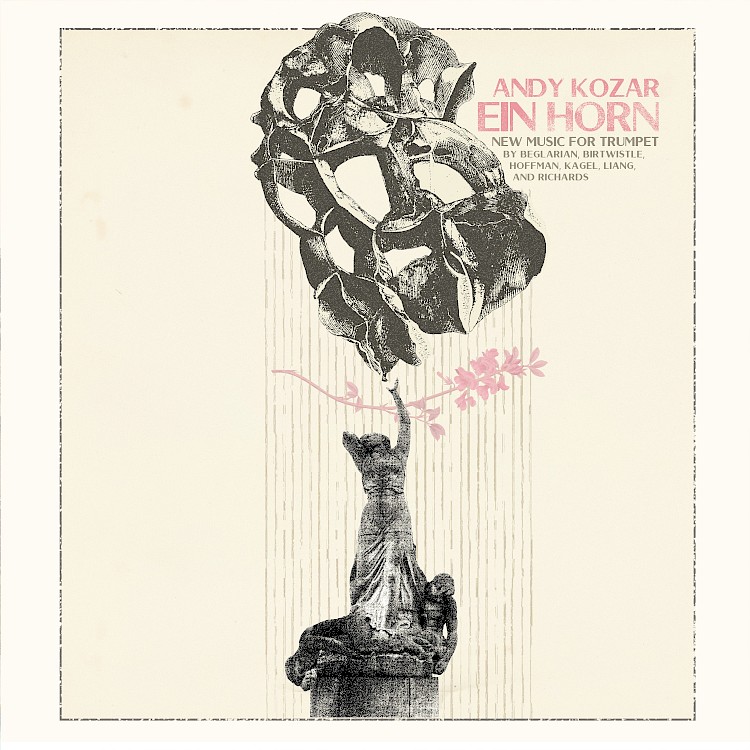
Andy Kozar's Ein Horn features works for multiple trumpets that reference the instrument's historical roles while pointing the way to ambitious new directions. Featuring music by Mauricio Kagel, Harrison Birtwistle, Eve Beglarian, Elizabeth Hoffman, Lei Liang, and Eric Richards, Kozar's thoughtful curation and powerful performances make this far more than a survey of new trumpet music and continues to demonstrate why he is one of its most ardent and prolific advocates.
| # | Audio | Title/Composer(s) | Performer(s) | Time |
|---|---|---|---|---|
| Total Time | 50:38 | |||
FanfanfarenMauricio Kagel | ||||
| Andy Kozar, trumpet | ||||
| 01 | I. Vivace | I. Vivace | 0:41 | |
| 02 | II. Allegretto | II. Allegretto | 0:58 | |
| 03 | III. Allegro | III. Allegro | 1:28 | |
| 04 | IV. Adagio | IV. Adagio | 1:22 | |
| 05 | V. Vivace | V. Vivace | 0:57 | |
| 06 | VI. Allegretto | VI. Allegretto | 2:04 | |
| 07 | VII. Largo | VII. Largo | 1:30 | |
| 08 | VIII. Allegro | VIII. Allegro | 1:04 | |
| 09 | IX. Largo | IX. Largo | 2:33 | |
| 10 | X. Allegretto | X. Allegretto | 1:22 | |
| 11 | XI. Allegretto | XI. Allegretto | 1:21 | |
| 12 | XII. Adagio | XII. Adagio | 1:29 | |
| 13 | Ein horn | Ein horn | Andy Kozar, trumpet, Eve Beglarian, electronics | 6:40 |
| 14 | Placid Mobile | Placid Mobile | Andy Kozar, trumpet | 3:43 |
| 15 | Possibly Brahms | Possibly Brahms | Andy Kozar, trumpet, Elizabeth Hoffman, electronics | 9:02 |
| 16 | Lake | Lake | Andy Kozar, trumpet | 5:06 |
| 17 | Fanfare for Diebenkorn | Fanfare for Diebenkorn | Andy Kozar, trumpet | 1:14 |
| 18 | fons et origo | fons et origo | Andy Kozar, trumpet | 8:04 |
Source and Origin
Ty Bouque, University of Chicago
—
There is much talk nowadays about what technology has wrought upon the social. There is fear—I share it— that what Baudrillard in The Ecstasy of Communication called “private telematics,” that distinctly twenty-first century isolation of the individual into self-sovereign digital universes of atomized autonomy, has irreparably damaged our capacity to be-in-relation to each other. Technology, once the promise of utopian connectivity, seems to have only made us less of an us: One as World, and not the other way around.
And so one has to ask, defend even: why use technology to surrogate the commune in a music intended for overwhelming communality? Why—excepting the monstrous logistics of securing 36 trumpet players who can articulate together in something like successful coordination—replace the treacherous, glorious relationality of ensemble music’s multiple humanity with the perfect homogeneity of the isolation-boothed individual, recording with and towards no one but himself? Is archival documentation—the overdue preservation of pieces like the Birtwistle or Kagel, unrecorded since their premieres—justification enough? Is this digital optimization, this virtual reality which modern multi-channel tracking permits, a merely satisfactory replacement for the grain de la trompette, as it were? Or is it precisely what does not happen on this album—what the studio singularity evacuates from the mix—that is, paradoxically, its expressive revelation?
I want to contend—and hope you do the same as you listen—that the trumpet ensemble, in its strange and freighted history, redirects questions of sociality in awkward and unexpected trajectories, trajectories which are doubly exposed by the manner of (non)assembly undertaken here. Kagel himself, in the program notes to his Fanfanfaren, suggests that “it is only now that [the trumpet fanfare] has lost its original function”—its chivalric battlefield heraldings long since drowned by drones and tanks—“that we can devote ourselves to the genre in a carefree manner.” I want to make the case against Kagel’s interpretation of his own work: it is precisely because the trumpet ensemble so viscerally retains its inheritance, because it cannot flee enough its fons et origo, its source and origin, that its instantiation here in virtual format can be received as anything more than mere lack. But, contra Kagel again, that receiving is hardly carefree: on the contrary, it involves an active and frustrating sequence of disrecognition, in which the entrained tendencies of assignation in the hearing of trumpet ensembles, the kinds of utterance we are habituated to ascribe to it, fail to cohere or arrive because this music both is and is not congregational. Precisely by divesting the ensemble’s latent potential for perlocutionary force, Ein Horn unconceals how the music itself interfaces with—recasts, upends, refutes, indulges, simulates, critiques, evacuates—its own insuperable origins in that fundamental cruelty around which Freud saw sociality as always anxiously constructed: homo homini lupus, man is wolf to man.
If we can devise a loose taxonomy of Western origins, the trumpet ensemble might be tracked back to two fundamental impulses, both of which are knitted up in utterances of force that themselves return to the same Biblical beginnings. The first, as Kagel rightly suggests, is trumpet as war herald, always magnified in quantity. The mass, coordinated blaring of annunciato, of violence’s impending approach, suggest that the trumpet ensemble is first a medium of limited but direct communication: signal and alarm, it is the trigger of battle’s initiation, the ego sum of war itself. That communication will take up new guises in the royal proclamation—dat-da-da-daa, “The King is Here”—but even there it retains destruction’s imminence (or, perhaps, eminence): coordinated trumpets always invoke the threatening presence of sovereign, if contested, force.
The ensemble’s second source, meanwhile (though hardly divorced from regency), is in the galleries of seventeenth-century Venetian churches, where peals of antiphons evoke the final coming of the Lord. (Notice kingship and its total sovereignty always bound up when the trumpet plays.) Their instantiation in Venice was a kind of simulated practice, an aestheticized test run of preparedness for the final Day of Judgment: here is how you will know the Lord has come. But if the monstrous inversion of this formula in the final moments of Ari Aster’s Hereditary, the brass pealing à la Mahler’s Eighth for a demon’s arrival on Earth, attests to anything, it is that spiritual eschatology is never devoid of violence: the dawn of the new world, simulated or otherwise, is always the excruciating end of this one. The massed trumpet heralds both.
These twin announcements—in Girard’s words, the violence and the sacred—route the trumpet ensemble all the way back to the Book of Revelations, where it is by seven trumpets that the end of the human world and the arrival of the everlasting kingdom is induced. In Chapter 11, verse 15, the seventh and last trumpet enters as a deafening multitude of voices from the heavens, proclaiming: “The kingdom of the world has become the kingdom of our Lord and of His Christ.” What remains of humanity is destroyed. From the first assembly, the trumpet ensemble thus always contains both mass death and religious ecstasy in its articulation: its summons of visceral, primal horror cannot be extricated from its glorious relief of salvation.
The history of the modern trumpet ensemble is, then, a history of litigation with these twin impulses. Whatever a composer chooses to do with such an instrumental composite, it is always done in relation to this fundamental truth: that humans together will always spill towards violence. The trumpet is the symbolic utterance of that primal fact, and any activation of it today must always contend with that encrustation. In their inevitable failure to forget the sacred destruction to which the trumpet ensemble is always destined, these many ways of writing around it testify to something like strategies of divestment: how to keep the trumpet ensemble from proclaiming the very thing we expect it always to proclaim?
Perfecting these works as music—that is to say, with the excess of attention lavished on articulation, on elegance, on accuracy, and on tone that is so characteristic of his trumpet playing—and erecting them in the vacuum of virtuality, Kozar has managed to expose by distance the expressive machinery which keeps the modern trumpet ensemble in permanent flight from its own implicit violence. The homogeneity permitted here effaces the ensemble of its embodied tendentious aggression, leaving exposed and undeployed the musical tactics for circumventing that association: we can see how the music negotiates its semiotic escape from eschatology—without having to witness the escape itself. By precisely not giving in to—let us say it—the marshaled masculinity that is the implicit destination of the trumpet ensemble’s gathered bodies, by erasing any assembly at all from its utterance, Kozar has drawn this music to the furthest limit of expressivity. It is only here, from such a vantage of remove, that expressive revelation of Ein Horn comes finally into view: by evacuating congregation from this music, the album exposes the fragile contingencies by which music prepares and rehearses alternative modalities of congregating, of being-in-relation to others, modalities that are both demilitarized and generative.
This album is thus not a digital sociality masquerading as embodied presence (that impoverished sense of togetherness which virtual meeting platforms always promise and then fail to surrogate). It is instead (and in keeping with Kozar’s long-standing educational commitments) an exercise, a kind of pedagogy for recognizing the many ways music thinks about alternative forms of relationality. That it is uniquely enabled by technology should hardly raise concerns, for at all moments it points back towards the world of bodies where those strategies of divestment may again be reintroduced as praxis towards a more ethical being-together.
Postscript
Included on this record is the first commercial recording of Harrison Birtwistle’s Placid Mobile. That piece, though quintessential Birtwistle in its extreme negotiation between line and density, encodes a formative early encounter with music-as-architecture which Ryan Streber’s studio mixing here nobly recreates. For a few brief years in the early 1960s, Harrison Birtwistle taught music to the primary school girls of the Cranborne Chase School in Wiltshire. Teaching was all fine—mostly he used their many school plays as a low-stakes environment to hone his emerging sensibility for writing theater music—but the summers were especially fruitful times. In 1964 and ’65, Cranborne’s New Wardour Castle played host to the Wardour Castle Summer School, a kind of New Music intensive that burned bright and hot and short. Among the performance offerings were evening recitals of antiphonal Venetian brass music, mounted by Birtwistle and Peter Maxwell Davies in the greenstone ruins of the Old Wardour Castle, itself a derelict monument to godliness and war: the Old Castle had its back wall blasted Eut during the English Civil War of 1642 in an attempt to rid it of occupying Parliamentarians, and no one bothered to rebuild it. Though written much later in 1998, Placid Mobile retains echoes of that initial exposure, massed trumpets crying the dark, empty corners of some war-begotten space.
– Ty Bouque
Read MorePress releases announcing a new album of layered, overdubbed music for one instrument usually indicate a Reichian or post-Reichian aesthetic (nothing to sneeze at!). Andy Kozar’s solo album Ein Horn of trumpet ensemble works is not such an album. Featuring music by Mauricio Kagel, Harrison Birtwistle, Eve Beglarian, Elizabeth Hoffman, Lei Liang, and Eric Richards, Kozar presents works that exist outside of the pulsing minimalist machine that has become closely associated with layered studio music for multiple iterations of one instrument. These are pieces that show the trumpet in many guises, sometimes touching upon its military fanfare or antiphonal associations, but always positioning it as a tool for broader aesthetic ambitions. Kozar’s thoughtful curation is matched by his excellent performances across a wide range of music, all of which make this album so much more than a layered recording, or a trumpet survey.
Kozar opens the recording with Mauricio Kagel’s Fanfanfaren, a set of twelve concise fanfares each of which explores a different tempo and character. Kagel did not necessarily intend for these works to be played all at once, in order, or even consecutively, but Kozar’s recording of the full set here provides a valuable resource to hear the composer’s boundless invention. From the fleet repeated figures of the opening “Vivace,” to the spidery intertwined counterpoint in the second movement “Allegretto,” the eerie klangfarben in the fourth movement “Adagio” to the chromatic canonic imitation in the fifth movement “Vivace, the shrouded mystery of the muted seventh and ninth movements both marked “Largo” (note the use of air sounds in a percussive capacity in the relatively expansive IX.), to the otherworldly timbral landscape in the somber final “Adagio,” we can hear a composer’s prodigious creativity at work amidst the limitations of the instrumentation and format.
Eve Beglarian’s Ein horn for flugelhorn and electronics is inspired by a Rilke sonnet, and features a trance-like quasi-ostinato in high register percussion. Sweeping overtone drones evocative of didgeridoo swirl before the solo trumpet emerges with a patiently rising line that explores the scale, as a bansuri player might excavate a raga. As the piece slowly fades, the steady percussion recedes, and we are left with ineffable waves of sound.
A special treat on the album is the premiere recording of Harrison Birtwistle’s short, haunting work Placid Mobile (1998). Conceived in a fanfare mold, the piece nevertheless possesses a depth, due to its rich harmonic material, that far surpasses most incarnations of the form. Beginning with antiphonal calls and responses between unison pitches and dense, closely spaced chords, the piece develops around the expansion of towering chords, accordion-like, the impetus of brief, three note figures, and short passing melodic fragments embedded in the thick texture.
Elizabeth Hoffman’s Possibly Brahms is the second of two works included here for solo trumpet and electronics. The solo material is virtuosic and improvisatory, placing the player in a protagonist role inhabiting a shifting electronic environment. Coordination between the live player and fixed media is loose, rendering subtle differences between each performance. Hoffman fashioned the electronic part from allusions to material from Brahms’ oeuvre, manipulating and distorting them, while the trumpet part references 12 Etudes for Trumpet, a work nominally credited to Brahms, though its attribution is the source of some debate. Abstracted as they may be, the shared sensibility between the source material of the live and fixed media parts lends the piece cohesion even amidst the relative freedom it constructs.
The imprint on the surface of the water of a beaver swimming in a lake provided the image for Lei Liang’s pacific Lake for two trumpets. Slow, descending bends punctuate plaintive phrases, heard with ambient reverb evoking the echo off of a nearby mountain. Liang divides the work into timbrally delineated sections by adding mutes midway through. The clarion calls in Lake suggest another key historical role for the trumpet and other brass instruments, that of hunting horn.
The album concludes with two paired works by Eric Richards, a composer known for his deconstructionist approach to composing. Fanfare for Diebenkorn is pointillistic, dotted with sharp attacks that animate an austere canvas. The tolling tones in Richards’ fons et origo reset the trumpet to its original nature before the advent of valves, articulating sonorous perfect intervals. Despite the gaze towards the instrument’s past, the unfolding of the piece is contemporary, or perhaps timeless, eschewing teleological development in favor of the creation of a seemingly independent organism of musical organization whose permutations are allowed to play out in a wash of overtones and staggered entrances. Within this limited pitch landscape, the entrance of the major third in the high register at 5:20 reads like a major structural landmark.
– Dan Lippel
All tracks recorded at Oktaven Audio, Mt. Vernon, NY
Recording Dates:
A native of Pittsburgh, Andy Kozar is a Boston and New York City based trumpeter, composer, and educator that has been called a 'star soloist' by TimeOutNY, noted for his 'precise trumpeting' by New York Classical Review and has been said to be ‘agile as he navigated leaps and slurs with grace...he shifted between lyricism and aggression deftly’ by the International Trumpet Guild Journal.
A strong advocate of contemporary music, he is a founding member of the contemporary music quartet loadbang which has been called ‘inventive’ by the New York Times, ‘cultivated’ by The New Yorker, and ‘a formidable new-music force’ by TimeOutNY. With loadbang, his playing has been said to be ‘polished and dynamic, with very impressive playing’ by the Baltimore Sun, and that he 'coaxed the ethereal and the gritty from [his] muted instrument...and revealed a facility for shaping notes and color' by the San Francisco Classical Voice. He is also a member the Byrne:KozarDuo, and has performed with new music ensembles including Bang on a Can, Ensemble Signal, Boston Modern Orchestra Project, Argento Chamber Ensemble, Talea Ensemble, Ensemble Echappe, Tilt Brass, Wet Ink, Boston Music Viva, and Mark Gould’s Pink Baby Monster. He has performed alongside artists and conductors such as Dave Douglas, Pablo Heras Casado, James Thompson, Mark Gould and Brad Lubman, in addition to working closely with numerous composers including Helmut Lachenmann, Christian Wolff, Joe Hisaishi (Spirited Away), George Lewis, Chaya Czernowin, and Pulitzer Prize winning composers Raven Chacon, David Lang, and Charles Wuorinen. Kozar has performed at venues both domestically and abroad including Carnegie Hall, Lincoln Center, The Kennedy Center, MoMA, Rothko Chapel, The Barclays Center, and Shanghai Symphony Hall.
A flexible performer well versed in many styles, he has performed with the St. Petersburg Ballet, Wordless Music Orchestra, the Ostravska Banda (Czech Rep.), and Symphony New Hampshire. As a baroque trumpeter, he has performed as a part of the Boston Early Music Festival and with period performance ensembles including Rebel Baroque Orchestra, American Baroque Orchestra, The Bach Players of Holy Trinity in New York City, Ensemble Musica Humana, and at St. Thomas alongside the St. Thomas Boys Choir. In addition to contemporary and traditional classical music, his versatility has also allowed him the opportunity to perform with Sigur Ros, Andrea Bocelli, the Grammy nominated Travis Sullivan’s Bjorkestra, Russian pop-stars Tamara Gverdtsiteli and Igor Krutoi, indie pop bands including Foley, YUCK, the Generationals, and Emanuel and the Fear, with Bang on a Can's Asphalt Orchestra, and on Broadway’s Mary Poppins.
As a commercial recording artist, he can be heard on indie pop albums by Yuck on Mercury Records, Emanuel and the Fear and Bennett Lin, the Hollywood film Sushi Girl, and on PBS’s special featuring baritone Paul Byrom from Celtic Thunder. As a classical recording artist he can be heard on labels including Mode Records, New Focus Recordings, Neos, Bridge Records, Wide Hive Records, and ANALOG Arts. In 2020, Andy released 'A Few Kites' on New Focus Recordings, an album of music for trumpet and electronics that was called 'entrancing' by Alex Ross (The New Yorker, The Rest is Noise) and that 'Trumpeters around the world owe Kozar...a debt of gratitude...the variety here is simply astonishing' by anearful.
In addition to performing, his work as a composer has been said to have 'intriguing sonorities' by the New York Times, to be ‘virtuosic’ by The New Yorker, ‘...extremely effective and quite touching’ by New Music Box, and ‘at the cutting edge of creativity’ by Sequenza21. It has been performed by loadbang, the MIVOS Quartet, Bang on a Can All Star’s pianist Vicky Chow, and many others.
Andy has studied with Anthony Pasquarelli, James Thompson, Brian McWhorter, Jens Lindemann and Mark Gould, has studied at Carnegie Mellon University, holds a BM from the Eastman School of Music, and a MM in contemporary performance at Manhattan School of Music. He has given lectures and master-classes at institutions including The Juilliard School, Eastman School of Music, Peabody Conservatory, New York University, and Northwestern University. Kozar regularly works as a teaching artist for the New York Philharmonic’s Very Young Composers program and is on faculty New England Conservatory Prep and at the Longy School of Music of Bard College in Boston where, in addition to teaching trumpet, he acts as the conservatory's Artistic Director, is the Chair of the Instrumental Studies Department, and is a co-director of the Divergent Studio, a summer program designed for young composers and performers of contemporary music. Andy is a Yamaha Performing Artist and exclusively performs on Yamaha trumpets.
https://www.andykozar.com/Ein Horn, a new album from trumpeter Andy Kozar of music for trumpet(s), is both a throwback to old forms and a creation of the digital age. Old forms because the sound of a trumpet ensemble goes back to hoary traditions of fanfares and alarums. Digital because Kozar played all the parts (except for some electronics) in scores that number as many as 36 trumpets. And whatever one thinks of the music, one can’t help but be impressed with the ear and the musicianship that went into the intricate overdubbing behind these recordings of pieces like Mauricio Kagel’s Fanfaren and Sir Harrison Birtwistle’s “Placid Mobile.”
The dozen short fanfares of Fanfaren vary in tempo, construction, flow, and dissonant density. But all call for precise ensemble playing. Kozar creates that in the studio, seemingly effortlessly. The ones marked “Vivace” especially impress on that score. The slow ones stretch the definition of “fanfare,” but so do the nontraditional flavors throughout. Harmonies – close, angular, piercingly inventive – along with tricky rhythmic juxtapositions and varied techniques create continual surprises. Only two of the dozen fanfares top two minutes in length. Yet each of the 12 makes a firmly rooted statement.
To vary the color, the album includes two pieces with electronics. The muted sounds, halting rhythm, and questioning ending of the last of the Fanfaren forms an apropos lead-in to the title track by Eve Beglarian. Scored for flugelhorn and electronics, “Ein Horn” enfolds sustained, sliding notes from the flugelhorn amid jingling bells and synthesized harmonic envelopes that open and close like moody ’70s prog-rock jams. Distinctions blur between synthesized and natural sounds. It’s an ambient space-out that lasts just long enough.
Birtwistle’s “Placid Mobile” for 36 trumpets revels in tone clusters that ring like church-organ chords. This piece is all about how cleanly the trumpet, in the purity of its open sound, can temper the glare of extreme dissonance. A “lead” trumpet plays steady tones each heralding a fresh cluster. The studio sessions must have felt like a hall of mirrors.
The reverberant synthesized soundbeds of “Possibly Brahms” by Elizabeth Hoffman feel like submerged echoes of Birtwistle’s clusters. Over them, a solo trumpet plays improvised-sounding figures that suggest soft jazz and other 20th-century musics. Still there’s a feeling of coordination between the two elements, as if the trumpet were triggering changes in the synthesizer accompaniment. A narrative does seem to unfold over the piece’s nine intriguing minutes. Towards the end we hear muted hints of piano. (Is this where the “Brahms” of the title comes in? I have read nothing about this piece; I choose to let its genesis remain a mystery.)
“Lake” by Lei Liang places two trumpets in an eerily resonant space where they interact to create warm, ambient harmonies. The sound opens up a bit at the end with the introduction of the nasality of a muted trumpet, but this remains a laid-back space. The album ends with two pieces by Eric Richards, a short fanfare and the repetitive eight-minute “fons et origo,” whose raison d’être eludes me. It’s a weak finish to an otherwise strong collection of music that proves the continuing relevance of the trumpet and the trumpet ensemble.
Recent releases from prolific new-music label New Focus Recordings show that not all “serious” contemporary music sounds uncomfortable to the ear. Some is quite “accessible” to the casual listener. (Lei Liang’s string quartets and David Salvage’s piano music come to mind.) The music on Ein Horn is less so, but nonetheless quite comprehensible. It’s not hard to hear what the composers are doing, what they’re going for.
Still, popular culture disdains “contemporary classical” music generally. Sometimes I feel academic framing contributes to the problem. Ty Bouque’s notes on the album provide good examples, to wit:
“This album is thus not a digital sociality masquerading as embodied presence (that impoverished sense of togetherness which virtual meeting platforms always promise and then fail to surrogate). It is instead (and in keeping with Kozar’s long-standing educational commitments) an exercise, a kind of pedagogy for recognizing the many ways music thinks about alternative forms of relationality.”
Pedagogy? OK, sure, but it’s music. For people to listen to. And it’s interesting and fun music to listen to. Let’s try and keep that in mind.
And this, about “Placid Mobile”: “though quintessential Birtwistle in its extreme negotiation between line and density, [it] encodes a formative early encounter with music-as-architecture which Ryan Streber’s studio mixing here nobly recreates.”
— Jon Sobel, 12.31.2025
The adventurous artist Andy Kozar fleshes out works for multiple trumpets, where 7 selections each radiate their own distinct approach under the chamber umbrella.
Mauricio Kagel’s “Fanfanfaren” opens with 12 quick segments that showcases 4 trumpets layered with playfulness and unpredictable ideas, and Eve Beglarian’s “Ein Horn” follows with flugelhorn and electronics interacting with a sonic appeal that’s mysterious and droning.
Harrison Bertwistle’s “Placid Mobile” lands in the middle and enlists 36 trumpets for the highly technical and cinematic presence, while "Possibly Brahms”, by Elizabeth Hoffman, pairs the rich trumpet with chilling electronics that makes this the album’s best.
Lei Liang’s “Lake” lands near the end and is strong on ambience via the 2 soft and atmospheric trumpets, and “Fons Et Origo” exits with 7 trumpets flowing together with bright textures in the Eric Richards selection.
An extremely creative outing that illustrates the many dimensions of his instrument, Kozar’s layered, powerful and minimal versus busy execution is quite engaging.
— Tom Haugen, 7.14.2026
New Focus Recordings is an artist-led collective label featuring releases in contemporary creative music of many stripes, as well as new approaches to older repertoire. The label was founded by guitarist Dan Lippel, composer Peter Gilbert in 2004, and composer/engineer Ryan Streber in 2004, formed …Read More …
Listen to full streaming tracks while you browse the site. New tracks enabled for streaming every month. Click on the button to open up the radio player.


