
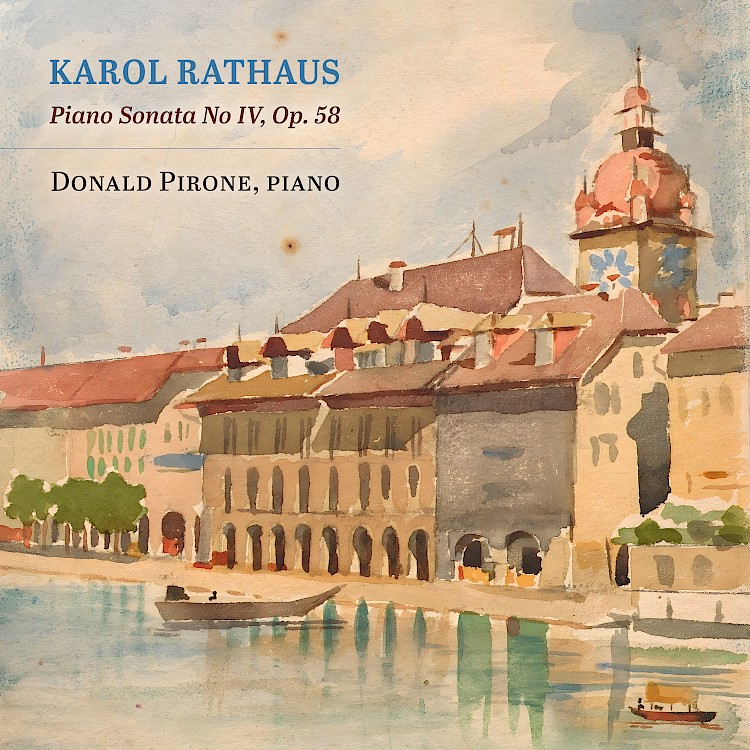
Pianist Donald Pirone releases Karol Rathaus' expansive and virtuosic Piano Sonata No. IV, a culminating work in the output of a composer/pianist who had fled the political instability in Central Europe in the 1930s. Rathaus' work reflects influences of some of the avant-garde directions of Schoenberg, Stravinsky, and Bartók, while remaining grounded in late romantic sensibilities.
| # | Audio | Title/Composer(s) | Time |
|---|---|---|---|
| Total Time | 20:33 | ||
Sonata No. IV, Op. 58 |
|||
| 01 | I. Allegro impetuoso | I. Allegro impetuoso | 8:46 |
| 02 | II. Andantino | II. Andantino | 6:50 |
| 03 | III. Allegretto ma non troppo | III. Allegretto ma non troppo | 4:57 |
Like so many Central European composers in the mid-20th century, Karol Rathaus fled political persecution and emigrated to the United States, first to Los Angeles where he became active as a film composer, and later to New York, where he spent the last years of his career teaching at Queens College while continuing to compose, securing commissions from several major American orchestras and the Metropolitan Opera. A virtuoso pianist, the instrument remained at the center of his musical life throughout, and here Donald Pirone documents his fourth and last sonata for piano in a bracing performance.
Rathaus' previous three piano sonatas were written in Berlin, while the fourth was written while he lived in New York. By this time in his life, Rathaus' style reflected his absorption of many stylistic approaches, and perhaps the geographic and psychic distance between New York and his life in pre-war Europe fed his polystylistic embrace. In this sonata, one hears a composer free from the compositional polemics that often dominated the work of mid-20th century artists. Influences of late Romantic figures like the virtuosity of Liszt and Chopin's lyricism live alongside fluid, atmospheric gestures reminiscent of Debussy; the folk-influenced angularity of Bartók dialogues with sardonic characterization that echoes Prokofiev.
Read MoreThe sonata's opening movement, Allegro impetuoso, begins with percolating trills and flourishes that are initially impressionistic before gradually becoming rhapsodic. The rate of expressive change in the movement is fairly quick, with pensive moments following directly after dramatic, virtuosic passages, and pointed chordal accents eliding into an off-kilter dance. A brief, punctuated three note figure in the bass register asserts itself throughout the movement, providing seed material for motivic development. The music becomes reflective shortly after the movement's midpoint, exploring some of the same motivic ideas as before in a dream-like, rhythmically free section. Pointed attacks in the lower register signal the impending return of the more vigorous opening material, pressing towards pillars of block chords that close the movement.
Tonally ambiguous, planed chord voicings open the second movement Andantino. Spare, connective melodic material provides relief from the immersive pianism of the first movement, though the Andantino is not without its bombastic moments. The energy accumulates towards a climax the references the opening chords, linked together by rhapsodic octaves. After the climax, Rathaus returns to the reflective mood of the beginning of the movement, adding playful chordal interjections between episodes of lyrical melody and evocative trills. A delicate high register arpeggio and resigned low bass note draw the Andantino to its close.
The final Allegretto ma non troppo announces itself with a jaunty subject that is subjected to some contrapuntal imitation before being supported by a driving arpeggiated ostinato in the bass. Militaristic repeated chords drive the texture forward, interspersed with linear scalar passages. When Rathaus brings back the initial buoyant theme, he mixes it with thundering octaves and heroic passagework, bringing back the pianistic virtuosity that was present in much of the sonata. After a dramatic descending scale, we hear a jazzy penultimate chord before the final cadence, perhaps a nod to his adopted home late in his life. Donald Pirone delivers a powerful and committed performance to Rathaus' final large scale work for piano, a portrait of an artist in exile.
– Dan Lippel
Recorded at LeFrak Concert Hall, Queens College, CUNY, 2011
Recording engineer: Rick Krahn
Producer: Joseph Liccardo
Piano technician: Andrew Saderman
Edited, mixed and mastered by Da-Hong SeeToo, 2013
Cover painting: Bertha Bucher, Rathaus (1915-1945)
Back cover painting: Charles Vetter (German, 1858-1936): München Marienplatz und altes Rathaus
Photo, p. 2: Portrait of composer Karol Rathaus
Photo, p. 3: Karol Rathaus; Queens College Photographs, Special Collections and Archives (SCA - 0055)
Design: Marc Wolf, marcjwolf.com
Donald Pirone is an acclaimed American pianist who has enjoyed a distinguished career as soloist and chamber musician. His performances of 18th-19th century music have been widely acclaimed and he has appeared in major venues in New York City and throughout the U.S. Mr. Pirone has devoted himself to the promotion of 20th-Century music, and he is recognized for his particular interest in the music of Karol Rathaus (1895-1954). His dissertation, Solo Music of Karol Rathaus: A Performance Guide, is the first in-depth study of the composer’s piano music. Karol Rathaus, a recording issued in 1988, is the first to have been devoted entirely to his music. Pirone performed chamber and solo works, including the Sonata for Piano and Clarinet, Op. 21, with Richard Goldsmith, and, for solo piano, Ballade, Op. 40, Variations on a Hurdy-Gurdy Theme, and Kujawiak, Op. 47.
The recording was recognized as an important contribution to the annals of early 20th century music: “Returning to his music after many years, in the capacity of a professional critic, I am struck by the enormous strength of character.” (Ovation Magazine). In a concert at Alice Tully Hall in Lincoln Center commemorating the 30th anniversary of the composer’s death, Mr. Pirone gave the New York premiere of the Concerto for Piano and Orchestra, Op. 45, with Martin Canellakis, conductor, and the Queens College Orchestral Society. He later recorded the concerto with the London Symphony Orchestra under JoAnn Falletta. The pianist and composer were hailed in the NY Times: “…one can almost imagine the composer himself at the keyboard…based on this reading, Rathaus’s Piano Concerto can well take its place in the repertory alongside Bartok’s 2nd and 3rd Concertos.” Rathaus’s Piano Sonata No. IV, Op 58, presented on this release, is one of the composer’s major piano works. At a performance in Weill Hall, it “…called to mind a spartan, cerebral cousin of the wartime sonatas” (New York Times), and at the Polish Jewish Music Conference at USCLA, “… the most persuasive work was Rathaus’s brooding Fourth Piano Sonata…given a compelling reading by Donald Pirone…” (LA Times).
Donald Pirone received his Bachelor of Music Degree at Queens College and was awarded a scholarship for study at The Juilliard School where he earned his Master’s Degree. His research and study of the solo piano music of Karol Rathaus culminated in his doctoral dissertation at New York University. In addition to works by Karol Rathaus, Mr. Pirone has premiered and recorded several new works of 20-21st-Century composers, including Allen Brings, Edward Smaldone and Leo Kraft. He can be heard on CRI, Koch International, Heritage, Navona, New Focus and New World Records.
Donald Pirone resides in New York, and is a member of the performance faculty at the Aaron Copland School of Music at Queens College. He was coordinator of the piano, chamber music and performance programs at the Eisman Center for Preparatory Studies in Music, where he served as Director from 2008–2018.
New Focus Recordings is an artist-led collective label featuring releases in contemporary creative music of many stripes, as well as new approaches to older repertoire. The label was founded by guitarist Dan Lippel, composer Peter Gilbert in 2004, and composer/engineer Ryan Streber in 2004, formed …Read More …
Listen to full streaming tracks while you browse the site. New tracks enabled for streaming every month. Click on the button to open up the radio player.


