
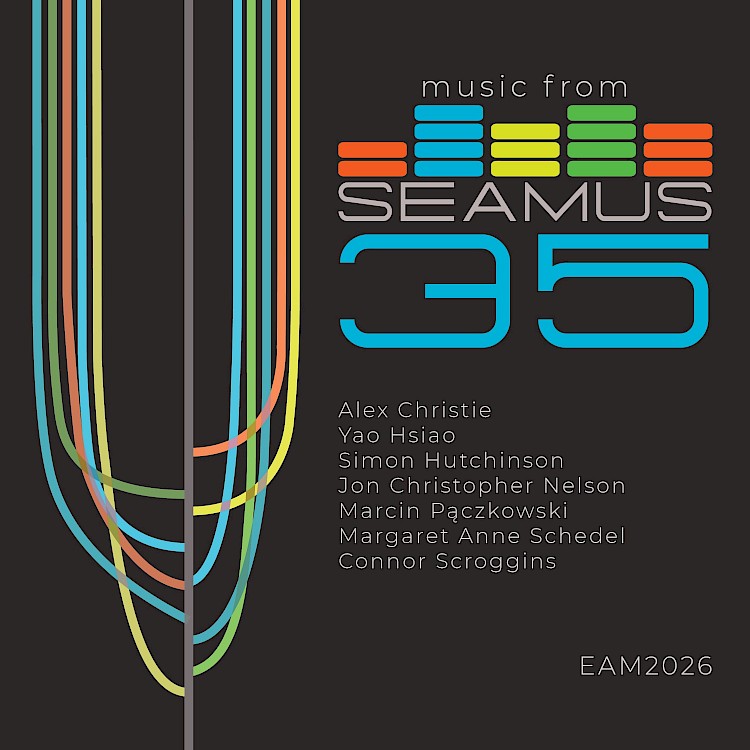
SEAMUS (Society for Electro-Acoustic Music in the United States) releases Volume 35, the 2026 iteration of its long running series featuring new works by its member composers. Featuring music by Jon Christopher Nelson, Alex Christie, Simon Hutchinson, Yao Hsiao, Margaret Ann Schedel, Connor Scroggins, and Marcin Pączkowski, the SEAMUS composers continue to push the boundaries of genre, showcasing the aesthetic possibilities of emerging and existing technologies.
| # | Audio | Title/Composer(s) | Performer(s) | Time |
|---|---|---|---|---|
| Total Time | 54:54 | |||
| 01 | Bang, Crunch, Bounce | Bang, Crunch, Bounce | Jon Christopher Nelson, electronics | 9:01 |
| 02 | Wordless, yet needing to embody anything | Wordless, yet needing to embody anything | Andrea Biagini, flutes, Michele Bianchini, saxophones, Chiara Franceschini, violin | 8:04 |
| 03 | Daiyu | Daiyu | Yao Hsiao, voice and iPad | 4:24 |
| 04 | CD 40209 | CD 40209 | Alex Christie, metronomes, contact microphones, photosensitive circuits, lights | 5:32 |
| 05 | Ancestor | Ancestor | Simon Hutchinson, live electronics | 8:33 |
| 06 | metanoia | metanoia | Ford Fourqurean, clarinet | 7:48 |
| 07 | Here comes a candle to light you to bed | Here comes a candle to light you to bed | Marcin Pączkowski, interactive electronics | 11:32 |
SEAMUS releases Volume 35 of its ongoing series featuring electro-acoustic works from its member composers. Volume 35 features works from the 2025 SEAMUS National Conference at Purdue University, as voted by the membership for inclusion. This volume features pieces by Jon Christopher Nelson, Alex Christie, Simon Hutchinson, Margaret Anne Schedel, Marcin Pączkowski, the SEAMUS Student Commission first prize work by Yao Hsiao and the second prize work by Connor Scroggins.
Bang, Crunch, Bounce is inspired by Loop Quantum Gravity, a theory that speculates that our known universe is in an infinite cycle consisting of a Big Bang, a subsequent expansion followed by a contraction, or Crunch, until everything compresses into another Big Bang, from which another universe Bounces into existence. Jon Christopher Nelson’s work contains numerous bang/crunch/bounce cycles that create a very small set of sonic universes, each selected from among field recordings of acoustic environments collected over three decades.
Connor Scroggins’ Wordless, yet needing to embody anything is the SEAMUS Student Commission second prize work. As the piece unfolds, various sonic moments suggest conflicting identities and directions. Reflecting his experiences with perception amid overstimulation and an effort to remain mentally present while, for example, walking outdoors.
Read MoreDaiyu, by Yao Hsiao, is the SEAMUS Student Commission first prize work. It is inspired by The Dream of the Red Chamber, portraying the tragic love between Baoyu and Daiyu. Structured in three sections, the work recalls Daiyu’s memories, presents traditional Yue opera singing and movement, and concludes with the symbolic burning of her writings. Daiyu’s sensitivity, fragility, and poetic grace are expressed through the lyrical style of Yue opera, woven together with contemporary electronic music and processed voice performance. Gestures on the iPad mirror her actions of reading and handling manuscripts, turning theatrical movement into real-time electronic control.
CD 40209 is Alex Christie’s assemblage of physical bodies that speak in different modes and are affected by their proximity to each other. As these bodies are rearranged and repositioned, they shape the resonance of the cumulative sonic network. Meanwhile, light pushes and pulls on sound-producers and casts shadows into the physical performance space. The result is rhythmic audio-visual texture that fluidly moves through stability and instability.
Simon Hutchinson’s Ancestor uses hybrid live electronic performance with both analog and digital synthesis and control, exploring the potential for using the best of both of these musical worlds. Analog synthesizers and other outboard gear have been enjoying a resurgence in recent years, leading to a new trend in performance setups that eschew laptops and software.
Written for Kyle Hutchins on the occasion of the retirement of Cort Lippe, metanoia by Margaret Anne Schedel celebrates changing one's mind. Drawing from a breathing meditation—breathe in, exhale, hold with empty lungs—and using fragile multiphonics, the performer breaks the stability of complex tones. Substance and accident fuse together, united by interactive sound processing. An optional small speaker array inside the instrument, controlled by a force-sensitive sensor, adds another layer of instability. Where is breath? In the stillness.
The title of Marcin Pączkowski’s Here comes a candle to light you to bed derives from a nursery rhyme referenced in George Orwell’s “1984”. Throughout the novel, the protagonist struggles to recall the poem’s ending, revealed only at the moment of his capture: “Here comes a candle to light you to bed, here comes a chopper to chop off your head.” This narrative highlights the volatility of memory against a backdrop of manipulated knowledge. This work employs a machine learning model as an active memory, to continuously re-composes itself during performance; the model retrains in real time, embedding new “memories” of the performer’s gestures.
Produced by SEAMUS
Mastered by Scott L. Miller
Graphic design by Alison Wilder
Jon Christopher Nelson (b. 1960) is currently a Professor of Composition at the University of North Texas where he is an associate of CEMI (Center for Experimental Music and Intermedia). Nelson’s electroacoustic music compositions have been performed widely throughout the United States, Europe, Asia, and Latin America. He has been honored with numerous awards including fellowships from the Guggenheim Foundation, the National Endowment for the Arts, and the Fulbright Commission. He is the recipient of Luigi Russolo (1995), Bourges Prizes (1996, 1997, 1999, 2002 and the Euphonies d'Or prize in 2004) and the International Computer Music Association's Americas Regional Award (2012) and Music Award (2020). In addition to his electro-acoustic works, Nelson has composed a variety of acoustic compositions that have been performed by ensembles such as the New World Symphony, the Memphis Symphony, the Brazos Valley Symphony Orchestra, ALEA III, and others.
Connor Scroggins is a composer who is currently seeking a PhD of Music Composition from University of North Texas. He recently completed a Master of Music from Bowling Green State University in 2022 and previously received a Bachelor of Music from Arkansas State University in 2020. He was a finalist for the 2023 ASCAP/SEAMUS Student Commission. At Arkansas State's Create@State research symposium, he presented on musique concrète instrumentale and won awards for his presentations on spectralism and musical logic. His current research interests include phenomenology and acoustic ecology. His works have been read and performed by Robin Meiksins, Chiara Franceschini, Ensemble Suono Giallo, The Rhythm Method String Quartet, Hypercube, New Thread Quartet, Apply Triangle Trio, Parker String Quartet, Unheard-of//Ensemble, The ___ Experiment, and Transient Canvas. His music has been performed in the United States and Europe at ilSUONO, ICMC, NYCEMF, SEAMUS National Conference, SPLICE Institute, NSEME, and the Saarburg Music Festival. He has participated in masterclasses from Ann Cleare, Clara Iannotta, Jason Eckardt, Augusta Read Thomas, Mari Kimura, Greg Wilder, Marina Kifferstein, and Stephanie Lamprea. He currently studies with Panayiotis Kokoras and previously studied with Elainie Lillios, Timothy Crist, Drew Schnurr, Mikel Kuehn, Marco Buongiorno Nardelli, Christopher Dietz, Derek Jenkins, and Carrie Leigh Page.
Yao Hsiao is a performer-composer, singer, voice artist, pianist, violinist, poet, and actor from Taiwan. They received their Master of Music degree in Composition from Indiana University Jacobs School of Music, where they studied with David Dzubay, Aaron Travers, Chi Wang, and John Gibson. Hsiao is currently pursuing a Doctor of Philosophy in Data-driven Music Performance and Composition at the University of Oregon, where they study with Jeffrey Stolet.
They have been inspired by literature ranging from Western poems to ancient Chinese poetry and Japanese haikus. Additionally, they were drawn to traditional Chinese culture. Chant of Languor and Dreamy Chant are inspired by Chinese poems, and Consort Yu for voice and live electronics is another piece of theirs combining Peking opera gestures and singing techniques, which they performed themselves. They were invited to perform this piece at conferences such as NIME 2024, SEAMUS 2024, EMM 2024, MOXsonic 2024, NYCEMF 2024, ICMC 2024, and SPLICE Festival VI. The piece was also selected as one of the finalists in the 2024 Sweetwater/SEAMUS Student Commission Competition. They also participated in Click Fest 2024, performing their piece Daiyu for voice, iPad, and live electronics.
Alex Christie makes acoustic music, electronic music, and intermedia art in many forms. His work has been called “vibrant”, “interesting, I guess”, and responsible for “ruin[ing] my day”. He has collaborated with artists in a variety of fields and is particularly interested in the design of power structures, systems of interference, absurdist bureaucracy, and indeterminacy in composition. He is currently based in Charlottesville, Virginia.
Recently, Alex’s work has explored the ecology of performance in intermedia art and interactive electronic music. Through real-time audio processing, instrument building, light, video, and theater, Alex expands performance environments to offer multiple lenses through which the audience can experience the work. Alex has performed and presented at a variety of conferences and festivals whose acronyms combine to spell nicedinsaucesfeeeemmmmmmfogascabsplotnort.
Alex serves as faculty, Director of Electronic Music, Director of Composers Forums, and Academic Dean at the Walden School of Music Young Musicians Program. He holds degrees from the Oberlin Conservatory and Mills College and is currently pursuing a PhD in Composition and Computer Technologies (CCT) at the University of Virginia as a Jefferson Fellow. Other interests include baseball and geometric shapes.
Simon Hutchinson is a composer and interdisciplinary artist whose work investigates the cultural narratives that are embedded in our interactions with technology. His works fuse European concert traditions, creative electronics, and global musical influences, creating interactive, immersive experiences that advocate for a thoughtful approach to the digital age.
Simon holds a PhD in Composition with supporting coursework in Intermedia Music Technology from the University of Oregon, and he is currently Professor of Music at the University of New Haven. He is internationally recognized as a composer and performer of electronic music, presenting works at festivals and conferences around the world. His creative and scholarly output spans such topics as interactive media, digital aesthetics, and the cultural implications of emerging technologies. His writings contribute to ongoing conversations on the evolving intersections of music, technology, and society, particularly in how digital tools reflect and influence cultural expression.
His recent works explore artificial intelligence and immersive audio, examining technology’s role as both a cultural medium and an extension of human ingenuity. Through projects that incorporate interactive environments and gameful structures, he investigates their possibilities in expressively reflecting broader cultural shifts, critically examining the role of technology in contemporary artistic practice.
Simon is currently the Chair of the Department of Music, Theater, and Dance at the University of New Haven. He teaches courses in composition, music technology, interactive media, world music, and music theory, and has previously held teaching positions at the University of Oregon, University of Montana, and Gordon College.
Through all of these creative and academic roles, he seeks to foster a greater critical engagement with technology through the expressive opportunities of music.
Margaret Anne Schedel forges connections between classical music, audio data research, and computational arts at Stony Brook University, where she is Professor of Music and core faculty at the Institute of Advanced Computational Science. Winner of NIME’s Pamela Z Innovation Award, she co-authored Cambridge University Press’s “”Electronic Music”” and co-founded Lyrai, using AI to create digital acoustic twins of architectural spaces.
Marcin Pączkowski (pronounced `marr-cheen pawnch-`koav-skee) is a composer, conductor, digital artist, and performer, working with both traditional and electronic media. As a composer, he is focused on developing new ways of creating and performing computer music. His pieces involving real-time gestural control using accelerometers have been performed worldwide, including International Computer Music Conference in Daegu, Korea, Music of Today concert series in Seattle, Washington, Northwest Percussion Festival in Ashland, Oregon, Toronto International Electroacoustic Symposium in Toronto, Canada, and the Audio Art festival in Kraków, Poland.
As the Music Director of Evergreen Community Orchestra, he presents concerts of diverse repertoire to local communities. He is also involved in performing new music and has led premieres of numerous works in Poland and the United States. His conducting performances with Inverted Space ensemble include Anahit by Giacinto Scelsi, featuring Luke Fitzpatrick on violin, Flurries by Brian Ferneyhough, and Hermetic Definition by Joël-François Durand. He is also active in the Seattle-area improvised music community performing on various instruments.
He received grants and commissions from Seattle Symphony, eScience Institute, Adam Mickiewicz Institute, and from Polish Institute of Music and Dance. He received his Ph.D. in Digital Arts and Experimental Media (DXARTS) from the University of Washington in Seattle, Washington. He also holds Masters’ degrees from the Academy of Music in Kraków, Poland, and from the University of Washington.
New Focus Recordings is an artist-led collective label featuring releases in contemporary creative music of many stripes, as well as new approaches to older repertoire. The label was founded by guitarist Dan Lippel, composer Peter Gilbert in 2004, and composer/engineer Ryan Streber in 2004, formed …Read More …
Listen to full streaming tracks while you browse the site. New tracks enabled for streaming every month. Click on the button to open up the radio player.


