Composer and pianist Richard Carrick's recent work fuses his penchant for long form composition, fluency in extended techniques, versatile performance practice, and interest in structured improvisation. This newest album-length work, l’Algérie is the second part of a trilogy of large-scale works inspired in part by the music of the Maghreb region of North Africa, drawing on Carrick's own family background and a fresh approach to the region's diverse musical heritage.
| # | Audio | Title/Composer(s) | Performer(s) | Time |
|---|---|---|---|---|
| Total Time | 44:32 | |||
l’Algérie | ||||
| Either/Or, Bahar Badieitabar, oud, Richard Carrick, piano, Jennifer Choi, violin, Justin Jay Hines, percussion, John Popham, cello | ||||
| 01 | Mémorial | Mémorial | 3:50 | |
| 02 | Aïn Bessem | Aïn Bessem | 1:48 | |
| 03 | Joie | Joie | 6:30 | |
| 04 | Interlude | Interlude | 3:48 | |
| 05 | La Reine | La Reine | 8:59 | |
| 06 | Les Cloches | Les Cloches | 5:55 | |
| 07 | Gnawa Loops | Gnawa Loops | 5:16 | |
| 08 | Inconnue | Inconnue | 2:39 | |
| 09 | Traverser | Traverser | 5:47 | |
Composer and pianist Richard Carrick conjures an evocative travelogue for an imagined journey through Algeria on his compelling new album-length work, l’Algérie. The second part of a trilogy of large-scale works inspired in part by the music of the Maghreb region of North Africa, l’Algérie is the most introspective and autobiographical piece of the project, drawing on the composer’s own family heritage and deeply personal exploration of the area’s richly varied musical traditions.
L’Algérie is scored for extended piano, oud, violin, cello and percussion, and performed by the acclaimed experimental chamber ensemble Either/Or: Carrick on piano, Bahar Badieitabar on oud, Jennifer Choi on violin, Justin Jay Hines on percussion and John Popham on cello. The concert-length composition is atypical in the contemporary and avant-garde chamber music world, where shorter, self-contained pieces are the norm — evidencing, as does much of his genre-blurring music, the influence of jazz, world music, and other forms on Carrick’s wide-ranging worldview.
L’Algérie is a vivid and original amalgam of refracted elements from Carrick’s North African influences; textural and timbral experiments with the composer’s innovative array of preparations and extended techniques; the intricate architecture of North African polyrhythms in contemporary chamber music; and excursions into improvisational elements.
The nine-movement work traverses an impressionistic landscape shaped by historical research and personal reflection, familial recollections and musical evolutions, abstract geography and improvisatory interpretation — shaped by Carrick’s compositional vision and singular vocabulary for the piano.
Read More“I've always had a passion for Algerian and North African music,” Carrick explains. “But there came a point when it seemed I would be unlikely to visit the country anytime soon. So I decided that to let the music guide me, to write a journal describing an imagined voyage to Algeria through music that I love from that region.”
Carrick’s fascination with the sounds and culture of the Maghreb was inherited from his mother, who was born in the town of Aïn-Bessem in northern Algeria. She left the country with her family after the Second World War to settle in France, where Carrick was born. He can still recall growing up with the cultural artifacts of the family’s past in North Africa: his grandparents conversing in Arabic and enjoying delectable meals of couscous.
Carrick’s fascination with the music of the Maghreb began to emerge in his compositions in 2009 after an inspirational visit to Morocco, when he wrote “Moroccan Flow (unfolding from unity)” as part of his Flow Cycle for Strings. The interest came to full fruition with 2023’s The Atlas, the first part of Carrick’s expansive, globally-minded trilogy — a trek into the titular mountain range composed for extended piano and string quartet. The third work, The Path, utilizes instrumentation similar to l’Algérie with Cuban tres in place of oud and drum set rather than percussion, allowing for a heavier, more groove-oriented approach inspired in part by ‘70s fusion and North African dance music.
Carrick set out to write l’Algérie with the danceable polyrhythms of Chaabi and the transcendent grooves of Gnawa music in mind, but as he wrote, he found that the suite began to draw more heavily on Arabic and Cantorial song. “Unexpectedly,” he says, “I ended up creating some of the most melodic music I've ever written through the inspiration of interesting meters and polyrhythms of Algerian music.”
The album opens with “memorial,” an embarkation point that sets out not only into unknown terrain but into a remembered past, evoked by haunting tones generated by the use of e-bows on piano strings. The impressionistic nature of the sojourn allows for travel in both time and place. The second movement sets down in the small desert town where Carrick’s mother was born, incorporating an echo of Cantorial melody in the pairing of oud and violin.
Explicit references to music and artists from Carrick’s research abound: the blind singer and oud player Reinette l’Oraniste, who introduced Arab-Andalus music to European audiences after relocating to Paris, in the fifth movement, “la reine;” the percussionist and composer Karim Ziad, a collaborator with popular raï singer-songwriters like Cheb Mami and Khaled, on the third movement, “joie,” which hints at his tune “The Joker;” while movement eight, “gnawa loops,” pays homage to “Kommi,” Ziad’s collaboration with pianist Omri Mor and guembri player Mehdi Nassouli.
“les cloches” reverberates with one of Carrick’s most inventive techniques inside the piano, creating a chiming, resonant tone with magnets, mutes, and a device he calls a “harmonizer” that interacts mesmerizingly with the oud and percussion. “interlude” and “inconnue” are both wholly improvised movements, though the line is blurred in Carrick’s work. “traverser” culminates the piece with a through-composed movement that builds in intensity and layered beauty.
– Shaun Brady/Richard Carrick
Recorded October 1, 2024 at Miller Theatre, NYC
Producer: Richard Carrick
Engineer: Joseph Branciforte
Editing: Richard Carrick
Mixing and mastering: John Escobar in RedRoom of EscobarMusic
Mixing and mastering assistant: Mar Giménez Marín
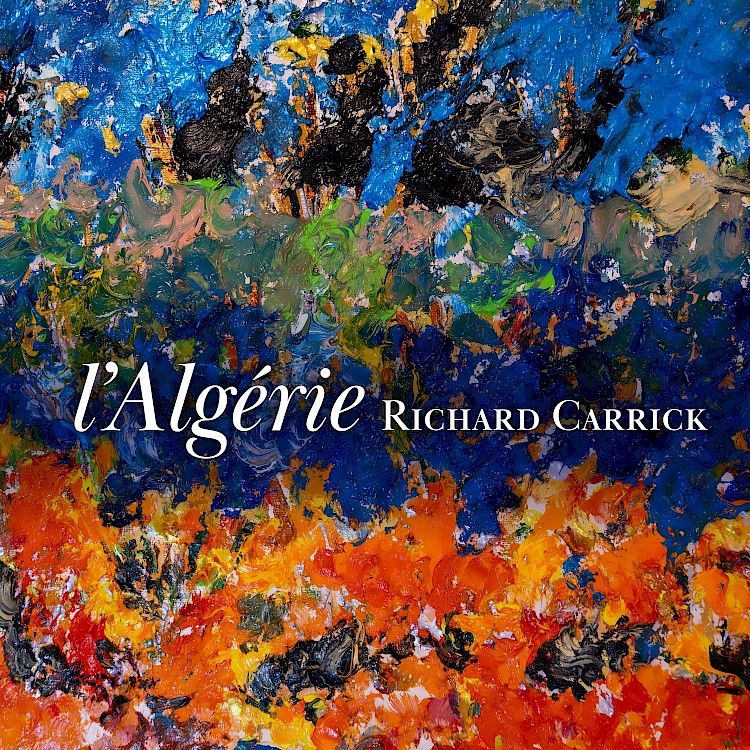
Cover painting: “Abundance” by Nomi Jovál (used by permission)
Additional paintings by Nomi Jovál
Design: Marc Wolf, marcjwolf.com
Richard Carrick (b. 1971, Paris, France) is a musician of wide-ranging vocations and interests, whose activities spans composition, performance, conducting, teaching artistry, education, lecturing, ensemble leadership, and curation. His reputation as an international leader in contemporary music rests on his tireless curiosity, intercontinental body of experience, and ceaseless exploration across disparate musical fields. His music is characterized by spatial depth and robust stasis; continual development and the evocation of profound human experiences.
Described both as "charming, with exoticism and sheer infectiousness" and "organic and restless" by The New York Times, Carrick's music is influenced by his multicultural background and experiences as well as his commitment to inspire professionals, audiences and youth through composition and live performance. His music spans beyond solo, chamber and orchestral compositions to include conceived works incorporating dance, graphic scores, multiple video projections, and group and conducted improvisation.
Carrick’s music has been programmed and presented internationally at festivals including NYPHIL BIENNIAL, ISCM World Music Days-Switzerland, Library of Congress, Enescu Festival, Pacific Rim Festival, Miller Theatre, Mid-American New Music Festival, and Darmstadt Summer Festival, and performed by musicians including the JACK Quartet, Mivos Quartet, Nieuw Ensemble, Wet Ink Ensemble, New York New Music Ensemble, Hyperion Ensemble, String Noise, Sequitur Ensemble, Musica Nova, Hotel Elefant, Marilyn Nonken, Taka Kigawa, Margaret Lancaster, Vasko Dukovski, Jennifer Choi, Tony Arnold, Magnus Andersson, Steven Schick, Rohan de Saram, and others. Recent Concert Portraits were presented by Miller Theatre (2019, 2024) Either/Or (2023, 2025), MIT (2023) Berklee (2024) and by New Chamber Ballet (2023, 2021) with whom he has written a number of new works for dance. He is the recipient of numerous awards, including a 2015-16 Guggenheim Fellowship in Music Composition and a 2011 Fromm Foundation Commission.
Carrick is co-founder and co-artistic director of the contemporary music ensemble Either/Or, declared 'first rate' and ‘a trustworthy purveyor of fresh sounds’ by The New York Times, and winner of the 2015 CMA/ASCAP Award for Adventurous Programming. As conductor and pianist, Carrick has worked closely with many celebrated composers including Helmut Lachenmann, Jonny Greenwood, Chaya Czernowin, Elliott Sharp, George Lewis, Anna Thorvaldsdottir, Iancu Dumitrescu, Robert Ashley, Karin Rehnqvist and Raphael Cendo. Carrick conducting E/O's ambitious single night concert of “John Cage Party Pieces” premiered 125 scores by renowned composers from around the world.
As teaching artist of considerable experience, Carrick was instrumental in the development and international expansion of the New York Philharmonic’s Very Young Composer program internationally, in which he mentored hundreds of young composers to compose pieces to be performed by New York Philharmonic musicians (including over 20 pieces premiered by the full NY Philharmonic Orchestra). He helped develop VYC ground breaking programs for young composers in Korea (with KACES), Japan and at the Barbican in the UK. During his work as a Guggenheim fellow, Carrick started two young composer programs, in Tel Aviv, Israel and Kigali, Rwanda.
Carrick serves as Chair of the Composition Department at Berklee College of Music, possibly the largest composition department in the world, where he has developed a number of new courses including the Neither/Nor Composer/Performer Ensemble, Composing New Music for Dance, Advanced Projects in Composition, and Introduction to Composition. He has presented masterclasses and lectures throughout the US, Canada, Holland, France, UK, Spain, Sweden, Germany, Israel, Rwanda, Japan and South Korea. Former posts include composition faculty at Columbia University (Graduate program) and New York University.
His latest release, The Atlas, for extended piano and string quartet, features his longtime collaborators Either/Or, and is the first in three projected CD’s based on hour long concept works. His previous release, Cycles of Evolution, incorporates pieces commissioned and performed by Musicians of the New York Philharmonic, Either/Or, Sweden’s Ensemble Son, Hotel Elefant and String Orchestra of Brooklyn. Carrick conducts or performs on all works on this CD, which includes his 'apocalyptic' multimedia work for performers and video, Prisoner's Cinema. Carrick's first recording, also on New World Records, the “rich, beguiling” (The New York Times) extended chamber composition Flow Cycle for Strings, translates psychologist Mihaly Csikszentmihalyi's 'flow' principle into sonic terms. 2020 release lanterne (New Focus Recordings)includes solo and chamber works by close collaborators, including his second string quartet Space:Time. Carrick's improvisation-based disc Stone Guitars (NFR) garnered critical attention in both the new music and guitar worlds, causing American Record Guide to note 'it may change your perception of electric guitar'.
A US/French citizen born in Paris of French-Algerian and British descent, Carrick received his BA from Columbia University, MA and PhD from the University of California-San Diego working with Brian Ferneyhough, and pursued further studies at IRCAM and the Koninklijk Conservatorium. Scores distributed by Project Schott New York.
Bio by Brad Balliett
http://www.richardcarrick.comOnce again collaborating with the Either/Or Ensemble, Carrick follows up the “dazzling versatility” of 2023’s The Atlas with a deeper dive into his mother’s Algerian roots. Joining Carrick on his trademark “extended” piano are Either/Or’s Bahar Badieitabar on oud, Jennifer Choi on violin, Justin Jay Hines on percussion, and John Popham on cello. The resulting 45-minute work is atmospheric and evocative, moving through its nine sections like flipping through a family photo album.
— Jeremy Shatan, 1.30.2026
l’Algérie, from pianist-composer Richard Carrick and his new-music ensemble Either/Or, is the second of three large-scale works inspired in part by the music of North Africa’s Maghreb region, where the composer has family roots. So, more than most music, this nine-part concert suite for “extended piano” (more typically called “prepared piano”), oud, violin, cello, and percussion lives in the realm of the imagination.
Like its predecessor The Atlas, l’Algérie is a concert suite that mingles Old World and New, grooving and drifting, familiar modes and eccentric effects, through-composed music and improvisation.
“Mémorial” opens with tones suggestive of controlled feedback and evolves into a contemplative collage of acoustic and electronic sounds that introduce the cast of instruments. Bahar Badieitabar’s oud enters with a brief melody, but the piece ends back in space. In “Aïn Bessem” the oud, again in its lower resonant register, and Jennifer Choi on the violin play an introductory duet that establishes a North African “setting.” I use that word deliberately, as listening to the album gives me the sense of a theatrical work peopled by instruments as “characters” who collectively tell a story.
The plot thickens in the rhythmic “Joie,” which brings in John Popham’s cello as low-end support, then the piano outlining repeated figures which solidify into unisons. A kind of mini-set of theme and variations thumps away, suggesting a ritual of solemn joy.
In an improvised “Interlude,” extended techniques from the strings create howls and squiggles until the oud again steps in with melodic riffing. The next two pieces form the heart of the album. The meditative “Reine” holds to an eccentric but steady 5/8 beat under colorful jazz-inspired pictures with an improvisatory feel, drawn first by Carrick on the piano, then by the oud, then the violin. Soaring harmonies develop from the ensemble over the continuing beat from the percussion and the low-end ostinatos. A final oud solo trickles over descending chromatic harmonies, and the piece ends with the sound-space opening up for a percussion solo from Justin Jay Hines.
The most unusual composition and timbres come from the extended piano in “Les Cloches,” where Carrick outfits the instrument with magnets, mutes, and a “harmonizer” (not the black box of that name that I remember from my electronic-music studies in the 1980s) that interacts with other instruments. Despite, or because of, the weirdness of the sound, the subtle dissonances, and the unorthodox rhythms, the piece develops into something quite lyrical and beautiful.
To my ear, the bouncy rhythm and repetitious figurations of “Gnawa Loops” has affinities with sub-Saharan Afropop. It’s another setting for improvisatory play, and it serves as the show’s “dance sequence.”
Regarding this and other movements, the liner notes describe homages to various musicians from the region – Karim Ziad, Omri Mor, singer and oud player Reinette l’Oraniste, guembri player Mehdi Nassouli. Fear not: Familiarity with their music is no more required for appreciating l’Algérie than visiting North Africa would be de rigeur for enjoying North African music.
As many plays do, the album loses a bit of momentum in its second half, specifically here with the improvised and rather aimless “Inconnue.” But it finishes on firmer ground with the ruminative ensemble piece “Traverser.” Here the characters seem to mull over the preceding drama and resolve to carry on in concert and with fortitude – even as sonic clouds gather and thicken in the final minutes and the scene climaxes with a soaring piano figure. Exeunt.
This album is the second part of Richard Carrick’s triptych of Maghreb-inspired music, which began with The Atlas (our review of which is linked above). l’Algérie was recorded live at Columbia University’s Miller Theatre in New York City.
— Jon Sobel, 3.26.2026
Nothing else sounds quite like l'Algérie (2024), the second album-length chapter in a trilogy composed by pianist Richard Carrick (b. 1971) and performed by Either/Or, the chamber quintet he co-founded and co-artistic directs. As its title inmates, the nine-part work was inspired, in part, by the music of the Maghreb region of North Africa and by extension Carrick's own family background (his mother was born in the town of Aïn Bessem in northern Algeria). In fusing formal composition and musical elements that evoke that North African subregion, Carrick, a Paris-born US/French citizen of French-Algerian and British descent, has created something wholly distinctive and engaging.
Joining him on the adventure are violinist Jennifer Choi, cellist John Popham, percussionist Justin Jay Hines, and oud player Bahar Badieitabar, the ensemble's instrumentation alone reflecting Carrick's cross-cultural sensibility. Currently Chair of the Composition Department at Berklee College of Music, he's a graduate of Columbia University and the University of California-San Diego who also studied at IRCAM and the Koninklijk Conservatorium. With musical interests so broad, he's fortunate to have Either/Or as both a creative outlet and vehicle. As two of the work's parts reveal (“Interlude” and “Inconnue”), the quintet is comfortable improvising in addition to executing notated charts; the line separating improv and composition also blurs during “Gnawa Loops” when Choi and Badieitabar solo like jazz players.
While l'Algérie can be experienced on purely musical grounds as a wide-ranging study in stylistic contrasts, musical traditions, and moods, it also allows the listener to treat it as a travelogue through the Algerian region. It qualifies as both an imagined public journey and personal meditation on family history. That the work refuses to be easily categorized—the catch-all world music makes the most sense, even if it ventures into folk, classical, and jazz—is one of the things that recommends it. Realizing that a visit to Algeria might not be on the immediate horizon, Carrick “decided that to let the music guide me, to write a journal describing an imagined voyage to Algeria through music that I love from that region.”
The journey begins with “Mémorial,” whose shimmering tones (produced by e-bows on piano strings) offer a cryptic, memory-haunted portal, the movement's time-suspending, dream-like quality enabling the listener to ease smoothly into the work's sound-world. Experimental textures intersect with oud picking and bell tinklings to intensify the exotic aura before Badieitabar ushers “Aïn Bessem” into being with an unaccompanied intro. Referencing directly the town where Carrick's mother was born, the melancholy that emerges from the pairing of oud and violin feels both forlorn and nostalgic. With the advent of “Joie,” the arrangement focus shifts rapidly to prepared piano, oud, and percussion, with the movement's folk-dance swing amplified by the strings' animated intertwining. Presenting the players at their most free and individually explorative, the wholly improvised “Interlude” follows, Badieitabar in particular making the most of the opportunity for self-expression.
Hines's hand drums and swaying rhythms imbue “La Reine” (at nine minutes the longest movement) with the aromatic mystery and intrigue of a spy caper, Carrick's jazzy acoustic piano offering a counterpoint to oud and strings—close your eyes and it's easy to picture yourself at some late-night Algerian cafe absorbing the faint traces of music from a nearby club. Carrick's inner piano treatments lend the music a metronomic feel during “Les Cloches,” after which the feverish “Gnawa Loops” delivers the work's most emphatic groove-centric statement. Whereas the penultimate “Inconnue” revisits a free-jam ethos, “Traverser” concludes the work with a through-composed expression that patiently guides the piece to a satisfying resolution.
In being performed by quintet, the work feels intimate; at the same time, pronounced timbral contrasts make the group seem larger than it is. While the trilogy's parts, The Atlas, l'Algérie, and The Path—the first, scored for piano and string quartet, imagines a trip into the titular mountain range and the third embraces a groove-driven approach inspired in part by ‘70s fusion and North African dance music—would have the greatest impact were they to be experienced together, l'Algérie, commendably compact at forty-five minutes, hardly suffers when presented alone.
— Textura, 5.27.2026
The pianist and composer Richard Carrick presents 9 diverse pieces that embrace extended techniques and structured improvisation that recruits the Either/Or ensemble.
“Mémorial” opens the listen with a distinct droning, where John Popham’s cello is used strategically, and “Ain Bessem” follows with Bahar Badieitabar’s precise oud adding much culture to the harmonic landscape.
Halfway through, “Interlude” focuses much on space and tension in its unpredictable demeanor, while “La Reine” enlists Carrick’s mesmerizing piano and Justin Jay Hines’ frisky percussion that work together with an atypical energy.
Residing close to the end, “Gnawa Loops” radiates animated keys, upbeat strings and crisp percussion via the rock focused moment, and “Traverser” exits with a cinematic appeal that enlists Jennifer Choi’s detailed violin, which helps create a haunting mood.
The songs reflect an imagined journey through Algeria, and ideas from chamber, jazz and world music populate the avant-garde experience that’s never short on texture or timbral exploration.
— Tom Haugen, 7.22.2026
New Focus Recordings is an artist-led collective label featuring releases in contemporary creative music of many stripes, as well as new approaches to older repertoire. The label was founded by guitarist Dan Lippel, composer Peter Gilbert in 2004, and composer/engineer Ryan Streber in 2004, formed …Read More …
Listen to full streaming tracks while you browse the site. New tracks enabled for streaming every month. Click on the button to open up the radio player.