
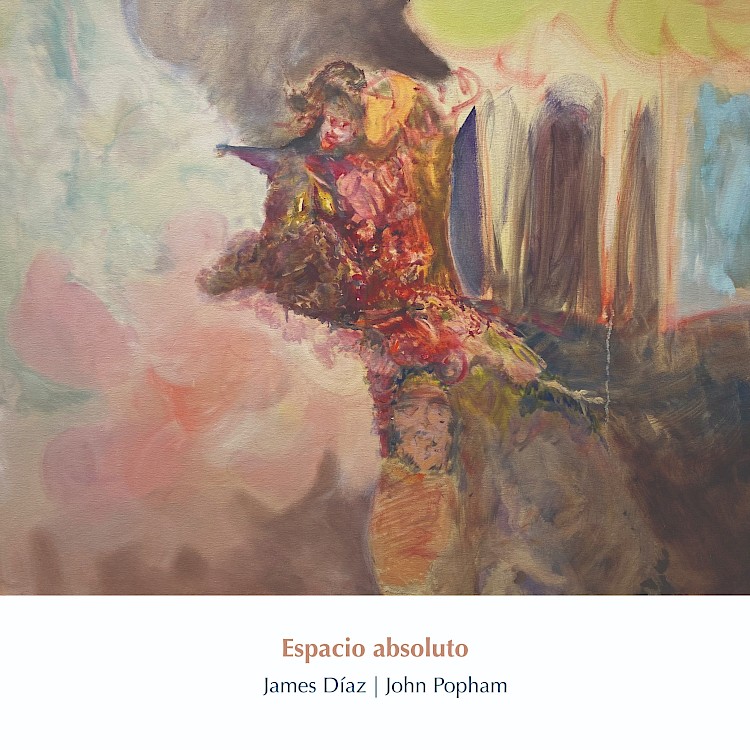
Espacio absoluto is a collection of nine works for solo cello that conjure sonic landscapes of dramatic timbral contrasts, hypnotic repetition, and multidimensional texture and feeling. Written by James Díaz and performed by longtime collaborator John Popham, the album draws inspiration from the concept of absolute space, an infinite, unchanging space that exists independently of its internal inhabitants. In these nine works, Díaz uses the cello as a source of both rich melodic material as well as kaleidoscopic textures that give form to these vivid spaces.
| # | Audio | Title/Composer(s) | Time |
|---|---|---|---|
| Total Time | 49:18 | ||
| 01 | Espacio absoluto | Espacio absoluto | 9:46 |
| 02 | Interludio I | Interludio I | 2:06 |
| 03 | Desiertos verdes | Desiertos verdes | 7:10 |
| 04 | Interludio II | Interludio II | 3:09 |
| 05 | From Pink to Orange | From Pink to Orange | 10:42 |
| 06 | Interludio III | Interludio III | 1:44 |
| 07 | Grand Oasis | Grand Oasis | 7:39 |
| 08 | A Warm Place without Memory | A Warm Place without Memory | 3:42 |
| 09 | Espacio tiempo | Espacio tiempo | 3:20 |
Colombian composer James Díaz creates immersive works characterized by shifting textures, vibrant sonic masses, and gradual fluctuations of energy. In his orchestral, chamber, and electroacoustic music, Díaz constructs sonic worlds that feel unrestrained by time and space. Over long expanses, instrumental textures are layered upon one another creating ever changing, hyperactive musical structures. The listener can engage with individual lines as they wax and wane and observe the interaction of restless musical agents. In Espacio absoluto, Díaz explores the full creative potential of a solitary acoustic instrument. Here complex structures are replaced by simpler forms comprising fragmented melodies, fragile harmonics, and melancholic gestures. Díaz thinks of these works as imaginary landscapes, writing, “each piece occupies a different location, yet returns to the same intangible field: a field where silence and sound drift freely, unanchored by time.”
The title track, Espacio absoluto, opens with a series of fragmented memories. Crystalline harmonics preface simple melodic lines. The music unfolds gradually, proceeding through repetitive gestures—brushed bow strokes, gentle ricochets, and quick harmonic bursts—before finding places of repose.
In Interludio I, a single line pushes and pulls, searching for its gravity. Pulsing harmonics shine over rich double stops as the music moves towards a destination that is perpetually out of reach. As it lurches forward, resonance accumulates, producing complex sonorities that engage the instrument’s vibrant sonic spectrum. In Desiertos verdes, the listener travels through an expansive terrain populated by harmonic flutters, lush double stops, and mesmeric swells. Peripatetic musical lines emerge along the way. After passing through a deep layer of double stops, a haunting melody takes form, punctuated by isolated pizzicati and bending glissandi.
Interludio II draws tension from two oppositional forces. While double stop swells propel the music forward, they are restrained by the ricochet’s necessary mechanics. The repeated articulation sonifies the bow’s collisions with the string, emphasizing the gravitational pull of this environment.
The album’s most kinetic work, From Pink to Orange, explores “form through transformation.” The cello’s arpeggiations are transformed by gradual alterations of pitch and bow placement, as well as the isolation of individual notes within the bariolage. The overall downwards trajectory of the piece eventually brings us into a deep register that has the capacity for both power and tenderness.
Interludio III further mines the richness of cello’s lowest register in a short interlude that feels subaquatic. Melodic lines push continuously towards the surface through expanding trills and double stops as moving gestures appear refracted by the water’s surface.
In Grand Oasis, Díaz imagines an infinite field where vast melodies spread beyond the horizon. Slow-moving phrases are interrupted by sharp attacks and expanded pauses while the music moves in circular waves. Towards the end of the work, a lilting rhythmic loop appears out of this environment, an animated ecosystem within this broad expanse.
A Warm Place without Memory returns to the sentimental lyricism of the album’s opening and highlights Díaz’s juxtaposition of melodic fragments with abstract textures. From the opening bars, we hear a melody beginning to crystallize among isolated trills and harmonics. After a dramatic build, the work concludes with a moment of moving stillness.
The postlude, Espacio tiempo, is Díaz and Popham’s most otherworldly landscape. A slow procession of multiphonics envelops the listener in sounds that are complex and magnetic. The listener floats in an extraterrestrial environment in which movement and direction are in a permanent state of suspension.
– John Popham
Recorded by Mike Tierney, Fieldnotes Studio, NYC
Mastered by Alan Silverman
Album art: Four Five Faces by Sky Riggs
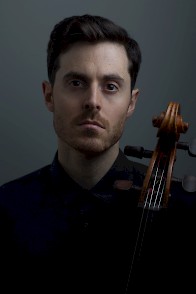 Cellist John Popham is a chamber musician and teacher based in Brooklyn, New York. His playing has been described as “brilliant” and “virtuosic” (Kronen Zeitung), “warm but variegated”, and “finely polished” (The New York Times).
Currently a member of Either/Or Ensemble and LONGLEASH, Mr. Popham has performed internationally with groups including Klangforum Wien, Talea Ensemble, and the Argento Chamber Ensemble. He has appeared as soloist with the Louisville Orchestra, the String Orchestra of Brooklyn, the Red Light Ensemble, and the Kunstuniversität Graz Chorus.
Recent festival appearances include Brücken (Austria), Open Musik (Austria), IMPULS (Austria), the Vermont Mozart Festival, USINESONORE (Switzerland), Bay Chamber (Maine), the Contemporary Classical Music Festival (Peru), Lucerne Festival, and Klangspuren (Austria).
Dedicated to new music performance, Mr. Popham has worked with composers including Pierre Boulez, Tristan Murail, Steve Reich, Nils Vigeland, and Reiko Füting. The recipient of a Fulbright research grant, Mr. Popham spent the 2013/2014 academic year in Austria, where he studied the performance practice of Klangforum Wien and worked with leading figures in contemporary Austrian music: Beat Furrer, Georg Friedrich Haas, Klaus Lang, and Pierluigi Billone.
Mr. Popham is currently cello faculty of the Extension Division of Rutgers University. He received his BM and MM from the Manhattan School of Music where he was a student of David Geber and David Soyer and was awarded the Manhattan School of Music Full Scholarship. He has recorded for Tzadik, Carrier, New Focus, Albany, and Arte Nova records.
http://www.johnpatrickpopham.comCalled “stark, haunting elegance” with “intimate focus” by The Washington Post and "ethereal" by The Wire, the music of Colombian-born composer and electroacoustic musician James Díaz embodies a spectrum of compositional practices, blending digital techniques and collaborative exploration. From electronic compositions to amplified solo works, orchestral pieces, and multimedia creations, his music strives to evoke distinctive sonic textures, assemble resonant sound masses, and construct psychedelic immersive environments.
Díaz has won multiple international and national awards. In 2022, Díaz was selected as one of the commissioned composers for the Composition Inclusion program and one of the winners of the National Sawdust's Digital Discovery Festival New Works Commission in 2020. In Colombia, Díaz has won all the major composition awards, such as the 2015 National Prize of Music in Composition and the 2014 National Prize for the Reopening of the Teatro Colón from the Ministerio de Cultura de Colombia, the 2018 Bogotá Philharmonic Prize in Composition, for his orchestral piece "Frack[in]g", as well as the 2015 Bogotá Philharmonic Prize for Wind Band, and the 2012 Bogotá Philharmonic Prize for Chamber Music.
Díaz’s works have been performed by leading orchestras including the Basel Sinfonietta, the Cologne Radio Orchestra (WDR Sinfonieorchester), the Sinfónica Nacional de Colombia, La Nueva Filarmonía, American Composers Orchestra, Orquesta Filarmónica de Medellín, Xalapa Symphony Orchestra, Nashville Symphony, Orquesta Filarmónica de Bogotá, and the Orchestra of St. Luke's and by ensembles such as The New York New Music Ensemble, Longleash, Sō Percussion, Yarn/Wire, HUB New Music, TAK Ensemble, National Sawdust Ensemble, La Sociedad, Unheard-of//ensemble, among others. Díaz’ music has been featured in festivals such as Time:Spans in New York, ACHT BRÜCKEN, and SinusTon in Germany, Culturescapes in Switzerland, and the International Winter Festival of Campos Do Jordao in Brazil. Similarly, in collaboration with filmmaker/producer Leticia Akel, his film music has been presented at the SIFF Seattle International Film Festival ShortsFest, Palm Springs International ShortFest, Madrid FCM-PNR Festival, Cinemaissí Festival (Finland), and the Huesca, Quito, Sao Paulo, and Santiago international festivals.
Díaz, serving as the first-time ever composer-in-residence for the Orquesta Filarmónica de Medellín, premiered "RETRO," his largest work for orchestra and electronics in 2019.
Díaz's music is exclusively published by Project Schott New York (PSNY).
New Focus Recordings is an artist-led collective label featuring releases in contemporary creative music of many stripes, as well as new approaches to older repertoire. The label was founded by guitarist Dan Lippel, composer Peter Gilbert in 2004, and composer/engineer Ryan Streber in 2004, formed …Read More …
Listen to full streaming tracks while you browse the site. New tracks enabled for streaming every month. Click on the button to open up the radio player.


