
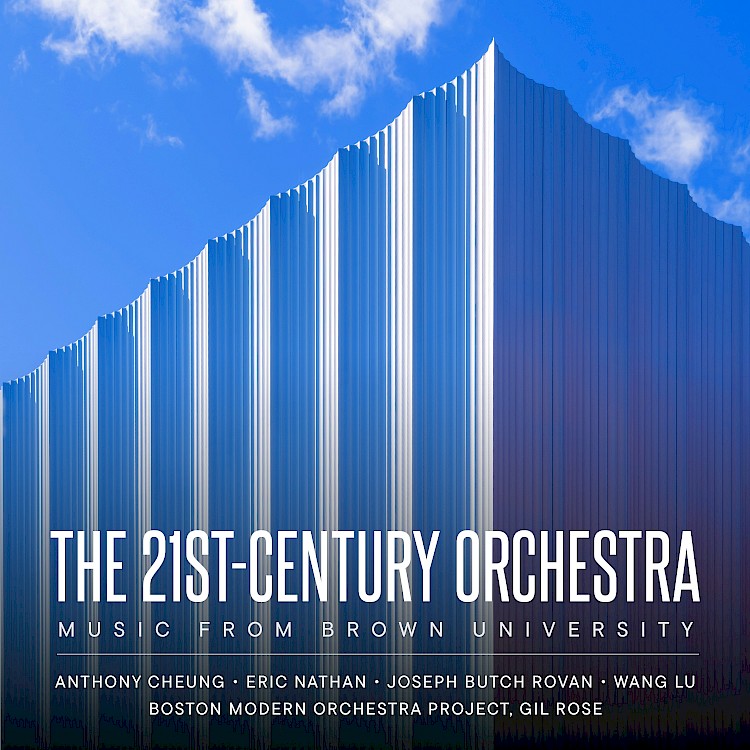
The 21st Century Orchestra is a celebration of the evolution of symphonic writing into our current era through the lens of the work of four composers on faculty at Brown University: Wang Lu, Anthony Cheung, Joseph Butch Rovan, and Eric Nathan. Despite their diverse stylistic approaches, they share a decidedly contemporary approach to writing for individual instruments and for contextualizing the modern orchestra, heard in expert performances by one of the premiere symphonies devoted to modern music in the United States, the Boston Modern Orchestra Project, led by Gil Rose.
| # | Audio | Title/Composer(s) | Time |
|---|---|---|---|
| Total Time | 61:38 | ||
| 01 | Surge | Surge | 6:17 |
| 02 | Voices of the Orchard | Voices of the Orchard | 10:12 |
| 03 | Scattering | Scattering | 14:46 |
| 04 | Volta | Volta | 15:23 |
| 05 | In Between II | In Between II | 15:00 |
The adage goes that it is much more difficult to change direction with a cruise ship than a small boat. Such is the case with symphony orchestras, and the orchestral world in general, in comparison to nimble chamber music organizations. For this reason, the kind of experimentation seen in chamber contexts has been slow to find its way into orchestral repertoire — the logistics are too complex, the financial stakes too high, and the risk aversion too entrenched, all for understandable reasons. But there are exceptions to every rule, and trailblazers for every path. The 21st Century Orchestra featuring the Boston Modern Orchestra Project (BMOP) celebrates a project curated by the Brown University faculty composers with one of the country’s seminal large ensembles for contemporary music that asserts exciting paths for the future. Wang Lu, Anthony Cheung, Joseph Butch Rovan, and Eric Nathan each cultivate ways to use the power and breadth of orchestral forces to manifest their individual aesthetic goals, navigating the unique factors involved in composing for large ensemble without compromising their visions.
Wang Lu’s Surge functions like an introductory overture to the recording, announcing itself immediately with a snare drum roll and heroic ascending trumpet fanfare. Dramatic, cinematic harmonies are fleshed out in the strings and brass, punctuated by wooden percussive hits. Wang Lu expertly balances solo and divisi moments with large tutti gestures, mixing the individual virtuosity associated with small ensemble contemporary music with the expanse of orchestral forces. Voices of the Orchard is an orchestral suite adapted from Wang Lu’s 2022 chamber opera The Beekeeper that explores how a piece of land holds onto stories, human and animal alike. The piece preserves an operatic emphasis on character and setting, shifting between evocative narrative sections. The opening material in the winds is lyrical with hints of foreboding lurking underneath, captured by the fragility of the high register violin writing, the mournfully subtle glissandi in the brass and strings, and a lilting repeated figure. The oboe and piccolo lead a sudden shift to a texture that bristles with life, like an ecosystem waking in the morning. When the strings take over with a languid line, the percussion supports with brushes on a snare drum outlining a light, swinging rhythm. Skittering sul ponticello figures in the strings, fleet chromatic runs in the piccolo, and a haunting bass drum roll remind the listener of dark forces in the background.
Butch Rovan’s Scattering introduces live electronics into the orchestra. The work features the TOSHI (The Orchestra-Synthesis Human Interface) system, which involves a controller worn on the wrist of the conductor that triggers electronic sounds based on their hand movements. The Covid-19 pandemic and George Floyd murder and subsequent protest movement moved Rovan to consider the nature of interconnected systems. The relationship between conductor and orchestra is indeed a system in itself, with a series of gestures that communicate musical directives. What would happen if that system was expanded to incorporate an element beyond the conventional forces of the orchestra? Rovan’s dramatic initial brass announcements are answered by ethereal electronic sounds, framing the discourse of the piece immediately as one that will take place past the boundaries of the instruments onstage. Often at phrase culminations, TOSHI captures the line and swirls sound spatially around the “hall” (or the stereo field), reinforcing the multi-dimensional context. Powerful unison bursts in the brass are answered by cavernous inward breathing sounds from TOSHI. Despite being the “foreign element” in an orchestral setting, in Scattering the orchestra plays the public role, while TOSHI brings us into a more internal sound world, amplified for the concert hall.
Anthony Cheung’s Volta refers to the poetry technique wherein the meaning of a poem suddenly pivots, transforming meaning. Cheung’s piece is full of such deft, clever turns, building up expectation just before the material takes an unexpected turn. It opens with collages of diversified activity broken up by short sustained violin phrases. Slapstick punctuations trigger furtive interlocking ensemble machines. An off-kilter dance is dotted by a cuckoo song in the winds, but just as the texture is settling, jagged brass shatter the light mood. Shrouded tremolos, fleet scale bursts, and brief hyper-expressive gestures characterize the next section. An oblique arrival on a unison pitch paves the way for elastic, gooey sighing gestures in the winds and tactile, staccato material in the strings. After a climactic segment that echoes the energy of the opening collage before blooming into cathartic exuberance, the work ends in a sparse haze, with a lone, unstable violin ascending into the ether.
Inspired by forest sounds near his home, Eric Nathan’s In Between II transforms the orchestral timbral palette to evoke a natural landscape and the wonder it inspires. We hear the rustling of leaves, swooshing of wind, and creaking of branches. The conductor’s gestures during these evocations are choreographed in the score, adding an artful visual element to the performance. Nathan asks members of the orchestra to play passages on harmonica, allowing the wind of the forest to animate the reeds of the instrument and produce a quasi-ambient harmony. When we hear the instruments enter in earnest nearly four minutes into the work, the environment has already been well established; we hear the orchestra “inside” of the sonic forest. Nathan unleashes the full force of the ensemble as the piece peaks, with epic swells that pass between rich brass, vigorous strings, and luminous bells. The ensemble coalesces into waves of shimmering harmony before closing with the forest sounds from the beginning and a lone violin playing in the high register. Nathan’s creativity is emblematic of the 21st Century Orchestra project as a whole; each composer approached it with reverence and discipline, bringing the richness of symphonic music into their realm of creative invention and pointing the way towards an invigorated role for orchestral repertoire in the future.
– Dan Lippel
Recorded October 25, 2024 at The Lindemann Performing Arts Center at Brown University, Main Hall during the Brown Arts Institute’s IGNITE Series, as part of the festival “The 21st Century Orchestra”
Recording producers: Eric Nathan (Executive), Anthony Cheung, Joseph Butch Rovan, Wang Lu
Sound engineers: James Moses, Joseph Butch Rovan (Scattering)
Editing, mix and mastering: James Moses, Joseph Butch Rovan (Scattering)
Photos of The Lindemann Performing Arts Center (cover, back cover, and pp. 3, 4, 6): Photo by Iwan Baan
© Iwan Baan, courtesy of Brown Arts Institute
Group photo of composers (p. 2) by Qiwen Ju © Brown University, courtesy of Brown Arts Institute
Concert photos (pp. 8-11, 15, 17) by Peter Chenot © Brown University, courtesy of Brown Arts Institute.
Gil Rose photo, p. 16: © Kevin Condon
Design: Marc Wolf, marcjwolf.com
Composer/pianist Anthony Cheung writes music that explores the senses, a wide palette of instrumental play and affect, improvisational traditions, reimagined musical artifacts, and multiple layers of textual meaning. His music has been commissioned by leading groups such as the Ensemble Modern, Ensemble Intercontemporain, Cleveland Orchestra (as the Daniel R. Lewis Composer Fellow), LA and New York Philharmonics, Frankfurt Radio Symphony Orchestra, Ensemble Musikfabrik, Yarn/Wire, Dal Niente, and the American Modern Opera Company (AMOC*). He has also written for flutists Claire Chase and Denis Bouriakov, the JACK, Escher and Spektral Quartets, vocalists Paul Appleby and Fleur Barron, violinists Miranda Cuckson and Jennifer Koh, and pianists Gloria Cheng, Gilles Vonsattel, David Kaplan, Shai Wosner, and Joel Fan. He has written music for film (null and void after Guy Maddin and the score to a documentary, The Burning Child), captioned sound sources (The Natural Word), and in collaboration with multiple poets (the echoing of tenses).
He is the recipient of a 2016 Guggenheim Fellowship, a 2012 Rome Prize, First Prize at the 2008 Dutilleux Competition, and has received multiple honors from the American Academy of Arts and Letters. As a co-founder of New York’s Talea Ensemble, he served as pianist and artistic director of the group. Recordings include five portrait discs on the New Focus, Kairos, Wergo, and Ensemble Modern labels, as well as recordings on Warner Classics, Tzadik, and Mode.
Anthony received a BA in Music and History from Harvard and a doctorate from Columbia University, and was a Junior Fellow at Harvard’s Society of Fellows. He previously taught at the University of Chicago and is an Associate Professor of Music at Brown University, where he teaches courses on topics ranging from theory and composition to the jazz orchestra and Asian musical modernisms.
http://acheungmusic.com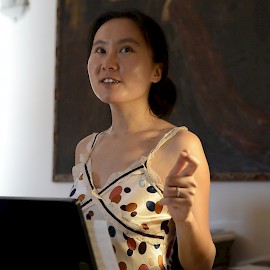
Composer and pianist Wang Lu (b. 1982) writes music that reflects a natural identification with influences from urban environmental sounds, freely improvised practices, linguistic intonation and contours, and traditional Chinese music, through the prism of contemporary instrumental techniques, field recordings, and new electronic sonic possibilities.
Wang Lu’s works have been performed internationally, by ensembles including the New York Philharmonic, the Chicago Symphony Orchestra MusicNOW, the Cincinnati Symphony, Aspen Music Festival, Ensemble Modern, Ensemble Intercontemporain, Ensemble Recherche, Ensemble Mosaik, the Tapiola Sinfonietta, Minnesota Orchestra, Boston Lyric Opera, Orchestre National de Lille, Musiques Nouvelles, Le Nouvel Ensemble Moderne, International Contemporary Ensemble, Talea Ensemble, Seattle Modern Orchestra, Alarm Will Sound, The Crossing Choir among others.
Wang Lu received Wladimir and Rhoda Lakond award from American Academy of Arts and Letters (2020), the Berlin Prize in Music Composition (2019) and was a 2014 Guggenheim Fellow. She has received commissions from the Koussevitzky Foundation at the Library of Congress and the Fromm Foundation at Harvard, the National Endowment for the Arts, and the Barlow Foundation.
Wang Lu’s music was programmed on festivals such as the 2023 Musical Nova in Finland, the New York Philharmonic’s 2022 Sound On series and 2014 Biennial, MATA Festival, Cresc. Biennale in Frankfurt, Gaudeamus Music Week, Tanglewood, Cabrillo Music Festival, Beijing Modern, Pacific and Takefu festivals in Japan, Mostly Mozart, Aspekte Festival in
Salzburg, and the Havana New Music Festival, among others. She has been a resident at the Civitella Ranieri Foundation, Yaddo, MacDowell, and Hermitage Artist Retreat. Collaborators have included poet Ocean Vuong.
Wang Lu is an Associate Professor of Music at Brown University, after receiving her doctoral degree in composition at Columbia University. Wang Lu’s portrait albums Urban Inventory (2018), and An Atlas of Time (2020) were released to critical acclaim.
https://www.wanglucomposer.comJoseph Butch Rovan is a composer, performer, media artist, and instrument designer who has served on the faculty of the department of Music at Brown University since 2004.
Rovan’s compositions have been performed all over the world, receiving early recognition in two of the Bourges International Electroacoustic Music Competitions as well as a first prize in the Berlin Transmediale Festival. His multipart installation Let us imagine a straight line was selected for the 14th WRO International Media Art Biennale in Poland. He has recorded on the Wergo, EMF, Circumvention, and SEAMUS labels.
The design of sensor hardware and wireless microcontroller systems for musical performance represents a central part of Rovan’s creative work, which has yielded two patents. Among his most recent projects are the TOSHI, a new conductor interface for orchestral synthesis, and a new accessible technology that allows non-sighted composers to program interactive computer music. His research has been featured in The Computer Music Journal, including in a special anthology presenting his custom GLOBE controller. A seminal essay written with Vincent Hayward was highly influential for the field of haptics, and a later piece on alternate controllers was included in Riley and Hunter’s Mapping Landscapes for Performance as Research, published by Palgrave Macmillan.
Earlier in his career, Rovan served as compositeur en recherche with the Real-Time Systems Team at the Institut de Recherche et Coordination Acoustique/Musique (IRCAM) in Paris, and then as a faculty member at Florida State University and the University of North Texas, where he headed the Center for Experimental Music and Intermedia. At Brown, he directed the Brown Arts Initiative from 2016-19, where he was instrumental in the design and planning of the Lindemann Performing Arts Center.
Eric Nathan’s (b. 1983) music has been called “as diverse as it is arresting” with a “constant vein of ingenuity and expressive depth” (San Francisco Chronicle), and “a marvel of musical logic” (Boston Classical Review). His work has received international acclaim with performances by the National Symphony Orchestra, Scharoun Ensemble Berlin, Dawn Upshaw, and Jennifer Koh, as well as at Carnegie Hall and the Aldeburgh Festival.
Recent highlights include three commissions from the Boston Symphony Orchestra, including the space of a door, premiered by Andris Nelsons and released on Naxos, and Concerto for Orchestra, which opened the 2019–20 season. Opening (2021), co-commissioned by the Milwaukee Symphony Orchestra and Koussevitzky Music Foundation, was broadcast nationally on PBS. In 2023, the Brown Arts Institute commissioned Open again a turn of light for choir and orchestra to open the inaugural performance at Brown’s Lindemann Performing Arts Center. His flute concerto The Seas Between Us receives premieres by four Mexican orchestras in 2025–26 with flutist Alejandro Escuer. National Sawdust has commissioned an evening-length work for cellist Jeffrey Zeigler and Gandini Juggling for 2026.
Nathan has been commissioned by the New York Philharmonic, Chamber Music Society of Lincoln Center, Eighth Blackbird, Tanglewood, Tonhalle Düsseldorf, Yellow Barn, and Aspen Music Festival. He is a recipient of the Rome Prize, Guggenheim Fellowship, and Goddard Lieberson Fellowship from the American Academy of Arts and Letters, and has held residencies at MacDowell, Copland House, and Civitella Ranieri. His portrait albums appear on Albany Records, BMOP Sound, and New Focus.
Nathan is Associate Professor of Music at Brown University, where he received the Wriston Fellowship for teaching excellence. He is Artistic Director of Collage New Music and was Composer-in-Residence with the New England Philharmonic (2019–25). He holds degrees from Yale, Indiana University, and Cornell. Eric Nathan’s compositions are available worldwide for rental and sale by Just a Theory Press.
The Boston Modern Orchestra Project is the premier orchestra in the United States dedicated exclusively to commissioning, performing, and recording music of the twentieth and twenty-first centuries. Described by The New York Times as “one of the most artistically valuable” orchestras in the country, BMOP is a unique institution in today’s musical world, disseminating exceptional orchestral music “new or so woefully neglected that it might as well be” via performances and recordings of the highest caliber.
Founded by Artistic Director Gil Rose in 1996, BMOP has championed composers whose careers span over a century. Each season, Rose brings BMOP’s award-winning orchestra, renowned soloists, and influential composers to the stage of New England Conservatory’s historic Jordan Hall, with programming that is “a safe haven for, and champion of, virtually every ism, and every genre- and era-mixing hybrid that composers’ imaginations have wrought” (Wall Street Journal). The musicians of BMOP are consistently lauded for the energy, imagination, and passion with which they infuse the music of the present era.
BMOP’s distinguished and adventurous track record includes premieres and recordings of monumental and provocative new works such as John Harbison’s ballet Ulysses, Charles Wuorinen’s Haroun and the Sea of Stories, and Lei Liang’s A Thousand Mountains, A Million Streams. The composers performed and commissioned by BMOP contain Pulitzer and Rome Prize winners, Grawemeyer Award recipients, and MacArthur grant fellows.
From 1997 to 2013 the orchestra won thirteen ASCAP Awards for Adventurous Programming. BMOP has been featured at festivals including Opera Unlimited, the Ditson Festival of Contemporary Music with the ICA/Boston, Tanglewood, the Boston Cyberarts Festival, Concerts at the Library of Congress (Washington, DC), the Festival of New American Music (Sacramento, CA), Music on the Edge (Pittsburgh, PA), and the MATA Festival in New York. During its 20th anniversary season, BMOP was named Musical America’s 2016 Ensemble of the Year, the first symphony orchestra in the organization’s history to receive this distinction.
BMOP has actively pursued a role in music education through composer residencies, collaborations with colleges, and an ongoing relationship with the New England Conserva- tory, where it is Affiliate Orchestra for New Music. The musicians of BMOP are equally at home in Symphony Hall, Weill Recital Hall at Carnegie Hall, and in Cambridge’s Club Oberon and Boston’s Club Café, where they pursued a popular, composer-led Club Concert series from 2004 to 2012.
BMOP/sound, BMOP’s independent record label, was created in 2008 to provide a platform for BMOP’s extensive archive of music, as well as to provide widespread, top-quality, permanent access to both classics of the 20th century and the music of today’s most innovative composers. BMOP/sound has released over 90 CDs on the label, bringing BMOP’s discography to over 100 titles. BMOP/sound has garnered praise from the national and international press; it is the recipient of a 2020 GRAMMY® Award for Tobias Picker: Fantastic Mr. Fox, eight GRAMMY® Award nominations, and its releases have appeared on the year-end “Best of” lists of The New York Times, The Boston Globe, National Public Radio, Time Out New York, American Record Guide, Downbeat Magazine, WBUR, NewMusicBox, and others.
BMOP expands the horizon of a typical “night at the symphony.” Admired, praised, and sought after by artists, presenters, critics, and audiophiles, BMOP and BMOP/sound are uniquely positioned to redefine the new music concert and recording experience.
A global leader in American contemporary music, Gil Rose is the founder of the performing and recording ensemble the Boston Modern Orchestra Project (BMOP), who “bring an endlessly curious and almost archaeological mind to programming... with each concert, each recording, an essential step in a better direction” (The New York Times), as well as the founder of Odyssey Opera, praised by The New York Times as “bold and intriguing” and “one of the East Coast’s most interesting opera companies.” Since its founding in 1996, the “unique and invaluable” (The New York Times) BMOP has grown to become the premier orchestra in the world for commissioning, recording, and performing music of the twentieth and twenty-first centuries. Under Rose’s leadership, BMOP has won seventeen ASCAP Awards for Adventurous Programming, been selected as Musical America’s Ensemble of the Year in 2016, and in 2021was awarded a Gramophone Magazine Special Achievement Award in recognition of its extraordinary service to American music of the modern era. In 2013, Gil Rose expanded his musical vision with the founding of Odyssey Opera, a company dedicated to eclectic and underperformed operatic repertoire from all eras. Working with an international roster of singers and directors, Odyssey has presented more than 35 operas in Boston, with innovative, thematically linked seasons. The company has also established itself as a leader of modern opera in the United States, having given three world premieres and numerous U.S. premieres. In addition to his role as conductor, Rose is leading the charge for the preservation and advancement of underperformed works through recordings. BMOP/sound, the independent record label Rose founded in 2008, has released over 86 recordings of contemporary music by today’s most innovative composers, including world premieres by John Cage, Lukas Foss, Chen Yi, Anthony Davis, Lisa Bielawa, Steven Mackey, Eric Nathan, and many others. With Rose as executive producer, the label has secured nine GRAMMY® nominations and a win in 2020 for Tobias Picker’s opera Fantastic Mr. Fox.
I’ve been listening to and lauding the work of Anthony Cheung for almost a decade now. “Stylish, assured, and expansive, Cheung’s compositions take you new places while feeling like they’ve always been there,” I wrote in 2016 when I included Dystemporal, the Talea Ensemble’s album of his work, on my Top 20. Then, in 2018, I wrote about his album, Cycles And Arrows, noting that the combination of his “deep scholarship and musical understanding” and his “sureness of orchestration” resulted in delightful works, like The Real Book Of Fake Tunes (2015) for string quartet and flute. I called Music For Film, Sculpture, and Captions, a “spine-tingling collection” that, along with All Road, another album for smaller forces, led me to herald 2022 as “a banner year for Cheung fans, a constituency which should be growing rapidly!”
In 2023, I got to hear Yarn/Wire play the world premiere of Tactile Values at Time::Spans, calling it a “customarily stylish” piece that I hoped would be recorded soon. That hasn’t happened yet, but I was lucky to hear it again last night, when it closed a Composer Portrait concert at the Miller Theatre. Played again by Yarn/Wire, it struck me as a work of synthesis, with pianos, keyboards, and percussion creating a new sound that is all of them and something else entirely.
We also got to hear a wonderful keyboard improvisation by Cheung, which was full of dreamy dissonance, and the JACK Quartet’s swashbuckling take on Twice Removed (2024), which ran a dynamic gamut from spectral to tough. The JACK then played The Real Book Of Fake Tunes with Claire Chase on flute, for a bravura performance in which the musicians’ glee became our own.
But the Cheung celebration did not end with the ovations for Tactile Values, because today sees the release of the world premiere recording of Volta (2022/24), a work for orchestra. Featured on The 21st-Century Orchestra: Music From Brown University, which includes pieces by Wang Lu, Joseph Butch Rovan, and Eric Nathan, Volta puts all of Cheung’s brilliance on full display for its 15-minute length. As Cheung points out in the liner notes, “In poetry a volta is a turn, a sudden shift in attitude, subject, form of address, even genre.” The concept is embodied by the ceaseless invention of the piece, which is performed with absolute mastery by the Boston Modern Orchestra Project, led by Gil Rose.
Starting with a fanfare of cymbals, winds, brass, and strings that sounds like the orchestra is trying to cram into an elevator, Volta soon establishes a sonic expanse that swoops, glides, doubles back, and stops short. With as much loud-quiet-loud as the average Pixies or Nirvana song, listening to Volta can be a physical experience if you let it. So why not let it?
The rest of The 21st-Century Orchestra is awesome, too, especially the two pieces by Wang Lu, who just happens to be married to Cheung. Way back in the before times (2019), I saw a Composer Portrait of her work at the Miller, which included the world premiere of A-PPA-Aratus played by Yarn/Wire and “a stunning addition to their repertoire.” Here, we can feast on Surge (2022) and Voices Of The Orchard (2024), both of which lead the orchestra on a merry chase with Wang’s busy, colorful, and charming music.
But for today, let the focus be on Anthony Cheung and the triumph of Volta, which should go on to be heard in concert halls around the world.
— Jeremy Shatan, 11.15.2025
Wenn es nicht scheppert und kracht, dann ist es keine Neue Musik! Alben wie das vorliegende „The 21st-Century Orchestra – Music from Brown University“ mit dem Boston Modern Orchestra Project (BMOP) unter seinem Dirigenten Gil Rose können uns von Glaubenssätzen wie diesem und auch von seiner noch schlimmeren Umkehrung heilen. Denn hier gibt es ergreifende, neue Orchestermusik zu hören.
Das BMOP ist weit mehr als ein Orchester, das sich auf Neue Musik spezialisiert hat. Über dieses Grundhandwerk hinaus laufen in dessen Umfeld immer wieder Projekte, die Neue Musik erarbeiten, dokumentieren und verbreiten. Im hauseigenen Label BMOP/sound wird ein stetig wachsendes Archiv an Aufnahmen auf Tonträgern aufgebaut. Diese Arbeit dient letztlich auch dazu, Repertoire langfristig in den Werkkanon Neuer Musik einzuschreiben.
Dieses Orchester ist damit der ideale Partner für das „The 21st Century Orchestra“-Projekt, das von Kompositionsprofessor*innen der Brown University als Festival betrieben wird, um neue Werke für Orchester zu entwickeln und zu präsentieren. Dabei geht es auch um das Phänomen, dass die Entwicklung und Verbreitung von Neuer Musik im Bereich der Kammermusik einfacher zu bewerkstelligen ist, im orchestralen Feld aber oft stockt aufgrund höherer Kosten und Risiken. Wang Lu, Anthony Cheung, Joseph Butch Rovan und Eric Nathan von der Kompositionsfakultät der Brown University verfolgen mit dem „The 21st Century Orchestra“-Projekt daher auch das Ziel, hierüber mehr zu erfahren und zu erforschen.
Die fünf auf dem Album befindlichen Werke der vier Komponist*innen sind sehr unterschiedlichen Stils, haben dann aber doch einiges gemeinsam. Alle arbeiten mit der Verbindung von zeitgenössischen Instrumentaltechniken und interdisziplinär erweiterten Klangmedien.
Zu letzteren gehört zum Beispiel das TOSHI-System, das Joseph Butch selbst entwickelt hat und in seinem Werk „Scattering“ zum Einsatz bringt. Letztlich ist es ein neues Instrument, mit dem der Dirigent mittels eines am Handgelenk befestigten Controllers die Erzeugung elektronischer Klänge steuert, die am Vortrag mitwirken. Dadurch wird er auch zum Instrumentalisten und lenkt den Vortrag zusätzlich auf ganz andere Weise. Das liest sich erst mal beeindruckend, und es wirkt wie eine Sache, die man macht, weil man es kann. Aber Butch und der Dirigent Gil Rose betten die elektronischen Klänge so „organisch“ in die Gesamtkomposition ein, dass sie wie eine Instrumentengruppe des Orchesters wirken. Neben der allgemein cineastisch, fast martialisch angelegten Grundstimmung überstreicht „Scattering“ zum Beispiel mit seinen vielen ruhigen Passagen doch eine sehr weite emotionale Palette, und wie auf dem gesamten Album wirkt das BMOP auch hier nicht nur wie ein idealer Partner für den Komponisten, sondern schon eher als Widmungsträger, dem auf den Leib geschneidert wurde. Man hört den Instrumentengruppen des Orchesters überall die hohe Expertise in dieser Musik an, da wird perfekt intoniert, perfekt interpretiert und darüber hinaus mit extrem viel Spielfreude agiert.
Am Anfang der Platte gibt es zunächst zwei Stücke von Wang Lu. Die mittlerweile sehr populäre Komponistin zeigt hier zwei unterschiedliche Werke. „Surge“ zeichnet sich durch seinen fanfarenhaften Charakter aus, und das Ensemble arbeitet die starken Wechsel zwischen Solopassagen und Tutti eindrucksvoll heraus. In diesem Werk zeigt sich aber auch schon die charaktervolle, beeindruckende Harmonik Wang Lus, die dann im zweiten Stück „Voices of the Orchard“ richtig in Erscheinung tritt. Bei der Ausführung kann ich gar keine bestimmten Instrumente hervorheben. Alle Beteiligten gestalten so kraftvoll und akkurat, mit so viel Gefühl für Maß und musikalischen Raum, dass ich einfach insgesamt begeistert bin. Gerade dieses Werk wird für mich durch das BMOP zum großen Hörgenuss, und aufgrund der manchmal witzigen Instrumentierung wähne ich mich ab und an in einem Traum über Richard Strauss.
Etwas komplexer wird es in Anthony Cheungs „Volta“, das durch häufige Themen- und Richtungswechsel bestimmt ist. Da setzt das Schlagwerk harsche Akzente, und die Bläser schalten sich prägnant ein, um dann aber auch in beeindruckenden Kleincrescendi zu wirken. Fast wie ein Murmeln bewegt sich das Stück voran, was vom gesamten Orchester abwechslungsreich ausgeführt wird.
Neue und sehr bewegende Orchestermusik aus einem Hotspot der zeitgenössischen Musik, die von absoluten Expert*innen konzipiert, komponiert und ausgeführt wird! Das ist wirklich ein Schatz!
Translation:
“If it doesn’t rattle and crash, it’s not new music!”
Albums like The 21st-Century Orchestra – Music from Brown University, performed by the Boston Modern Orchestra Project (BMOP) under conductor Gil Rose, help dispel myths like this—and their even worse reversals. What this album offers is moving, compelling new orchestral music.
BMOP is far more than an orchestra that specializes in new music. Beyond their core work, they continuously develop, document, and disseminate contemporary repertoire through various projects. Their in-house label, BMOP/sound, maintains a growing archive of recorded works—an effort to cement these pieces in the long-term canon of contemporary music.
BMOP is the ideal partner for Brown University’s “The 21st Century Orchestra” initiative, a festival run by the university’s composition faculty to commission and present new orchestral works. One key focus of the project is the persistent imbalance in new music development: while chamber music thrives, orchestral music often lags due to higher costs and logistical risks. Faculty composers Wang Lu, Anthony Cheung, Joseph Butch Rovan, and Eric Nathan launched this project to better understand and address that gap.
The album features five works by these four composers, each with a distinctive style, yet united in their integration of modern instrumental techniques and expanded sonic media across disciplines.
Among the innovations is TOSHI, a system developed by Joseph Butch Rovan and used in his piece Scattering. It functions like a new instrument: the conductor, wearing a wrist-mounted controller, triggers electronic sounds that interact with the live orchestra—making the conductor both interpreter and performer. While this may sound like a gimmick, the electronics are so organically woven into the texture that they feel like a natural extension of the orchestra. Scattering carries a broadly cinematic, almost martial energy, but also contains extended, quiet passages that explore a rich emotional spectrum. As with every track on this album, BMOP plays not merely as an ideal ensemble for the composer—it feels tailor-made for them. Their intonation, phrasing, and sheer joy in playing demonstrate mastery at every turn.
The album opens with two pieces by Wang Lu, a highly acclaimed composer who showcases two very different sides of her voice. Surge stands out for its fanfare-like energy, with bold contrasts between solo lines and full ensemble. Her distinct and powerful harmonic language is already present here but becomes even more striking in Voices of the Orchard. It's hard to single out any one instrument or section—every performer plays with such clarity, control, and sensitivity to space and proportion that the entire piece becomes captivating. Thanks to BMOP’s interpretation, Voices of the Orchard is a true highlight. At times, the quirky instrumentation even evokes a surreal dream of Richard Strauss.
Things get more intricate in Anthony Cheung’s Volta, marked by constant shifts in theme and direction. Percussion strikes sharp contrasts, and winds cut in with clarity before dissolving into delicate crescendos. The piece moves forward like a murmur, carried by the ensemble’s dynamic and nuanced execution.
New and deeply moving orchestral music from a hotspot of contemporary composition—conceived, composed, and performed by absolute experts! This is truly a treasure!
— Stefan Pillhofer, 12.18.2025
The orchestra as reliquary, preserving rather than innovating. Should we write off this decade? At least Scattering includes electronics.
— Ethelbert Nevin, 12.01.2025
Four other university-affiliated composers – all at Brown University – showcase some contemporary works for larger forces on a New Focus Recordings release. Two of the pieces on the disc are by Wang Lu (born 1982). The opening Surge brings up-to-date sensibilities to the concept of an orchestral curtain-raiser. There is plenty of sound and fury throughout, with emphatic full-orchestra swells contrasted with more-modest material. The work is performative and not wholly convincing, but showcases Lu’s ability to handle large instrumental forces. Voices of the Orchard, a brief suite adapted by Lu form his chamber opera The Beekeeper, has greater feeling and subtlety, with well-made contrasts between brighter rhythmic material and a contrasting darker undercurrent. Scattering by Joseph Butch Rovan (born 1959) is a rather peculiar experimental work that functions by having the conductor, Gil Rose, wear a wrist controller that calls up electronic sounds based on his hand movements. Technology aside, the piece has unsurprising (if intermittently effective) contrasts between sectional outbursts (the brass is prominent) and quieter material (often from its electronic elements). It is more intriguing as an intellectual exercise than as a musical exploration. Volta by Anthony Cheung (born 1982) is equally full of contrasts, indeed seeming to be all contrast, with instrumental groupings piling on each other, thematic elements (rather than actual themes) starting and then breaking off, energetic material starting and then stopping to make way for more-settled elements, and so forth. It is rather exhausting to hear and at 15½ minutes is considerably longer than it needs to be. But if it is also exhausting to play, the Boston Modern Orchestra Project gives no indication of finding it problematic: the orchestra handles this and everything else on the CD with appropriate intensity, skill and sure-handed balance. The concluding work on the disc, In Between II by Eric Nathan (born 1983), spends its first four minutes – a time that seems much longer – attempting to establish a forest milieu before the orchestra actually plays as an orchestra. Thereafter the ensemble goes through an unsurprising series of expansions and contractions, swells and diminuendos, forward-driving elements and quiescent ones. Another work that outstays its welcome, it would have been better at half its 15-minute length, but it does show – as, indeed, do all the pieces here – that today’s university-based composers continue to explore orchestral possibilities within a contemporary context, not always effectively in terms of audience connection but often interestingly from an intellectual standpoint.
— Mark Estren, 12.18.2025
Founded in 1996, the Boston Modern Orchestra and their director Gil Rose have done invaluable work in commissioning and performing contemporary works. Their extensive recordings catalogue covers music from Piston and Barber to, as this disc shows, works by young artists.
This discsurveys contemporary symphonic music – all the works were written in the last four years – through the ears of four composers on the music faculty at Brown University in Rhode Island. This is clear a thriving faculty free of dogma as all the composers write in very different styles.
Composer and pianist Wang Lu studied at the Beijing Central Conservatory of Music and Columbia University and her music explores her Chinese heritage in a contemporary Western context. Her Surge which opens the disc is, she tells us, inspired by first hearing the New York Philharmonic in 2005 and thoughts of the Philadelphia Orchestra in China in 1973. It begins with a drum roll and rather jazzy trumpet solo. What then follows is what sounds like a collage work of fragmentary solos and theatrical gestures. It is quite entertaining but not what I was expecting from her notes.
Her second work, Voices of the Orchard, is a ten-minute orchestral suite adapted from her 2022 chamber opera The Beekeeper which “explored how a piece of land can hold on to stories, both human and animal alike”. It is a gently theatrical work that sounded more balletic than operatic. There is colourful writing for the ensemble hinting at characters we cannot see. It is an enjoyable work which has left me wanting to see/hear the original.
Butch Rovan is a composer, performer, media artist, and instrument designer who has worked at Brown since 2004. He designs electronic hardware and wireless systems for use in musical performance. Among his most recent projects are the TOSHI, (The Orchestra-Synthesis Human Interface), a new conductor interface for orchestral synthesis.
TOSHI features in his work Scattering, recorded here. This intriguingly involves a controller worn on the wrist of the conductor that triggers electronic sounds based on the conductor’s hand movements. The excellent liner notes show an example of the notation for the conductor’s hands. Scattering, his notes tell us, was inspired by William Meredith’s poem “Examples of Created Systems”, the Covid-19 pandemic and George Floyd’s death; this led him to consider the nature of interconnected systems.
I am not sure that I heard any of this in the music or if that is even possible. What we have is a mostly bright, toccata type movement of about fifteen minutes, mainly for acoustic instruments whose sounds are sometimes picked up by TOSHI and transformed. I think in a live performance this probably has some spatial effect in the hall; this simply does not come across on the disc. There are some sparky electronic sounds, some growly sounds and some breathy sounds which put me in mind of Tippett’s Symphony No 4. I could not really connect them to the acoustic music nor the inspirations for the work. That said, it is colourfully intriguing.
Anthony Cheung studied at Harvard and Columbia, and his main teachers were Bernard Rands and Tristan Murail. He has received many awards including a 2016 Guggenheim Fellowship, the American Academy of Arts and Letters (Charles Ives Fellowship and Scholarship) and in 2012 a Rome Prize from the American Academy in Rome.
His work Volta refers not, as I had hoped, to the vigorous dance much favoured by Elizabeth 1, but to “a poetry technique wherein the meaning of a poem suddenly pivots, transforming meaning”. Cheung’s piece is compositionally the most traditional work on the disc. And apart from the poetic title there are no extramural ideas tacked onto the music. There are, as one might expect, a number of rapid changes of mood and texture as the work continues and about mid-way through it becomes more introspective. It is all very atmospheric, leaving a lingering feeling of something disturbing. The many solos sound excellently played by the orchestra and Mr Rose manages the hairpin turns effectively.
Eric Nathan studied at Yale, Indiana and Cornell university’s where his teachers included Claude Baker, Sven-David Sandström and Steven Stucky. Like Dr Cheung, he has received many awards including a Rome Prize and a 2014 Guggenheim Fellowship. He seems to have received numerous high-profile commissions, and it is surprising that little of his music has been recorded.
In Between II transforms an earlier work for ensemble into one for full orchestra. On YouTube one can find live performances of both versions of the work. It was inspired by a memory that the composer had of standing in a forest near his house and observing the trees and presumably listening to the wind. The work begins with the orchestra making noises of and wind blowing and leaves rustling. On the video, one can see the conductor at this point making sweeping directional gestures with his hands. The liner notes show examples of the notation for his hands. I think the concept was probably more interesting than the execution.
The work continues in a mainly fragmented textural way. There are pops and squeaks interspersed amongst sustained chords passed between different orchestral groupings. Halfway through, a big brass chorale appears and the textures coalesce around a vigorous dancelike figure for the whole orchestra. This leads to a tremendous stormy climax, after which the nature sounds of the opening return to close the work quietly. It is a pleasantly atmospheric work, but I rather prefer composers to create a natural world though music rather than imitate it in breaths and rustles. I am not advocating for rehashed Dvorak or Tchaikovsky or even Janáček, but the 21st century composer’s palette is far richer than shown here.
All in all, this is an interesting disc. It shows composers in a certain place and time feeling their way through a Western orchestra. Whether their ideas will follow through or fall by the wayside like much post war academic music when the god of serialism had to be worshiped remains to be seen. Whatever happens I am glad to have heard them trying.
— Paul RW Jackson, 2.08.2026
New Focus Recordings is an artist-led collective label featuring releases in contemporary creative music of many stripes, as well as new approaches to older repertoire. The label was founded by guitarist Dan Lippel, composer Peter Gilbert in 2004, and composer/engineer Ryan Streber in 2004, formed …Read More …
Listen to full streaming tracks while you browse the site. New tracks enabled for streaming every month. Click on the button to open up the radio player.


